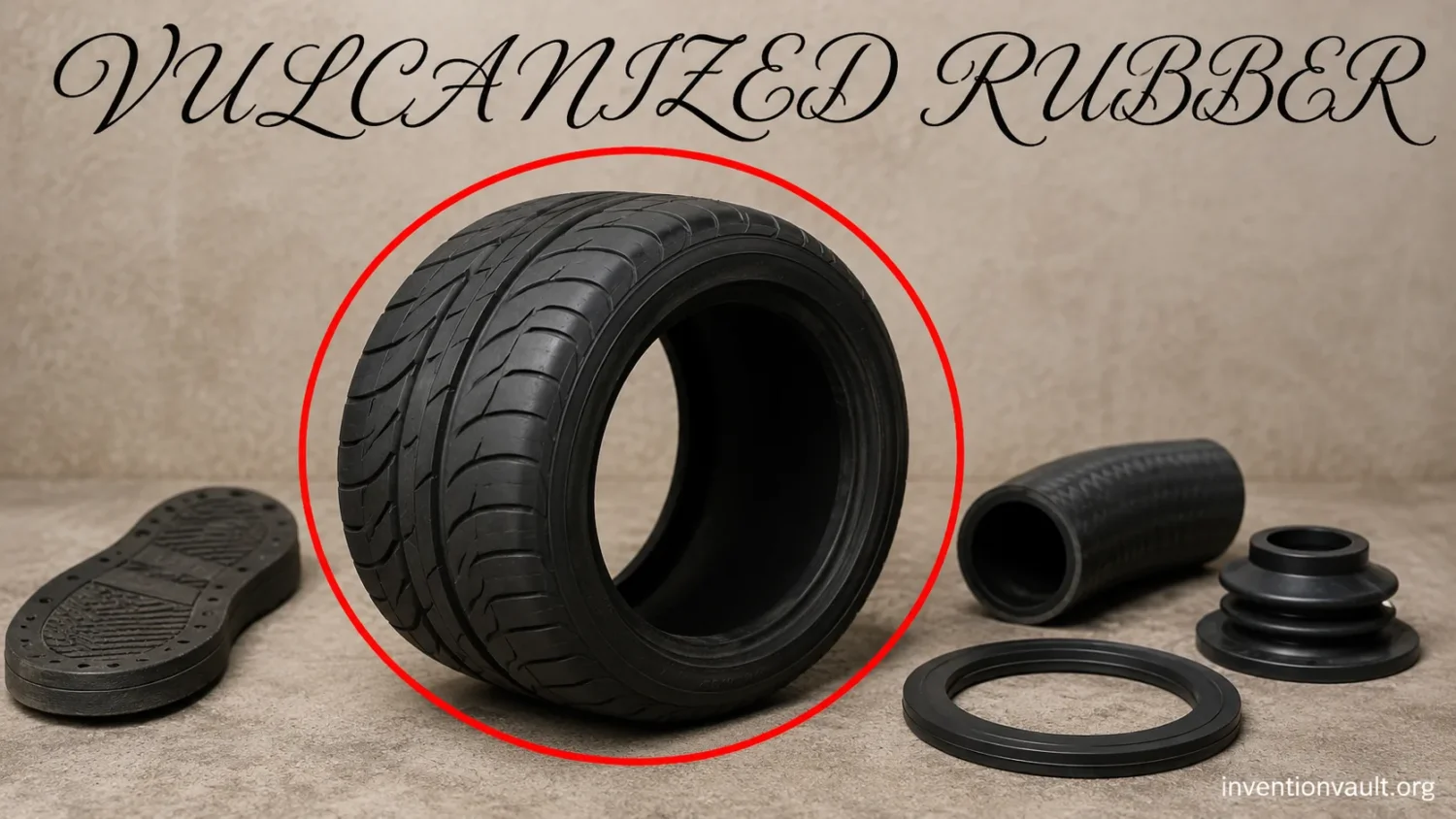
| Invention | Vulcanized rubber |
|---|---|
| Main Inventor | Charles Goodyear, American self-taught inventor and rubber experimenter |
| Core Material Change | Natural rubber was heated with sulfur, creating a tougher and more stable rubber |
| Discovery Period | Commonly linked to Goodyear’s experiments in 1839 |
| Patent Date | June 15, 1844 |
| U.S. Patent Number | US3633A, “Improvement in India-rubber fabrics” |
| Problem It Solved | Raw rubber became sticky in warm weather, stiff in cold weather, and unreliable for many products |
| Why Sulfur Mattered | Sulfur helped form links between rubber molecules, improving elasticity, strength, and heat resistance |
| Name Origin | “Vulcanization” refers to Vulcan, the Roman god associated with fire |
| Early Uses | Waterproof cloth, shoes, belts, hoses, gaskets, dental plates, and coated fabrics |
| Later Industrial Impact | Made rubber suitable for tires, seals, machine parts, electrical insulation, and many everyday goods |
| Common Misunderstanding | Goodyear did not found the Goodyear Tire & Rubber Company; it was named after him decades later |
Rubber was useful before Charles Goodyear, but it was also stubborn. It softened in summer, hardened in winter, stuck to itself, smelled unpleasant when it aged, and often failed just when buyers expected it to work. Goodyear’s work with sulfur and heat changed rubber from a promising curiosity into a dependable industrial material. The invention was not simply a better recipe. It was a change in the behavior of rubber itself.
The invention of vulcanized rubber sits in a rare place in industrial history: one small chemical change opened the door to shoes, rainwear, belts, hoses, seals, vehicle tires, medical goods, electrical parts, and countless flexible components. It also shows how invention often works in real life. Not as a clean flash of genius, but as years of trial, failed batches, debt, argument, observation, and one material that refused to behave until the right treatment was found.
The Rubber Problem Before Goodyear
Natural rubber, historically called India rubber or caoutchouc, comes from latex produced by certain plants. Long before 19th-century factories used it, people in Mesoamerica had already processed rubber-like materials for balls, bands, and waterproof items. That earlier history matters because Goodyear did not invent rubber itself. His invention made rubber stable enough for the machine age.
Early manufacturers admired rubber because it stretched, resisted water, and returned to shape. Then the trouble appeared. A rubber coat might look useful in a shop, then turn soft and tacky in heat. In cold conditions, the same material could stiffen and crack. This made early rubber goods risky for buyers and expensive for makers.
Plain explanation: raw rubber had elasticity, but it lacked weather stability. Vulcanization gave rubber a more reliable internal structure, so it could keep useful properties across a wider range of conditions.
Charles Goodyear and the Long Search
Charles Goodyear was born in New Haven, Connecticut, in 1800. He was not trained as a modern chemist, yet he became absorbed by the problem of unstable rubber. During the 1830s, he tried different additives and treatments, including powders and chemical washes, hoping to remove rubber’s stickiness without destroying its flexibility.
Goodyear’s work was difficult to separate from financial pressure. He moved between workshops, relied on help from family and backers, and tested rubber in conditions that were closer to improvised craft than formal laboratory science. That detail gives the story its sharper edge. Vulcanization was not born in a large company research department. It came from patient material testing by a man who kept returning to the same failure until the material finally changed.
The familiar story says Goodyear noticed the effect after rubber mixed with sulfur met heat, often described as contact with a hot stove. The exact accident is hard to reconstruct in every detail, but the historical center is clear: rubber, sulfur, and controlled heat produced a material that no longer behaved like ordinary raw rubber.
What Sulfur Did to Rubber
Natural rubber is mainly made of long polymer chains. Before vulcanization, those chains can slide past one another too easily when warmed. That sliding helps explain why early rubber products became sticky and weak. When rubber is heated with sulfur, sulfur atoms help create bridges between parts of the polymer chains. These bridges are called crosslinks.
Crosslinks do not turn rubber into stone. Good vulcanized rubber still stretches. The difference is that the chains are held in a more controlled network. After stretching, the material can pull back toward its former shape. It resists heat better. It does not collapse into the same sticky mass as untreated rubber.
Before Vulcanization
- Softened and became tacky in heat
- Stiffened and cracked in cold weather
- Could smell and degrade during storage
- Had limited value for demanding machine parts
After Vulcanization
- Held shape better across temperature changes
- Remained elastic and more durable
- Worked for belts, seals, hoses, and coated fabrics
- Allowed later tire and transport uses to grow
The 1844 Patent
Goodyear received U.S. Patent No. 3633 on June 15, 1844, for improvements in preparing fabrics of caoutchouc or India rubber. The patent language belongs to the mid-19th century, so it does not read like a modern polymer science paper. Still, it records the protected method that made Goodyear’s name inseparable from vulcanized rubber.
The patent centered on preparing rubber materials so they could be used in fabric-based goods. That point is often missed. Vulcanization did not begin as “the tire invention.” Tires came later. Goodyear’s immediate world included waterproof clothing, coated textiles, shoes, straps, and other flexible goods that needed rubber to stay usable in ordinary weather.
| Period | Development | Why It Mattered |
|---|---|---|
| Before the 1800s | Processed natural rubber was known in parts of the Americas | Rubber had cultural and practical uses before industrial chemistry changed it |
| Early 1800s | Rubber entered waterproof clothing and novelty goods | Manufacturers saw promise but struggled with heat and cold failure |
| 1830s | Goodyear tested many ways to stabilize rubber | Repeated failures narrowed the search toward chemical treatment and heat |
| 1839 | Goodyear’s sulfur-and-heat discovery is commonly dated to this year | The material showed a more permanent change in texture and behavior |
| 1844 | U.S. Patent No. 3633 was granted | The process moved from experiment toward protected industrial use |
| Late 1800s | Rubber uses expanded in machinery and transport | Vulcanized rubber became central to tires, belts, seals, and industrial parts |
| 1900s and After | Accelerators, synthetic rubbers, and engineered compounds improved production | Rubber could be designed for more exact performance needs |
Why the Name Vulcanization Was Used
The word vulcanization refers to Vulcan, the Roman god associated with fire and metalworking. The name fits the process because heat is not just a background detail. Heat helps sulfur interact with rubber in a way that changes the material’s structure. Without that controlled heating, the rubber-sulfur mixture would not deliver the same useful result.
The name also shows how 19th-century inventors often blended classical language with new industrial processes. “Vulcanized rubber” sounded technical, durable, and tied to fire. More importantly, the word gave manufacturers a label for a material that behaved differently from ordinary India rubber.
Vulcanized Rubber Was More Than a Tire Story
Modern readers often connect vulcanized rubber with tires first. That is understandable, but it narrows the invention too much. The first value of vulcanized rubber lay in making ordinary rubber goods less unreliable. Footwear could handle wet ground better. Belts could transmit motion in factories. Hoses and gaskets could bend, seal, and return to shape. Waterproof fabrics became more useful because the rubber layer was less likely to fail under changing weather.
One overlooked use was dentistry. In the mid-19th century, vulcanized rubber helped make denture bases more affordable than earlier materials such as gold. That did not make the invention medical in the modern treatment sense; rather, it shows how a materials breakthrough can reach daily life through unexpected routes.
Vulcanized rubber mattered because it turned flexibility into something manufacturers could trust. Stretch alone was not enough. The invention gave rubber memory, toughness, and practical range.
Technical Notes Without the Jargon
Vulcanization is sometimes described too simply as “adding sulfur to rubber.” That is only part of the story. The useful change depends on the rubber type, sulfur amount, temperature, heating time, and later additives. Too little curing leaves rubber weak. Too much crosslinking can make it hard, brittle, or unsuitable for flexible products.
Different rubber goods need different levels of stiffness and elasticity. A soft rubber band, a tire tread, a shoe sole, a conveyor belt, and a sealing gasket do not ask the material to do the same job. Modern rubber makers adjust compounds to match each use. Goodyear’s sulfur cure opened the path; later chemistry made the path wider and more controlled.
| Property | Untreated Rubber | Vulcanized Rubber |
|---|---|---|
| Heat Behavior | Can soften and become sticky | More stable under ordinary heat exposure |
| Cold Behavior | Can stiffen and crack | Usually keeps better flexibility |
| Elastic Recovery | Can deform more easily | Returns to shape more reliably |
| Wear Resistance | Limited for heavy use | Better suited to friction, bending, and pressure |
| Industrial Value | Useful but unpredictable | Reliable enough for manufactured goods |
The Role of Thomas Hancock
The history of vulcanized rubber also includes Thomas Hancock, a British rubber manufacturer and inventor. Hancock worked on rubber processing and obtained British protection for related vulcanization work in the 1840s. This created a complicated transatlantic patent story. Goodyear’s name became the best-known one in the United States, while Hancock’s role remained important in Britain’s rubber industry.
This does not erase Goodyear’s achievement. It makes the invention history more accurate. Vulcanization was not a single neat moment owned by one workshop in isolation. It was a race to control a difficult material at a time when rubber promised profit but punished almost every careless process.
What Goodyear Did Not Invent
Several myths cling to Charles Goodyear. The most common one says he founded the Goodyear Tire & Rubber Company. He did not. The company was founded in 1898, decades after his death, and was named in his honor. Another myth says he invented tires. He did not invent pneumatic tires. His work made later rubber tire development far more practical.
It is also better to say that Goodyear developed and patented a practical process for vulcanized rubber, not that he invented rubber itself. Rubber’s older story includes Indigenous knowledge, plant latex, trade, and many experiments before the 1840s. Goodyear’s place in that story is still large: he solved the stability problem that kept rubber from reaching much wider use.
Main Types and Descendants of Vulcanized Rubber
Goodyear’s sulfur-cured natural rubber was the starting point for a family of rubber materials. Later engineers and chemists adjusted rubber formulas for strength, weather resistance, oil resistance, electrical insulation, grip, and long service life. The result is not one single rubber, but a broad class of elastic materials made for different jobs.
| Rubber Type or Product Form | Main Feature | Common Uses |
|---|---|---|
| Vulcanized Natural Rubber | High elasticity and good mechanical strength | Tires, bands, vibration mounts, seals, footwear |
| Hard Rubber or Ebonite | More heavily vulcanized and rigid | Early electrical parts, combs, instrument pieces, historic molded goods |
| Reinforced Rubber | Rubber combined with fabric, cords, or fillers | Belts, hoses, tire carcasses, industrial sheets |
| Synthetic Vulcanized Rubbers | Engineered from synthetic polymers | Vehicle parts, weather seals, oil-resistant gaskets, technical components |
| Foamed Rubber | Elastic material with cellular structure | Cushioning, padding, insulation, comfort products |
Why the Invention Still Matters
Rubber remains one of the hidden materials of modern life. People notice steel, glass, concrete, and plastic more easily. Rubber works quietly: it seals doors, grips roads, absorbs vibration, protects wires, moves fluids, cushions steps, and keeps machinery from shaking itself apart. Many of those uses depend on the basic idea that Goodyear proved in the 1840s: rubber could be chemically stabilized without losing its useful elasticity.
The scale is large. Recent industry data places world rubber production in the tens of millions of tonnes per year when natural and synthetic rubber are counted together. Tire manufacturing uses a large share of global rubber, but the full reach of vulcanized rubber goes far beyond cars. Hospitals, farms, factories, rail systems, aircraft maintenance, home appliances, footwear, sports equipment, and construction all rely on rubber parts that must bend without failing too soon.
That modern scale also brings material questions that Goodyear never faced in the same form: recycling, longer product life, responsible sourcing, and cleaner processing. Current research into rubber devulcanization and circular use exists because vulcanization is both useful and durable. The same crosslinked structure that gives rubber strength also makes end-of-life recovery more difficult. This is one reason researchers study ways to reclaim rubber value without losing the qualities that made vulcanization useful in the first place.
How Vulcanization Changed Manufacturing
Before vulcanized rubber, a maker could design a clever rubber product and still lose trust when the material failed in ordinary weather. After vulcanization, rubber became a material designers could plan around. It could be cut, molded, coated, pressed, and combined with textiles or metal. That changed factory work as much as consumer goods.
Belts made from improved rubber helped transfer motion in industrial machinery. Hoses moved water, steam, air, and other fluids more flexibly than rigid pipe in many settings. Gaskets and seals helped machines hold pressure. Waterproof clothing and shoes became more reliable. Each use seems small on its own. Together they show why a change in material behavior can reshape many industries at once.
A Useful Way to Remember the Invention
Goodyear did not make rubber stretchy. Nature had already done that. He helped make rubber dependable. The invention’s value was stability: rubber could now be warm, cold, wet, bent, pressed, and still remain useful.
The Human Side of the Invention
Goodyear’s personal story was not a simple victory story. He spent years in financial difficulty and fought to protect his patent rights. His invention later became famous, yet he did not enjoy the kind of wealth that later rubber industries produced. That detail should not be used to turn the article into tragedy. It does, however, reveal a plain truth about invention: discovering a useful process and benefiting from it are not always the same thing.
His legacy survived because the material worked. Manufacturers could test it, use it, improve it, and adapt it. That is the strongest proof for any materials invention. A name may fade; a process that solves a hard problem keeps moving from one product to the next.
What Made Vulcanized Rubber Different From Earlier Treatments
Many early treatments tried to hide rubber’s weaknesses. Some coatings or chemical washes reduced surface tack for a time. Others changed color or texture. Vulcanization went deeper. It changed how the rubber network behaved. That is why the invention was able to support durable products rather than only temporary improvements.
The sulfur cure also made rubber more compatible with manufacturing. Once a maker could predict the material, product design became less guesswork. A belt could be sized for a machine. A seal could be shaped for a joint. A shoe sole could be made for repeated flexing. The material no longer acted like a seasonal gamble.
The Invention’s Place in Industrial History
Vulcanized rubber belongs beside inventions that changed not one product, but the material choices available to whole industries. It did not replace metal, wood, leather, or cloth. It filled gaps those materials could not fill: flexible sealing, elastic grip, shock absorption, waterproof bending, and repeat movement under load.
That is why the invention still feels modern. A factory robot, bicycle tire, train component, laboratory stopper, sneaker sole, refrigerator seal, or vibration mount may look far removed from Goodyear’s 1840s experiments. Yet all of them draw from the same material idea: rubber can be made elastic and stable at the same time.
Details Readers Often Miss
- Vulcanization is a process, not a single product. It can produce soft, flexible rubber or harder rubber depending on the formula and curing conditions.
- Sulfur was not just a filler. It helped change the internal structure of the rubber by forming links between polymer chains.
- The early patent focus included rubberized fabrics. The tire-centered view came later, after transport technology expanded.
- Goodyear’s name became larger after his lifetime. The famous tire company used his name as a tribute, not because he founded it.
- Rubber history is older than the 19th century. Goodyear’s achievement was stabilizing rubber for industrial use, not discovering the natural material.
References Used for This Article
- Smithsonian Libraries and Archives — Gum-elastic and Its Varieties: Goodyear’s own 1853 work gives a primary historical account of rubber and vulcanization.
- Google Patents — US3633A, Improvement in India-rubber Fabrics: The patent record identifies Goodyear’s 1844 protected process for India-rubber fabrics.
- National Inventors Hall of Fame — Charles Goodyear: This inventor profile summarizes Goodyear’s vulcanization work and industrial legacy.
- National Archives — The Era of False Teeth for the Masses: This archival article notes how vulcanized rubber affected 19th-century dental materials.
- Rubber Chemistry and Technology — Vulcanization of Rubber: This technical historical article explains the pre-vulcanization weakness of early rubber goods.
- National Library of Medicine — Thermochemistry of Sulfur-Based Vulcanization: This open scientific article supports the technical discussion of sulfur-based rubber curing.
- Malaysian Rubber Council — World Rubber Production, Consumption and Trade: This industry source provides recent figures on world rubber production and consumption.
- Connecticut History — Charles Goodyear’s Machine for Making Rubber Fabrics: This historical source explains Goodyear’s rubberized fabric work and related patent activity.