
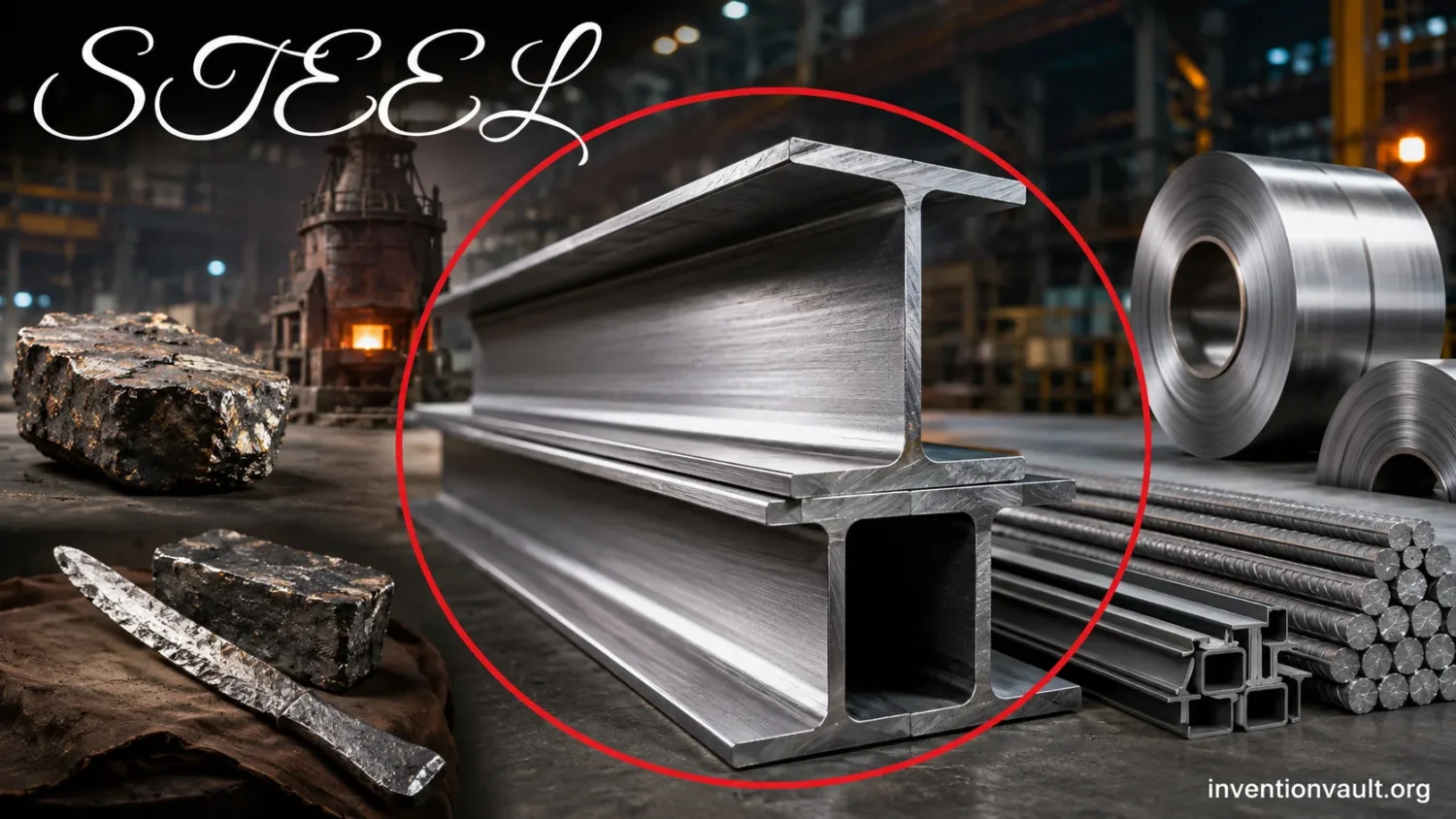
Steelmaking Evolution Map
How Steel Became Industrial
Trace the shift from carbon-controlled iron to crucible steel, converter refining, measured chemistry, modern furnaces, and global production.
Material origins
Carbon Made Iron Tunable
Early observation
Metalworkers learned that iron exposed to carbon-rich conditions could become harder, creating early steel-like materials long before industrial chemistry.
Main difficulty
The problem was control. Carbon could vary from the surface to the center, while phosphorus, sulfur, and other impurities could weaken the finished metal.
Material idea
Steel emerged as a family of iron-based alloys whose properties depend on composition, heating, cooling, forging, and later measured processing.
Steel began as control over iron chemistry, not as one material created on one date.
Crucible steel
Huntsman Improved Uniformity
Sheffield work
In the 1740s, Benjamin Huntsman melted selected steel in crucibles, producing cleaner and more even metal than cementation steel alone could provide.
Best uses
The material suited springs, cutting tools, dies, clocks, and precision parts that needed predictable hardness and consistency.
Scale limit
Crucible steel remained costly and batch sizes were small, so it could not yet supply the tonnage demanded by railways and heavy structures.
Crucible melting improved steel quality before converter technology attacked the larger problem of cost and volume.
Pneumatic refining
Bessemer Made Steel Faster
Patent milestone
Henry Bessemer patented his practical converter process in 1856, using a blast of air through molten pig iron to oxidize carbon and other elements.
Heat balance
Oxidation reactions released enough heat to help keep the metal molten while refining proceeded rapidly inside the converter.
Industrial effect
Large batches could be produced far faster than older methods, lowering the cost of steel for rails, structures, ships, and machinery.
Bessemer did not invent steel itself; he changed the speed and economics of making it in industrial quantities.
Raw-material expansion
Basic Linings Addressed Phosphorus
Original limit
Acid-lined Bessemer converters could not remove phosphorus well, restricting the process to suitable low-phosphorus iron.
Thomas-Gilchrist step
Basic refractory linings and lime-rich slags allowed phosphorus to move into the slag during refining.
Why it mattered
The change widened the range of ores and pig irons that could feed mass steelmaking in regions with phosphoric raw materials.
Industrial steel expanded when furnace chemistry adapted to raw materials that the first Bessemer process could not handle.
Process control
Open Hearth Favored Adjustment
Slower refining
Open-hearth furnaces took longer than converter blows, but operators could sample the melt and make chemical corrections during production.
Scrap use
The route could combine molten iron with steel scrap, linking steelmaking more closely to recovery and reuse of existing metal.
Quality control
More time for testing and adjustment helped steelmakers meet demanding specifications for broader engineering applications.
Steelmaking became more predictable as chemical measurement joined furnace skill and batch production.
Modern production
Oxygen and Electric Furnaces Took Over
Basic oxygen
Basic oxygen furnaces refine molten iron with high-purity oxygen, allowing fast large-scale steelmaking with tighter control than older air-blown converters.
Electric arc
Electric arc furnaces melt scrap and other iron-bearing inputs with electrical energy, supporting recycling and flexible production of many steel grades.
Shared objective
Both routes still manage the same metallurgical problem: control carbon, impurities, alloy additions, temperature, and final properties.
Modern furnaces changed the energy source and process control while keeping steelmaking centered on deliberate chemistry.
Latest full-year scale
Global Output Was About 1.85 Billion Tonnes
2025 world total
World crude steel production was about 1.85 billion tonnes in 2025, using the latest full-year global total published by the World Steel Association.
What the number measures
Crude steel is steel in its first solid or usable form before the full range of rolling, finishing, coating, and fabrication steps.
Historical scale change
The figure places modern steelmaking far beyond the small batches of crucible steel and early converter production that shaped its industrial history.
The 2025 total provides one consistent full-year baseline for the modern scale of steel production.
| Field | Detailed Information |
|---|---|
| Invention Focus | Steel, an iron-carbon alloy refined for strength, toughness, shaping, and large-scale industry. |
| Not a Single-Date Invention | Steel developed through many steps: early carburized iron, cementation steel, crucible cast steel, Bessemer steel, open-hearth steel, basic oxygen steel, electric furnace steel, and specialized alloy steels. |
| Most Associated Inventor | Sir Henry Bessemer, who patented a practical mass-production steelmaking process in 1856. |
| Earlier Major Contributor | Benjamin Huntsman developed crucible cast steel in Sheffield in the 1740s, producing cleaner and more uniform steel for tools, springs, and fine instruments. |
| Parallel Contributor | William Kelly worked on an air-blown iron refining method in the United States, and his pneumatic process later gained formal recognition as part of steelmaking history. |
| Core Technical Change | Steelmaking turned the control of carbon and impurities into an industrial process rather than a slow craft skill. |
| Bessemer Process Date | 1856 is widely used as the landmark year for industrial steel because Bessemer’s converter made large batches of steel far faster and cheaper than older methods. |
| Typical Composition Idea | Steel is mostly iron with a small but controlled amount of carbon, usually below the carbon level of cast iron. |
| Industrial Impact | Mass steel changed railways, bridges, ships, machines, tools, pressure vessels, engines, buildings, and later automobiles and appliances. |
| Modern Scale | World crude steel production reached about 1.85 billion tonnes in 2025, providing a current full-year measure of steelmaking at global scale. |
| Modern Relevance | Today steel remains central because it can be made in many grades, reused as scrap, and recycled repeatedly through suitable steelmaking routes. |
Steel was not invented in the neat way a single tool or machine might be invented. It was learned, corrected, overheated, ruined, remade, and finally brought under control. The real invention was not merely a harder metal. It was the ability to make stronger metal on purpose, in large quantities, with chemistry that could be adjusted for rails, bridges, tools, ships, machines, and later the whole structure of modern industry.
The invention of steel is best understood as a chain of improvements. Early metalworkers knew that iron could be hardened by contact with carbon. Later makers learned to melt, refine, and test it. Bessemer’s breakthrough then changed the price and speed of production. After that, open-hearth furnaces, basic oxygen furnaces, and electric arc furnaces turned steel into a family of materials rather than one fixed metal.
What Steel Actually Is
Steel is an alloy based on iron. Its defining feature is controlled carbon. Too little carbon and the metal behaves more like soft wrought iron. Too much and it moves toward brittle cast iron. Within the right range, iron gains a rare balance: it can be strong, workable, hardenable, weldable, and durable, depending on how it is made.
This is why steel became different from earlier iron materials. It was not only stronger. It was tunable. A rail needs wear resistance. A spring needs elasticity. A beam needs strength without sudden fracture. A kitchen pan, a surgical tool, and a turbine shaft all ask for different behavior. Steel answered these needs through composition and heat treatment.
| Material | Main Character | Typical Carbon Relationship | Why It Matters |
|---|---|---|---|
| Wrought Iron | Soft, tough, fibrous, and easy to work by hammering | Very low carbon | Useful before mass steel, but limited in hardness and strength. |
| Steel | Stronger and more controllable than wrought iron | Controlled carbon, usually below cast iron levels | Can be shaped, rolled, hardened, tempered, alloyed, and standardized. |
| Cast Iron | Hard and good for casting, but more brittle | Higher carbon than steel | Good for complex cast shapes, less suitable for many load-bearing uses where toughness is needed. |
Before Bessemer: The Long Road to Controlled Steel
Long before industrial furnaces, metalworkers noticed that iron changed when heated with carbon-rich materials. This did not give them modern steelmaking, but it opened the path. The hardest part was not discovering that carbon could strengthen iron. The hard part was controlling how much carbon entered the metal and removing unwanted elements without ruining the batch.
One early method, known as the cementation process, heated wrought iron bars in contact with carbon for long periods. The surface absorbed carbon, and the resulting blister steel could be worked further. It helped toolmaking, but it did not give perfect uniformity. A bar could vary from surface to center, and makers often had to judge quality by experience rather than precise measurement.
The next great step came in Sheffield. In the 1740s, Benjamin Huntsman, a clockmaker and instrument maker, developed crucible cast steel. He melted selected steel in sealed crucibles and produced a cleaner, more even material. This was a major advance for springs, cutting tools, dies, and fine mechanical parts. It made steel more reliable, but still not cheap enough for railways, large bridges, and heavy structures.
Cementation Steel
Made by heating wrought iron with carbon. Useful, but slow and uneven. It belongs to the craft stage of steelmaking.
Crucible Cast Steel
Melted and refined in crucibles. Cleaner and more consistent, especially for tools and precision parts, but still costly.
Converter Steel
Made by refining molten pig iron in a converter. This moved steel from specialty material to industrial material.
The Bessemer Breakthrough
Sir Henry Bessemer’s process changed the economic meaning of steel. His converter blew air through molten pig iron. Oxygen in the air reacted with carbon and other unwanted elements. Those reactions helped generate heat, so the metal stayed molten while impurities burned away or moved into slag. In plain terms, the converter turned a difficult refining job into a fast batch process.
The old problem had been cost. Steel existed, but it was too expensive for many heavy uses. The Bessemer process made large quantities possible. That shift mattered as much as the chemistry. Once steel became affordable, engineers could design rails that lasted longer, bridges that carried heavier loads, and machines that worked under higher stress.
Steel became an industrial material when makers could refine molten iron quickly, repeat the process, and deliver predictable strength at a price large projects could bear.
Bessemer was not the only person working on air-blown refining. William Kelly in the United States developed related ideas, and later historians have treated his work as part of the same wider movement in pneumatic steelmaking. The name “Bessemer process” endured because Bessemer patented, promoted, and industrialized the method with unusual force.
Why Air Changed Molten Iron
The Bessemer converter looks simple in outline: a large vessel, molten pig iron, and a blast of air. Inside, the chemistry is more delicate. Pig iron contains carbon, silicon, manganese, and sometimes phosphorus or sulfur. Some elements help under certain conditions. Others weaken steel if left uncontrolled. The converter’s job was to remove enough unwanted material while leaving, or later adding back, the right chemistry.
- Carbon had to be lowered from pig iron levels to steel levels.
- Silicon and manganese oxidized during the blow and helped form slag.
- Phosphorus created a harder problem, especially with certain ores.
- Recarburizing additions, including manganese-bearing alloys, helped correct the final steel after the blow.
This detail is often missed: the Bessemer process was not simply “air makes steel.” It was a production system that needed suitable raw iron, converter lining, timing, and final adjustment. Early Bessemer steel sometimes suffered from inconsistent quality. Industrial success came only after operators learned how to manage those limits.
The Phosphorus Problem
Phosphorus was one of the quiet barriers in early mass steel. Many iron ores contained enough phosphorus to make ordinary Bessemer steel less reliable for demanding work. The original acid-lined converter could not remove it well. That meant the process depended heavily on low-phosphorus ores, which were not available everywhere at low cost.
The basic Bessemer process, also called the Thomas-Gilchrist process, used a basic lining such as dolomite or lime-bearing material. This allowed phosphorus to move into the slag. It widened the raw materials that could be used and helped steelmaking grow in regions where phosphoric ores were common. It also shows why steel’s invention was not one magic moment. Each furnace solved one problem and revealed another.
| Process | Main Period of Rise | What It Improved | Main Limit |
|---|---|---|---|
| Cementation | Early modern period into the 18th century | Added carbon to wrought iron to make steel-like material | Slow and uneven across the bar |
| Crucible Cast Steel | 1740s onward | Produced cleaner, more uniform steel for tools and precision work | High cost and small batch size |
| Bessemer Converter | 1850s onward | Fast mass production from molten pig iron | Limited control and trouble with phosphorus-rich raw iron |
| Basic Bessemer / Thomas-Gilchrist | Late 1870s onward | Helped remove phosphorus using a basic lining | Still less controlled than later furnace methods |
| Open-Hearth Furnace | Late 19th and early 20th centuries | Allowed better chemical testing and adjustment during refining | Slower than converter methods |
| Basic Oxygen Furnace | Mid-20th century onward | Used oxygen rather than air for faster, cleaner refining | Best suited to large integrated steelworks |
| Electric Arc Furnace | 20th century onward | Uses electricity and scrap steel efficiently for many grades | Depends on electricity supply and scrap quality |
Why Steel Was Stronger Than Older Iron
Steel’s strength comes from structure as much as composition. Carbon atoms fit into the iron crystal structure and change how the metal deforms. Heat treatment can rearrange those structures. Quenching, tempering, rolling, and alloying let makers change hardness, toughness, ductility, and wear resistance. A blacksmith could sense some of this by color and sound. Industrial steelworks turned it into controlled practice.
That control gave steel a wide design range. Low-carbon steel could be rolled into sheets and beams. Medium-carbon steel could serve shafts and machinery. High-carbon steel worked for springs and cutting edges. Alloy steels, with elements such as chromium, nickel, molybdenum, manganese, vanadium, or tungsten, added corrosion resistance, heat resistance, hardness, or strength under heavy stress.
Steel’s advantage was choice. It could be soft enough to form, hard enough to cut, tough enough to carry load, or resistant enough to survive harsh conditions. Few older structural materials offered that range.
Steel and the Rise of Heavy Industry
The 19th century needed a material that could handle speed, weight, and repetition. Iron rails wore out. Bridges grew longer. Machines ran harder. Steam engines, shipyards, mines, and factories all demanded materials that could be supplied in large pieces with repeatable strength. Mass steel arrived at the right moment.
Railways gave steel one of its earliest large markets. Steel rails could handle heavier traffic and longer service than many iron rails. That reduced replacement work and made faster transport more practical. Structural steel then changed bridges and buildings. Instead of relying only on masonry or wrought iron, engineers could design long spans, skeleton frames, and large industrial sheds with new freedom.
Steel also changed tools. Better steel meant sharper cutting tools, stronger dies, more accurate machine parts, and longer-lasting springs. Those improvements fed back into manufacturing itself. Better machines made better steel products, and better steel products made better machines.
Main Types of Steel That Grew From the Invention
The word steel can hide a large family of materials. The invention did not stop with Bessemer rails. Over time, steelmakers learned to make grades for different work. Some grades favor low cost and formability. Others serve high temperature, corrosion, wear, pressure, or precision.
| Steel Type | Basic Description | Common Uses |
|---|---|---|
| Low-Carbon Steel | Easy to form, weld, and roll; often used where shaping matters. | Sheet metal, beams, pipes, panels, general fabrication |
| Medium-Carbon Steel | Stronger and harder than low-carbon steel after suitable treatment. | Shafts, gears, axles, machine parts |
| High-Carbon Steel | Can become very hard; less ductile than lower-carbon grades. | Springs, cutting edges, wires, wear parts |
| Alloy Steel | Contains added elements to adjust strength, heat behavior, toughness, or hardenability. | Automotive parts, pressure equipment, machinery, tools |
| Stainless Steel | Contains enough chromium to resist corrosion under many conditions. | Kitchenware, medical instruments, tanks, architecture, food equipment |
| Tool Steel | Designed for hardness, wear resistance, and cutting performance. | Dies, molds, drills, cutters, gauges |
| Electrical Steel | Made for magnetic performance in electrical equipment. | Transformers, motors, generators |
| Weathering Steel | Designed to form a protective surface layer in suitable outdoor conditions. | Bridges, outdoor structures, architectural panels |
The Shift From Craft Skill to Measured Chemistry
Early steel depended heavily on judgment. Workers watched color, flame, slag, fracture, and sound. Skilled judgment still matters in metallurgy, but industrial steel added measurement. Chemical analysis, furnace control, rolling schedules, and mechanical testing made it possible to order a grade and expect it to behave within known limits.
This is one of steel’s less visible inventions: standardization. A bridge designer, rail company, machine builder, or shipyard could not depend on guesswork. They needed material that met specifications. Steel became reliable when its chemistry, processing, and testing formed one system.
- Carbon content affected hardness, strength, and ductility.
- Manganese helped improve workability and controlled some unwanted effects of sulfur.
- Chromium and nickel opened the way to stainless and special alloy steels.
- Heat treatment changed internal structure after shaping.
- Mechanical tests allowed buyers to compare strength, toughness, and performance.
Open-Hearth Steel and Better Control
The open-hearth furnace did not have the drama of a Bessemer blow, but it solved a serious industrial need: time. Operators could sample the metal and adjust the chemistry during refining. The process was slower, yet that slower pace gave more control. For many demanding structural uses, control mattered more than speed.
By the late 19th and early 20th centuries, open-hearth steel became a dominant route in many places. It helped steel move from rails and basic products into broader engineering. The process also accepted scrap steel along with molten iron, which made it useful in an industrial economy that was already producing large amounts of metal waste.
Basic Oxygen and Electric Furnace Steel
Modern steelmaking owes much to the old Bessemer idea, but it no longer depends on ordinary air. Basic oxygen steelmaking uses high-purity oxygen to refine molten iron faster and with better control. This avoided some problems caused by nitrogen in air-blown processes and helped large integrated steel plants produce massive tonnage.
Electric arc furnaces took another path. They can melt scrap steel and selected raw materials using electricity. This route became central for recycling and for many specialty steels. It also made steelmaking more flexible in regions without full blast-furnace operations. The furnace changed, but the old goal remained: control carbon, remove unwanted elements, and shape the final chemistry for the job.
Steel by the Numbers
Steel’s scale is hard to picture. World crude steel production reached about 1.85 billion tonnes in 2025, using the latest complete calendar-year total from the World Steel Association. The figure keeps the modern scale section on a full-year basis rather than mixing an annual total with a single month. Steel remains one of the working materials behind transport, energy, water systems, manufacturing, housing, food equipment, and everyday tools.
| Scale Marker | What It Shows |
|---|---|
| 1740s | Crucible cast steel in Sheffield helped make cleaner steel for precision tools and springs. |
| 1856 | Bessemer’s patented converter process made steel production faster and cheaper. |
| Late 1870s | The basic Bessemer process helped deal with phosphorus-rich raw materials. |
| 20th Century | Open-hearth, basic oxygen, and electric furnace routes expanded steel into many grades. |
| 2025 | World crude steel production reached about 1.85 billion tonnes, using the latest complete annual total. |
Why Steel Still Matters
Steel remains widely used because it combines strength, price, availability, and recyclability. It can be produced in enormous volumes, yet also tailored for fine technical uses. A skyscraper beam and a surgical-grade stainless instrument share the same broad material family, but their grades, treatments, and quality checks differ sharply.
Another reason is recovery. Steel scrap can be collected magnetically, remelted, and returned to production. Not every scrap stream is equal, and clean sorting still matters, but the material itself fits a circular industrial model better than many alternatives. This has made steel central to discussions about lower-waste manufacturing and lower-emission production routes.
Recent steel research and investment focus on cleaner furnaces, better scrap use, direct-reduced iron, hydrogen-based trials, improved coatings, and higher-strength grades that use less material for the same load. The historical invention of steel was about controlling carbon. The present challenge is wider: control chemistry, energy, recycling, and performance at the same time.
Common Misunderstandings About the Invention of Steel
One misunderstanding is that Bessemer invented steel itself. He did not. Steel existed before him. His achievement was to make steel production fast and economical enough for large industry. Another misunderstanding is that stronger always means better. In real engineering, too much hardness can bring brittleness. The best steel is the grade that fits the load, shape, environment, and safety needs.
A third mistake is treating steel as one material. It is more accurate to think of steel as a controlled family of iron-carbon alloys. That family grew because inventors, chemists, furnace workers, and engineers kept solving practical problems: uneven carbon, high cost, phosphorus, poor control, corrosion, heat, wear, and recycling.
How Steel Changed Industry
Steel changed industry because it made stronger structures and better machines ordinary. It lowered the cost of durable rails. It improved shafts, gears, springs, bolts, pipes, and cutting tools. It supported larger bridges, higher buildings, larger ships, safer pressure systems, and more dependable factory equipment. The invention did not replace every older material, but it gave engineers a new default when strength and reliability mattered.
The deepest effect was quiet. Steel let designers trust a material before the object existed. A bridge, engine, rail line, crane, or lathe could be planned around known grades and tested properties. That trust turned metallurgy into infrastructure.
References Used for This Article
- Science Museum Group — Original Pilot Bessemer Converter, 1865: A museum record describing Bessemer’s converter and its role in large-scale steelmaking.
- Encyclopaedia Britannica — Bessemer Process: A concise reference on the process, its date, and its place in steel history.
- American Chemical Society — Kelly Pneumatic Iron Process: A professional chemistry source on William Kelly’s contribution to air-blown iron refining.
- U.S. National Park Service — Daniel Johnson Morrell: Provides historical context on William Kelly, Henry Bessemer, and pneumatic conversion of molten iron into steel.
- Sheffield Museums — Benjamin Huntsman Clock: A museum source tied to Huntsman’s early crucible cast steel in Sheffield.
- World Steel Association — The Steel Story: An industry reference on the development from Bessemer to open-hearth and later steelmaking routes.
- World Steel Association — 2025 Global Crude Steel Production Totals: Supplies the updated full-year 2025 world crude steel production total used for the modern scale section.
- World Steel Association — Circular Economy: A source on steel recycling and closed material loops.
- Google Patents — H. Bessemer, Manufacture of Iron and Steel: A patent record for Bessemer’s 1856 steelmaking invention.