
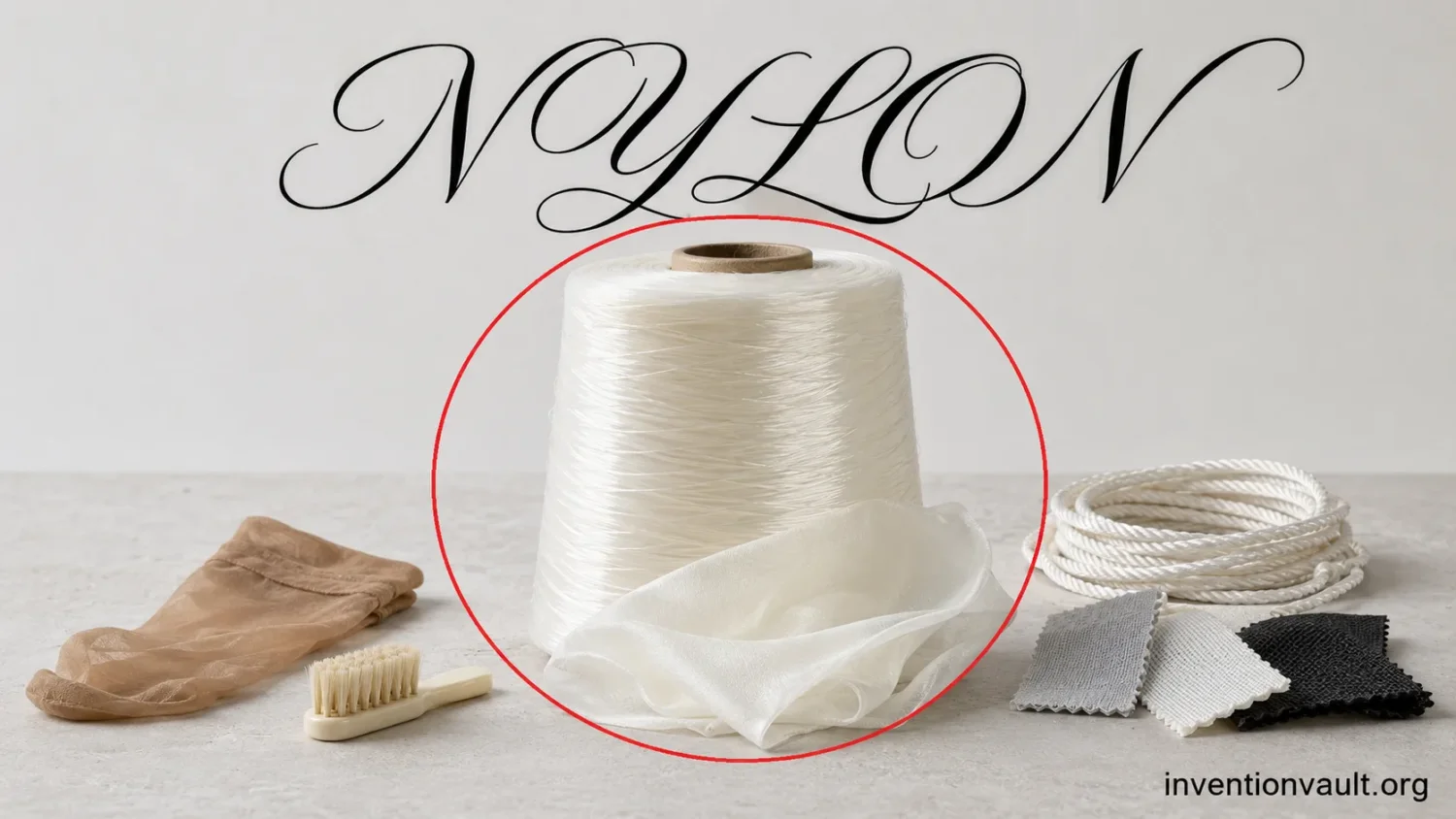
Material Evolution File
How Nylon Became a Working Fiber
Trace how polymer theory, molecular design, cold drawing, factory engineering, and new markets turned nylon 6,6 into a practical synthetic fiber.
Research Direction
Testing the Macromolecule Idea
Selected file: Testing the Macromolecule Idea. Choose another file to update this evidence card.
Selected
The open question
Chemists still disputed whether polymers were true long-chain molecules or smaller units held together by weaker forces. Deliberately synthesizing high-molecular-weight chains could test the long-chain model.
DuPont’s research program
DuPont hired Wallace H. Carothers in 1928 to lead fundamental organic-chemistry research at its Experimental Station near Wilmington, Delaware, without assigning an immediate consumer product.
Research method
Carothers’s group reacted molecules with two functional ends, allowing each molecule to connect at both sides and extend a chain through repeated condensation reactions.
Nylon began as a controlled test of molecular theory, not as a finished textile proposed by a lone inventor.
Fiber Behavior
Cold Drawing Reveals Strength
Selected file: Cold Drawing Reveals Strength. Choose another file to update this evidence card.
Selected
Julian Hill’s filament
In 1930, research associate Julian W. Hill produced a high-molecular-weight polyester that could be pulled from a molten sample into a thin filament.
What drawing changed
Stretching the cooled filament to several times its original length aligned polymer chains along the fiber axis. The drawn thread became far stronger than the undrawn material.
Why polyester stopped short
The early polyester softened at an impractically low temperature and was vulnerable to dry-cleaning solvents, so it could not withstand ordinary clothing care.
The failed polyester supplied the processing insight nylon needed: molecular orientation could turn a weak filament into a useful fiber.
Chemical Turn
Polyamides Replace Early Polyesters
Selected file: Polyamides Replace Early Polyesters. Choose another file to update this evidence card.
Selected
Return to fiber research
Research director Elmer K. Bolton urged the group to resume synthetic-fiber work in 1934, this time concentrating on polyamides rather than the low-melting polyesters.
Donald Coffman’s result
On May 24, 1934, Donald D. Coffman drew an elastic polyamide filament that resisted water and had a higher melting point than the earlier polyester fibers.
Remaining obstacle
Coffman’s promising polymer depended on an intermediate that was difficult to manufacture. A workable fiber still required monomers that industry could obtain at factory scale.
Better fiber chemistry solved the heat and solvent problem, but raw-material access still separated a laboratory success from a product.
Selected Composition
Nylon 6,6 Becomes the Candidate
Selected file: Nylon 6,6 Becomes the Candidate. Choose another file to update this evidence card.
Selected
Dated preparation
On February 28, 1935, Gerard Berchet in Carothers’s group prepared the polyamide made from hexamethylenediamine and adipic acid, then called fiber 66.
Meaning of 6,6
The two sixes count the carbon atoms in the diamine and the diacid used to form the repeating polyamide chain; they are not a strength grade.
Why this formulation won
Carothers favored polyamide 5,10, but Bolton selected 6,6 because its starting chemicals offered a more practical route from available benzene-based feedstocks.
Useful property set
After drawing, fiber 66 combined high tensile strength, elasticity, solvent resistance, water tolerance, and a melting point suitable for textile care and industrial processing.
The chosen nylon was not merely the strongest sample; it joined useful fiber properties to a chemical supply route that could be expanded.
Industrial Translation
From Ounces to Continuous Production
Selected file: From Ounces to Continuous Production. Choose another file to update this evidence card.
Selected
More than polymerization
Engineers had to manufacture both monomers, control chain length, remove water, melt the polymer without damaging it, filter it, and spin uniform filaments through tiny openings.
Team scale
More than 230 chemists and engineers worked on nylon at some point before the first full plant, according to the American Chemical Society’s historical account.
Patent record
Carothers’s U.S. Patent 2,130,948, covering synthetic linear polyamide fibers and related forms, was filed April 9, 1937, and issued September 20, 1938.
Seaford plant
DuPont began building its first nylon plant in Seaford, Delaware, in 1938. The plant began commercial nylon production on December 15, 1939.
Factory nylon depended on reaction control, clean feedstocks, precision spinning, drawing machinery, and coordinated work across several technical departments.
Consumer Entry
Bristles First, Stockings Next
Selected file: Bristles First, Stockings Next. Choose another file to update this evidence card.
Selected
First commercial use
The Dr. West’s Miracle-Tuft toothbrush, sold from February 24, 1938, used nylon bristles in place of animal hair and reached consumers before nylon hosiery.
Public announcement
DuPont formally announced nylon on October 27, 1938. Stockings then appeared in demonstrations and exhibitions while mills refined knitting, dyeing, sizing, and heat-setting methods.
Two sales milestones
A limited Wilmington sale took place on October 24, 1939. Nationwide stocking sales began May 15, 1940, after production and textile finishing had caught up with demand.
The famous 1940 stocking launch followed two years of bristle sales, wear tests, mill trials, publicity, and production preparation.
Material Family
One Name, Many Polyamides
Selected file: One Name, Many Polyamides. Choose another file to update this evidence card.
Selected
Independent nylon 6 route
In 1938, Paul Schlack at IG Farben polymerized caprolactam into nylon 6. It used one six-carbon monomer rather than the two monomers used for nylon 6,6.
Wartime conversion
During World War II, U.S. nylon output shifted from civilian hosiery toward parachutes, tire cord, rope, netting, and other military supplies that had relied on silk.
Beyond yarn
Because nylons are thermoplastics, manufacturers also mold them into gears, bearings, housings, fasteners, cable ties, and under-hood vehicle parts.
Unfinished material problem
Modern nylon remains durable in discarded products. Dyes, finishes, fiber blends, and mixed components complicate sorting and recovery even when the base polymer can be remelted or depolymerized.
Nylon developed from one commercial fiber into a polyamide family spanning textiles, monofilaments, films, and load-bearing molded parts.
Nylon is a family of synthetic polyamides first made commercially practical through research led by Wallace H. Carothers at DuPont. Gerard Berchet prepared the defining nylon 6,6 composition on February 28, 1935; DuPont announced nylon in 1938, began full-plant production in 1939, and supported nationwide hosiery sales in 1940. Its strength comes from the chemistry of the polyamide chain and from drawing the spun filament so those chains become aligned.
| Record | Verified detail |
|---|---|
| Material class | Synthetic thermoplastic polyamide |
| Defining early formulation | Nylon 6,6, made from adipic acid and hexamethylenediamine |
| Research organization | DuPont Experimental Station, near Wilmington, Delaware |
| Research leader | Wallace H. Carothers |
| Dated nylon 6,6 preparation | Gerard Berchet, February 28, 1935 |
| Core fiber process | Polymerization, melt spinning, cooling, and drawing |
| First commercial consumer use | Nylon toothbrush bristles, 1938 |
| Nationwide hosiery launch | May 15, 1940 |
Material Name
Nylon is not one molecule. It is a family of polyamides. The original DuPont story centers on nylon 6,6, while nylon 6 and later grades use different monomers or chain structures.
Who Invented Nylon, and When?
Wallace Carothers is usually named as the inventor of nylon because he directed the DuPont research program that established the chemistry of high-molecular-weight polyesters and polyamides. That credit is useful but incomplete. Nylon moved from theory to product through a team whose members solved different parts of the problem.
Carothers joined DuPont in 1928 to study large organic molecules. Julian W. Hill’s 1930 polyester work showed that a spun filament could gain strength when cold-drawn. Donald D. Coffman produced a promising polyamide filament in 1934. Gerard Berchet prepared nylon 6,6 on February 28, 1935. Elmer K. Bolton, DuPont’s chemical director, chose 6,6 over another strong candidate because its starting materials offered a more workable industrial path. Paul Flory helped describe and control polymerization behavior, while chemical engineers and technicians developed the feedstocks, reactors, spinnerets, drawing equipment, and textile operations required for steady production.
The date depends on the event being described. February 28, 1935 marks the preparation of the selected nylon 6,6 polymer. U.S. Patent 2,130,948 was filed in 1937 and issued in 1938. The public announcement came in October 1938. A full production plant began operating in December 1939, and nylon stockings went on nationwide sale in May 1940. None of those later dates changes when the polymer was first prepared; each records a different stage.
Patent vs. Material
The September 20, 1938 patent date is sometimes presented as nylon’s invention date. The patent documented and protected polyamide-fiber work that had already produced nylon 6,6 in 1935.
Why Earlier Artificial Fibers Were Not Enough
Silk supplied fine, strong filaments, but it depended on sericulture and international trade. Rayon offered an industrial alternative, yet rayon begins with natural cellulose that is chemically dissolved and regenerated. DuPont’s researchers were pursuing a fiber whose long-chain material could be assembled from smaller molecules rather than extracted from an existing natural polymer.
The first promising answer came from polyesters. In 1930, Hill produced a polyester with enough molecular weight to form filaments. When a cooled strand was stretched, its polymer chains became more orderly and the thread became much stronger. This drawing effect would remain central to nylon manufacturing.
The polyester itself was a dead end for clothing. It melted too easily and did not tolerate common dry-cleaning solvents. Polyamides offered stronger attractions between chains and better heat resistance. Coffman’s 1934 polyamide proved the direction could work, but its chemical intermediate was too difficult to make. The winning material had to satisfy both the textile test and the supply-chain test.
How Nylon 6,6 Is Made
Nylon 6,6 begins with hexamethylenediamine and adipic acid. Each monomer has two reactive ends. When they react in closely controlled proportions, amide links join the units into long chains and water is removed. The carbon count in the two monomers gives nylon 6,6 its name: six carbons in the diamine and six in the diacid.
Industrial production does not stop when the polymer forms. Molecular weight, moisture, temperature, contamination, and residence time all affect whether the melt can be spun into even, unbroken filaments. The polymer is commonly converted into chips for controlled handling before it is melted and spun.
- Prepare the nylon saltAdipic acid and hexamethylenediamine are combined in balanced proportions, helping maintain the end-group balance needed for long chains.
- Build the polyamideHeat and pressure drive step-growth polymerization. Water formed during the reaction is removed while operators control molecular weight and melt quality.
- Form and remelt chipsThe polymer can be extruded, cooled, and cut into chips, then dried and remelted to feed spinning equipment at a steady rate.
- Spin the filamentsMolten nylon passes through a spinneret containing many small holes. The emerging streams cool and solidify as continuous filaments.
- Draw and finishRollers stretch the filaments, aligning chains and raising tensile strength. The yarn may then be twisted, textured, heat-set, cut into staple, or wound.
Why Nylon Fiber Is Strong
Nylon’s strength is not explained by one feature. Amide groups along neighboring polymer chains can form hydrogen bonds, increasing attraction between chains. Parts of the material arrange into ordered crystalline regions, while other portions remain less ordered and permit movement. That mix supports strength, toughness, and recoverable deformation.
Drawing changes the internal structure. Freshly spun filaments contain chains with less orientation along the filament axis. Stretching pulls many chains into the direction in which the fiber will carry load. More of the applied force can then pass along the covalently bonded chain backbones and between closely packed chains. An undrawn nylon strand and a well-drawn yarn can therefore behave very differently even though their chemical formula is the same.
The resulting fiber resists abrasion, survives repeated bending, and offers high strength for its mass. It can be made into very fine continuous filaments or thicker monofilaments. Heat can set a desired shape or texture because nylon is thermoplastic.
Those advantages come with tradeoffs. Nylon absorbs more moisture than polyester, which can alter dimensions, stiffness, and electrical behavior. Prolonged ultraviolet exposure can weaken unprotected grades. High heat can soften or melt the polymer, and strong acids can attack its amide bonds. Additives, stabilizers, coatings, and grade selection tailor nylon to a use but do not remove every limit.
Nylon 6,6 and Nylon 6 Are Related, Not Identical
Nylon 6,6
Prepared from hexamethylenediamine and adipic acid through step-growth polymerization. The 6,6 denotes the carbon count of the two monomers. DuPont selected this composition in 1935.
Nylon 6
Prepared from the six-carbon ring compound caprolactam by ring-opening polymerization. Paul Schlack developed the commercial route at IG Farben in 1938; it later appeared under the Perlon name.
Both polymers contain recurring amide groups and can be spun as fibers or used as engineering plastics. They differ in repeat-unit structure, processing behavior, moisture response, melting range, dyeing behavior, and the recycling route available to a producer. The word nylon alone therefore does not always identify an exact resin.
From Toothbrush Bristles to Nylon Stockings
Hosiery made nylon famous, but bristles reached the market first. The Dr. West’s Miracle-Tuft toothbrush went on sale in February 1938 with nylon filaments replacing animal bristles. A bristle was a sensible early application: it demonstrated resilience, uniform diameter, water tolerance, and repeatable factory production without requiring the fine yarn and careful finishing demanded by sheer stockings.
DuPont formally announced nylon on October 27, 1938, at the future site of the New York World’s Fair. Publicity ran ahead of supply. Experimental stockings had to solve practical textile problems involving yarn tension, knitting, seams, dye uptake, shrinkage, and heat setting. A limited Wilmington sale in October 1939 tested the market. Nationwide sales began on May 15, 1940.
Nylon hosiery offered a smooth, close fit and better abrasion resistance than the silk and rayon alternatives then in use, though early advertising sometimes encouraged unrealistic expectations about runs and durability. DuPont sold yarn to textile mills rather than making all finished stockings itself, so commercial adoption also depended on mill equipment and finishing knowledge.
War Redirected the New Fiber
After the United States entered World War II, civilian nylon became scarce as output shifted toward military procurement. Parachutes are the best-remembered use, but nylon also went into tire cord, tow ropes, netting, fuel-tank fabrics, shoelaces, and other equipment. These applications reduced dependence on imported silk and exposed the material to demanding load, wear, and weather conditions.
Wartime demand expanded production experience, but it did not mean one grade served every task without modification. Yarn thickness, twist, weave, heat setting, coatings, and component design determined whether nylon’s properties translated into a reliable product. After the war, civilian hosiery returned, and manufacturers extended nylon into carpets, upholstery, clothing, fishing line, luggage, sports equipment, and industrial textiles.
Nylon Became an Engineering Plastic
The same polyamide chemistry that produces a drawable fiber can be processed into solid shapes. Nylon’s combination of toughness, wear resistance, low friction, and moldability made it useful for mechanical and electrical components. Reinforcing fibers, mineral fillers, heat stabilizers, impact modifiers, and flame-retardant systems later widened the range of service conditions.
| Material form | Typical products | Property used |
|---|---|---|
| Continuous filament | Hosiery, performance fabric, tire cord, parachute cloth | Fine diameter, draw strength, flexibility |
| Staple fiber | Blended apparel, carpets, upholstery | Abrasion resistance and textile processability |
| Monofilament | Fishing line, brush bristles, meshes, sutures | Uniform strand, resilience, toughness |
| Molded resin | Gears, bearings, cable ties, connectors, vehicle parts | Wear resistance, low friction, repeatable molding |
| Film and specialty forms | Packaging films and industrial membranes | Toughness and barrier performance suited to the grade |
This expansion also changed the meaning of nylon in ordinary speech. In a clothing label, it normally describes fiber content. In a machine drawing, it may refer to a molded polyamide grade whose reinforcement, moisture conditioning, and service temperature matter as much as the base polymer name.
Durability Creates a Recovery Problem
Nylon’s resistance to ordinary wear is valuable during use and troublesome after disposal. A clean, identified thermoplastic stream can be ground, remelted, and compounded, although heat history and contamination can lower performance. Chemical routes can break some nylons into smaller molecules or recover monomer; nylon 6 is especially suited to routes that return it to caprolactam.
Textile waste is rarely a clean polymer stream. Fabric may combine nylon with elastane, polyester, coatings, adhesives, dyes, metal hardware, and dirt. Sorting these materials and removing additives can cost more than producing a consistent virgin feedstock. Mechanical recycling may also shorten chains or fibers, directing the recovered material into a less demanding use.
Like other synthetic textiles, nylon fabrics can release small fibers during manufacture, wear, and washing. Shedding varies with yarn type, fabric construction, surface treatment, age, and laundering conditions; the polymer name alone does not predict a garment’s release. Longer product life, designs that avoid hard-to-separate blends, controlled production scrap, take-back streams, and polymer-specific recovery all address different parts of the problem.
What Nylon Changed in Materials Engineering
Nylon demonstrated that a material could be designed across several connected levels. Chemists selected repeat units and molecular weight. Process engineers controlled polymerization and melt quality. Fiber engineers used spinnerets and drawing to organize the chains. Textile mills converted the resulting yarn into fabrics whose performance also depended on construction and finishing.
Its history also separates invention from deployment. The dated laboratory preparation in 1935 did not automatically yield a factory, a supply of pure monomers, stable spinning, compatible dyes, or a national market. Those later achievements turned nylon from an experimental polyamide into a durable fiber and engineering resin. That combined chemical and manufacturing model became common across the synthetic-material industries that followed.
Questions People Ask About Nylon
Is nylon a plastic or a fiber?
It is both, depending on form. Nylon is a thermoplastic polyamide. Manufacturers can spin it into textile fibers and monofilaments, cast it as film, or mold it into solid engineering parts.
Was nylon invented to replace silk?
The original DuPont research program investigated polymer chemistry without a single assigned consumer product. Silk replacement became an attractive commercial goal after the fiber properties emerged, especially for hosiery and later for wartime parachutes.
What was the first nylon product sold?
A nylon-bristled Dr. West’s Miracle-Tuft toothbrush reached the market in February 1938. Nylon stockings followed with a limited sale in 1939 and nationwide U.S. sales in 1940.
Does nylon mean the same thing as polyamide?
Polyamide is the wider chemical class. Nylon commonly refers to synthetic aliphatic polyamides such as nylon 6 and nylon 6,6. Product labels in some regions use the abbreviation PA followed by a grade number.
Why is nylon 6,6 written with two sixes?
The first six refers to the six carbon atoms in hexamethylenediamine; the second refers to the six carbons in adipic acid. The numbers identify the monomer structure, not the number of strands or a performance rating.
References Used for This Article
- National Museum of American History, “Nylon Thread” — museum record for the early nylon 6,6 specimen and its February 1935 dating.
- American Chemical Society, “Wallace Carothers and the Development of Nylon” — polymer research, fiber 66 selection, scale-up work, and the first nylon plant.
- Science History Institute, “Nylon: A Revolution in Textiles” — team contributions, early polyesters, market introduction, and wartime production shift.
- Hagley Museum and Library, “On This Date in 1938” — dating and context for the first commercial nylon-bristled toothbrush.
- U.S. Patent 2,130,948, “Synthetic Fiber” — filing, issue date, claims, and description of linear condensation polyamide fibers.
- American Chemical Society, “Caprolactam” — Paul Schlack’s 1938 ring-opening route to nylon 6 and its distinction from nylon 6,6.
- Global Challenges, “Recycling and Degradation Pathways of Synthetic Textile Fibers such as Polyamide and Elastane” — mechanical and chemical recycling routes and the sorting problems created by mixed textile waste.