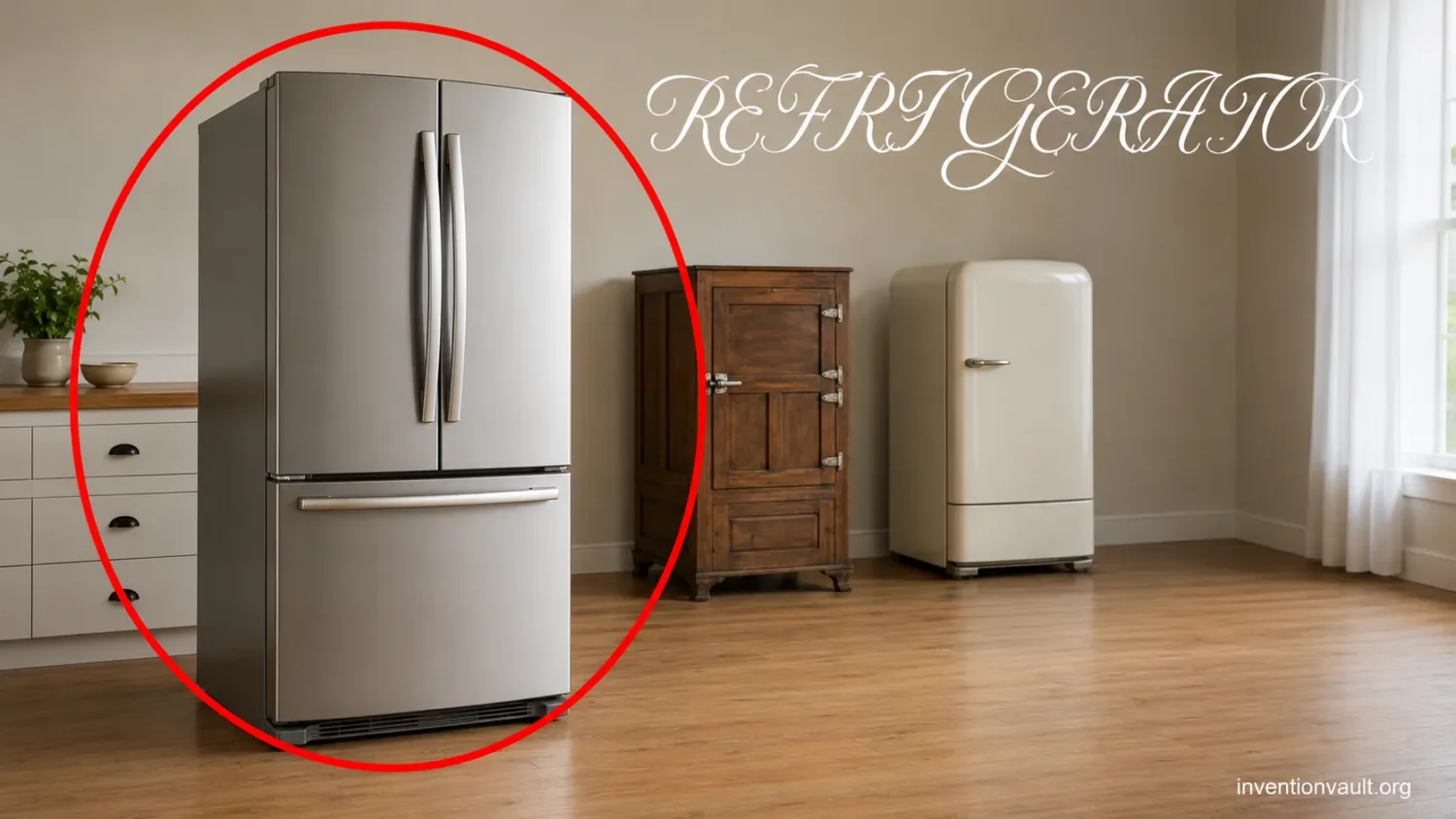
Household Cooling Evolution File
How Cold Entered the Home
Trace how stored ice, closed cooling cycles, electric appliances, mass production, and changing refrigerants created the household refrigerator.
Storage Method
The Household Icebox
Selected file: The Household Icebox. Choose another file to update this evidence card.
Cooling source
An icebox contained a block of harvested or factory-made ice. It did not produce cooling mechanically; melting ice absorbed heat that entered the cabinet.
Cabinet construction
Wooden walls, cork or mineral insulation, a metal-lined food chamber, shelves, and a drainage pan slowed heat entry and managed meltwater.
Daily limitation
Storage temperature varied with the remaining ice, cabinet condition, room temperature, and door use. Households also depended on regular ice deliveries.
The icebox established the insulated food cabinet, but continuous cooling still arrived from outside the home.
Mechanical Principle
A Repeating Refrigeration Cycle
Selected file: A Repeating Refrigeration Cycle. Choose another file to update this evidence card.
Laboratory evidence
William Cullen demonstrated artificial cooling by evaporating a liquid under reduced pressure in 1748. The experiment showed a physical principle rather than a household machine.
Unbuilt concept
Oliver Evans described a closed vapor-compression arrangement in 1805. His proposal supplied a mechanical concept, but he did not construct the refrigerator.
Working closed cycle
Jacob Perkins received a British patent in 1834 for apparatus that circulated a volatile fluid through evaporation, compression, condensation, and reuse. John Hague built the experimental machine.
Recirculating the working fluid removed the need to consume a fresh cooling substance during every cycle.
Industrial Engineering
Refrigeration Becomes Dependable
Selected file: Refrigeration Becomes Dependable. Choose another file to update this evidence card.
Ice without winter
John Gorrie developed an air-cycle machine for cooling and ice production, receiving a United States patent in 1851. Commercial success did not follow.
Alternative cycle
Ferdinand Carré developed an ammonia-water absorption machine in the late 1850s. Heat, rather than a mechanically driven compressor, powered its refrigerant circulation.
Industrial efficiency
Carl von Linde patented an efficient ammonia vapor-compression system in 1876. Breweries, ice plants, warehouses, and food processors supplied an early market for large installations.
Industrial service improved compressors, seals, controls, and heat exchangers before those parts became small enough for kitchens.
Domestic Package
DOMELRE Replaces the Ice Block
Selected file: DOMELRE Replaces the Ice Block. Choose another file to update this evidence card.
Packaged unit
Fred W. Wolf Jr. developed DOMELRE in 1913 as a factory-made electric cooling unit that could be mounted on an existing icebox.
Automatic operation
A thermostat controlled the system, while an air-cooled condenser removed the need for a household water connection. The user could plug in the assembled package.
Commercial boundary
Several thousand units were sold between 1914 and 1922, according to ASHRAE. High cost and limited household electrification kept the market small.
DOMELRE joined automatic cooling and the familiar icebox cabinet without yet creating an affordable mass household appliance.
Mass Appliance
The Refrigerator Reaches More Homes
Selected file: The Refrigerator Reaches More Homes. Choose another file to update this evidence card.
Integrated product
Manufacturers combined the insulated cabinet, motor, compressor, controls, condenser, and evaporator into a product sold and serviced as one appliance.
Monitor-Top launch
General Electric introduced its Monitor-Top refrigerator in 1927. Its sealed cooling assembly sat above the cabinet and became one of the first widely popular American electric models.
Conditions for adoption
Lower prices, expanding electric service, installment credit, factory production, and established repair networks made ownership practical for a growing share of households during the 1930s.
Mass adoption depended on manufacturing, electricity, financing, and service as much as on the cooling cycle itself.
Refrigerant Choice
Lower Immediate Risk, Hidden Cost
Selected file: Lower Immediate Risk, Hidden Cost. Choose another file to update this evidence card.
Early working fluids
Ether, ammonia, sulfur dioxide, and methyl chloride could provide useful cooling, but household leaks could bring fire, toxicity, or other exposure hazards.
CFC introduction
Thomas Midgley Jr., Albert Henne, and Robert McNary developed chlorofluorocarbon refrigerants. Commercial production of R-12 began in 1931.
Delayed consequence
CFCs were stable, nonflammable, and comparatively low in acute toxicity. That same atmospheric stability allowed chlorine from released CFCs to damage stratospheric ozone.
A fluid chosen for household safety later forced engineers to account for effects far beyond the appliance.
Environmental Redesign
Cooling After the CFC Era
Selected file: Cooling After the CFC Era. Choose another file to update this evidence card.
Ozone response
The 1987 Montreal Protocol established controls on ozone-depleting chemicals. Refrigerator makers changed refrigerants, insulation blowing agents, factories, and recovery practices.
Second tradeoff
Many HFC replacements do not deplete ozone, yet some have high global-warming potential. The 2016 Kigali Amendment created an international HFC phase-down.
Current direction
Many domestic systems now use small charges of isobutane, alongside improved insulation, electronic controls, efficient compressors, and designs intended to limit leakage.
Modern refrigerator design weighs food preservation, energy use, fire safety, manufacturing, service, and atmospheric effects together.
The household refrigerator was not invented in one event. Its familiar form emerged when an insulated food cabinet was combined with a repeatable refrigeration cycle, a compact electric drive, automatic temperature control, dependable manufacturing, and a refrigerant suitable for domestic use. Jacob Perkins demonstrated an early working vapor-compression machine in 1834, while Fred W. Wolf Jr.'s 1913 DOMELRE helped turn mechanical refrigeration into a plug-in household product. Affordable factory-built models made electric refrigeration common only later.
| Year | Person or development | What changed |
|---|---|---|
| 1748 | William Cullen | Demonstrated cooling through evaporation under reduced pressure. |
| 1805 | Oliver Evans | Described an unbuilt closed vapor-compression system. |
| 1834 | Jacob Perkins and John Hague | Patented and constructed an experimental closed-cycle vapor-compression machine. |
| 1851 | John Gorrie | Received a United States patent for a mechanical ice-making and cooling machine. |
| 1876 | Carl von Linde | Patented an efficient ammonia compression system suited to industrial operation. |
| 1913 | Fred W. Wolf Jr. | Developed DOMELRE, an automatic electric unit for mounting on an icebox. |
| 1927 | General Electric Monitor-Top | Helped establish the integrated refrigerator as a mass household appliance. |
| 1931 | Commercial R-12 production | Provided a nonflammable refrigerant with lower immediate toxicity than several earlier fluids. |
| 1987 onward | Montreal Protocol and later amendments | Drove replacement of ozone-depleting refrigerants and further changes in cooling technology. |
Who Invented the Refrigerator?
No single name answers every version of this question. William Cullen demonstrated artificial cooling but did not build a practical refrigerator. Oliver Evans described a vapor-compression machine but left it unbuilt. Jacob Perkins secured a patent and had an experimental closed-cycle machine constructed. John Gorrie produced ice mechanically, while Carl von Linde made compression refrigeration efficient enough for broad industrial use.
The domestic appliance involved another set of problems. It had to operate automatically, fit inside a kitchen, release heat without a water connection, avoid excessive noise, maintain a useful temperature, and be manufacturable at a price households could eventually afford. Fred W. Wolf Jr.'s DOMELRE addressed several of these requirements in one packaged electric unit. The Monitor-Top and competing refrigerators then helped move the technology into a larger consumer market.
Dating the First
The first artificial-cooling experiment, closed-cycle patent, working machine, electric household unit, self-contained cabinet, and widely purchased refrigerator occurred at different times. Calling any one of them simply “the first refrigerator” hides those distinctions.
Cold Storage Before Electric Refrigerators
Households preserved food through drying, salting, smoking, fermentation, cool cellars, spring houses, and short-term storage with natural ice. These methods served different foods and climates. None offered automatic, year-round temperature control inside an ordinary kitchen.
The icebox brought chilled storage into the home during the nineteenth century. A block of ice occupied an upper or side compartment. As heat entered the cabinet, the ice melted and absorbed some of that heat. Cool air circulated around the food chamber, while meltwater drained into a pan that had to be emptied or into a connected pipe.
Icebox
An insulated cabinet that depended on delivered ice. Cooling weakened as the ice melted, and the system required drainage, cleaning, and repeated ice replacement.
Mechanical Refrigerator
An insulated cabinet with machinery that moved heat outside. A thermostat could restart the system whenever the interior temperature rose above its set range.
The icebox contributed more than a name. Cabinet makers learned how shelf position, insulation, door fit, interior lining, air circulation, and drainage affected food storage. Early electric units could therefore replace the ice while continuing to use an established cabinet design.
How Mechanical Refrigeration Developed
Evaporation Made Cooling Measurable
A liquid absorbs energy when it changes into vapor. Lowering the pressure can make that liquid boil at a lower temperature, allowing it to take heat from nearby material. Cullen's 1748 demonstration used this relationship to produce cooling in a laboratory. It established a principle but offered no practical way to circulate and reuse the vapor.
Evans later proposed a closed system in which a volatile fluid would evaporate at low pressure, be compressed, release heat while condensing, and then return for another cycle. Reusing the same fluid was essential. A machine that consumed its refrigerant continuously would be expensive, inconvenient, and difficult to operate inside a home.
Perkins Turns the Idea into Machinery
Perkins received his 1834 patent for apparatus that produced ice and cooled fluids. The machine constructed by John Hague circulated a volatile liquid through a closed compression cycle. It was experimental rather than a commercial kitchen product, yet its arrangement contains the operating sequence used by most later refrigerators.
Perkins did not solve every engineering problem. Compressors leaked, seals wore out, manufacturing tolerances were limited, and the available working fluids introduced fire or health hazards. The machine nevertheless showed that mechanical parts could repeatedly pump heat from a cold space to warmer surroundings.
Industrial Refrigeration Builds a Market
Gorrie's air-cycle machine arose from his interest in producing ice and cooling rooms in a warm climate. His 1851 patent did not lead to a lasting business, but it supplied documented evidence that mechanically produced ice could serve places without dependable natural ice.
Carré's ammonia-water absorption machine used a different route. Instead of relying primarily on a mechanical compressor, it used heat to separate and circulate ammonia within an absorption cycle. Absorption systems later found domestic uses where gas, kerosene, or another heat source was more available than dependable electricity.
Linde approached refrigeration through thermodynamics, compressor design, and industrial operation. His 1876 ammonia system offered breweries and other businesses a more efficient machine. Industrial customers could justify the cost, provide trained operators, and maintain equipment too large or hazardous for a kitchen. Their demand supported the improvement of compressors, piping, valves, condensers, and controls.
How a Modern Refrigerator Moves Heat
A refrigerator does not manufacture a substance called cold. It transfers thermal energy from the insulated cabinet to the room. Electricity powers the compressor, so the condenser must release both the heat collected inside the cabinet and part of the energy supplied to the machinery. This is why the rear, sides, or lower ventilation area can feel warm.
- EvaporationLow-pressure refrigerant enters the evaporator and boils at a low temperature. The phase change absorbs heat from the cabinet air and stored contents.
- CompressionThe compressor draws in refrigerant vapor and raises its pressure. Its temperature also rises, allowing it to release heat to the warmer room.
- CondensationHot, high-pressure vapor passes through the condenser. Heat moves into the surrounding air, and the refrigerant becomes a high-pressure liquid.
- ExpansionA capillary tube or expansion device restricts the liquid flow, lowering its pressure and temperature before it returns to the evaporator.
A thermostat or electronic sensor monitors cabinet temperature and controls compressor operation. The system runs when heat entering through the walls, door seals, food, or open doorway raises the temperature. It stops after the interior returns to the selected range.
Parts That Make the Cycle Practical
- Compressor: circulates refrigerant and creates the pressure difference required by the cycle.
- Condenser: transfers heat from the hot refrigerant to room air.
- Expansion device: meters refrigerant and produces the pressure drop before evaporation.
- Evaporator: absorbs heat from the food compartment or freezer.
- Insulated cabinet: slows heat flow through the walls, floor, and door.
- Door gasket: limits warm, moist air leakage around the closed door.
- Controls and sensors: regulate temperature, defrost cycles, fans, alarms, and compressor speed.
Insulation is part of the cooling system even though it does not move. Better insulation reduces the rate at which heat enters, allowing a smaller or less frequently operated compressor to maintain the same interior temperature. Magnetic door gaskets, molded plastic liners, improved foam insulation, and reduced thermal bridges all lowered operating demand.
Turning Machinery into a Kitchen Appliance
Early domestic refrigeration equipment could be noisy, expensive, difficult to install, or dependent on plumbing. Some designs placed the machinery in a basement and connected it to a kitchen cabinet. Others attached a cooling package to an existing icebox. The final appliance form required manufacturers to place the necessary equipment within or directly beside the cabinet.
DOMELRE and Automatic Control
Wolf's DOMELRE, developed in 1913 and sold from 1914, arrived as an assembled package. It used an air-cooled condenser, automatic temperature control, and an electric motor. Installation did not require a continuous water connection. A freezing tray also allowed the system to make small ice pieces instead of merely preserving delivered blocks.
DOMELRE is best described as an early successful mass-marketed package unit, not the moment when every modern refrigerator feature appeared. It was installed on an icebox rather than sold only as the later one-piece cabinet form. Its price also placed it beyond many households.
Integrated Cabinets and Factory Production
During the 1910s and 1920s, manufacturers tested different machinery locations, cabinet materials, controls, and sales models. Separately developed products contributed to the refrigerator that buyers recognized as a single appliance. Sealed assemblies reduced leakage and limited the installation work required inside the home.
The General Electric Monitor-Top, introduced in 1927, placed its sealed mechanism in a visible cylindrical housing above the cabinet. The shape led to its nickname because it resembled the turret of the Civil War vessel USS Monitor. Its broad commercial reach made it an early landmark of household adoption, although it was not the first machine to refrigerate food electrically.
Appliance production also needed a support system. Electric utilities had to reach homes, wiring had to carry motor starting loads, retailers needed demonstrations and credit plans, and technicians needed parts and service knowledge. During the 1930s, falling prices and financing helped more American households replace ice delivery with electric cooling.
Why Refrigerants Kept Changing
A useful refrigerant must boil and condense within practical pressure and temperature ranges. It must also work with compressor oil, metals, seals, and manufacturing methods. Domestic service adds stricter concerns about toxicity, flammability, leakage, and the amount of fluid placed inside the appliance.
Early refrigeration machinery used fluids that included ether, ammonia, sulfur dioxide, and methyl chloride. Each offered workable thermodynamic properties, but leaks could expose occupants to fire or toxic gas. Ammonia remains effective in many industrial systems operated under controlled engineering and maintenance conditions, yet it was poorly suited to small early household appliances with uncertain seals.
CFC-12 and Its Environmental Cost
Research begun in the late 1920s produced chlorofluorocarbon refrigerants with low flammability and lower acute toxicity. Commercial R-12 production began in 1931. Its stability and compatibility made sealed household refrigeration easier to manufacture and market.
The environmental drawback became clear decades later. Released CFC molecules can persist long enough to reach the stratosphere, where ultraviolet radiation releases chlorine that destroys ozone. The Montreal Protocol, adopted in 1987, established international controls on ozone-depleting substances and drove changes in refrigerants and foam production.
HFC refrigerants avoided ozone depletion because they contain no chlorine, but some retain high global-warming potential. The Kigali Amendment adopted in 2016 created a phase-down schedule for HFCs. Domestic refrigerator makers have also adopted low-charge hydrocarbon systems, especially isobutane, which has low global-warming potential but requires equipment designed for its flammability.
Sealed-System Safety
Refrigerant circuits can contain pressurized, flammable, toxic, or oxygen-displacing fluids depending on the model and age. The tubing should not be punctured, heated, cut, or opened outside appropriate appliance-service and refrigerant-recovery procedures.
What Refrigeration Changed at Home
Reliable refrigeration lengthened the time available between purchasing and preparing many perishable foods. Milk, meat, cooked dishes, and produce could be held under more stable conditions than an icebox usually provided. Leftovers became easier to retain, while daily dependence on an iceman and meltwater drainage declined.
The refrigerator also became the household endpoint of a wider cold chain. Refrigerated processing plants, railcars, trucks, warehouses, and shop displays could deliver chilled products, but their value depended on continued cold storage after purchase. The home appliance completed that chain.
Freezer compartments expanded the range of foods that could be stored for longer periods. Larger postwar models supported frozen vegetables, concentrated juices, prepared meals, and bulk purchasing. These changes altered shopping schedules and kitchen work, though they did not remove the need for hygiene, packaging, or correct storage temperatures.
For current household use, the main refrigerator compartment should remain below 40°F, or about 4°C. The United States Department of Energy identifies 35–38°F, with 37°F as an optimal setting, for the main compartment. A freezer is normally set to 0°F, or about −18°C.
Design Changes Inside Modern Refrigerators
Automatic Defrosting
Moist room air enters whenever the door opens. Water vapor can freeze on a cold evaporator, creating an insulating frost layer that restricts airflow. Frost-free refrigerators periodically warm the evaporator with a defrost heater, drain the resulting water, and restart cooling. The feature removes manual defrost work but adds controls and an intermittent energy load.
Forced Air and Separate Zones
Fans circulate chilled air through the cabinet, reducing large temperature differences between shelves. Dampers or separate evaporator circuits can divide airflow between refrigerator and freezer sections. Produce drawers adjust moisture retention through venting, while some pantry compartments provide a temperature range suited to meat, drinks, or other foods.
Electronic and Variable-Speed Control
Mechanical thermostats switch a fixed-speed compressor on and off. Electronic controls can use several sensors, coordinate fans and defrosting, and detect an open door. Variable-speed compressors adjust cooling output instead of repeatedly operating only at full power, which can reduce temperature swings and starting losses.
Efficiency and Cabinet Layout
Energy use depends on cabinet size, insulation, gasket condition, ambient temperature, door openings, defrost design, compressor efficiency, and features such as through-door ice dispensers. More interior volume and more external openings generally create additional heat gain. Design therefore balances storage convenience against the energy required to keep that space cold.
Common Refrigerator Misconceptions
Does a refrigerator create cold?
No. It removes heat from its cabinet and releases that heat into the room. The sensation of cold reflects lower thermal energy inside the compartment.
Was the electric refrigerator invented in 1913?
The 1913 DOMELRE was an early automatic electric household package, but mechanical refrigeration had already been demonstrated in the nineteenth century. Later integrated models were more influential in mass ownership. The answer changes with the type of “first” being discussed.
Did CFC refrigerants make refrigerators completely safe?
CFCs reduced the immediate fire and toxicity problems associated with several earlier working fluids. They introduced a different harm when released: ozone depletion and climate forcing. No refrigerant choice can be judged by only one property.
Why does a closed refrigerator still need to run?
Insulation slows heat transfer but cannot stop it. Heat passes through cabinet materials and seals, while door openings and newly added food introduce extra heat. The compressor runs periodically to remove that incoming energy.
The Refrigerator as an Evolving System
The household refrigerator grew from several connected lines of work rather than a lone prototype. Iceboxes supplied the cabinet concept. Cullen demonstrated evaporative cooling, Evans described a closed cycle, Perkins built the early vapor-compression arrangement, and industrial engineers made refrigeration dependable. Wolf packaged electric cooling for domestic use, while later manufacturers lowered cost and organized production, distribution, and repair.
The machine continues to change because its design problem extends beyond temperature. Engineers must limit energy use, control moisture, maintain food-safe conditions, select lower-impact refrigerants, prevent leaks, support repair, and recover materials at disposal. The outward form remains familiar, but the compressor, insulation, controls, airflow, and working fluid continue to be revised.
References Used for This Article
- ASHRAE, Air-Conditioning and Refrigeration Chronology — dates for early experiments, patents, refrigerants, and industrial systems.
- ASHRAE, DOMELRE First Electric Refrigerator — design, production, controls, and commercial history of Fred W. Wolf Jr.'s household unit.
- Smithsonian National Museum of American History, Keeping Your Food Cool — icebox use, Monitor-Top history, and household adoption.
- United States Environmental Protection Agency, Refrigerant Safety — early refrigerant hazards, CFC development, and environmental tradeoffs.
- United States Department of Energy, Refrigerator and Freezer Use and Temperature Tips — modern storage temperatures and refrigerator operating guidance.
- United Nations Environment Programme, Montreal Protocol — CFC controls, the HFC phase-down, and amendment dates.