
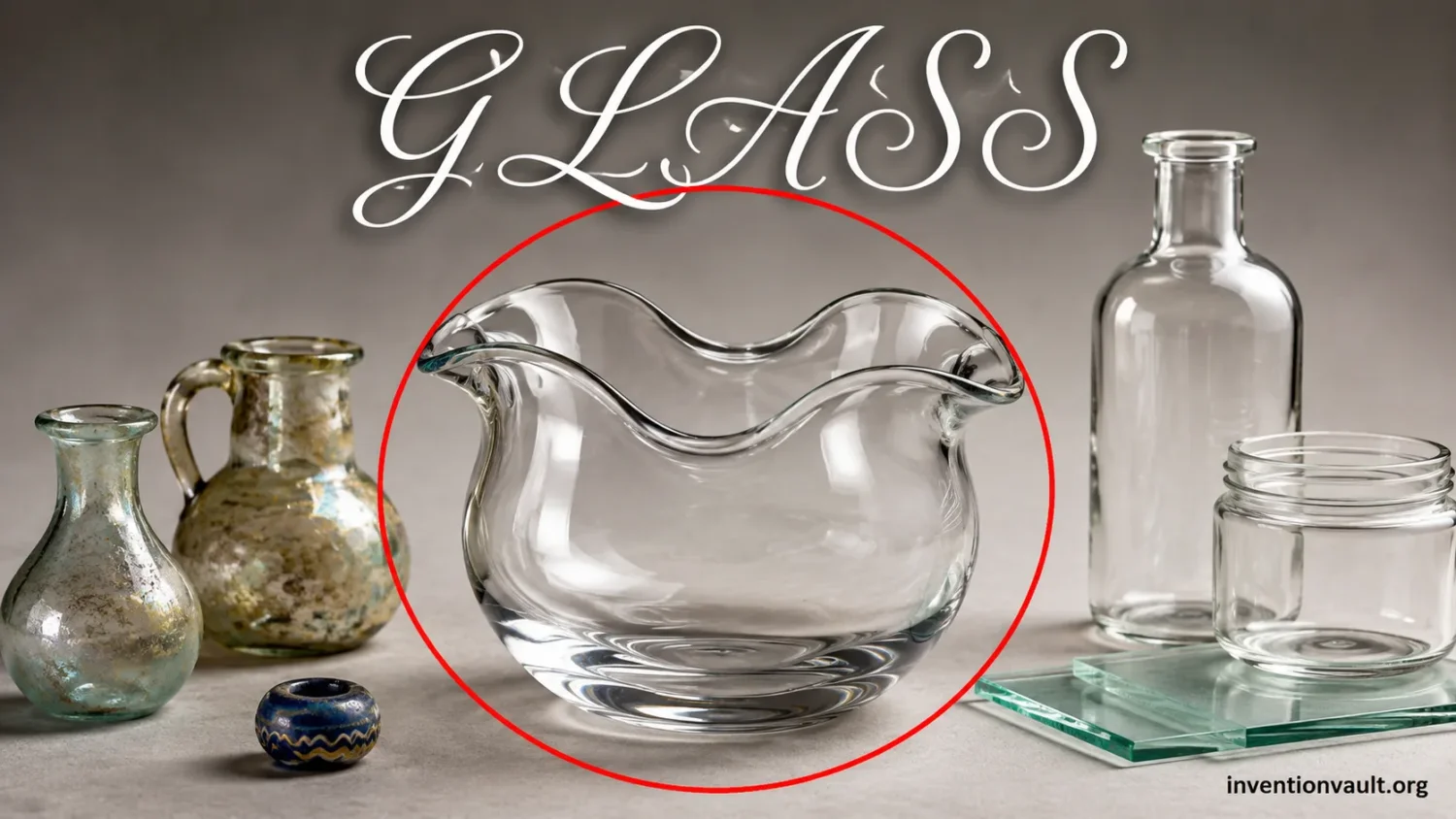
| Field | Verified Detail |
|---|---|
| Invention | Human-made glass, a non-crystalline transparent or translucent material formed by heating silica-rich ingredients until they fuse and then cooling the melt without forming regular crystals. |
| Earliest Known Human-Made Glass | Usually placed in the late third millennium BCE to early second millennium BCE, with early evidence linked to Mesopotamia, Egypt, and nearby eastern Mediterranean regions. |
| Single Inventor? | No confirmed single inventor is known. Glassmaking grew from craft experiments with glazes, faience, mineral pigments, furnace heat, and silica-rich sands. |
| Early Forms | Small beads, inlays, amulets, colored decorative pieces, and later core-formed vessels for oils, perfumes, and precious liquids. |
| Early Ingredients | Silica from sand or crushed quartz, alkali flux such as plant ash or natron, and lime-bearing material that helped stabilize the glass. |
| Major Ancient Change | The spread of glassblowing around the first century BCE/CE made hollow glass vessels faster to produce and easier to shape. |
| Major Modern Change | The float glass process, developed by Sir Alastair Pilkington in the 1950s, made large, flat, optically smooth glass sheets practical for windows, vehicles, mirrors, and displays. |
| Common Modern Base Glass | Soda-lime glass, widely used for windows and containers, often contains roughly 70–74% silica with soda and lime as major modifiers. |
| Transparent Material Family | Natural glass, soda-lime glass, borosilicate glass, lead crystal, fused quartz, tempered glass, laminated glass, optical glass, glass-ceramics, and chemically strengthened display glass. |
| Why It Matters | Glass changed storage, architecture, lenses, scientific instruments, lighting, screens, solar panels, fiber optics, and laboratory work. |
Glass was not born as a clear window. Its first human-made forms were usually small, colored, costly, and handled like stone, metal, or jewelry. The invention of glass began when craftspeople learned that sand, alkali, lime, heat, and careful cooling could create a new material: solid like stone, workable like a melt, and sometimes able to let light pass through. That strange mix of hardness and brightness is why glass moved from ornament to vessel, from vessel to lens, and from lens to the screens and fibers used today.
Glass has no single named inventor. It came from repeated craft discoveries in heat, minerals, and furnace control. The better question is not “Who invented glass?” but how people learned to turn opaque mineral mixtures into a material that could protect, preserve, magnify, transmit, and display.
Before Human-Made Glass
Nature made glass long before people did. Volcanic obsidian forms when silica-rich lava cools so quickly that crystals do not have time to grow. Early communities shaped obsidian into sharp tools and polished objects because it fractured cleanly and held a fine edge. It was glass, but not an invention.
Other transparent or semi-transparent materials also mattered. Rock crystal, clear quartz, amber, and polished gemstones taught people that solid matter could carry light. These natural materials were rare and hard to shape. Human-made glass offered something different: it could be colored, melted, molded, and repeated.
Where Glassmaking Started
Archaeological evidence points to a broad invention zone rather than one workshop. Mesopotamia, Egypt, and neighboring regions of the eastern Mediterranean all appear in the early story. The safest dating places human-made glass around 4,000 years ago, with earlier related work in glazes and faience helping to prepare the craft.
Early glass was often opaque and richly colored. Craftspeople were not trying to make window panes. They were making objects that could imitate lapis lazuli, turquoise, and other valued stones. Blue and green tones came from mineral colorants such as copper compounds; iron impurities could push glass toward greenish or brownish shades.
That point is easy to miss. Transparency was not the first goal of glassmaking. Color, shine, rarity, and controlled imitation came first. Clear glass became more important later, when makers gained cleaner raw materials, better furnaces, and stronger control over bubbles and impurities.
What Early Glass Was Made From
The basic recipe sounds simple, but each ingredient had a job. Silica supplied the main body of the glass. Alkali lowered the melting temperature, since pure silica needs extreme heat. Lime made the final material more durable in ordinary use.
| Ingredient | Role in the Glass | Historical Notes |
|---|---|---|
| Silica | The main glass former; usually from sand or crushed quartz. | High silica content gives glass its rigid network structure. |
| Alkali | Lowers the melting temperature so furnaces can fuse the mixture. | Ancient makers used plant ash or natron, depending on place and period. |
| Lime | Improves chemical durability and helps stop the glass from dissolving too easily. | Lime could enter through sand impurities or added calcium-rich material. |
| Colorants | Gave blue, green, amber, purple, white, or opaque effects. | Copper, cobalt, iron, manganese, tin, and antimony compounds could alter color and opacity. |
| Refining Conditions | Helped remove bubbles and improve optical quality. | Better furnace control slowly made clearer glass possible. |
Modern soda-lime glass still follows the same general logic. A typical composition may contain about 70–74% silica, with soda and lime forming much of the remainder. Exact formulas vary by product, factory, and performance target.
From Beads to Vessels
The earliest glass objects were small because early glassmaking demanded high heat, patient handling, and rare skill. Beads and inlays suited the material well. They needed little volume, showed color beautifully, and could travel as luxury items.
Hollow vessels required a harder step. Before glassblowing, makers often used core-forming. A clay or sand core gave the vessel its inner shape. Hot glass was wound or gathered around it, decorated while soft, cooled, and then cleared of the core. The method produced small perfume bottles, cosmetic containers, and ritual objects with narrow openings and dense colors.
Core-formed glass was laborious, so it remained valuable. Each object carried the marks of hand control: trails, zigzags, feathered decoration, and layered colors. It was not yet the common household glass people know now.
Why Glassblowing Changed Everything
Glassblowing appeared around the first century BCE or first century CE in the eastern Mediterranean world. The change was practical. A craftsperson could gather molten glass on the end of a blowpipe, inflate it, rotate it, shape it, and open it into a vessel. The technique saved time and allowed thinner walls.
This was one of the great turning points in glass history. Glass moved from rare decorated pieces toward bottles, cups, jars, lamps, and tableware. Shapes became more varied. Production widened. Clearer glass gained new value because people could see the liquid, powder, or object inside.
Glassblowing did not invent glass. It changed glass from a slow luxury craft into a more flexible material culture. That difference matters because many short histories blur the invention of glass with the later invention of blown glass.
The Slow Road to Clear Glass
Transparent glass needed cleaner ingredients and better heat control. Sand often contains iron, and iron can tint glass green or brown. Bubbles, unmelted grains, and uneven cooling could distort light. To make clearer glass, makers had to refine raw materials, adjust furnace atmosphere, and master annealing.
Annealing is controlled cooling. Without it, glass can trap internal stress and crack later. Ancient makers learned this through practice rather than modern physics. The lesson stayed the same: glass may look solid and finished, but its strength depends on what happened while it cooled.
Clear glass also changed how people thought about containers. A ceramic jar hides its contents. A glass vessel shows color, level, cleanliness, and movement. That simple visual advantage shaped medicine storage, food preservation, laboratory work, and later display technology.
Window Glass and Flat Sheets
Flat window glass came later than small vessels. Ancient panes were often small, uneven, and less clear than modern glass. For centuries, making large flat sheets meant accepting distortion or spending time grinding and polishing the surface.
Several methods appeared over time. Crown glass used a blown globe that was opened and spun into a disk. Cylinder glass used a blown cylinder that was cut open and flattened. Plate glass could be cast and polished for better optical quality. Each method improved access to daylight indoors, but none solved the problem fully.
Float Glass and the Modern Window
The modern answer arrived in the 1950s with the float glass process. Sir Alastair Pilkington and his team developed a method in which molten glass flows onto a bath of molten tin. The glass spreads, levels itself, and forms a smooth ribbon. Because it floats, both surfaces can become remarkably flat without the heavy grinding and polishing once required.
In float production, molten glass may enter the tin bath at about 1,000°C. Modern float lines can make glass sheets far thinner or thicker than early window glass; Pilkington technical material notes a range from about 0.4 mm to 25 mm for the process. This is why today’s buildings, vehicles, mirrors, cabinets, solar panels, and screens can rely on large, consistent sheets.
The float process also changed price and scale. Clear, flat glass stopped being a scarce architectural luxury and became an industrial material. The effect was quiet but vast: brighter rooms, larger shopfronts, safer vehicle glazing, better mirrors, and more precise optical surfaces.
Main Types of Glass and Transparent Materials
Glass is not one material. It is a family. Different formulas serve different jobs, and transparent materials now include both traditional glass and newer engineered solids.
| Material Type | Main Use | What Made It Useful |
|---|---|---|
| Soda-Lime Glass | Windows, jars, bottles, common flat glass. | Low cost, good clarity, workable melting range, easy mass production. |
| Borosilicate Glass | Laboratory ware, cookware, lighting, technical glass. | Better thermal shock resistance than ordinary soda-lime glass. |
| Lead Crystal | Decorative glass, optical uses in older formulas, fine tableware. | High brilliance and strong light refraction. |
| Fused Quartz | Optics, semiconductor work, high-temperature parts. | Very high silica content and strong resistance to heat. |
| Tempered Glass | Doors, side windows, furniture, protective panels. | Heat treatment creates surface compression, improving impact resistance. |
| Laminated Glass | Windshields, safety glazing, skylights. | Layers hold together with an interlayer, helping the pane remain in place after cracking. |
| Optical Glass | Lenses, microscopes, telescopes, cameras. | Controlled refractive index and low distortion. |
| Glass-Ceramics | Cooktops, technical parts, thermal products. | Controlled crystallization inside a glass body gives high heat resistance. |
| Chemically Strengthened Glass | Phone screens, tablets, touch displays. | Ion exchange creates a compressed surface layer that resists scratches and impact better than ordinary thin glass. |
| Transparent Polymers | Lightweight lenses, shields, display covers. | Lower weight and easier forming, though scratch resistance and heat behavior differ from glass. |
Glass in Science and Measurement
Glass helped science because it lets people observe without touching. A clear vessel can hold a reaction while showing color change, bubbles, sediment, or separation. A lens can bend light into an enlarged image. A thermometer tube can show expansion. A prism can split light.
That usefulness came from more than transparency. Glass is also chemically stable with many substances, easy to clean, and formable into tubes, bulbs, plates, and sealed containers. Laboratory glassware did not appear fully formed in one moment; it grew from centuries of furnace skill, clearer melts, and better shaping tools.
Glass and the Invention of Lenses
Transparent materials changed vision. Polished glass lenses led to eyeglasses, magnifiers, microscopes, telescopes, cameras, and projectors. The lens story depends on optical quality: a material must be clear, shaped with precision, and predictable when light passes through it.
Small defects matter in optics. Bubbles, streaks, and uneven composition can bend light in unwanted ways. That is why optical glass became its own branch of glassmaking. It required measured formulas, strict melting conditions, and careful cooling. The goal was not only to see through glass, but to see accurately.
Glass in Communication and Energy
The modern information age uses glass in less obvious places. Optical fibers carry light signals through thin strands of highly purified glass. Touchscreens depend on thin, strengthened transparent sheets. Solar panels use glass to protect cells while letting sunlight reach them.
The United Nations recognized 2022 as the International Year of Glass, reflecting the material’s role in technology, culture, and sustainable production. That recognition fits the long arc of the invention: glass began as colored craft material, then became a practical partner in storage, vision, architecture, electronics, and renewable energy systems.
What Glass Does Well
- Lets light pass while blocking weather, dust, or touch.
- Can be molded, blown, drawn, cast, polished, tempered, or coated.
- Resists many everyday chemicals.
- Can be recycled without losing its basic glass identity.
What Makers Had to Control
- Raw material purity.
- Furnace temperature and atmosphere.
- Bubbles and unmelted particles.
- Cooling stress during annealing.
- Surface flatness for windows and displays.
How Glass Differs From Crystal
The word “crystal” can confuse readers. In materials science, a crystal has atoms arranged in a repeating pattern. Glass does not. It is amorphous, meaning its internal structure lacks that long-range order. A drinking “crystal” goblet may be called crystal because of tradition, clarity, sound, or lead content, not because it has a true crystal structure.
This amorphous structure explains many glass behaviors. Glass softens over a range of temperatures rather than melting at one sharp point like ice. It can be reheated and shaped, then cooled into a solid. That is part of its unusual charm as an invention: it sits between liquid handling and stone-like use.
Timeline of the Invention of Glass
| Period | Development | Why It Matters |
|---|---|---|
| Stone Age | Use of natural glass such as obsidian. | People valued glass-like materials before they could make glass. |
| Late 3rd Millennium BCE | Early human-made glass and related vitreous materials appear in the Near East. | Craftspeople learned to fuse mineral mixtures into artificial glassy objects. |
| 2nd Millennium BCE | Glass beads, inlays, and small vessels spread across high-skill workshops. | Glass became a controlled luxury material. |
| 1st Century BCE/CE | Glassblowing spreads. | Hollow glass objects became faster to make and more varied in form. |
| Medieval to Early Modern Period | Improved window glass, stained glass, mirrors, and clearer formulas. | Glass entered architecture, worship spaces, trade, domestic life, and instruments. |
| 17th–19th Centuries | Better lenses, plate glass, chemical glassware, and industrial furnaces. | Glass became vital to science, measurement, lighting, and urban architecture. |
| 1950s | Float glass process developed. | Large, flat, low-distortion sheets became easier to produce at industrial scale. |
| Late 20th–21st Centuries | Optical fibers, strengthened display glass, coated glass, smart glazing, solar glass. | Transparent materials became part of digital communication and energy systems. |
What Many Short Histories Miss
Many summaries present glass as a sudden accident: sand met fire and became transparent. The real story is more useful. Early glass was rarely clear, and it did not come from ordinary campfire heat. It needed furnace temperatures, mineral knowledge, and repeated craft decisions. The invention was a long technical learning curve.
Another missed point is the difference between making glass, making vessels, and making flat transparent sheets. These were separate achievements. Beads came before blown vessels. Small panes came before modern windows. Float glass came much later and gave the modern world its broad, clean sheets of architectural glass.
A third missed point is that transparent materials did not stop with glass. Fused quartz, borosilicate glass, optical glass, laminated glass, glass-ceramics, and transparent polymers each solved a different problem. The invention of glass opened a material path, and later makers kept widening it.
Why the Invention Still Matters
Glass matters because it does something rare: it separates without hiding. A window separates room from weather. A bottle separates liquid from air. A lens separates blurred sight from sharp sight. A fiber-optic strand separates a light signal from outside interference. A display cover separates fingers from electronics while still letting images through.
That is the lasting achievement of glass. It made transparency useful, durable, repeatable, and eventually affordable. The earliest makers could not have imagined modern screens or solar modules, yet their experiments with silica, alkali, color, and furnace heat began the same material story.
Terms That Help Explain Glass
| Term | Meaning |
|---|---|
| Amorphous | A solid structure without the repeating atomic pattern found in true crystals. |
| Annealing | Controlled cooling that reduces internal stress in glass. |
| Flux | An ingredient that lowers the melting temperature of silica. |
| Faience | A glazed, silica-rich material related to early glass technology but not the same as fully glassy objects. |
| Core-Forming | An early method for shaping hollow glass around a removable inner core. |
| Glassblowing | A shaping method that inflates molten glass through a blowpipe. |
| Float Glass | Flat glass made by floating molten glass on molten tin. |
| Tempering | Heat treatment that strengthens glass by creating surface compression. |
| Laminated Glass | Glass made with an interlayer so cracked pieces tend to stay together. |
| Optical Glass | Glass made for controlled light transmission, refraction, and low distortion. |
References Used for This Article
- United Nations Digital Library — International Year of Glass, 2022 Draft Resolution: This official record supports the modern recognition of glass in technology, culture, and sustainability.
- The Corning Museum of Glass — Origins of Glassmaking: This museum source supports the early Mesopotamian dating and basic sand, soda, and lime explanation.
- The Metropolitan Museum of Art — Roman Glass: This museum essay supports information on ancient vessel production and Roman-era glass use.
- Republic of Türkiye Ministry of Culture and Tourism — The History of Ancient Glass: This official cultural source supports the Bronze Age origin discussion and early opaque colored glass.
- Google Patents — Manufacture of Flat Glass: This patent record supports the technical description of floating glass ribbon on molten metal.
- Pilkington — The Float Process: This technical page supports the modern float glass process, temperature, and thickness range.
- Pilkington — Invention of Float Glass: This heritage source supports the 1950s development timeline and industrial scale of float glass.
- Glass Alliance Europe — 2022 United Nations International Year of Glass: This industry association page supports the link between glass, modern technology, and sustainability goals.