
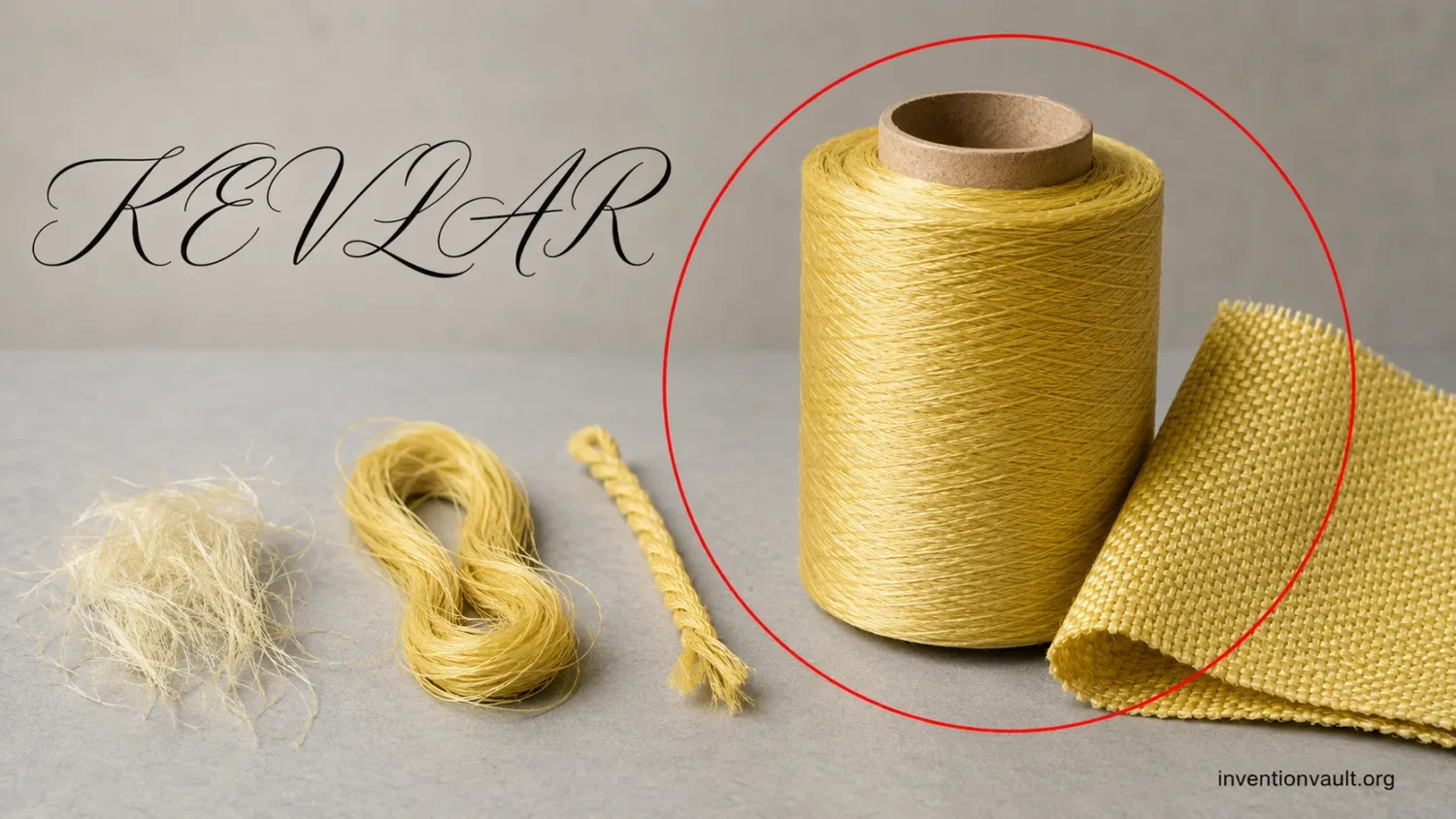
Aramid Development Record
How Kevlar Became a High-Strength Fiber
Follow the chemical discovery, molecular alignment, spinning process, scale-up work, and applications that turned an unusual polymer solution into Kevlar.
Research brief
A Fiber Beyond Ordinary Nylon
Selected file: A Fiber Beyond Ordinary Nylon. Choose another file to update this evidence card.
Selected
Industrial objective
DuPont researchers sought lightweight fibers with greater stiffness, strength, and heat resistance than established synthetic fibers. Tire reinforcement was an early target because lighter cords could reduce reliance on steel.
Chemical direction
The investigation moved toward aromatic polyamides. Their benzene-ring-rich backbones promised rigid chains, but those same chains were difficult to melt, dissolve, and process.
Unresolved problem
A strong polymer was not enough. Researchers needed a high-molecular-weight material that could be placed in solution and formed into continuous, well-oriented filaments.
The search defined Kevlar’s real challenge: joining rigid molecular chemistry with a workable fiber-forming process.
Laboratory observation
Kwolek’s Unusual Polymer Solution
Selected file: Kwolek’s Unusual Polymer Solution. Choose another file to update this evidence card.
Selected
1965 experiment
Stephanie Kwolek prepared rigid-chain aromatic polyamides at DuPont and obtained a solution that was cloudy, opalescent, and unexpectedly fluid rather than clear and syrup-like.
Reason for caution
Cloudiness could indicate particles capable of blocking or damaging spinneret holes. Kwolek nevertheless pressed for a spinning test because the solution’s unusual behavior suggested an ordered polymer state.
Discovery boundary
The experiment opened the route to high-modulus aramid fibers. It was not yet the complete commercial Kevlar process, which required more polymer, solvent, spinning, and production work.
Recognizing the solution as useful preserved a research path that its unfamiliar appearance might otherwise have ended.
Molecular behavior
Liquid-Crystalline Chain Alignment
Selected file: Liquid-Crystalline Chain Alignment. Choose another file to update this evidence card.
Selected
Rodlike molecules
Para-oriented aromatic rings and amide links make the polymer chains comparatively straight and resistant to rotation. Above a concentration threshold, groups of these rods align into ordered solution domains.
Optical anisotropy
The ordered solution interacts with light differently according to direction. This anisotropic behavior distinguishes it from an ordinary polymer solution containing randomly coiled chains.
Processing advantage
Flow through a spinneret turns the ordered domains toward the filament axis. Much of the orientation needed for high strength is therefore created during spinning rather than by extensive drawing afterward.
Liquid-crystalline order provided a direct route from rigid molecules to highly aligned filaments.
Performance test
The First High-Modulus Filaments
Selected file: The First High-Modulus Filaments. Choose another file to update this evidence card.
Selected
Spinneret result
The low-viscosity solution formed coherent fibers rather than causing the expected processing failure. Mechanical tests showed tensile strength and stiffness far above those of familiar textile fibers.
Structural reason
Loads applied along the filament act mainly along extended covalent backbones. Hydrogen bonding and close packing between neighboring chains help the ordered structure resist separation.
Team transition
Once the result was confirmed, the work expanded from laboratory polymer experiments to a coordinated DuPont program involving polymer chemistry, solution preparation, spinning, heat treatment, and product testing.
The spinning test converted unusual solution behavior into measured evidence of a new fiber class.
Polymer selection
PPTA Becomes the Kevlar Polymer
Selected file: PPTA Becomes the Kevlar Polymer. Choose another file to update this evidence card.
Selected
Chemical identity
The commercial fiber uses poly(p-phenylene terephthalamide), commonly shortened to PPTA or PPD-T. It is produced from para-phenylenediamine and terephthaloyl chloride by condensation polymerization.
Para geometry
Each chain-extending bond occupies the para position on an aromatic ring. This geometry keeps the backbone straighter than the kinked, meta-oriented chains used in fibers such as Nomex.
Patent record
Kwolek’s patent family documented anisotropic aromatic-polyamide dopes and fibers with exceptional tensile properties. Patent publication dates followed years of laboratory work and should not be treated as the discovery date.
PPTA supplied the molecular regularity needed to carry liquid-crystalline orientation into a commercial para-aramid fiber.
Production engineering
From Polymer to Continuous Yarn
Selected file: From Polymer to Continuous Yarn. Choose another file to update this evidence card.
Selected
Spinning medium
PPTA does not melt into a conveniently spinnable liquid. Industrial production dissolves the polymer in concentrated sulfuric acid to prepare an anisotropic spinning dope.
Dry-jet wet route
Herbert Blades developed a process that extrudes the dope through spinneret holes, across a short air gap, and into a coagulation bath. Stretching in the gap aids axial orientation.
Shared scale-up work
Other DuPont researchers refined polymer synthesis, chain length, solvent handling, washing, neutralization, heat treatment, and equipment control. Wesley Memeger Jr. later contributed a commercially workable synthesis route.
Production depended on controlling corrosive solvent chemistry while preserving molecular order through every forming and washing stage.
Adoption record
Industrial and Protective Uses
Selected file: Industrial and Protective Uses. Choose another file to update this evidence card.
Selected
Commercial introduction
Kevlar entered commercial production in 1971, roughly six years after Kwolek’s discovery. Tire cords and other reinforcement products were among its first intended markets.
Armor testing
During the 1970s, U.S. law-enforcement research tested layered Kevlar fabric as lightweight soft armor. A 1975 field program placed about 5,000 armors with 15 urban police departments.
Wider forms
Filament yarn, woven cloth, chopped fiber, pulp, and composite reinforcement now serve ropes, cables, hoses, friction products, protective clothing, aircraft structures, sporting equipment, and vehicle parts.
Kevlar spread because the same oriented fiber could be engineered into flexible textiles, cords, laminates, and rigid composites.
Kevlar is a high-strength synthetic fiber developed from Stephanie Kwolek’s 1965 research on liquid-crystalline aromatic polyamide solutions at DuPont. The commercial material is a para-aramid fiber made from poly(p-phenylene terephthalamide), or PPTA. Kwolek established the chemical and processing route that made exceptionally stiff, strong fibers possible, while a wider research and engineering team converted that discovery into a repeatable industrial product introduced in 1971.
| Item | Verified description |
|---|---|
| Material class | Para-aramid synthetic fiber |
| Commercial name | Kevlar, a DuPont trademark |
| Main polymer | Poly(p-phenylene terephthalamide), abbreviated PPTA or PPD-T |
| Foundational discovery | Stephanie Kwolek’s high-strength aromatic-polyamide fiber research in 1965 |
| Commercial introduction | 1971 |
| Defining structure | Rigid para-oriented chains aligned along the fiber axis |
| Fiber-forming method | Dry-jet wet spinning from a liquid-crystalline solution |
| Useful property combination | High tensile strength and modulus at low weight, with thermal stability and resistance to many chemicals |
What Kevlar Actually Is
Kevlar is the trademarked name of a DuPont product family, not the generic name for every yellow high-strength fiber. The broader material class is aramid, a contraction of “aromatic polyamide.” Kevlar belongs to the para-aramid branch because its chain-extending bonds occupy opposing para positions on the aromatic rings.
Material Name
Kevlar is a brand of para-aramid fiber. Other para-aramid products can have related chemistry and properties without being Kevlar, while meta-aramids belong to a structurally different branch of the aramid family.
This distinction matters because aramid fibers do not all respond to loads and heat in the same way. Para-aramids favor tensile strength and stiffness. Meta-aramids, including Nomex, have kinked chains that do not pack or align as closely, but they perform well in heat- and flame-resistant textiles.
The Research Problem Before Kevlar
Nylon had shown that synthetic polyamides could be spun into durable fibers. Yet its flexible aliphatic chains limited the stiffness and heat performance available for demanding reinforcement. Researchers began examining polymers with aromatic rings in their backbones because those rings restrict molecular rotation and create straighter chains.
The chemistry introduced a processing problem. Flexible polymers can often be melted and extruded or dissolved into ordinary, randomly coiled solutions. Rigid aromatic polyamides resist melting and common solvents. A polymer with excellent theoretical strength had little industrial value unless it could be formed into continuous filaments without destroying its molecular order.
Kwolek had already worked on low-temperature condensation methods for aromatic polyamides. This experience allowed her to prepare high-molecular-weight polymers without relying on melt polymerization above 200°C. By 1964, her research had turned toward rigid, para-oriented chains expected to produce stiffer fibers.
Stephanie Kwolek’s 1965 Discovery
Polymer solutions used for fiber spinning were normally clear and viscous. One of Kwolek’s experimental aromatic-polyamide solutions behaved differently: it was thin, cloudy, and opalescent when stirred. Such an appearance could mean that undissolved matter was present, raising the risk that a spinning test would block the spinneret.
Kwolek argued that the solution should still be tested. When extruded through the laboratory spinneret, it formed fibers with unexpected strength and stiffness. The solution was later understood as liquid-crystalline: its rigid rodlike molecules had formed ordered domains rather than remaining as random coils.
The discovery was broader than a single finished polymer formulation. Kwolek’s early work with poly(p-benzamide) helped establish how rigid-chain aromatic polyamides could form ordered solutions and high-modulus fibers. DuPont’s commercial team subsequently developed PPTA as the polymer used for Kevlar.
Discovery vs. Patent Record
The laboratory discovery occurred in 1965. Related patent families were filed and published over several later years, while commercial Kevlar appeared in 1971. None of those later dates replaces the original research date.
Why the Team History Matters
Kwolek’s observation and persistence supplied the decisive experimental route, but commercial Kevlar did not emerge from one test tube without further work. Paul Morgan’s polymer research helped advance aromatic polyamide chemistry. Herbert Blades developed the dry-jet wet spinning method used to form highly oriented filaments. Other DuPont chemists and engineers worked on polymer molecular weight, sulfuric-acid solutions, coagulation, heat treatment, quality control, and production equipment.
Wesley Memeger Jr., who joined the Kevlar research group in 1971, contributed a commercially workable way to synthesize polymer chains of suitable length. These roles do not weaken Kwolek’s inventor credit. They explain the difference between discovering a new material route and operating an industrial fiber system.
Why Kevlar Has High Tensile Strength
Kevlar’s performance begins with molecular geometry. PPTA contains alternating aromatic rings and amide groups. The para arrangement gives the chain a straight, rodlike shape, while the aromatic rings restrict rotation. Unlike a flexible polymer chain that can coil and uncoil under load, a PPTA chain already lies in an extended configuration.
During spinning, the liquid-crystalline domains turn toward the direction of flow. The resulting filaments contain chains aligned mainly along the fiber axis. A tensile load therefore acts along strong covalent bonds in the polymer backbone rather than first spending energy straightening disordered coils.
Amide groups on neighboring chains form hydrogen bonds, while closely packed aromatic structures add further intermolecular attraction. These forces help transfer load from one chain to the next. The result is high tensile strength, high modulus, limited elongation, and low density compared with metals.
Strength Comparison
The familiar claim that Kevlar is five times stronger than steel refers to tensile performance on an equal-weight basis for selected fiber and steel comparisons. It does not mean that any Kevlar object outperforms steel of the same thickness under compression, cutting, heat, or impact.
Strength Is Directional
Molecular alignment also creates anisotropy. Kevlar is strongest when a force pulls along the filament. Loads applied across the chains depend more heavily on weaker intermolecular forces. This is why a finished component needs suitable weave directions, fiber angles, resin bonding, layer counts, and edge protection.
Kevlar fibers perform less impressively in compression than in tension. A filament can develop small kinks when compressed, reducing its ability to carry load. Composite designers often combine aramid with carbon fiber, glass fiber, metals, or resins so that each material handles the stresses it suits best.
How Kevlar Fiber Is Manufactured
PPTA cannot be processed like a common melt-spun plastic. It tends to decompose before reaching a convenient flowing melt. Manufacturing therefore depends on solution chemistry and careful control of chain orientation.
- Synthesize PPTAPara-phenylenediamine reacts with terephthaloyl chloride in a low-temperature condensation reaction, producing long aromatic polyamide chains and hydrogen chloride as a by-product.
- Prepare the spinning dopeThe isolated polymer is dissolved in concentrated sulfuric acid at a controlled concentration and temperature. The resulting dope forms ordered liquid-crystalline domains.
- Extrude through an air gapThe dope passes through fine spinneret holes and crosses a short air space. Shear and stretching orient the rigid polymer chains along the emerging filaments.
- Coagulate and washThe filaments enter a liquid bath that removes the sulfuric acid and solidifies the polymer. Repeated washing and neutralization reduce residual acid.
- Dry and finish the yarnControlled drying, heat treatment, surface finishing, and winding produce yarn suited to weaving, cord construction, composite bonding, or conversion into shorter fiber forms.
Dry-jet wet spinning separates the spinneret from the coagulation bath with an air gap. This allows the emerging streams to stretch before solidification, helping preserve axial order and permitting faster, more controlled production than direct extrusion into the bath.
Useful Properties and Material Limits
| Property | Engineering value | Boundary or trade-off |
|---|---|---|
| High tensile strength | Carries large pulling loads with relatively little material | Performance depends on fiber direction, grade, construction, and damage history |
| High modulus | Resists stretching in cords, cables, hoses, and composite reinforcement | Low elongation can be unsuitable where large elastic movement is required |
| Low density | Reduces weight compared with many metal reinforcement systems | Equal thickness does not produce the same comparison as equal weight |
| Thermal stability | Retains useful properties at temperatures that weaken many common fibers | It can degrade at high temperatures and is not immune to prolonged thermal exposure |
| Cut and abrasion resistance | Supports protective gloves, ropes, belts, and reinforced products | Cut resistance varies with fabric construction and does not make a product cut-proof |
| Energy absorption | Layered fabrics can spread and dissipate impact energy | Ballistic performance belongs to the tested armor system, not to the fiber name alone |
| Chemical resistance | Handles many fuels, lubricants, and industrial environments | Strong acids, strong bases, ultraviolet exposure, moisture, and heat can affect long-term properties |
Ultraviolet light can discolor and weaken exposed aramid fibers, so outdoor products usually employ jackets, coatings, or other shielding. Moisture and temperature also matter over long service periods. NIST aging studies on high-strength para-aramid yarns found general resistance under most tested environments, with measurable changes appearing under the most severe combined heat and humidity condition.
Machining Kevlar composites presents another difficulty. Fibers can fuzz, fray, or pull out rather than break cleanly under ordinary cutting tools. Suitable tooling, resin systems, surface treatments, and production controls are needed to create clean edges and dependable bonds.
From Tire Cord to Body Armor
Tire reinforcement helped shape the original research target. A strong, light cord could reinforce rubber while reducing the weight associated with steel. Kevlar later found related work in conveyor belts, high-pressure hoses, power-transmission belts, ropes, mooring lines, and fiber-optic cable strength members.
Its best-known application developed through a separate testing and design program. In the early 1970s, the U.S. National Institute of Law Enforcement and Criminal Justice, a predecessor of the National Institute of Justice, investigated layered Kevlar fabric for lightweight police armor. Researchers examined penetration resistance, blunt trauma, required layer counts, wearability, and field performance rather than assuming that strong yarn automatically made an effective vest.
A large field test began in 1975 with about 5,000 armors distributed among 15 urban police departments. That program helped establish soft body armor as wearable equipment for routine police work and supported later performance standards.
Armor Safety
Kevlar cloth, loose fiber, or an improvised stack of layers is not certified body armor. Protection depends on the complete tested system, threat rating, panel condition, fit, coverage, carrier, and manufacturer instructions.
Kevlar Forms and Applications
Continuous Filament Yarn
Long filaments can be twisted, woven, braided, or laid in parallel. This form appears in tire cords, ropes, cables, hoses, belts, ballistic fabrics, and composite reinforcement. Yarn grade and finish are selected for textile handling, rubber adhesion, resin bonding, or fatigue performance.
Woven and Layered Fabric
Woven Kevlar distributes loads across crossing yarns. Multiple fabric layers can deform, stretch, and transfer impact energy over a wider area. Different weave patterns alter drape, stability, yarn movement, and resistance to particular threats.
Pulp, Fibrids, and Short Fibers
Finely divided aramid forms reinforce friction materials, gaskets, seals, papers, thermoplastics, and elastomers. Kevlar pulp became a useful replacement for asbestos in some brake and clutch products because its fibrillated surface can form a reinforcing network inside a compound.
Structural Composites
Kevlar fabric or unidirectional fiber can be embedded in resin to make light panels and shells. Uses include aircraft and marine parts, vehicle panels, helmets, pressure vessels, sporting goods, and impact-resistant structures. Aramid often appears in hybrid laminates where carbon supplies greater stiffness and aramid improves toughness or damage tolerance.
Protective Equipment
Cut-resistant gloves, sleeves, helmets, and protective garments use aramid yarns in constructions matched to the expected hazard. The fiber may be blended with steel, glass, elastomeric yarn, or other textiles. A material label alone cannot state the protection level of the finished product.
Kevlar, Nomex, and Other Aramids
| Fiber type | Chain arrangement | Typical design priority |
|---|---|---|
| Kevlar and related para-aramids | Predominantly straight, para-oriented aromatic chains | High tensile strength, stiffness, reinforcement, and energy absorption |
| Nomex and related meta-aramids | Kinked, meta-oriented aromatic chains | Heat- and flame-resistant papers, insulation, and protective textiles |
The two branches share aromatic polyamide chemistry but are not interchangeable. Meta-aramids do not develop the same axial packing and tensile modulus as para-aramids. Para-aramids can tolerate heat well, yet a garment designed mainly for flame exposure may use a meta-aramid fabric, blends, coatings, and several protective layers rather than substituting a high-strength cord fiber.
Kevlar also exists in grades tailored for different work. Industrial yarns, ballistic grades, high-modulus composite fibers, pulp, and short fibers differ in tensile behavior, surface treatment, filament size, and processing characteristics. Referring simply to “Kevlar” does not identify the exact grade or finished-product performance.
Questions People Ask About Kevlar
Who invented Kevlar?
Stephanie Kwolek is credited with the foundational 1965 discovery that led to Kevlar. Her work showed that liquid-crystalline aromatic polyamide solutions could be spun into fibers with extraordinary strength and stiffness. DuPont researchers and engineers then developed the commercial PPTA polymer, spinning process, manufacturing system, and applications.
Is Kevlar stronger than steel?
Selected Kevlar fibers have about five times the tensile strength of steel on an equal-weight basis. The comparison changes when materials are judged by equal thickness, compression, hardness, temperature, cutting, fatigue, or the performance of finished structures.
Is Kevlar bulletproof?
No material should be described as universally bulletproof. Properly designed and tested armor containing para-aramid can resist specified threats. Ammunition type, velocity, shot placement, panel construction, wear, moisture, fit, and test standard all affect the result.
Does Kevlar melt?
Kevlar does not provide a convenient melt for ordinary melt spinning. Its rigid aromatic structure tends to decompose under severe heat, so the fiber is produced from a solution rather than by melting polymer pellets.
Why is Kevlar usually yellow?
The natural golden-yellow color comes from the polymer’s chemical structure and the way it absorbs visible light. Coatings, blends, fabric finishes, and surrounding materials can conceal or alter the visible color in finished products.
Can Kevlar rust?
Kevlar does not rust because it contains no iron. It can still lose performance through ultraviolet exposure, chemical attack, abrasion, flex damage, heat, moisture-related aging, or poor bonding within a composite.
Kevlar’s Place in Materials Engineering
Kevlar showed that exceptional fiber performance could be created by controlling molecular shape and alignment rather than merely searching for a chemically strong substance. Its production joins low-temperature polymer synthesis, liquid-crystalline behavior, directional flow, coagulation, and finishing into one material system.
The history also separates several events often compressed into the word “invention.” Kwolek discovered the high-strength fiber route in 1965. Later patent records defined parts of the chemistry and fiber structure. Blades and other engineers established scalable spinning methods. Commercial production began in 1971, and lightweight police armor followed through years of testing during the 1970s.
Para-aramid fibers now compete and cooperate with carbon, glass, ultra-high-molecular-weight polyethylene, ceramics, metals, and newer composite systems. Kevlar remains useful where low mass, tensile strength, stiffness, toughness, and thermal stability must be balanced in a fiber that can become yarn, cloth, cord, pulp, or laminate.
References Used for This Article
- Science History Institute, “Stephanie L. Kwolek” — used for the 1965 discovery, liquid-crystalline polymer behavior, low-temperature condensation work, and development history.
- Science History Institute Digital Collections, 1998 oral history with Stephanie Kwolek — used for laboratory spinning, sulfuric-acid processing, heat treatment, team development, and scale-up context.
- U.S. Patent 3,819,587, “Wholly Aromatic Carbocyclic Polycarbonamide Fiber” — used for anisotropic spinning dopes, fiber orientation, tensile properties, and patent chronology.
- U.S. Patent 3,767,756, Herbert Blades, “Dry-Jet Wet Spinning Process” — used for the air-gap spinning route and concentrated-acid dope requirements.
- Hagley Museum and Library, “Kevlar” — used for Wesley Memeger Jr.’s contribution to commercially workable PPTA synthesis.
- DuPont, “Kevlar Properties” — used for material classification, fiber forms, properties, limitations, and industrial applications.
- National Institute of Standards and Technology, “Effects of Temperature and Humidity on High-Strength p-Aramid Fibers Used in Body Armor” — used for environmental aging and tensile-property findings.
- National Institute of Justice, “Technology ’70s Style: NIJ in the Forefront of Body Armor Research and Development” — used for the 1970s armor program, test stages, and 1975 field trial.