
| Detail | Information |
|---|---|
| Invention | Bakelite, a phenol-formaldehyde thermosetting resin |
| Inventor | Leo Hendrik Baekeland, Belgian-born American chemist and entrepreneur |
| Year Developed | 1907 |
| Place of Development | Baekeland’s laboratory in Yonkers, New York |
| Public Announcement | Presented to the New York Section of the American Chemical Society on February 8, 1909 |
| Main Patent | U.S. Patent 942,699, “Method of Making Insoluble Products of Phenol and Formaldehyde” |
| Patent Granted | December 7, 1909 |
| Material Type | Thermoset plastic: once cured, it does not melt back into a moldable liquid |
| Chemical Basis | Condensation reaction of phenol and formaldehyde |
| Why It Mattered | It is widely recognized as the first fully synthetic plastic, made from synthetic chemical components rather than a modified natural polymer. |
| Early Uses | Electrical insulators, radio cabinets, telephone parts, handles, buttons, jewelry, laboratory items, and molded consumer goods |
| Recognition | The original Bakelizer was named a National Historic Chemical Landmark by the American Chemical Society in 1993 |
Bakelite changed the story of materials because it did something earlier plastics had not done. It was not carved from horn, pressed from shellac, or chemically altered from cellulose. It was made by building a new resin from small chemical ingredients, then locking that resin into a hard form with heat and pressure. That difference gave Bakelite its place as the first fully synthetic plastic and gave Leo Baekeland a lasting position in invention history.
The invention did not arrive as a decorative novelty. It came from a practical problem. Electrical systems were spreading through homes, factories, telephones, radios, and machinery. The new age of wiring needed materials that could resist heat, hold shape, and insulate electricity. Natural materials could help, but they varied in supply and performance. Baekeland saw an opening for a material that chemistry could control more tightly.
Core idea: Bakelite was not only “a new plastic.” It was a new way to make stable molded objects from chemistry, pressure, fillers, and controlled curing. That made it useful in electrical equipment long before plastic became a common word in everyday life.
Who Was Leo Baekeland?
Leo Hendrik Baekeland was born in Ghent, Belgium, in 1863. He trained as a chemist and built his career at a point when chemistry was moving from laboratory discovery into industrial production. After moving to the United States, he first gained success with Velox photographic paper, a product that could be used under artificial light. That success gave him money, freedom, and a private laboratory.
That laboratory mattered. Bakelite was not a lucky one-day result. Baekeland studied the reaction between phenol and formaldehyde with unusual patience. He adjusted proportions, temperature, pressure, catalysts, timing, and fillers. His notebooks show the habits of a chemist who wanted a material that could be repeated, sold, and trusted.
Baekeland’s strength was not only invention. He understood that a material needs a process. A useful plastic had to be made in batches, shaped in molds, and sold into industries that had real technical needs. That is why Bakelite moved from laboratory resin to commercial material rather quickly after its patent protection was secured.
The Problem Bakelite Solved
Before Bakelite, manufacturers used natural and semi-synthetic materials such as shellac, hard rubber, horn, ivory, gutta-percha, and celluloid. Each had value, but each also had limits. Some softened too easily. Some burned too readily. Some depended on animal or plant sources. Others could not be molded into durable electrical parts at scale.
Baekeland first looked for a synthetic substitute for shellac, a natural resin used in coatings and electrical work. The early results did not satisfy him. Then he moved toward a harder goal: a molded resin that would become insoluble, infusible, and dimensionally stable after curing.
Those words sound technical, yet their meaning is simple. A cured Bakelite object would not dissolve like a soft resin. It would not melt back into a puddle under ordinary heat. It would hold its shape inside switches, sockets, radio cases, appliance handles, and other products that faced warmth, handling, or electricity.
How Baekeland Made Bakelite Different
The chemistry behind Bakelite starts with phenol and formaldehyde. When these ingredients react, they form a resin through condensation. Baekeland’s breakthrough was not merely noticing that reaction. Other chemists had seen phenol-formaldehyde products before. His achievement was learning how to control the reaction so the material could be shaped, filled, cured, and made useful.
The decisive step was the use of heat and pressure in a controlled vessel. Baekeland’s pressure apparatus became known as the Bakelizer. It helped manage a reaction that could otherwise foam, crack, or form an unusable mass. The machine turned a difficult resin into a processable industrial material.
Fillers also played a large role. Wood flour, fabric, paper, and mineral materials could be blended with the resin to improve strength, reduce cost, and give molded parts more reliable behavior. In many commercial products, the visible “Bakelite” object was a phenolic resin composite, not pure resin alone.
| Property | What It Meant in Practice | Why Manufacturers Valued It |
|---|---|---|
| Electrical Insulation | It resisted electrical conduction. | Useful for switches, sockets, plugs, terminals, and radio parts. |
| Heat Resistance | It kept its form better than many earlier moldable materials. | Helpful for handles, electrical housings, and appliance parts. |
| Thermoset Behavior | Once cured, it did not melt back into a soft molding material. | Allowed parts to remain stable during normal service. |
| Moldability | It could be pressed into shaped molds before final curing. | Made repeatable mass production possible. |
| Hard Surface | It produced firm, rigid objects with a polished finish. | Suited radio cabinets, telephone housings, knobs, and decorative goods. |
| Filler Compatibility | It worked with wood flour, fabric, paper, and mineral fillers. | Improved cost control and mechanical performance. |
The 1907 Discovery and the 1909 Patent
Baekeland developed Bakelite in 1907. He filed important patent claims that same year, and the best-known U.S. patent was granted on December 7, 1909. The patent title was plain: Method of Making Insoluble Products of Phenol and Formaldehyde. Plain titles often hide large changes.
The patent described a method for producing hard, compact, insoluble, and infusible condensation products from phenols and formaldehyde. Those terms carried commercial weight. They told manufacturers that this was not just another lab resin. It could become a shaped article.
Baekeland also presented the invention to the New York Section of the American Chemical Society on February 8, 1909. That public announcement placed Bakelite before a scientific audience at a moment when electric power, telecommunications, and consumer manufacturing were all expanding. The timing helped the material find buyers.
Bakelite and the First Synthetic Plastic Claim
Bakelite is widely recognized as the first fully synthetic plastic. Earlier materials such as Parkesine and celluloid were commercially important plastics, but they were based on chemically modified natural cellulose. Bakelite stood apart because its phenol-formaldehyde resin was created from synthetic chemical components rather than a pre-existing natural polymer skeleton.
That distinction is why searches for the first synthetic plastic, Leo Baekeland’s plastic invention, and the 1907 invention of Bakelite point to the same material. The broader sequence of Parkesine, celluloid, later thermoplastics, and modern polymer families is covered in the separate history of plastic.
The name itself carried Baekeland’s identity. “Bakelite” linked the inventor to the material, and the trade name became so familiar that many people later used it loosely for early hard plastics. Collectors still need to be careful: not every old brown or colorful plastic object is true Bakelite.
Why Bakelite Worked So Well in Electrical Products
The early success of Bakelite came from electrical manufacturing. Radios, telephones, lighting systems, plugs, switches, sockets, and motor components needed a material that could separate conductive parts and survive routine heat. Bakelite fit that need better than many natural substitutes.
Its electrical insulation made it useful where safety and reliability depended on keeping current in the right path. Its molded shape allowed factories to produce the same part again and again. Its hard surface also gave products a finished look. A radio cabinet could be functional and visually neat at the same time.
This is one reason Bakelite became a familiar material in homes. People did not usually see the chemistry. They touched the knob, lifted the telephone receiver, turned the switch, or listened to the radio. Bakelite entered daily life through objects that felt solid, modern, and dependable.
Common Early Uses
- Radio cabinets and knobs
- Telephone housings and receivers
- Electrical switches and sockets
- Insulating parts for machinery
- Appliance handles and cookware handles
- Buttons, bangles, beads, and decorative pieces
Material Advantages
- Rigid after curing
- Good electrical insulation
- Good heat resistance for many household uses
- Moldable before final hardening
- Compatible with useful fillers
- Suitable for repeated factory production
Thermoset Plastic Explained Simply
Many modern plastics soften when heated and can be reshaped. These are thermoplastics. Bakelite belongs to another family: thermosets. A thermoset forms a cross-linked structure during curing. After that, ordinary reheating does not return it to a moldable state.
This behavior made Bakelite valuable for durable parts, but it also gave the material limits. A cured Bakelite object could not be melted down and remolded like polyethylene or polystyrene. Repair, reuse, collection, and preservation therefore became more practical than remelting.
The same thermoset character still explains why phenolic resins remain useful in industrial materials today. They appear in laminates, adhesives, insulation products, friction materials, molded components, and electrical applications where heat resistance and stable form are valued.
Bakelite, Catalin, and Other Early Phenolic Plastics
The word “Bakelite” is often used too broadly. True Bakelite usually refers to Baekeland’s phenol-formaldehyde thermoset resin and its filled molding compounds. Related phenolic plastics appeared later, and some looked quite different.
Catalin, for example, was also a phenolic resin, but it was often cast rather than compression molded with heavy fillers. It could appear in brighter colors and translucent forms, which made it popular for jewelry, radio cases, desk items, and decorative objects. Many colorful “Bakelite” collectibles are actually Catalin or another early plastic.
This distinction is useful because the invention of Bakelite was not only about appearance. Its early industrial value came from reliable molded performance. Decorative phenolics later widened the cultural memory of the material, but the first commercial strength of Bakelite came from insulation, hardness, and heat resistance.
| Material | Basic Source or Chemistry | Common Traits | Relation to Bakelite |
|---|---|---|---|
| Bakelite | Phenol-formaldehyde thermoset resin | Hard, heat-resistant, electrically insulating, often filled | The original commercial synthetic plastic associated with Baekeland |
| Celluloid | Modified cellulose, usually cellulose nitrate with camphor | Flexible or rigid, moldable, used before Bakelite | Earlier plastic-like material, but not fully synthetic in the same sense |
| Catalin | Phenolic resin, often cast | Bright colors, translucent effects, decorative appeal | Related phenolic plastic, often mislabeled as Bakelite in collectibles |
| Hard Rubber | Vulcanized natural rubber with high sulfur content | Hard, dark, useful in electrical and industrial goods | An older competitor in some applications |
| Shellac | Natural resin from lac insects | Coating, varnish, electrical use, limited supply | One of the materials Baekeland hoped to replace or improve upon |
A Material Made for Mass Production
Bakelite suited the factory floor. Powdered molding compound could be placed into a heated mold, pressed, cured, and removed as a finished part. That process supported repeatable shapes and reduced dependence on hand carving or machining.
The material also gave designers more freedom. They could make curved housings, ridged knobs, threaded caps, small insulating pieces, and decorative surfaces with the same general family of compounds. Bakelite did not remove all limits, but it widened the design vocabulary of early electrical goods.
By 1910, Baekeland had formed the General Bakelite Company. During the following decades, phenolic molding compounds spread into consumer products and industrial parts. In 1924, Baekeland appeared on the cover of Time magazine, a sign that his work had moved beyond specialist chemistry into public recognition.
What Bakelite Looked and Felt Like
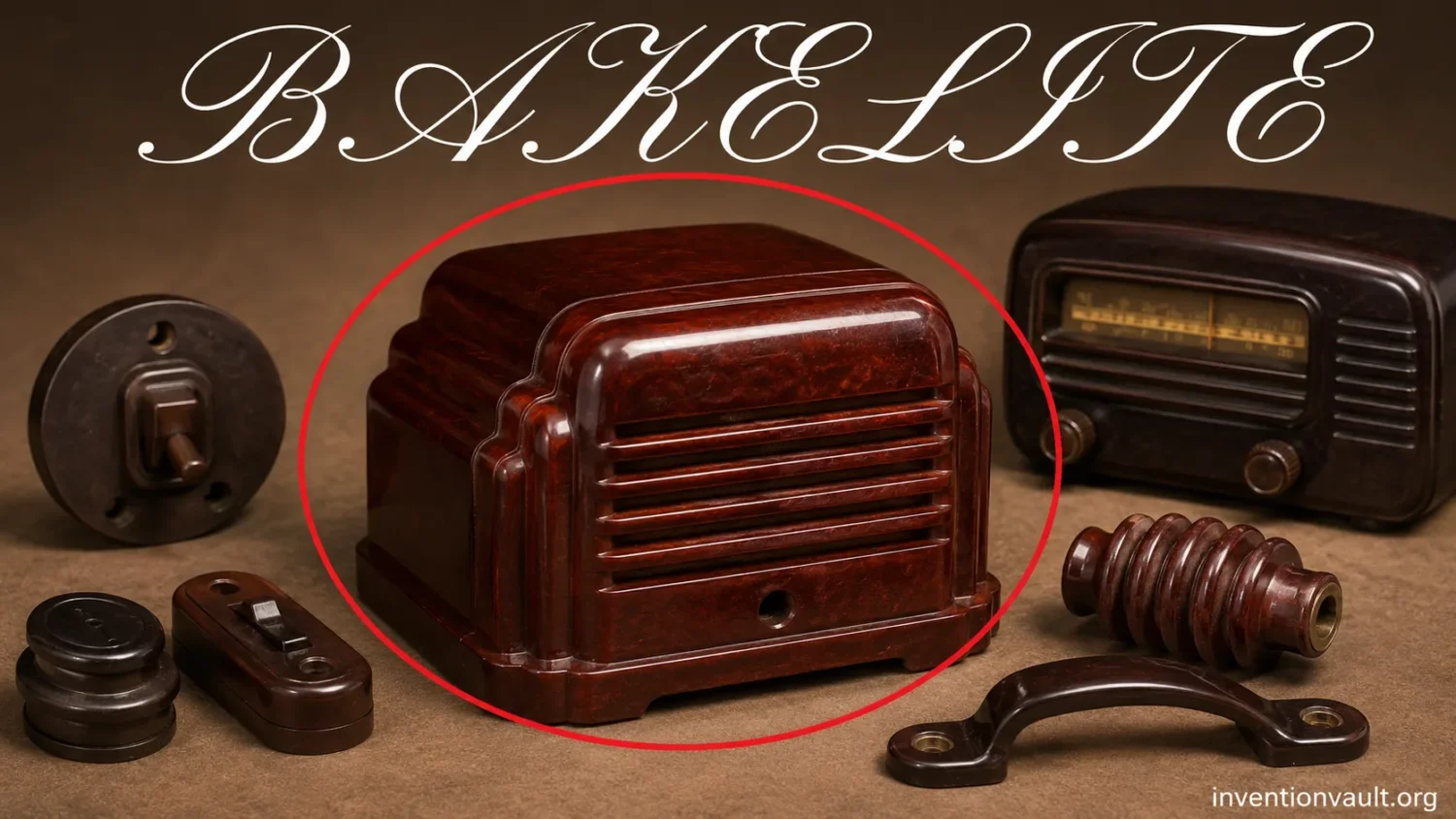
Many original Bakelite objects have a dark brown, black, reddish-brown, or amber tone, especially when filled with wood flour or other dark fillers. The surface can be glossy after polishing and often feels heavier and harder than many later plastics. When used in electrical goods, it gave products a compact, serious appearance.
Its look became part of twentieth-century design. Old telephones, radios, switches, handles, and desk objects carry a visual memory of the material. Bakelite was not transparent like glass and not warm like wood, but it had its own identity: dense, molded, smooth, and industrial.
Collectors value early Bakelite objects today because they sit at the crossing point of chemistry, design, manufacturing, and domestic life. A small radio knob can tell a larger story about electricity entering the home, chemistry entering the factory, and plastic entering culture.
What Many Short Histories Leave Out
Short accounts often say Baekeland “invented plastic” and stop there. That wording hides three useful details. First, he did not invent every plastic. He invented Bakelite, the first fully synthetic plastic to gain major commercial use. Second, earlier chemists had produced phenol-formaldehyde reactions, but Baekeland made the reaction controllable and manufacturable. Third, Bakelite’s first strength was not cheap novelty; it was technical performance.
Another missed detail is the role of pressure. The Bakelizer was not a side note. It helped Baekeland control the curing process, manage byproducts, and create a material that could leave the laboratory. Without process control, the resin would have remained a chemical curiosity.
A third overlooked point is the difference between Bakelite and later colorful phenolic collectibles. The public often remembers bangles and old radios, yet the invention’s deepest early importance came from parts that worked quietly inside electrical systems.
Bakelite’s Place in Plastic History
Bakelite did not create every later plastic, but it proved that a fully synthetic resin could become a dependable commercial material. After it, chemists and companies developed other polymer families including urea-formaldehyde resins, acrylics, polystyrene, nylon, polyethylene, silicones, and many others.
The lesson was larger than one formula. Baekeland showed that a material could be designed for a task. Need insulation? Adjust the resin and fillers. Need molded shape? Control heat and pressure. Need mass production? Turn chemistry into a repeatable process. That way of thinking shaped much of twentieth-century materials science.
Modern readers also see Bakelite through a wider lens. Early plastics solved real manufacturing problems, yet today’s material choices must consider durability, repair, reuse, emissions, and end-of-life handling. Bakelite remains useful as history because it shows both the promise of synthetic materials and the need to design materials with their full life cycle in mind.
Technical Notes Without the Lab Jargon
Bakelite belongs to the phenolic resin family. Phenolic resins form when phenol reacts with an aldehyde, most famously formaldehyde. Depending on conditions, the reaction may produce different intermediate resins before final curing. Baekeland’s patented work focused on producing hard, insoluble, infusible products that could be shaped and set.
The cured structure is cross-linked. Think of it as a network rather than a pile of loose strands. That network gives Bakelite its hardness and heat stability. It also explains why the final object cannot be softened and reshaped like many packaging plastics.
In commercial molding compounds, fillers changed the resin’s behavior. Wood flour could reduce brittleness and cost. Paper or fabric could support laminated materials. Mineral fillers could improve heat and wear behavior. The final product depended on both the resin chemistry and the chosen reinforcement.
| Year | Event | Why It Matters |
|---|---|---|
| 1863 | Leo Hendrik Baekeland was born in Ghent, Belgium. | His chemistry training later shaped his industrial inventions. |
| 1890s | Baekeland developed Velox photographic paper in the United States. | The success gave him resources for independent research. |
| 1907 | Baekeland developed Bakelite in Yonkers, New York. | The first fully synthetic plastic moved from experiment toward industry. |
| 1909 | He announced Bakelite to the New York Section of the American Chemical Society. | The invention entered scientific and industrial discussion. |
| 1909 | U.S. Patent 942,699 was granted on December 7. | The patent protected a method for hard phenol-formaldehyde products. |
| 1910 | The General Bakelite Company was formed. | Commercial production and licensing expanded. |
| 1924 | Baekeland appeared on the cover of Time. | His invention had entered wider public notice. |
| 1993 | The original Bakelizer was recognized as a National Historic Chemical Landmark. | The apparatus was honored as part of the history of modern plastics. |
Why the Invention Still Matters
Bakelite still matters because it marks a clear change in how people made things. Before it, many materials came from forests, mines, animals, plants, or modified natural substances. After it, chemists could create new materials with targeted properties and then build industries around them.
It also changed expectations. A molded electrical part no longer had to imitate wood, metal, or horn. It could be plastic and still be strong, precise, attractive, and safe for its intended use. That shift opened space for new product forms, especially in electrical and household design.
The material’s legacy is visible in every later discussion about polymers. Bakelite introduced a practical model: design the chemistry, control the process, choose fillers, shape the object, and match the material to the job. More than a century later, that model still guides material selection in engineering and manufacturing.
References Used for This Article
- American Chemical Society — Leo Hendrik Baekeland and the Invention of Bakelite: Landmark material on Bakelite, Baekeland, and the first fully synthetic plastic.
- Google Patents — US942699A Method of Making Insoluble Products of Phenol and Formaldehyde: Patent record for Baekeland’s 1909 phenol-formaldehyde process.
- Science History Institute — Leo Hendrik Baekeland: Biography covering Baekeland’s life, Velox paper, and Bakelite work.
- Smithsonian Institution — Leo H. Baekeland Papers: Archival record for Baekeland’s papers and invention history.
- Syracuse University Libraries — Bakelite Collection: Collection notes on Bakelite uses, cultural value, and the Bakelizer recognition.
- Science Museum Group — Bakelite, the First Synthetic Plastic: Museum article explaining the 1909 patent and the material’s identity.