
| Fact | Detail |
|---|---|
| Invention Name | Plastic, understood as moldable polymer materials rather than one single object. |
| Early Breakthrough | Parkesine, introduced by Alexander Parkes in the 1860s, is often described as the first manufactured plastic. |
| First Commercial Success | Celluloid, developed by John Wesley Hyatt in the late 1860s, became the first widely successful plastic material. |
| Synthetic Era Milestone | Bakelite, developed by Leo Hendrik Baekeland in 1907, marked the move to fully synthetic plastic. Its invention is covered separately in Bakelite. |
| Main Material Family | Polymers: long-chain molecules that can be shaped through heat, pressure, chemistry, or casting. |
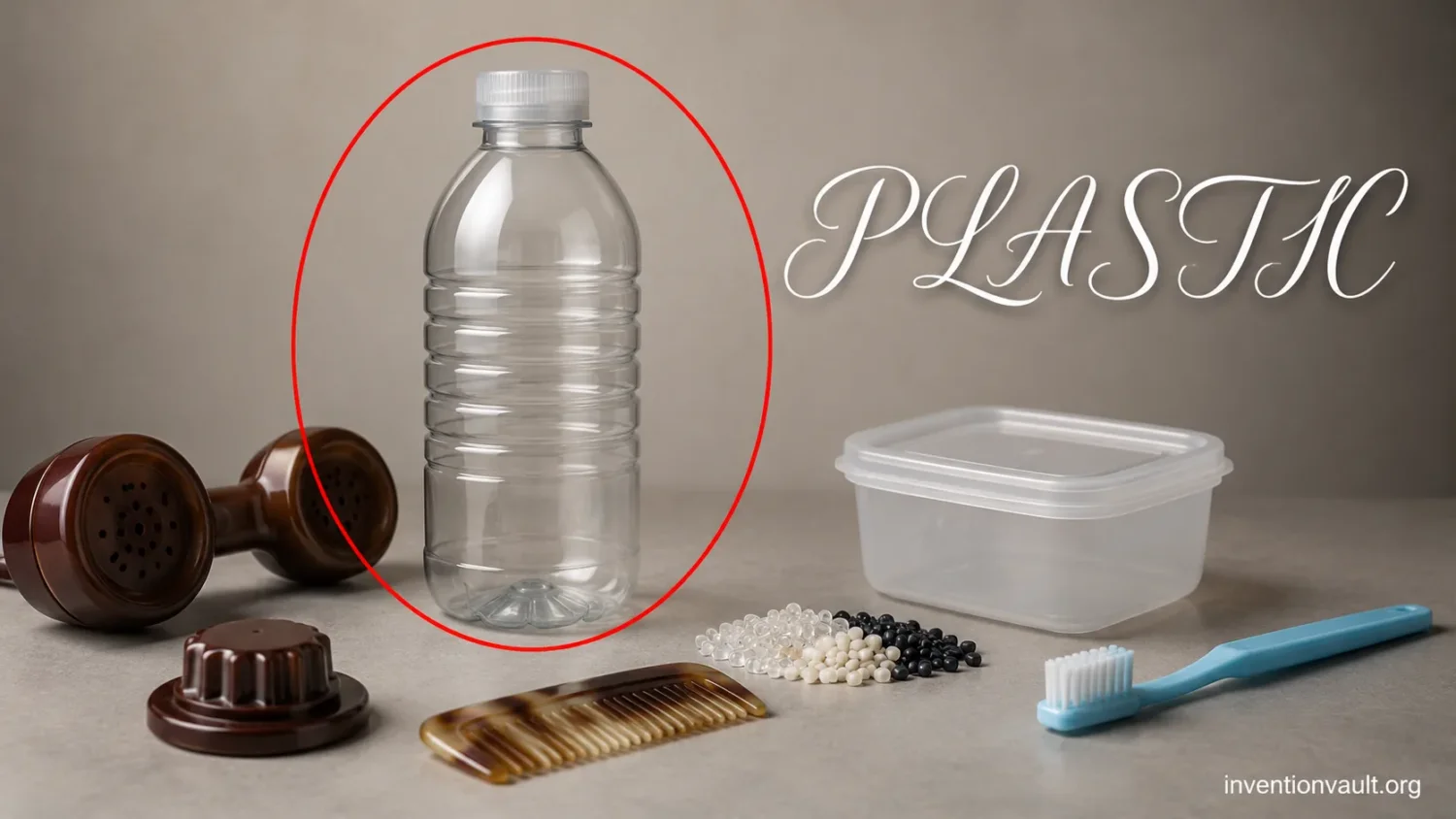
| Early Uses | Combs, billiard balls, buttons, photographic film, radio cases, electrical insulators, telephones, jewelry, and household goods. |
| Why It Mattered | Plastic gave manufacturers a moldable, lightweight, low-cost alternative to ivory, horn, shellac, glass, metal, and wood. |
| OECD 2019 Baseline | Global plastic production reached about 460 million tonnes in 2019, while plastic waste reached about 353 million tonnes. These are OECD baseline figures for 2019, not 2026 production or waste totals. |
Plastic was not invented in one clean moment. It arrived through a chain of experiments: modified natural polymers in the 19th century, celluloid’s commercial rise, fully synthetic resins in the early 20th century, and then a widening range of thermoplastics and thermosets. The history of plastic is therefore the history of a material category, not the launch of a single product.
The word plastic originally pointed to a property: the ability to be shaped. In material science, the term came to describe moldable substances built from polymers. Some early plastics began with natural cellulose. Later plastics came from laboratory-made molecular structures. This shift changed manufacturing, design, electrical engineering, packaging, medicine, transport, photography, and domestic life.
What Plastic Means as an Invention
Plastic is not one substance. It is a broad family of polymer materials. A polymer is made of repeating molecular units joined into long chains. Those chains can behave in different ways. Some soften when heated. Some set permanently. Some stretch, some resist heat, some insulate electricity, and some stay clear like glass.
This is the reason plastic became so useful. Inventors were not only replacing one material with another. They were learning how to design matter for a purpose: a transparent film, a hard casing, a flexible tube, a waterproof coating, or a light molded part.
Useful distinction: early plastic history has several different “firsts.” Parkesine represents an early manufactured plastic, celluloid became the first large commercial success, and Bakelite marked the move to fully synthetic plastic.
Before Plastic: The Problem of Natural Materials
Before plastics, manufacturers relied heavily on materials such as bone, horn, shellac, ivory, tortoiseshell, wood, rubber, glass, and metal. These materials worked well, but they had limits. Some were expensive. Some were fragile. Some were hard to shape in repeatable forms. Some depended on natural supply.
The first plastic inventors were solving practical problems. They wanted substitutes for rare or costly materials, and they wanted objects that could be shaped in molds. The target was not luxury. It was repeatability. A comb, button, handle, billiard ball, or film strip had to be made again and again with the same form.
Parkesine and The First Manufactured Plastic
Alexander Parkes, a British inventor from Birmingham, introduced Parkesine in the 1860s. It was based on cellulose nitrate, a modified form of plant cellulose. Parkesine could be softened and shaped, then hardened into decorative goods. It looked promising because it could imitate expensive natural materials.
Parkesine did not become a lasting commercial triumph. The material could be difficult to control, and early production faced quality problems. Still, Parkes showed something new: a manufacturer could take natural matter, chemically alter it, and create a moldable material with its own identity.
Parkesine sits near the start of plastic history because it showed that chemically modified natural material could become a new moldable manufacturing material. That step came decades before fully synthetic resins.
Celluloid and The First Commercial Plastic Age
John Wesley Hyatt developed celluloid in the late 1860s. Like Parkesine, it was made from modified cellulose, not from a fully laboratory-built polymer chain. Yet celluloid did what Parkesine struggled to do: it entered mass production and reached ordinary buyers.
Celluloid appeared in combs, collars, boxes, handles, toys, billiard balls, decorative pieces, and later photographic film. It could be colored, patterned, pressed, cut, and polished. It helped create a market for attractive molded goods at lower prices.
Celluloid also changed visual culture. Its use in photographic and cinema film helped images travel, multiply, and become a public experience. This part of plastic history is often reduced to “a substitute for ivory,” but the material’s bigger role was broader: it helped mass culture become portable, reproducible, and cheaper to distribute.
| Material | Main Origin | Historical Role | Typical Uses |
|---|---|---|---|
| Parkesine | Modified cellulose | Early manufactured plastic shown in the 1860s | Decorative objects, small molded items |
| Celluloid | Cellulose nitrate and camphor | First commercially successful plastic | Combs, film, billiard balls, toys, household goods |
| Bakelite | Phenol-formaldehyde resin | Early fully synthetic thermoset milestone | Electrical parts, molded housings, handles, consumer goods |
Thermoplastics and Thermosets
One of the clearest ways to understand plastic is to separate thermoplastics from thermosets. The difference shaped factories, product design, repair, recycling, and daily use.
Thermoplastics
Thermoplastics soften when heated and harden when cooled. This can happen many times, depending on the material and how it is processed. Celluloid belongs near this side of the story, and later examples include polyethylene, polypropylene, PVC, polystyrene, acrylic, and nylon.
- Useful for molded parts, films, fibers, bottles, sheets, and packaging.
- Often chosen when flexibility, light weight, or repeat processing matters.
Thermosets
Thermosets cure into a fixed shape and do not soften back into a moldable state during ordinary reheating. Bakelite is an early thermoset milestone; later thermosetting resins expanded the same general processing idea into many industrial uses.
- Useful for heat-resistant parts, insulators, handles, panels, and molded casings.
- Often chosen when dimensional stability matters more than remelting.
The Main Plastic Families That Followed
During the 20th century, companies and laboratories developed polymers for specific properties. Plastic history became a sequence of material inventions, with each polymer opening a different route for manufacturing.
| Plastic Family | Known For | Common Historical Uses |
|---|---|---|
| Phenolic Resin | Heat resistance and electrical insulation | Bakelite radios, switches, telephones, handles |
| Polyethylene | Light weight, moisture resistance, flexibility | Film, containers, cable insulation, bottles |
| Polyvinyl Chloride | Rigid or flexible forms | Pipes, flooring, wire coating, records |
| Polystyrene | Clear rigid form or foam form | Packaging, model parts, insulation, containers |
| Acrylic | Clear, glass-like appearance | Signs, aircraft windows, display panels |
| Nylon | Strong synthetic fiber | Textiles, bristles, cords, mechanical parts |
| Polypropylene | Low density and fatigue resistance | Hinged caps, containers, fibers, household goods |
| PET | Clear, strong, and widely used in fibers and bottles | Textiles, beverage bottles, film |
Why Plastic Became So Versatile
Plastic became useful because it linked chemistry with shaping. A metal part may need machining. Glass needs careful forming and can break easily. Wood varies by grain and moisture. Plastic could be molded into repeatable shapes, sometimes with color already built in.
The same broad material class could produce a hard telephone casing, a soft tube, a transparent sheet, a waterproof film, a synthetic fiber, or a foam. That range made plastic attractive to engineers and designers.
- Low density: many plastics are lighter than glass or metal.
- Moldability: complex shapes can be formed in large numbers.
- Electrical insulation: early plastics helped the growth of safe electrical goods.
- Color and surface control: objects could be made glossy, matte, patterned, clear, opaque, or textured.
- Material tuning: chemists could adjust hardness, flexibility, transparency, and heat behavior.
Plastic in Electricity, Photography, and Everyday Objects
The early plastic story becomes clearer when seen through applications. Celluloid spread through household goods, photography, and film, while early thermosetting resins opened another route into electrical insulation and molded industrial parts. The detailed invention history of Bakelite belongs to that separate material story.
Celluloid played a different role. It was light, colorful, and easy to shape into decorative objects. Its use in film connected plastic to photography and cinema. A material first promoted as a substitute for natural goods ended up helping create a new visual culture.
The Numbers Behind The Plastic Age
The scale of plastic use grew sharply after the mid-20th century. The OECD’s 2019 global baseline places plastic production at about 2 million tonnes in 1950 and about 460 million tonnes in 2019. Plastic waste reached about 353 million tonnes in 2019, while only a small share was recycled after losses in the recycling process. The 460 million and 353 million tonne figures describe the OECD’s 2019 reference year and should not be read as 2026 production or waste totals.
UN Environment Programme material also reports that more than 400 million tonnes of plastic are produced each year, and an estimated 19–23 million tonnes of plastic waste enters aquatic ecosystems annually. These figures show why design, reuse, recovery, and material choice are now part of the material’s modern history.
| Measure | Reported Figure | What It Shows |
|---|---|---|
| Plastic production in 1950 | About 2 million tonnes | Historical comparison used by the OECD to show the growth of global plastics. |
| OECD 2019 plastic production baseline | About 460 million tonnes | A 2019 reference figure, not a 2026 production estimate. |
| OECD 2019 plastic waste baseline | About 353 million tonnes | A 2019 reference figure for global plastic waste generation. |
| Plastic waste entering aquatic ecosystems | Estimated 19–23 million tonnes per year | UNEP estimate illustrating the continuing pollution burden. |
2026 Global Plastics Treaty Status
As of October 14, 2026, negotiations toward a UN international legally binding instrument on plastic pollution remain unfinished, so there is no completed global plastics treaty in force from this process. The third part of the fifth negotiating session, INC-5.3, took place in Geneva on February 7, 2026, but it was limited to organizational and administrative matters, including the election of officers; UNEP states that no substantive negotiations were held during that session. Work continued during 2026 through meetings, consultations, correspondence, and preparations leading toward INC-5.4. The process still covers plastic pollution across the material life cycle, but the final treaty text, obligations, implementation rules, and entry-into-force conditions remain subject to further negotiation.
What Many Plastic Histories Leave Out
Many short accounts treat plastic history as a straight line: celluloid, Bakelite, modern packaging. The real story has more texture. Three points often get missed.
Plastic Began as Material Substitution
Early plastics did not begin as disposable goods. They began as substitutes for scarce, costly, or hard-to-shape materials. Parkesine and celluloid imitated materials such as ivory, tortoiseshell, and horn, while early synthetic resins also entered uses previously served by natural insulating materials.
The Word Covers Many Behaviors
A soft plastic bag, a rigid acrylic sheet, a nylon fiber, and a Bakelite radio case do not behave alike. The shared idea is polymer chemistry plus shape control. Without that distinction, plastic sounds simpler than it is.
The Invention Did Not End in 1907
The arrival of fully synthetic resins opened a new phase, but it did not finish the invention of plastic. The 20th century brought new polymers, catalysts, molding methods, and processing routes as chemists learned to tune molecular structure for specific tasks.
How Plastic Changed Design
Plastic changed what products could look like. Earlier goods often carried the marks of carving, joining, polishing, casting, or machining. Plastic invited curves, rounded corners, seamless casings, bright colors, translucent panels, and mass-produced decorative detail.
Designers could think in molds. A radio case, a toothbrush handle, a camera body, or a kitchen knob could be shaped for grip, color, brand identity, and easy cleaning. Plastic made the outside of a product part of its function.
It also changed repair and replacement. Some plastic products were made to last for years. Others were made cheaply enough to replace. That tension sits inside plastic history from the start: durability and disposability grew from the same material freedom.
How Plastic Changed Science and Industry
Plastic linked laboratory chemistry with industrial production. Early synthetic resins showed that a material could be created through controlled chemical reactions and then paired with molding, fillers, additives, and dedicated factory equipment.
After that, polymer research became a serious industrial field. Companies studied chain length, heat behavior, crystallinity, additives, fillers, colorants, and processing methods. A polymer was rarely just a pure substance. It could be blended, filled, reinforced, softened, stabilized, or foamed.
This is why plastic belongs among the most influential material inventions. It did not only add new objects to daily life. It gave engineers a new way to think about matter.
Material Benefits and Design Responsibility
Plastic’s advantages are real: low weight, shape control, insulation, durability, hygiene, and cost efficiency. These features help medical devices, food protection, electrical safety, transport parts, water systems, electronics, and protective packaging.
The same features also require care. A long-lasting material can become a waste problem when used for a short-life item. A light package can reduce transport weight but still create recovery challenges. A durable polymer can protect a product, then remain in the environment if it is not collected or reused.
Modern plastic history therefore includes smarter design: fewer unnecessary layers, clearer material labeling, repairable products, reusable containers, recycled content where suitable, and polymers chosen for the job rather than for habit.
Plastic’s Place in Invention History
The invention of plastic belongs beside the invention of steelmaking processes, synthetic dyes, rubber vulcanization, electrical insulation, and modern ceramics. It changed the relationship between chemistry and objects. Instead of cutting products from what nature supplied, manufacturers could ask for a material with chosen properties.
Parkes showed that modified natural matter could become moldable. Hyatt showed that such a material could reach mass markets. The later move to fully synthetic resins widened what chemists could design, and polymer science expanded the field into films, fibers, foams, resins, elastomers, engineering plastics, and composite materials.
Plastic’s history is not a simple celebration and not a simple warning. It is the story of a material family that solved old problems, created new industries, and forced new questions about design, use, and responsibility.
References Used for This Article
- American Chemical Society — Leo Hendrik Baekeland and the Invention of Bakelite: Supports Bakelite’s place as the milestone that moved plastic history into fully synthetic resins.
- Science History Institute — History and Future of Plastics: Historical overview covering celluloid, Bakelite, and later polymer growth.
- Science Museum — The Age of Plastic: From Parkesine to Pollution: Museum article explaining Parkesine, celluloid, and the rise of plastic materials.
- National Museum of American History — Celluloid: The First Plastic: Smithsonian exhibition page on celluloid as an early commercially successful plastic material.
- OECD — Global Plastics Outlook: Provides the 2019 baseline of about 460 million tonnes of plastic production and 353 million tonnes of plastic waste.
- UN Environment Programme — Plastic Pollution: Global reference on plastic production, waste, and leakage into aquatic ecosystems.
- UN Environment Programme — Intergovernmental Negotiating Committee on Plastic Pollution: Tracks the negotiations toward an international legally binding instrument and the work leading toward later INC sessions.
- UN Environment Programme — Third Part of the Fifth Session (INC-5.3): Confirms that the February 7, 2026 session was convened for organizational and administrative purposes and held no substantive negotiations.