
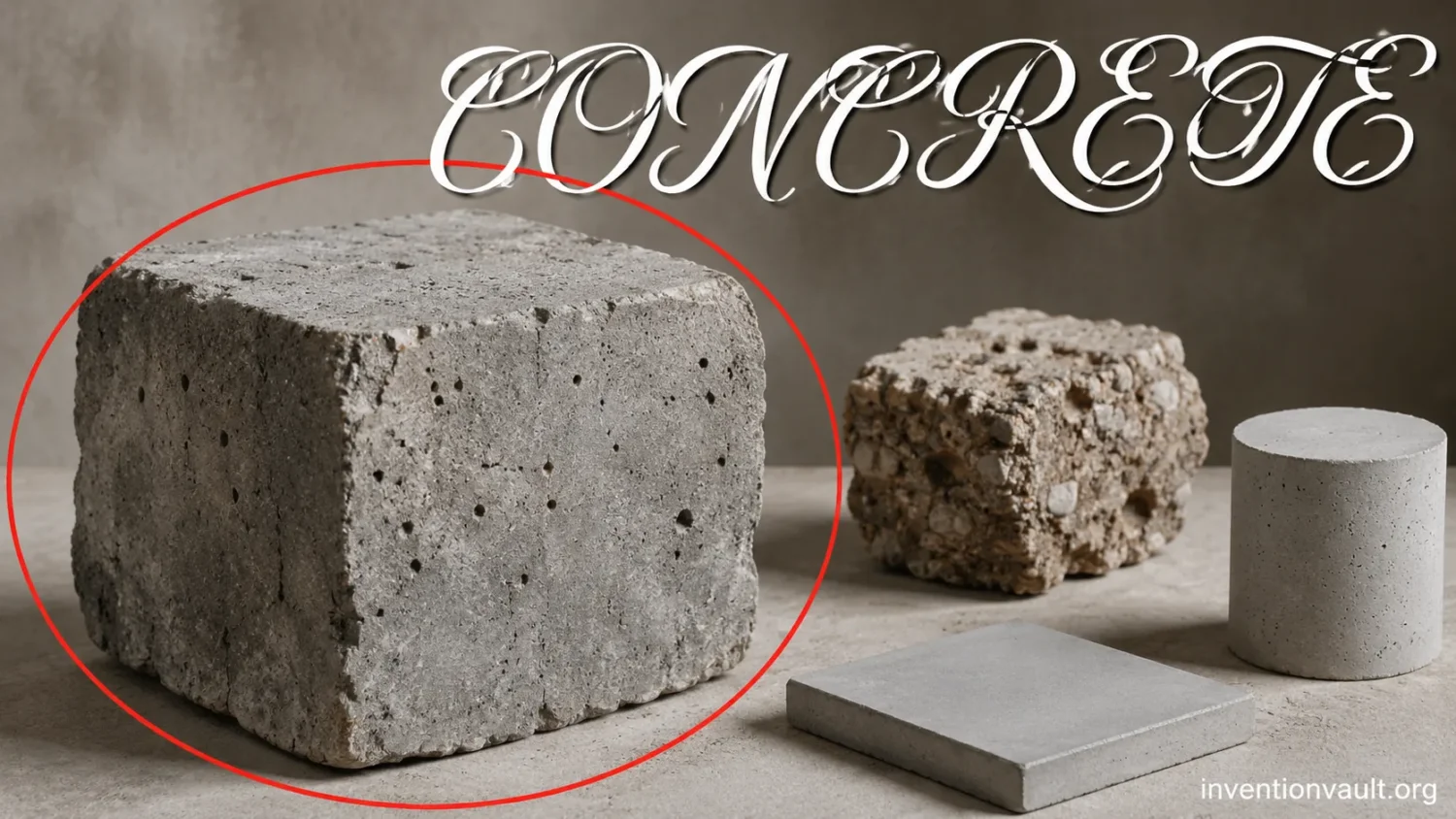
| Detail | Information |
|---|---|
| Invention Name | Concrete, with Roman hydraulic concrete known as opus caementicium |
| Earliest Known Roots | Early lime-based building mixtures appeared in several ancient societies before Rome, but Roman builders refined concrete into a large-scale engineering material. |
| Main Roman Period of Use | Widespread use developed from the late Republic into the Roman Empire, especially from the 2nd century BCE onward. |
| Main Roman Ingredients | Lime, water, aggregate, rubble, brick fragments, volcanic ash, and regional pozzolanic materials. |
| Durability Secret | Pozzolanic ash, careful aggregate choices, marine mineral reactions, and lime-rich clasts that can help seal small cracks. |
| Famous Surviving Example | The Pantheon in Rome, whose concrete dome still stands after nearly two millennia. |
| Technical Breakthrough | Hydraulic behavior: Roman concrete could set and harden in damp conditions, including marine works, when volcanic ash reacted with lime. |
| Modern Scientific Interest | Researchers study Roman concrete to design longer-lasting, lower-maintenance materials for modern infrastructure. |
| Common Misunderstanding | Roman concrete was not simply “stronger” than modern concrete. Its value came from durability, chemistry, and design fit. |
Concrete did not arrive as one neat invention with a single name attached to it. Its history is older, rougher, and more practical. People learned that burned limestone, water, sand, stone, and broken material could make a hard mass. The Romans turned that useful idea into an engineering language. They used it for vaults, baths, harbors, aqueducts, temples, apartment blocks, and domes. Their version, often called Roman concrete or opus caementicium, changed how large spaces could be built.
The story matters because concrete is still everywhere. Roads, bridges, homes, ports, tunnels, water systems, and public buildings rely on it. Modern concrete serves speed and standardized strength. Roman concrete, by comparison, teaches a different lesson: a material can last when its chemistry suits its setting, when builders understand local stone, and when design works with gravity rather than fighting it.
Concrete Before Rome
Long before Roman engineers poured vaults and harbor piers, builders used lime-based binders in floors, walls, and plaster. Early mixtures did not always behave like modern concrete, and they were not used on the same scale. Some were closer to mortar or lime plaster. Still, they proved a basic idea: heat stone, change its chemistry, mix it with water and mineral material, then let it harden.
The Roman contribution was not the first spark. It was the refinement. Roman builders learned how to combine lime, stone, sand, broken brick, tuff, and volcanic ash so the material could carry weight in forms that cut stone alone made difficult or expensive. They also learned where each mix worked best. That local intelligence is part of the invention.
Concrete is better understood as an evolving material family. Ancient Rome did not invent every part of it, but Roman engineers made concrete central to architecture at a scale the Mediterranean world had not seen before.
What Made Roman Concrete Different
Roman concrete used a binder and aggregate, like modern concrete, but its chemistry was different. The binder often relied on lime and pozzolana, a volcanic ash named after the region around Pozzuoli near Naples. When this ash met lime and water, it formed compounds that could harden even in damp places. That behavior made concrete useful for ordinary walls, but it also opened the door to harbors, baths, cisterns, and foundations exposed to moisture.
Romans did not use one universal recipe. They adjusted mixtures by site, use, and available material. In Rome, tuff and brick fragments often appeared. In coastal works, volcanic ash and seawater reactions mattered more. In domes, lighter aggregates could reduce weight higher up in the structure. This is one reason simple “secret recipe” explanations miss the point.
The Binder
The binder held the mass together. Roman binders often used lime with reactive volcanic material. The chemistry produced mineral phases that gave the material long life in the right conditions.
The Aggregate
Aggregate gave body and volume. Stone, rubble, brick, tile, and volcanic fragments could be chosen by weight, availability, and purpose. The Pantheon shows how aggregate choice could shape structure.
The Roman Durability Secret
For many years, the most familiar explanation focused on volcanic ash. That remains part of the story. Pozzolanic material reacts with lime to create a cementing matrix that resists moisture better than ordinary lime mortar. In marine concrete, seawater could also take part in slow mineral reactions. Researchers have identified minerals such as aluminous tobermorite and phillipsite in ancient Roman seawater concrete, showing that the material could keep developing internally after it hardened.
Recent research added a sharper detail. The small white chunks seen in Roman concrete, once dismissed as signs of poor mixing, are now studied as lime clasts. When tiny cracks allow water to enter, these calcium-rich particles can dissolve and recrystallize, helping seal cracks before they spread. The process does not make Roman concrete magical, and it does not mean every Roman wall repaired itself perfectly. It does show that some ancient mixes carried a built-in repair mechanism.
The newer evidence points toward hot mixing. In this method, quicklime was combined with dry pozzolanic and aggregate materials before water was added. The reaction produced heat and left behind reactive lime-rich features. A preserved Pompeii construction site, studied with modern chemical analysis, has given researchers rare material evidence for how such mixing could have happened in practice.
| Durability Factor | What It Did | Why It Matters |
|---|---|---|
| Pozzolanic Ash | Reacted with lime to form hydraulic cementing compounds. | Allowed concrete to harden in damp settings and resist water damage. |
| Lime Clasts | Provided reactive calcium-rich spots inside the material. | Could help small cracks seal when water entered. |
| Hot Mixing | Created heat and preserved reactive lime features. | May explain why lime clasts were not accidental flaws. |
| Seawater Reactions | Encouraged growth of durable mineral phases in marine concrete. | Helped some harbor structures survive harsh coastal settings. |
| Aggregate Grading | Changed density and weight by location in the structure. | Helped large domes and vaults manage stress. |
Why the Pantheon Still Matters
The Pantheon is the most famous concrete lesson from Rome. Its dome spans about 43 meters and remains the largest unreinforced concrete dome still standing. The achievement did not depend on one trick. It came from geometry, wall thickness, aggregate selection, coffering, and a careful reduction of weight toward the top.
At the lower parts of the dome and supporting structure, heavier materials could bear compression. Higher up, lighter volcanic materials reduced load. The circular form distributed forces. The oculus at the top removed weight while bringing in light. Roman concrete made this possible because it could be formed into large continuous masses instead of assembled only from cut blocks.
The Pantheon also shows why Roman concrete should not be judged only by modern compressive strength tests. A modern engineer might design with reinforced steel, strict codes, and rapid construction schedules. Roman builders relied on mass, compression, geometry, and mineral chemistry. Different tools. Different aims.
Concrete and Roman Architecture
Concrete let Roman builders think in curves. Vaults, domes, barrel roofs, and large interiors became easier to build. Stone could still face the structure. Brick could protect or shape it. Marble could decorate it. Behind those surfaces, concrete carried much of the load.
This changed public architecture. Baths could hold wide vaulted halls. Amphitheaters could use layered substructures. Aqueducts and cisterns could manage water. Harbors could extend into the sea. Concrete turned construction from a stone-by-stone problem into a system of mass, mold, and cure.
Roman concrete was not just a material. It was a construction method that changed the size, shape, and life span of buildings.
Main Types of Ancient Concrete Use
Roman concrete served different tasks, and each task pushed builders toward different choices. A harbor pier did not need the same mixture as a vaulted bath hall. A foundation did not need the same weight profile as a dome.
| Use Type | Typical Setting | Material Feature | Known Value |
|---|---|---|---|
| Marine Concrete | Harbors, piers, breakwaters | Volcanic ash, lime, rock, seawater interaction | Resisted long exposure to marine conditions |
| Vault Concrete | Baths, halls, corridors | Mass concrete shaped by temporary formwork | Created wide interior spaces |
| Dome Concrete | Temples and large covered rooms | Weight-reducing aggregate changes upward | Allowed large curved roofs without steel reinforcement |
| Wall Core Concrete | Urban buildings, terraces, retaining walls | Concrete core faced with brick, stone, or other finish | Reduced reliance on fully cut stone construction |
| Water Works Concrete | Cisterns, aqueduct channels, baths | Hydraulic behavior and protective linings | Supported storage and movement of water |
The Role of Pozzolana
Pozzolana deserves careful attention because it is often reduced to a single magic ingredient. It was not magic. It was geology used well. Volcanic ash from areas around the Bay of Naples contained reactive silica and alumina. Mixed with lime and water, it helped form stable compounds that ordinary lime mortar could not produce as effectively.
This mattered most where water threatened normal mortar. In marine settings, Roman concrete could behave in a way that feels almost reversed from the modern expectation: water did not always ruin it quickly. In some cases, seawater helped generate mineral growth inside the concrete over long periods. The process was slow, local, and dependent on the right chemistry.
Not every Roman site had the same ash, and not every Roman structure survived in the same way. The best examples endured because materials, setting, and design worked together. That is the more accurate durability secret.
Hot Mixing and Lime Clasts
The phrase hot mixing describes a method in which quicklime joins the dry mixture before water is added. Quicklime reacts strongly with water. The reaction releases heat, changes the local chemistry, and can create porous lime-rich fragments within the hardened concrete.
Those fragments matter because cracks need pathways. When water moves into a crack, it may encounter lime clasts. Calcium can dissolve, travel a short distance, and form new calcium carbonate crystals. That new mineral can fill small openings. In plain language, the concrete has a way to close some of its own wounds.
This does not turn Roman concrete into an all-purpose modern replacement. The ancient material set slowly in many settings, varied by region, and depended on resources that are not available everywhere. Still, the principle is powerful: durability can come from designed reactivity, not only from initial strength.
What the Pompeii Evidence Added
Pompeii gave researchers something rare: a building site interrupted mid-work. Materials, unfinished walls, tools, and dry mixture remains preserved a snapshot of construction rather than only the finished monument. Modern analysis of these remains supports the idea that quicklime could be pre-mixed with dry pozzolanic material before water was added.
This matters because finished structures can hide process. A wall tells us what survived. A worksite tells us how builders may have prepared the material before it hardened. The Pompeii evidence narrows the gap between laboratory theory and ancient practice.
Roman Concrete Was Not Always Better
A fair history should avoid simple praise. Modern concrete can reach high early strength, follow strict standards, support tall buildings with steel reinforcement, and serve uses Roman builders never faced. Roman concrete often had lower compressive strength than many modern mixes. It also depended heavily on local materials and careful placement.
Its advantage was life span in suitable settings. Roman concrete worked especially well where mass, compression, mineral reactions, and slow curing could do their work. Modern reinforced concrete has other challenges, including steel corrosion, fast construction demands, and material choices shaped by cost and code.
The useful comparison is not “ancient versus modern.” It is short-term strength versus long-term durability. Roman concrete reminds engineers that a structure’s first decade should not be the only measure of success.
Technical Lessons Still Studied Today
Modern interest in Roman concrete has grown because concrete production has a large environmental footprint. Cement production accounts for about 7–8% of global carbon dioxide emissions in many current estimates, mainly because limestone calcination and kiln fuel both release CO₂. A concrete that lasts longer can reduce repair cycles, demolition waste, and replacement demand.
Roman-inspired research does not mean copying an ancient recipe exactly. The world cannot simply mine the same volcanic ash everywhere. Modern safety, testing, reinforcement, climate, and supply chains are different. The better path is to study the principles: reactive mineral phases, self-sealing behavior, lower-clinker binders, careful aggregate use, and materials suited to their environment.
- Use local mineral chemistry wisely instead of treating aggregate as filler only.
- Design for moisture exposure rather than assuming water is always only an enemy.
- Extend service life so fewer structures need early replacement.
- Build crack tolerance into the material where safe and tested self-sealing methods can help.
Why Concrete Changed Human Construction
Concrete changed construction because it could be shaped before it became stone-like. It filled forms, wrapped irregular aggregate, and hardened into a unified mass. For Roman builders, this meant speed, scale, and new geometry. They could create thick walls, curved vaults, and large domes without carving every part from solid stone.
It also changed labor and supply. Broken brick, rubble, local stone, and volcanic material could become useful parts of a structure. Cut stone still mattered, but concrete gave builders more flexibility. A beautiful marble surface could cover a concrete core. A brick facing could shape a wall while the interior carried mass.
The invention of concrete, especially in its Roman form, belongs to the history of practical intelligence. It shows how observation, local resources, trial, error, and craft can produce a material that outlives the people who made it.
Timeline of Concrete and Roman Durability Research
| Period or Date | Event | Why It Matters |
|---|---|---|
| Ancient Pre-Roman Periods | Builders used lime-based plasters, mortars, and early cementing materials. | These methods prepared the ground for later concrete technology. |
| 2nd Century BCE | Roman hydraulic concrete became widely used in major works. | Concrete became a practical material for large architecture and engineering. |
| 1st Century BCE | Roman maritime concrete appeared in harbor works around the Mediterranean. | Concrete proved useful in wet and coastal settings. |
| c. 125–128 CE | The Pantheon in Rome reached its final imperial form. | Its unreinforced concrete dome remains a reference point for ancient engineering. |
| 2017 | Studies of Roman marine concrete highlighted seawater-driven mineral formation. | Researchers gained a clearer picture of long-term mineral growth. |
| 2023 | Research on lime clasts and hot mixing explained a self-sealing mechanism. | The white fragments in Roman concrete gained a new technical meaning. |
| 2025 | Analysis of a preserved Pompeii construction site supported hot-mixing evidence. | Ancient process evidence became stronger, not only laboratory-based. |
The Durability Secret in Plain Terms
The durability secret of Roman concrete is not one ingredient. It is a chain of good decisions. Use a reactive ash. Mix it with lime. Choose aggregate by purpose. Let mineral reactions continue over time. Shape the structure so compression does most of the work. In some cases, preserve lime-rich clasts that can help seal small cracks.
That chain explains why some Roman structures still stand while many later materials have failed sooner. It also explains why the ancient recipe cannot be copied blindly. Roman concrete worked because it matched its world: its geology, its labor, its forms, and its engineering habits.
The invention of concrete is therefore not only a story about Ancient Rome. It is a story about durability as a design choice. The Romans did not have modern instruments, but they learned from material behavior. Their concrete still carries that lesson in stone, ash, lime, and time.
References Used for This Article
- MIT News — Riddle Solved: Why Was Roman Concrete So Durable?: Explains lime clasts, hot mixing, and self-healing behavior in Roman concrete.
- Science Advances — Hot Mixing: Mechanistic Insights Into the Durability of Ancient Roman Concrete: Presents the technical study behind the hot-mixing and lime-clast interpretation.
- Nature Communications — An Unfinished Pompeian Construction Site Reveals Ancient Roman Building Technology: Documents material evidence from Pompeii that supports Roman hot-mixing practice.
- American Mineralogist — Phillipsite and Al-Tobermorite Mineral Cements Produced Through Low-Temperature Water-Rock Reactions in Roman Marine Concrete: Details mineral formation in ancient Roman seawater concrete.
- Berkeley Lab Advanced Light Source — The Ancient Roman Secret to Concrete Resilience in Seawater: Summarizes research on Roman marine concrete and seawater-driven durability.
- MIT Climate Portal — Concrete: Provides modern background on concrete use and its environmental impact.
- Global Cement and Concrete Association — About Cement and Concrete: Gives industry-level background on concrete as a widely used material.