Automation Invention Map
From Fixed Automation to Industrial Robots
Trace the shift from hard-wired factory motion to Devol’s programmable manipulator, Unimate’s production debut, electric control, and today’s sensor-rich robot systems.
Factory Automation Before Robots
Motion Was Tied to the Machine
Current stage
What factories already had
Transfer machines, mechanical sequencing, cams, relays and dedicated handling equipment could repeat production cycles long before industrial robots appeared.
The changeover problem
A purpose-built automatic machine could be very fast, but assigning it a substantially different job often required mechanical redesign rather than a changed set of stored instructions.
Human advantage
Manual handling remained flexible because a worker could adapt to a new part or sequence without rebuilding the production machinery. Automation needed a way to recover some of that flexibility.
The industrial robot emerged from a search for automatic machinery that could change jobs without being mechanically rebuilt for every new sequence.
Patent Record
Devol Separates Motion From Hardware
Current stage
Application date
George C. Devol Jr. filed his application for Programmed Article Transfer on December 10, 1954. It later became U.S. Patent 2,988,237.
What the patent addressed
The document described automatically operated material-handling machinery and a control arrangement able to record, sense and reproduce programmed operations.
Why programming mattered
Devol explicitly contrasted his adaptable system with specialized cam-controlled machines, whose mechanisms were expensive to redesign when a different repetitive task was required.
Patent issue
The patent was granted on June 13, 1961, more than six years after filing. The filing date and the later factory installation therefore represent different historical events.
The defining step was not simply an articulated arm; it was an automatic manipulator whose sequence could be stored and changed.
Working Machine
The Patent Becomes Unimate
Current stage
Devol and Engelberger
Devol met engineer Joseph Engelberger in 1956. Engelberger recognized a factory market for the programmable manipulator and helped secure financing and turn the invention into an industrial product.
1959 development milestone
The International Federation of Robotics records a developed Unimate in 1959. The early machine weighed about two tons and used hydraulic actuators.
Stored motion
Joint positions taught to the machine were stored as a program on a magnetic drum and replayed during operation, allowing a physical sequence to be repeated automatically.
Unimate showed that programmable manipulation could survive the transition from a patent concept to heavy industrial machinery.
Production Use
Unimate Goes to Work at GM
Current stage
Production-line milestone
In 1961, a Unimate entered production use at General Motors’ Ternstedt operation in the Trenton, New Jersey area, establishing the best-known first factory application of an industrial robot.
The job
The robot handled hot die-cast metal pieces, moving them through a repetitive production sequence that exposed human workers to heat and heavy machinery.
Why this task fitted
Die-casting produced predictable part locations and repeated motions. The work demanded little interpretation but rewarded reliable handling through the same cycle many times.
Industrial robotics first proved itself on a narrow, repetitive and hazardous handling task rather than as a general mechanical replacement for factory workers.
Drive Technology
Electric Axes Replace Hydraulic Muscle
Current stage
Hydraulic beginning
Early Unimate machines used hydraulic actuation, which could produce the force needed for heavy factory handling but brought fluid, maintenance and control demands.
KUKA FAMULUS
KUKA dates its FAMULUS to 1973 and describes it as the first industrial robot with six electromechanically driven axes.
ASEA IRB 6
Introduced in 1974, the ASEA IRB 6 combined all-electric drive with microprocessor control in a commercially available industrial robot, pointing toward the architecture that later became familiar in factories.
Electric drives made precise electronic control easier and helped industrial robots move into applications beyond the heavy handling jobs suited to early hydraulic machines.
Control Evolution
Robots Gain Feedback and Perception
Current stage
Beyond playback
Later controllers could calculate motion paths rather than merely replay taught joint positions, while encoders supplied continuous information about where each axis was located.
Process sensing
Machine vision, force and torque sensing, proximity detection and process monitoring allowed robot systems to respond to part position, contact forces and manufacturing conditions.
Robot versus workcell
A factory installation usually includes much more than the arm: tooling, fixtures, sensors, guarding, conveyors, machines and control equipment together create the working robot cell.
Sensing did not replace programmability; it added information that let programmed machines cope with more variation in real production environments.
Industrial Scale
From One Unimate to Millions
Current stage
Operating stock
World Robotics 2026 reports that the global operational stock reached 5.079 million industrial robots in 2025, up 9% from the previous year.
Annual installations
Factories installed about 603,000 industrial robots during 2025, the first year annual installations passed the 600,000-unit mark.
China’s share
China installed about 354,000 units in 2025, representing 59% of worldwide installations for the year.
Current control direction
Industrial robotics now incorporates richer sensing, networked production systems and AI-assisted functions such as path planning, failure prediction, simulation-based training and new programming interfaces.
The scale changed by millions of machines, while the original idea of assigning physical work through changeable instructions remained recognizable.
The industrial robot is generally credited to American inventor George C. Devol Jr., whose 1954 patent application described a programmable system for automatically moving articles. Joseph Engelberger then helped turn that concept into the commercial Unimate robot. By 1961, a Unimate was performing production work for General Motors, moving hot die-cast components through a repetitive factory cycle. The invention was not simply a mechanical arm. Its defining feature was that the machine’s work sequence could be stored, repeated and changed without designing a new mechanism for every task.
| Industrial robot milestone | Record |
|---|---|
| Principal credited inventor | George C. Devol Jr. |
| Patent application | December 10, 1954 |
| Patent | U.S. Patent 2,988,237, Programmed Article Transfer |
| Patent granted | June 13, 1961 |
| Commercial development | George Devol, Joseph Engelberger and Unimation |
| Early developed Unimate | 1959 development milestone |
| Production-line milestone | General Motors, 1961 |
| Original factory role | Handling hot die-cast metal parts |
| Defining idea | Automatic, reprogrammable manipulation |
Dating the First
The 1954 patent filing, the developed Unimate recorded in 1959 and the 1961 GM installation answer different questions. Calling any one of them the sole “invention date” hides the difference between concept, working machine and production adoption.
Factories Were Automated Before They Had Robots
The industrial robot did not introduce repetition to manufacturing. Factories already used transfer lines, automatic machine tools, relays, cams, mechanical stops and other dedicated systems that could execute the same sequence thousands of times.
The weakness of much of this automation was where the instructions lived. In a purpose-built mechanical system, much of the operating sequence was embodied in the shape and arrangement of cams, linkages, switches and dedicated tooling. When the product or sequence changed enough, the machinery itself might have to change.
Devol’s patent described this problem directly. It contrasted flexible manual handling with specialized cam-controlled machinery. Human handling could adapt rapidly to a new assignment, but required continuing labor. A dedicated automatic system could remove that labor from a repetitive cycle, yet it could become expensive when each new job demanded another specialized mechanical design.
The programmable manipulator offered a third possibility: retain automatic repetition while moving more of the task definition into a changeable control sequence.
| Factory system | How motion is determined | What happens when the job changes? |
|---|---|---|
| Fixed transfer or cam-controlled machine | Mechanical layout, cams, stops and dedicated controls | Mechanical modification may be required |
| Teleoperator | A human continuously commands the manipulator | The operator adapts the motion |
| Numerically controlled machine tool | Stored numerical instructions control machining motion | A new machining program can be loaded within the machine’s intended process |
| Industrial robot | A stored program controls a multipurpose manipulator | The sequence and tooling can be changed for another suitable task |
The 1954 Patent Defined the Break With Fixed Automation
On December 10, 1954, Devol filed a patent application titled Programmed Article Transfer. The title is revealing. He was not proposing a humanoid mechanical worker. His patent concerned automatically operated material-handling machinery and the control equipment needed to make such machinery adaptable.
The patent described a movable mechanical output member, recording media, sensing elements, control circuits and a transfer head. Commands and positional information could be recorded and later used to reproduce an operating sequence. The machine could therefore perform a repeated transfer cycle without a worker steering every movement.
This distinction is more useful than the appearance of the arm. An articulated mechanical arm can still be a manually operated device. A programmable factory robot connects the manipulator to an automatic control system that can store and execute the task.
- Teach or record positionsThe required positions and joint states are established for the handling cycle and encoded for later use.
- Store the sequenceThe early Unimate control system retained the programmed sequence on magnetic storage rather than embedding every step in a dedicated mechanical cam arrangement.
- Read the next commandThe controller retrieves the next required state and sends commands to the machine’s motion-control equipment.
- Drive the manipulatorHydraulic actuators move the early robot’s joints toward the recorded positions while the control system tracks the sequence.
- Operate the end toolThe robot grips, moves, releases or positions the workpiece as required by the production cycle.
- Repeat automaticallyAfter completing the sequence, the robot returns through its programmed cycle without continuous human steering.
Modern industrial robot programming bears little resemblance to a magnetic-drum control system, but the separation between machine hardware and changeable task instructions remains fundamental.
George Devol Invented the Concept; Joseph Engelberger Built the Business Around It
Credit for the industrial robot becomes clearer when invention and commercialization are separated. George Devol is the named inventor on U.S. Patent 2,988,237. His contribution was the programmable article-transfer concept and its control method.
Joseph Engelberger entered the story from a different direction. He was an engineer with experience in industrial controls and an interest in robotics. Devol and Engelberger met in 1956. Engelberger saw that Devol’s machine could become a commercially useful form of flexible factory automation and helped secure financial backing for its development.
By 1957, Engelberger had persuaded Condec leadership to support work on Devol’s invention. Their effort developed into Unimation and the Unimate product line. Engelberger’s role included turning a patented concept into machinery manufacturers could buy, integrate and maintain.
George Devol
Created and patented the programmable article-transfer concept that supplied the technical basis for the industrial robot.
Joseph Engelberger
Helped engineer, finance, promote and commercialize the technology through Unimation, converting the invention into an industrial robotics business.
Calling both men simply “the inventor” loses this distinction. Devol supplied the patented invention; Engelberger was central to making it a viable industrial product and establishing a market around it.
Unimate Was a Heavy Hydraulic Machine, Not a Thinking Robot
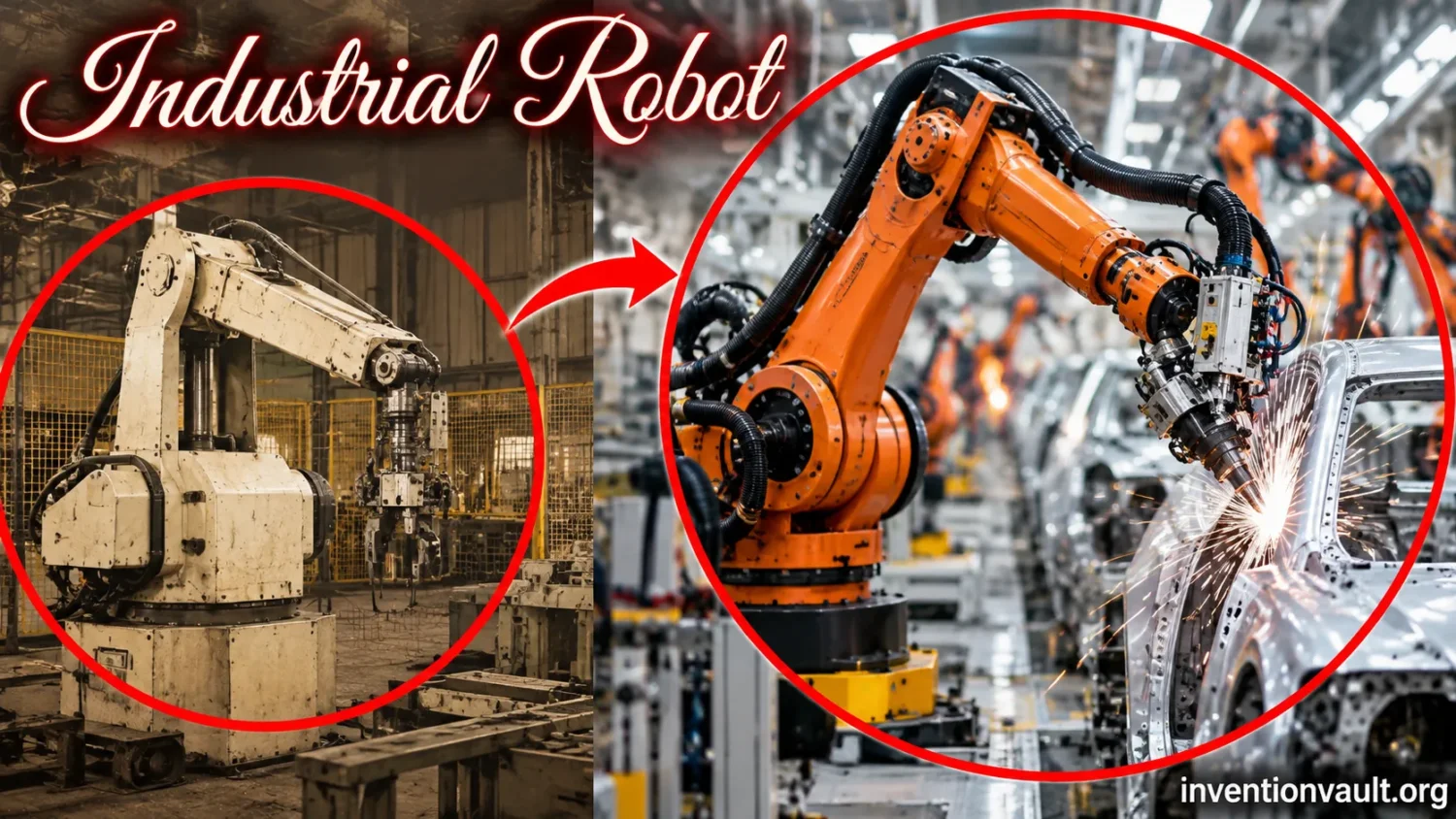
The early Unimate looked very different from compact modern robot arms. The International Federation of Robotics describes the 1959 machine as weighing about two tons. Its joints were moved by hydraulic actuators, and its programmed positions were stored on a magnetic drum.
The operator could teach joint positions and a sequence. During production, the controller replayed those recorded positions. This operating style is often described as teach-and-repeat or playback control.
There was no machine vision interpreting an arbitrary pile of parts, no language model receiving spoken instructions and no autonomous planning system deciding how production should proceed. The robot did not need those abilities to solve its first industrial problem.
What it could do was far more specific: execute a stored sequence, move a workpiece automatically, repeat the motion reliably and accept a different programmed sequence when reassigned to another suitable operation.
Programming Is Not AI
Unimate’s historical importance comes from reprogrammable automatic manipulation, not artificial intelligence. Modern AI can extend a robot’s perception and planning, but AI is not required for a machine to qualify as an industrial robot.
Why General Motors Was an Ideal First Customer
The first factory job did not demand human-like dexterity. It demanded endurance around a hot, repetitive process.
In 1961, a Unimate entered service at General Motors’ Ternstedt operation in New Jersey. The robot handled hot metal pieces produced by die casting. Contemporary historical accounts place the installation in the Trenton area; some later records describe the location more specifically as Ewing Township. The production function itself is much less disputed: the robot removed and transferred hot castings through a repeated cycle.
That assignment suited early robotics because the environment was highly structured. The die-casting machine presented parts in predictable locations. The robot did not need to recognize an unknown object or invent a new grasp. It needed to execute the same controlled movement when the production process reached the appropriate state.
- Die-casting cycle finishesThe press produces a hot metal component at a repeatable machine location.
- Robot approachesUnimate follows its taught motion to the pickup position.
- Part is transferredThe manipulator removes the hot casting from the hazardous machine area.
- Part is placed or stackedThe robot moves the component to the next defined location in the manufacturing process.
- Robot returnsThe arm resets for the next die-casting cycle and repeats the stored sequence.
The work demonstrates an enduring principle in factory robotics: early automation succeeds most easily when the task is repetitive, the environment is controlled and the part locations can be predicted.
What “First Industrial Robot” Actually Means
Unimate is commonly described as the first industrial robot, but the wording should not be expanded into “the first robot.” Mechanical automata, remote manipulators, experimental machines and other forms of automatic control predated it.
The claim refers to a narrower engineering category: a programmable automatic manipulator intended for industrial work and, in the 1961 milestone, successfully placed into production use.
What the Evidence Supports
Devol’s December 1954 patent application documents the programmable handling invention, while the 1961 General Motors installation provides the established production-line milestone for Unimate. These records support different parts of the industrial robot origin story.
The distinction also explains why a numerically controlled milling machine is not simply another industrial robot. Both use programmed motion, but the NC machine is organized around a defined machining process between the cutting tool and workpiece. The industrial robot was conceived as a multipurpose manipulator whose end tooling and program could be changed for different handling and production assignments.
A Robot Arm Is Only Part of a Robot Workcell
Images of factories often make the arm look like the whole automation system. In practice, the robot usually depends on equipment around it.
The National Institute of Standards and Technology, drawing on the ISO industrial-robot definition, describes an industrial robot as an automatically controlled, reprogrammable, multipurpose manipulator programmable in three or more axes. NIST separately describes the robot system or workcell as including the robot together with end effectors and supporting machinery, automation, sensors, fixtures and other equipment needed to perform the task.
This distinction matters when tracing the effect of Devol’s invention. A robot can provide adaptable motion, but a factory cell still has to present the part, hold it correctly, tell the robot when the process is ready, protect people from hazardous motion and coordinate the robot with the surrounding machine.
| Part of the workcell | Typical function |
|---|---|
| Industrial robot | Produces the programmed movement |
| End effector | Grips, welds, paints, dispenses or performs another process |
| Fixture | Locates and holds the workpiece |
| Sensors | Report part presence, position, force or process state |
| Production machine | Performs operations such as casting, machining or forming |
| Safety equipment | Controls access and hazardous motion according to the cell design |
| Cell controller | Coordinates the robot with the rest of the process |
This is why installing a robot does not automatically create an automated factory. The arm is a reprogrammable motion resource inside a larger production system.
Electric Drives Changed What Factory Robots Could Become
Hydraulics suited the heavy loads expected of early industrial robots, but electric motors offered a different development path. They avoided hydraulic fluid and worked naturally with advancing electronic servo control, enabling compact designs and precise axis control.
KUKA dates its FAMULUS to 1973 and describes it as the first industrial robot with six electromechanically driven axes. One year later, Sweden’s ASEA introduced the IRB 6, which combined an all-electric drive system with microprocessor control in a commercially available industrial robot.
Electric-Drive Firsts
The FAMULUS and IRB 6 milestones use different criteria. KUKA’s 1973 claim concerns six electromechanically driven axes; the 1974 IRB 6 is described as the first commercially available all-electric industrial robot with microprocessor control.
The change was not cosmetic. Better electrical servo systems and digital controllers allowed robot makers to manage acceleration, position and coordinated multi-axis motion with finer control. Electric robots could also be designed for smaller payloads and applications where leakage from hydraulic systems was undesirable.
The familiar six-axis articulated arm that now appears in welding cells, machine-tending stations and assembly lines grew out of this marriage of electric servo drives, feedback devices and computer control.
Industrial Robots Spread by Taking On Different Factory Tasks
Material handling came first because it matched what the original Unimate did well. As control, tooling and drive technology improved, robots moved into production processes where a repeatable path or tool orientation mattered as much as moving the part itself.
| Factory task | Why robot automation fits |
|---|---|
| Material handling | Repeated pickup, transfer and placement can be programmed as a stable cycle. |
| Spot welding | A robot can place a welding gun at many programmed locations around a vehicle body. |
| Arc welding | Controlled continuous motion helps maintain a repeatable tool path along a joint. |
| Painting | The arm can follow a programmed surface path while keeping workers away from spray and solvent exposure. |
| Machine tending | A robot can load a part, wait for the machine cycle, unload it and transfer it onward. |
| Palletizing | Repeated lifting and placement positions can be generated from the required stacking pattern. |
| Assembly | Smaller electric robots can position components, tools and fasteners through repeated controlled motions. |
The useful unit of automation is therefore often the task, not the occupation. A robot may perform the welding motion while people configure the cell, maintain equipment, prepare tooling, inspect defects, recover faults and supervise production.
From Playback Control to Robots That Can Sense
Unimate could repeat taught joint positions, but later robot systems gained much richer feedback. Encoders measured axis motion continuously. Computer controllers calculated coordinated paths. Vision systems estimated where parts were located. Force and torque sensors measured contact between the tool and workpiece.
These additions altered the kind of uncertainty a robot could handle. A pure playback machine works best when everything arrives exactly where expected. A vision-guided robot can compensate for some variation in part location. Force control can let a robot react to contact during insertion, finishing or assembly rather than relying only on a predetermined position.
None of these developments removed the original idea of programmability. They added feedback channels around it:
Early industrial robot: stored sequence → motion → repeat.
Sensor-equipped robot: program + sensor feedback → adjusted motion.
Modern AI-assisted system: program + sensing + computed models → greater adaptation within defined operating limits.
From One Unimate to More Than Five Million Industrial Robots
The scale reached by factory robotics makes the 1961 installation easier to place in perspective. According to the International Federation of Robotics’ World Robotics 2026 data, the operational stock reached 5.079 million industrial robots in 2025, an increase of 9% over the previous year.
About 603,000 new industrial robots were installed during 2025, up 11%. China accounted for roughly 354,000 installations, or 59% of the global total.
| World Robotics 2026 measure | 2025 result |
|---|---|
| Industrial robots operating worldwide | 5.079 million |
| Annual installations | 603,000 |
| Operational stock change | +9% |
| Installation change | +11% |
| China installations | 354,000 |
| China share of worldwide installations | 59% |
Industrial robots now operate across automotive production, electronics, metalworking, machinery, plastics, food handling and many other manufacturing sectors. Their geometry varies as well: articulated arms, SCARA machines, Cartesian robots and high-speed parallel robots solve different motion problems.
What links these machines to Devol’s invention is not a particular arm shape. It is the ability to assign controlled physical work through a programmable machine rather than through a mechanism permanently dedicated to one motion sequence.
AI Adds Another Control Layer, but It Does Not Redefine the Original Invention
Modern factory robotics is now moving beyond deterministic programming in selected applications. The International Federation of Robotics identifies AI and autonomy among the main robotics trends for 2026. Analytical AI can support predictive maintenance and planning, while generative systems are being explored for programming, simulation data and human-machine interaction. Agentic approaches aim to combine planning with adaptation.
Vision-language interfaces can also lower the effort required to describe or configure certain robot tasks. Simulation systems let engineers generate trajectories and test cell behavior before deploying programs on physical machinery.
These capabilities should not be projected backward onto Unimate. The first industrial robot did not interpret its surroundings or decide what should be manufactured. Its achievement was narrower and mechanically useful: it made a physical factory task reprogrammable.
Modern AI addresses another problem—how much a machine can perceive, infer and adapt when conditions are not completely predetermined. That is an extension of industrial robotics, not the reason the category first appeared.
The Part of Devol’s Invention That Survived
Almost every technical layer around the first Unimate has changed. Magnetic-drum storage gave way to digital memory and networked controllers. Hydraulic actuation lost ground to electric servo drives. Basic playback gained trajectory calculation, machine vision, force sensing, simulation and data exchange with factory systems.
The most durable idea is less visible than any of those components.
Before programmable robotics, assigning a new automatic task could mean redesigning much of the machine that performed it. Devol’s approach moved more of that assignment into stored instructions. The same class of manipulator could therefore be taught another suitable sequence instead of being built from scratch for one repetitive motion.
That separation of machine from task program is the thread connecting a two-ton hydraulic Unimate to the millions of electronically controlled robot arms working in factories today.
References Used for This Article
- Google Patents — U.S. Patent 2,988,237, “Programmed Article Transfer”: patent filing and grant dates, inventor attribution, control architecture and Devol’s description of programmable handling versus specialized cam-controlled machinery.
- National Institute of Standards and Technology — A Simple Guide for Manufacturers on When to Choose a Robot: industrial-robot definition, including automatic control, reprogrammability, multipurpose manipulation and three-or-more-axis programming.
- International Federation of Robotics — Robot History: 1959 Unimate development details, hydraulic actuation, magnetic-drum programming and the 1961 General Motors production installation.
- National Inventors Hall of Fame — The Invention of the Industrial Robot: George Devol’s inventor role, Unimate development and early General Motors use.
- Association for Advancing Automation — Joseph Engelberger and Unimate: Devol and Engelberger’s 1956 meeting, 1957 financing effort and Engelberger’s role in commercial development.
- KUKA — History of KUKA: the 1973 FAMULUS milestone and its six electromechanically driven axes.
- ABB — 140 Years of ASEA: the 1974 IRB 6 and its all-electric, microprocessor-controlled commercial design.
- International Federation of Robotics — World Robotics 2026 industrial robot figures: 2025 operational stock, annual installations and China’s installation share.
- International Federation of Robotics — Top 5 Global Robotics Trends 2026: current developments in AI, autonomy, IT/OT integration, safety and advanced robot control.