
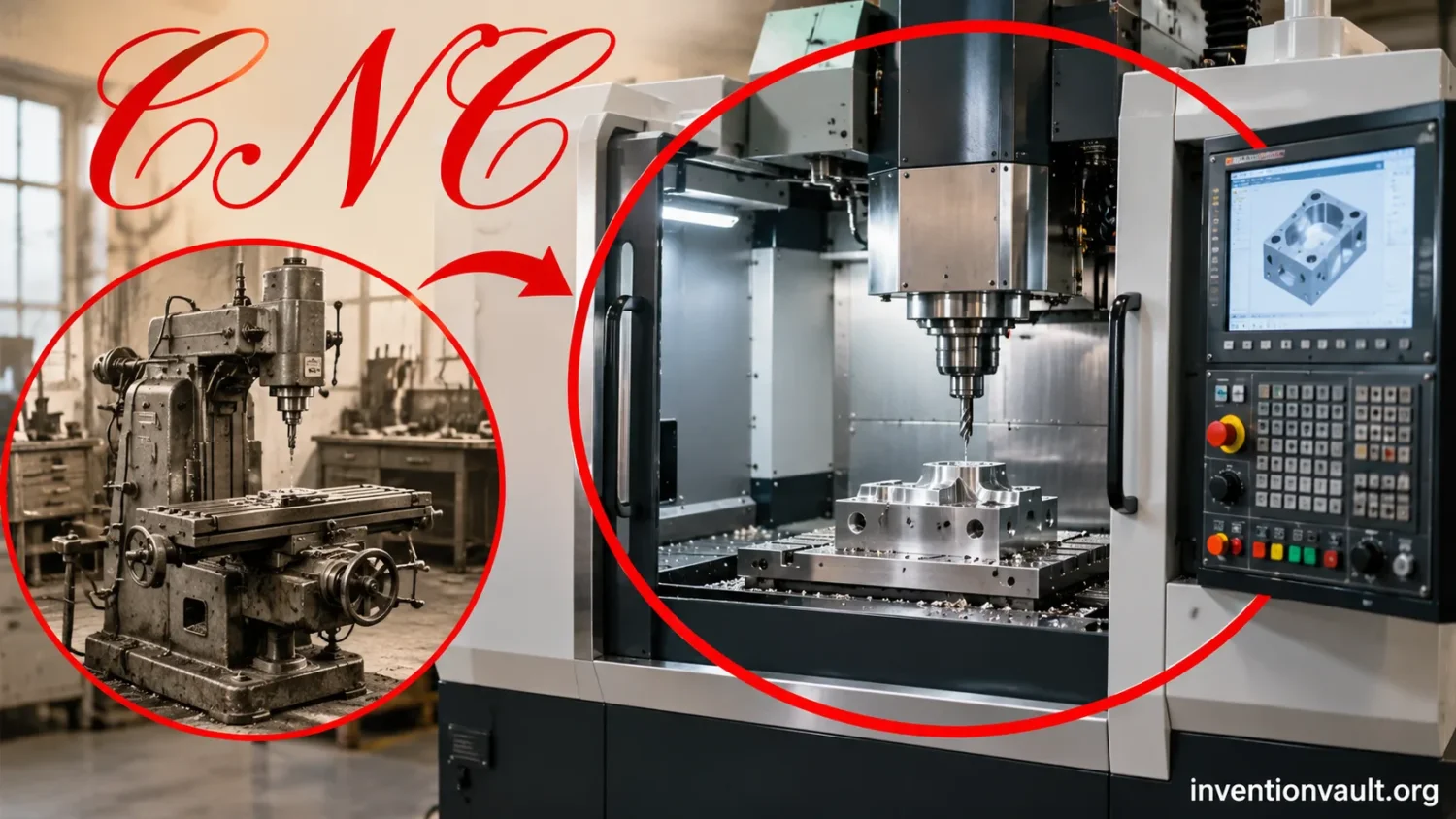
Control Evolution Map
How NC Became CNC
Trace the shift from aircraft coordinates and punched tape to computer-resident machine control and microprocessor CNC.
Manufacturing problem
Aircraft Shapes Become Numerical Data
Current stage
The geometry problem
Complex rotor-blade and aircraft contours were difficult to reproduce economically with templates and manually guided machine tools. Their shapes could instead be represented as sets of calculated coordinates.
What changed
A machinable contour no longer had to exist only as a physical master pattern. Numerical values could describe points along the required surface and guide later manufacturing operations.
Why aircraft mattered
Aerospace work combined demanding contour geometry, small production runs and tight dimensional requirements, making it an unusually strong test case for programmable machine control.
The first step toward CNC was turning geometry into information that a manufacturing system could process.
Coordinate control
Parsons and Stulen Connect Coordinates to Machining
Current stage
John T. Parsons
Parsons pursued the use of numerical coordinate information to manufacture complex aircraft-related shapes rather than relying entirely on manually produced templates and continuous operator guidance.
Frank L. Stulen
Stulen contributed the mathematical and engineering work needed to calculate coordinate data and translate the geometric idea into a practical manufacturing method.
Later recognition
The U.S. National Medal of Technology record names Parsons and Stulen together for developing and successfully demonstrating the numerically controlled machine-tool approach for three-dimensional shapes.
Their contribution established the data-driven machining idea on which later NC and CNC systems could be built.
Working NC system
MIT Demonstrates Numerical Control in 1952
Current stage
Machine architecture
MIT’s Servomechanisms Laboratory converted a Cincinnati Hydro-Tel milling machine into a system whose three machine motions could be directed by numerical information encoded on punched paper tape.
Control method
The director interpreted the tape, decoding servos converted commands into shaft rotations, and power servos moved the machine while feedback reported progress through the control system.
Correct historical label
The contemporary MIT record called it a numerically controlled milling machine. It was a landmark NC system, not a modern stored-program CNC controller with an onboard digital computer.
The 1952 machine proved that encoded numerical instructions could control coordinated machine-tool motion.
Part programming
APT Moves Toolpath Calculation to Computers
Current stage
The new bottleneck
Once machines could follow numerical instructions, preparing enough coordinate and motion data for complicated parts became laborious. Machine control had advanced faster than practical part programming.
APT’s role
MIT work led by Douglas T. Ross and colleagues allowed programmers to describe part geometry and tool motion in a higher-level form while a general-purpose computer performed much of the calculation.
Measured example
In a 1959 MIT presentation, J. Francis Reintjes reported that one aircraft plant reduced programming for a particular part from about 200 man-hours to five using APT.
Computer-assisted programming made numerical control more practical without yet putting the computer inside the machine controller.
Computer connection
DNC Links Computers and Machine Tools
Current stage
Centralized computing
Direct numerical control connected a central computer with machine tools, allowing machining data to be managed or delivered without treating every punched tape as an isolated physical program record.
What DNC was not
A computer serving several machines was architecturally different from giving each individual controller its own computer. That distinction separates DNC from the later CNC arrangement.
Industrial bridge
DNC showed how digital computing could become part of factory-level machine control before small, affordable processors made dedicated machine-resident computers practical.
The computer entered the machining system before it became a standard component inside each individual controller.
Computerized controller
Minicomputers Turn NC into CNC
Current stage
The architectural change
During the early 1970s, falling computer cost made it practical to place a programmable computer within the numerical-control system rather than implementing most control behavior through fixed wiring alone.
1972 example
Okuma records its OSP 2000 of 1972 as a practical CNC equipped with a built-in computer and as the company’s first CNC controller.
1973 example
General Electric’s MC8500 series, introduced in 1973 with a PDP-8 minicomputer, illustrates the same transition toward computer numerical control in commercial machine-tool systems.
CNC emerged when software running on a machine-associated computer began replacing functions previously fixed into the control hardware.
Microprocessor control
Microprocessors Make CNC Easier to Spread
Current stage
Smaller control hardware
Microprocessors reduced the size and cost of implementing programmable machine control while allowing more controller behavior to be defined through software rather than dedicated logic circuits.
Commercial example
Okuma records the OSP 300 series, completed in 1976, as a CNC controller with a built-in microprocessor and links it with wider use of multi-axis CNC lathes.
Long-term result
Program memory, editing, offsets, interpolation, diagnostics and later networking could develop within a computer-based control architecture that was far more adaptable than early hard-wired NC.
By the microprocessor era, computer numerical control was becoming a practical controller architecture rather than an exceptional installation.
CNC was not invented by one person on one date. John T. Parsons and Frank L. Stulen helped establish numerical control as a manufacturing method; MIT demonstrated a landmark three-axis NC milling system in 1952; and true computer numerical control emerged later as minicomputers and then microprocessors moved into machine controllers. Calling the 1952 MIT machine the “first CNC machine” compresses several different inventions into one event. It was an NC machine controlled from numerical data on punched tape. The computer inside the controller—the defining feature behind the historical distinction between NC and CNC—arrived as a later step.
| Historical question | Evidence-based answer |
|---|---|
| Who pioneered numerical machine control? | John T. Parsons and Frank L. Stulen are formally recognized together for developing and demonstrating the numerical-control approach for machining three-dimensional shapes. |
| What happened at MIT in 1952? | The Servomechanisms Laboratory operated a three-axis numerically controlled milling machine that read encoded instructions from punched paper tape and used servo control with feedback. |
| Was the 1952 machine CNC? | In the historical sense used to distinguish early NC from later CNC, no. Its control system did not contain the stored-program digital computer associated with 1970s CNC. |
| When was the Parsons–Stulen patent filed? | May 5, 1952. U.S. Patent 2,820,187 was granted on January 14, 1958. |
| What solved the programming problem? | Computer-assisted part-programming systems, especially MIT’s APT work, shifted much of the geometry and toolpath calculation from manual processing to general-purpose computers. |
| When did CNC emerge as a distinct architecture? | Commercial machine-resident computer controls appeared in the early 1970s, followed by microprocessor-based CNC during the decade. |
NC Is Not Automatically CNC
Numerical control means machine motion is directed by encoded numerical instructions. Computer numerical control is the later form in which a programmable computer performs controller functions. Modern usage often treats NC and CNC loosely, but the distinction matters when dating the invention.
The Problem That Led to Numerical Control Was an Aircraft Shape
The path to CNC did not begin with someone deciding to replace a machinist with a computer. It began with a geometry problem. Aircraft and rotor components could require complex curves whose surfaces had to be produced repeatedly and with tight dimensional control. Conventional practice often depended on physical templates, models, tracer systems and skilled manual setup.
Those methods worked, but complicated contours created an awkward chain. A designer defined a shape, another process produced an accurate master or template, and the machining operation then reproduced that geometry. The template itself had to be accurate enough that its errors would not be carried into every finished component.
A different approach was possible if the shape could be described mathematically. Instead of treating the contour only as a physical object, engineers could express locations along it as numerical coordinates. Once the coordinates existed, the next question was mechanical: could those numbers command the movement of a machine tool?
This shift from shape as template to shape as data is the part of the CNC story that is easily missed. The later controller, programming language and computer all depended on it.
Parsons and Stulen Turned Geometry into Machining Data
John T. Parsons, working through Parsons Corporation in Michigan, pursued numerical methods in aircraft-related manufacturing during the 1940s. Frank L. Stulen brought mathematical and engineering expertise to the effort. Coordinate calculations could be performed using punched-card data-processing equipment and then applied to the preparation of machining information.
The idea did not yet resemble a modern CNC machining center. There was no compact controller running a stored part program, no color display and no CAM workstation posting G-code across a network. The conceptual break was earlier: the desired geometry and cutter locations could be expressed numerically, and those numbers could become instructions for production equipment.
Parsons is often named alone in simplified histories. The official U.S. National Medal of Technology record does not describe the achievement that way. In 1985, John T. Parsons and Frank L. Stulen were named together for their development and successful demonstration of the numerically controlled machine-tool approach used to produce three-dimensional shapes.
The Parsons–Stulen Patent Shows What the Early Idea Was Trying to Replace
Their patent application, filed on May 5, 1952, was titled Motor Controlled Apparatus for Positioning Machine Tool. The patent described automatically controlling machine tools from media containing stored information, including punched cards or tape.
Its background also identified a manufacturing problem that helps explain the invention. Airfoil-like surfaces were commonly produced with models or templates that guided the machine or checked the work. Making those physical references could itself be expensive because they had to be more accurate than the finished component.
U.S. Patent 2,820,187 was granted on January 14, 1958. The six-year gap between filing and grant is one reason patent dates should not be used as automatic invention dates.
Patent vs. Working Technology
The May 1952 application and January 1958 patent grant document the Parsons–Stulen invention claim. Neither date by itself establishes the birth of CNC: NC development was already underway, while machine-resident computer control came later.
The Air Force and MIT Turned the Concept into a Servo-Controlled Machine
Complex aircraft production gave the U.S. Air Force a reason to support work on programmable machining. The problem was no longer limited to calculating coordinate points. A machine had to read numerical instructions, convert them into coordinated motion and verify that each axis actually reached the commanded position.
That brought the problem into the territory of servomechanisms and feedback control. MIT’s Servomechanisms Laboratory had expertise in those fields, much of it related to control problems developed during and after World War II.
By 1952, the laboratory had produced an experimental numerical-control system around a Cincinnati Hydro-Tel milling machine. An MIT News Service release dated August 1952 described the machine as responding to instructions transmitted as numbers. Digital information derived from drawings and specifications was encoded on punched paper tape, interpreted by a machine director and converted into machine movement through servomechanisms.
The project engineer was James O. McDonough, working under laboratory director William M. Pease. The contemporary MIT description also identifies the Air Materiel Command at Wright-Patterson Air Base as the contracting organization.
How the 1952 MIT Numerical-Control Machine Worked
The 1952 installation matters not because it looked like a present-day CNC machine—it did not—but because it established a control chain that is still recognizable. The instructions existed separately from the physical contouring hardware, and feedback closed the loop between a commanded position and the machine’s actual movement.
- Encode the machining dataCoordinates and other numerical instructions derived from the part information were punched into paper tape.
- Read and interpret the tapeThe control director read the hole patterns and converted the encoded information into commands for the machine’s axes.
- Convert commands into motionDecoding servos translated the instructions into shaft rotations, which were transmitted electrically to the machine’s power servos.
- Move the controlled axesThe servo system drove the relevant machine motions rather than requiring an operator to continuously guide the cutter along the contour by hand.
- Feed position information backThe control system continuously exchanged information about machine progress so that actual movement could be compared with the commanded movement.
Period technical reporting described the experimental installation as a converted Cincinnati Hydro-Tel surrounded by a large electronic director. The physical scale of the control hardware is a useful reminder that electronic numerical control arrived before a computer small enough and cheap enough to be assigned permanently to an individual machine tool.
The machine also separated two things that had long been tightly coupled: the physical machine and the information describing the part. A new component no longer required a completely new mechanical contouring arrangement. A different numerical instruction set could define a different path.
The Feedback Loop Outlived the Punched Tape
The storage media and electronics changed dramatically after 1952, but the control problem did not disappear. A commanded machine position is useful only if the controller can make the physical axis follow it closely.
A closed-loop CNC axis therefore still works around a related sequence: the control establishes a desired position or motion, a drive moves the axis, a feedback device reports the actual condition, and the controller corrects the remaining error. Modern servo drives and encoders are far removed from the 1952 hardware, yet the command–motion–feedback relationship connects the two generations.
Who Invented CNC? The Credit Depends on Which Step Is Being Asked About
A single-name answer confuses several engineering achievements. The invention history becomes clearer when credit is assigned to the task each person or organization actually performed.
| Contributor | Documented role in the development chain | Best historical description |
|---|---|---|
| John T. Parsons | Advanced the use of numerical coordinate information in machine-tool production of complex shapes. | Major pioneer of numerical control. |
| Frank L. Stulen | Worked on the mathematical and engineering methods used to turn complex geometry into usable manufacturing data. | Co-developer in the early NC work. |
| U.S. Air Force / Air Materiel Command | Supported development aimed at difficult aircraft manufacturing problems and funded the MIT machine-control work. | Research sponsor and industrial demand source. |
| MIT Servomechanisms Laboratory | Built and operated the landmark 1952 tape-fed, servo-controlled milling system. | Developer of the landmark early NC implementation. |
| James O. McDonough and William M. Pease | McDonough supervised the machine project under Pease’s laboratory direction, according to MIT’s 1952 record. | Engineering leadership for the MIT NC system. |
| Douglas T. Ross, J. Francis Reintjes and the APT effort | Developed computer-assisted methods that made the preparation of complex NC toolpaths far more practical. | Part-programming and computerization milestone. |
| 1970s controller makers | Placed minicomputers and later microprocessors inside numerical-control systems. | Commercial transition from hard-wired NC to CNC. |
What Different Records Actually Establish
- Patent recordThe Parsons–Stulen application documents a claimed method and apparatus for automatic machine-tool positioning. A patent filing does not prove that later CNC architecture already existed.
- 1952 MIT recordThe contemporary announcement documents an operating numerical-control milling machine using punched tape, decoding equipment, servos and feedback.
- 1959 APT demonstrationMIT’s surviving presentation documents computer-assisted generation of machining instructions and shows that programming had become a separate engineering problem.
- 1970s commercial controller recordsMinicomputer and microprocessor products document the later stage in which the computer became part of the machine-control architecture itself.
The most defensible answer to “Who invented CNC?” is therefore layered. Parsons and Stulen belong at the beginning of numerical control; the MIT team established a working servo-controlled NC system; later programmers and controller engineers supplied the computerization that turned NC into CNC.
The 1952 Machine Solved Control but Exposed a Programming Problem
A machine able to follow thousands of numerical instructions creates a second problem: someone has to generate those instructions correctly. For a simple movement, the burden is modest. For a complicated aircraft contour, manually calculating cutter positions and translating them into machine instructions can become a major task.
This is why the invention of computer-controlled machining cannot be understood only by looking at control cabinets. The usefulness of numerical control depended on a parallel advance in part programming.
Early NC could move according to numerical data without having a computer inside the machine. General-purpose computers could still be used elsewhere to prepare that data. This distinction matters: computer-assisted preparation of an NC program is not the same architecture as CNC.
APT Made Complex Numerical Control Easier to Program
MIT researchers developed automatic programming techniques to reduce the manual data-processing burden. APT—Automatically Programmed Tool—allowed the part programmer to describe geometry and intended cutter motion in a higher-level form rather than manually calculating every low-level machine coordinate.
Douglas T. Ross led computer-applications work associated with APT. J. Francis Reintjes, who directed the Servomechanisms Laboratory during much of this period, later described the system publicly with Ross in a 1959 MIT Science Reporter program.
The demonstration showed an approach in which geometric entities such as points, lines and circles could be defined symbolically. The computer could use those relationships to determine the tool path. Changes to dimensions could also be introduced by changing defined values rather than reconstructing an entire geometric calculation from the beginning.
The programming work was not confined to one laboratory group. Reintjes said that 19 aircraft plants cooperated in developing the broader programming system. That industry participation reflected the scale of the problem: numerical-control machines were useful only if manufacturers could create their programs at a workable cost.
A 200-Hour Programming Job Reduced to Five Hours
The 1959 MIT presentation included an unusually concrete example. Reintjes reported that one aircraft plant had reduced the programming time for a particular part from 200 man-hours to five man-hours through APT.
That figure should not be treated as a universal productivity ratio. It referred to one part at one plant. Its historical value is different: it shows why computer-assisted programming mattered. The machine could already follow numerical instructions; the bottleneck had shifted toward creating those instructions efficiently.
NC, DNC and CNC Describe Different Control Architectures
The letters are easy to blur together because all three approaches use numerical machining information. Their architectures, however, are different.
| Architecture | Where the machining instructions come from | Role of the computer | Historical meaning |
|---|---|---|---|
| NC | Commonly removable media such as punched paper tape in early systems. | A computer may help prepare the program elsewhere, but the machine controller need not contain one. | Numerical instructions control machine motion through dedicated control hardware. |
| DNC | Machining information is supplied or managed through a central computer serving machine tools. | The computer operates at the factory or multi-machine level. | Computing becomes directly connected to production equipment without requiring a separate full computer in every early controller. |
| CNC | The part program can be stored, interpreted and managed within the computer-based machine-control system. | A programmable computer forms part of the individual control architecture. | Control functions move from largely hard-wired logic toward software-defined behavior. |
This progression also explains why 1952 is a poor date for declaring CNC fully invented. Numerical machine control had been demonstrated, but the electronics industry had not yet supplied an economical machine-resident computer architecture comparable to what appeared two decades later.
The 1970s Put the Computer Inside the Controller
The distinction between NC and CNC became much more concrete as minicomputers became small and affordable enough to dedicate to manufacturing control. Functions that previously required purpose-built electronic logic could now be carried out through programs running on a computer associated with the machine.
No single commercial product provides a universally accepted birth certificate for CNC. Different manufacturers developed computerized controls, and definitions of “first” vary according to whether the criterion is prototype, commercial introduction, built-in computer, practical production use or microprocessor control.
Two documented examples show the transition clearly.
Okuma OSP 2000: A Built-In Computer in 1972
Okuma records completion of the OSP 2000 in 1972. The company’s historical record describes it as a practical CNC system with a built-in computer and identifies it as Okuma’s first CNC. The controller was fitted to several of the company’s machine tools and remained in production for years.
This is different in kind from the 1952 MIT machine. Both systems used numerical information to command machining, but the 1972 controller belonged to the era in which a computer could reside inside the control system rather than being a separate calculation resource used to prepare tape.
GE MC8500: Minicomputer CNC in 1973
General Electric’s MC8500 series provides another early-1970s example. Historical trade reporting describes the 1973 system as one of the early commercial computer numerical controls and notes its use of a PDP-8 minicomputer.
The examples should be read as markers of an industry transition, not as evidence that every machine builder switched at once. Hard-wired NC, DNC and computerized controllers coexisted while the economics and reliability of digital electronics continued to change.
Microprocessors Changed the Economics of CNC
Minicomputers proved that programmable computing could live within the machine-control environment. Microprocessors made that approach smaller and less expensive.
Okuma’s history records the OSP 300 series in 1976 as a controller with a built-in microprocessor. Similar changes were occurring across the control industry as processor cost fell and digital integration improved.
The resulting shift was more than replacing punched tape with electronic memory. A programmable controller could perform behaviors in software that would have required additional or redesigned hard-wired circuitry in earlier controls.
That opened the way for features such as:
- Program storage and editing: machining programs could remain in memory and be modified without preparing an entirely new physical tape.
- Tool and work offsets: the controller could apply stored numerical corrections between programmed geometry and the physical machining setup.
- Cutter compensation: programmed geometry could be adjusted for cutter dimensions within the control logic.
- Reusable machining cycles: common sequences could be represented more compactly rather than written as long collections of elementary moves.
- More capable interpolation: the controller could calculate intermediate commanded positions for coordinated axis motion.
- Diagnostics and parameters: machine behavior could be monitored and configured through data held by the control system.
The broad engineering change can be stated simply: early NC encoded the work as numbers; CNC also made much of the controller itself programmable.
Interpolation Turned Coordinates into Continuous Tool Motion
A list of coordinate points does not by itself produce a smooth contour. The control system must determine how the machine moves between commanded positions.
For point-to-point work, the machine may primarily need to arrive accurately at specified locations. Contouring operations create a different demand because axis motion must be coordinated throughout the cut.
Interpolation supplies the intermediate motion. Linear interpolation creates a straight path between defined positions. Circular interpolation coordinates axes to follow an arc. More advanced controllers later expanded the range of mathematical motion available, but the general problem was present from early continuous-path numerical control: several machine axes had to move together so the cutter followed the intended geometry.
This is why aircraft contouring was such an effective test for numerical control. It demanded more than automatic positioning. The machine had to convert discrete numerical instructions into controlled continuous movement.
APT, G-Code, CAM and CNC Are Different Parts of the Digital Machining Chain
These terms are sometimes treated as if they describe competing versions of the same invention. They operate at different levels.
| Term | What it does | What it is not |
|---|---|---|
| APT | Provides a higher-level method for describing geometry and tool motion so a computer can calculate machining data. | It is not the physical machine controller itself. |
| G-code / RS274-family NC code | Represents machine motions and functions in a form interpreted by numerical-control systems. | It is not synonymous with CNC hardware. |
| CAM | Modern computer-aided manufacturing software calculates toolpaths, machining strategies and other production data from digital part geometry. | It does not directly replace the servo control that moves the physical axes. |
| CNC controller | Interprets the machine program, calculates commanded motion and coordinates drives, spindle functions, offsets and other machine operations. | It is not merely a program format. |
A modern workflow may therefore move from a CAD model to CAM-generated toolpaths, through a postprocessor into machine code, and finally into a CNC controller that converts those instructions into coordinated physical motion. Each layer solves a different problem.
APT deserves attention because it exposed the same separation decades earlier. The computer could reason about part geometry and generate machining information even when the machine tool itself still used an NC controller.
What CNC Changed in Manufacturing
The effect of numerical and computer numerical control is better understood through changed production tasks than through broad claims about automation.
Complex Shapes Became Repeatable Programs
When geometry could be represented through numbers and motion commands, repeating a contour no longer depended on manually retracing the same path. Once a valid program and setup existed, the same controlled motions could be reproduced on subsequent parts.
A Machine Could Change Jobs by Changing Information
Traditional automatic machinery could be very productive when built around a fixed product, but changing the job might require cams, templates or other dedicated hardware. Numerical control moved more of that product-specific information into a replaceable instruction set.
This was especially useful in aircraft work, tooling, dies, molds and other production where geometries might be complicated while quantities were too small to justify a dedicated transfer line for each part.
Skill Moved Rather Than Simply Disappearing
Numerical control reduced the need for an operator to manually steer a cutter through every programmed path. It did not remove machining knowledge from production.
Work shifted toward part programming, tool selection, setup, fixturing, offsets, process planning, inspection and diagnosis. The rise of APT even created a distinct role around preparing numerical-control programs. Later CAD/CAM systems changed that role again without removing the need to understand the relationship between geometry, cutting tools and machine behavior.
Programs Became Manufacturing Assets
The 1952 MIT team already recognized an advantage of punched tape: once prepared correctly, it formed a compact record that could be reused for duplicate parts. CNC extended this idea by storing and editing programs electronically and later connecting machines to wider digital production systems.
Why the 1952 Machine Should Be Called NC Rather Than CNC
The distinction is not pedantry. It identifies two different inventions.
1952 Numerical Control
Punched tape supplied numerical commands to a dedicated electronic director and servo system. Computing could help prepare the numbers, but a stored-program digital computer was not the machine controller.
1970s Computer Numerical Control
A minicomputer or microprocessor became part of the individual numerical-control system, allowing controller functions and program handling to be performed through software.
Modern writers sometimes use “CNC” retrospectively for nearly any digitally directed machine tool because present-day numerical control is overwhelmingly computer based. That shorthand is understandable in casual use, but it obscures the very transition an invention history needs to explain.
The 1952 MIT project demonstrated that a machine tool could turn encoded numerical information into controlled three-axis movement. The CNC era began when falling computer cost made it practical for the computer itself to become part of the controller.
The Invention of CNC Was a Chain of Solved Problems
| Period | Development | Problem it solved |
|---|---|---|
| 1940s | Parsons and Stulen apply calculated coordinate data to aircraft-related manufacturing. | Representing difficult physical contours as numerical information. |
| Late 1940s–early 1950s | Air Force-backed work expands the idea toward automatic machine-tool control. | Turning coordinate information into controlled physical production. |
| 1952 | MIT operates its landmark three-axis numerical-control milling machine. | Reading encoded numerical instructions and converting them into closed-loop machine motion. |
| May 5, 1952 | Parsons and Stulen file their machine-tool positioning patent application. | Formally documenting their stored-information approach to automatic machine positioning. |
| January 14, 1958 | U.S. Patent 2,820,187 is granted. | Patent protection for the described method and apparatus. |
| Late 1950s | APT brings general-purpose computers into preparation of complex NC programs. | Reducing the labor required to calculate and encode complicated toolpaths. |
| 1960s | NC use expands while computer-connected approaches such as DNC develop. | Managing and delivering machining data more directly through computing systems. |
| Early 1970s | Commercial controls begin incorporating minicomputers. | Moving controller behavior from dedicated wiring toward programmable computing. |
| Mid-to-late 1970s | Microprocessor CNC develops. | Reducing control size and cost while expanding software-defined functions. |
| Later decades | CAD/CAM, electronic program transfer, machining centers and multi-axis systems mature around CNC. | Connecting digital part geometry, toolpath generation and programmable production more directly. |
Common CNC History Claims That Need More Precise Wording
“John Parsons invented CNC in 1949.”
Parsons belongs near the beginning of the story, but this wording assigns the later CNC architecture to an earlier numerical-control concept. Parsons and Stulen helped develop the coordinate-based machining method that led to NC. Computerized machine controllers followed later.
“MIT invented CNC in 1952.”
MIT’s 1952 machine was a major working NC demonstration. Contemporary MIT material calls it a numerically controlled milling machine and describes punched tape, electronic decoding and servo control. Labeling it CNC removes the later computer-in-controller step from the history.
“John Parsons was the only inventor.”
This omits Frank L. Stulen’s documented contribution and the separate engineering carried out at MIT. The official U.S. technology medal record recognizes Parsons and Stulen together.
“The 1958 patent marks the invention of CNC.”
The patent was filed in 1952 and granted in 1958. Patent grant date, working prototype date and commercial architecture are different milestones. The patent documents early automatic machine-control ideas; it does not make 1958 the date when onboard computer control appeared.
“APT was the first CNC system.”
APT addressed part programming. A general-purpose computer could calculate toolpath information that an NC machine would later execute. The computer performing that programming did not automatically become the machine’s own controller.
“G-code is CNC.”
G-code is a family of machine-programming conventions. CNC is the control architecture that interprets machine instructions and directs the physical equipment. A programming language and a controller are related components, not interchangeable terms.
What a Modern CNC Machine Still Inherits from Early NC
A current machining center looks little like MIT’s room-sized 1952 installation. Program storage is electronic, processors are compact, axis feedback is digital, CAM systems can calculate enormous toolpaths and machines may coordinate five or more controlled axes while automatically changing tools.
Yet several ideas remain recognizable:
- a desired part geometry is represented numerically;
- the geometry is converted into an executable sequence of machine motion;
- the controller coordinates multiple machine functions;
- servo systems convert commands into controlled physical movement;
- feedback reports what the machine actually did;
- interpolation determines motion between programmed positions;
- changing information can change the part without rebuilding the basic machine-control mechanism.
The durable invention was therefore not a particular paper tape, cabinet or programming language. It was the separation of part information from machine motion, followed by progressively better ways to calculate, store, interpret and execute that information.
So When Was CNC Actually Invented?
There is no single date that accurately covers the entire invention. The history has several boundaries, each answering a different question.
If the question is about the origins of numerical machine control, the Parsons–Stulen work of the 1940s belongs near the start. If the question is about a landmark working numerical-control milling system, MIT’s 1952 machine is the central milestone. If the question is about computer-generated machining programs, APT and related late-1950s work form another step.
If “CNC” is used in its historically useful sense of computer numerical control—a programmable computer forming part of the machine-control system—the answer moves into the early 1970s, when commercial minicomputer controls appeared. Microprocessors then accelerated the replacement of hard-wired control logic during the remainder of the decade.
CNC was therefore an evolutionary invention with identifiable contributors rather than a one-day invention with one inventor. Parsons and Stulen established an early numerical-control path; MIT demonstrated that numerical information could drive a feedback-controlled machine tool; APT made complex programming more manageable; and the electronics industry eventually made it practical to put programmable computing directly inside the controller.
References Used for This Article
- U.S. Patent and Trademark Office — 1985 National Medal of Technology and Innovation Laureates. Used to verify the joint recognition of John T. Parsons and Frank L. Stulen for developing and demonstrating numerically controlled machine-tool technology.
- MIT Institute Archives and Special Collections — 1952 News Service record on the numerically controlled milling machine. Used for the contemporary description of punched-tape input, servo operation, feedback, project leadership and Air Materiel Command support.
- MIT Science Reporter — “Automatically Programmed Tools” (1959). Used for APT development, the role of Douglas T. Ross and J. Francis Reintjes, cooperation with aircraft plants and the documented programming-time example.
- U.S. Patent 2,820,187 — Motor Controlled Apparatus for Positioning Machine Tool. Used to verify the Parsons–Stulen inventorship, May 5, 1952 filing date, January 14, 1958 grant date and the patent’s description of stored-information machine control.
- Okuma Corporation — 120-Year Historical Record. Used specifically for Okuma’s records of the 1972 OSP 2000 built-in-computer CNC and the 1976 microprocessor-based OSP 300.
- American Machinist — 1970s machine-control history. Used for industry context on the transition from hard-wired NC and DNC toward minicomputer CNC, including the GE MC8500 example.
- National Institute of Standards and Technology — NIST RS274/NGC Interpreter. Used to check terminology around RS274-family numerical-control code and its role as machine instructions rather than the CNC controller itself.
- Electronics, November 1952 — contemporary report on the MIT numerical-control milling system. Used for period technical context on the converted Cincinnati Hydro-Tel and its large electronic director.