
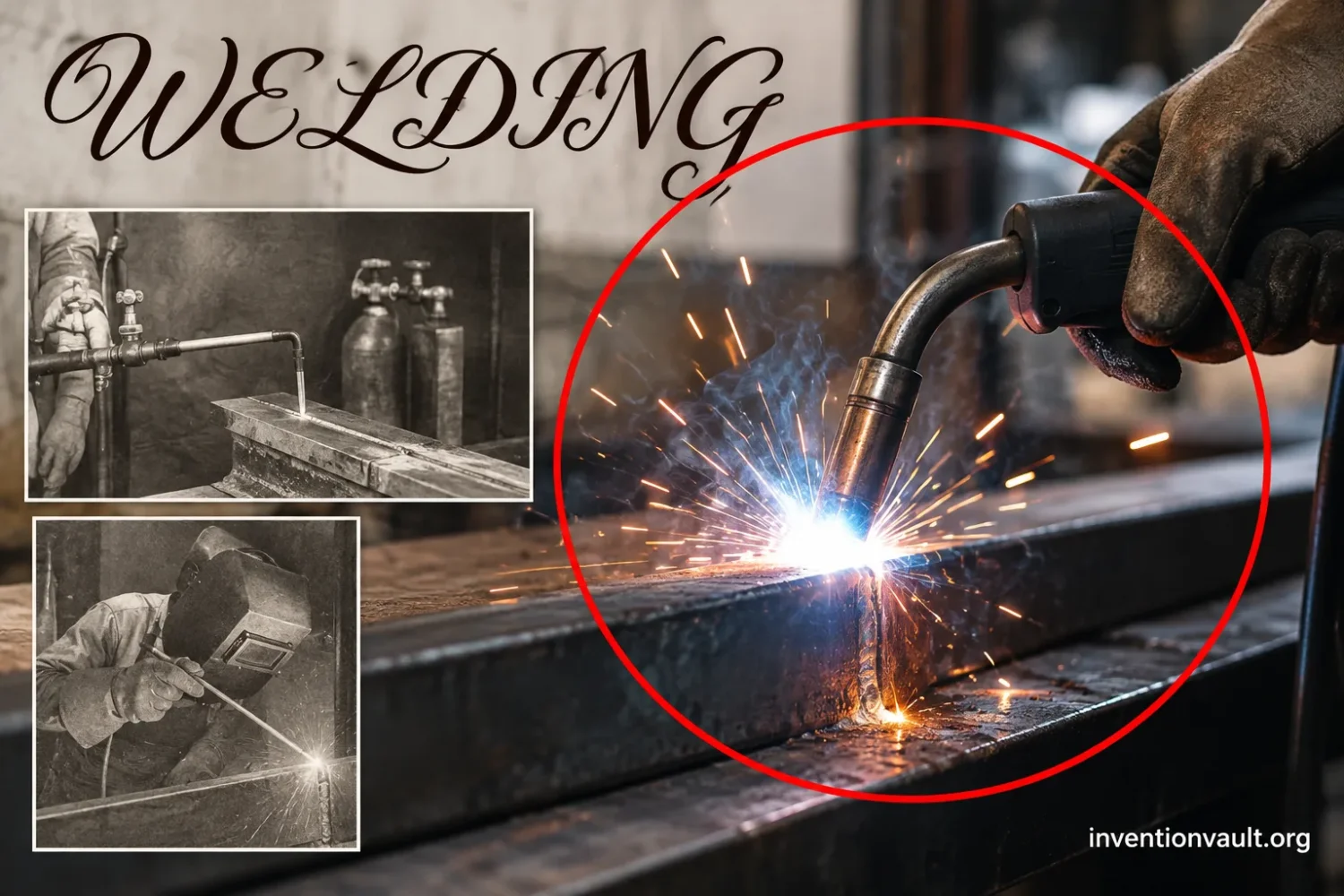
Joining Process Evolution
How Welding Became Modern
Follow the changes in heat, electrodes, shielding and control that turned forge joining into several distinct welding process families.
Early joining method
Forge Welding Before Electricity
Current stage
Evidence
Metalworkers were joining heated metal by hammering or pressing it together thousands of years before electrical welding. Archaeological examples are commonly traced to roughly the third millennium BCE.
Joining mechanism
The surfaces were heated until sufficiently workable, brought into close contact and forced together. No electric arc, electrode, shielding gas or modern power supply was involved.
Historical limit
Forge welding proves that welding itself cannot be assigned to a nineteenth-century inventor. What appeared in the 1800s was a new family of controllable welding processes.
Welding began as a craft method; the later invention story concerns controlled heat sources and repeatable industrial processes.
Physical precursor
The Electric Arc Becomes Available
Current stage
Humphry Davy
Davy demonstrated electric arc phenomena around 1800 and later produced a sustained arc with carbon electrodes. His experiments established an intense electrical source of localized heat.
Vasily Petrov
Petrov produced a continuous electric arc in 1802 and described its ability to generate intense heat, including the possibility of using it for melting metals.
Discovery versus application
Neither experiment was yet a practical arc-welding system. The arc first had to move from a laboratory electrical phenomenon to a controlled tool applied directly to a workpiece.
The arc supplied the missing heat source, but another generation of inventors had to turn it into a metal-joining process.
Practical arc milestone
Carbon Arc Welding Takes Shape
Current stage
1881 application
Auguste de Méritens used arc heat to join lead plates for storage batteries in France. This was an early practical step from arc experiments toward direct metal joining.
Benardos and Olszewski
Nikolay Benardos and Stanisław Olszewski developed a carbon-arc system in which an arc formed between an external conductor and the metal being worked.
Patent record
Their patent family began in Europe in 1885. The U.S. application was filed on December 3, 1885, and U.S. Patent 363,320 was issued on May 17, 1887.
Carbon arc welding is one of the clearest points where modern electrical welding becomes a documented, usable process rather than an electrical experiment.
Parallel electrical branch
Resistance Welding Avoids the Arc
Current stage
Elihu Thomson
Thomson developed resistance welding during the mid-1880s. Instead of directing an open arc at the surface, his systems passed high current through contacting metal parts.
Where heat forms
Electrical resistance at and near the interface generates heat. Pressure then forces the heated surfaces together, creating a joint without requiring an arc between a handheld electrode and the workpiece.
Industrial descendants
The principle led to processes such as spot and seam welding, later suited to repeated sheet-metal joints and mechanized manufacturing.
Modern welding was already branching into different mechanisms: one concentrated arc heat at a surface, another generated heat within the joint.
Electrode evolution
The Electrode Becomes Filler Metal
Current stage
Metal electrode
Nikolay Slavyanov in 1888 and Charles L. Coffin soon afterward developed approaches using metal electrodes, moving arc welding beyond the non-consumable carbon rod.
What changed
A consumable electrode could maintain the arc while its own metal entered the molten joint. Heat production and filler-metal delivery were now combined in one working element.
Coated electrode
Oscar Kjellberg later developed a coated metal electrode. His U.S. patent application was filed in 1907 and issued in 1910, documenting a consumable electrode surrounded by a non-combustible covering.
Electrode design changed welding from simply producing heat into controlling what metal entered the joint and what surrounded it during deposition.
Molten-pool control
Shielding Makes Cleaner Arc Processes Possible
Current stage
The atmospheric problem
Molten weld metal can react with surrounding gases. Fluxes, electrode coatings and later externally supplied shielding gases gave engineers different ways to control the environment around the arc and weld pool.
TIG / GTAW
Russell Meredith perfected the Heliarc process in 1941, combining a non-consumable tungsten electrode with inert-gas shielding. It became the process now generally called gas tungsten arc welding.
MIG / GMAW
Battelle Memorial Institute developed gas metal arc welding in 1948 using a continuously fed consumable wire inside a shielding-gas envelope, joining wire feeding and atmospheric protection in one process.
Once the weld pool could be shielded and fed predictably, arc welding became easier to tailor to metals that earlier methods handled poorly.
Solid-state process
Friction Stir Welding Removes Melting
Current stage
1991 invention
Wayne Thomas and colleagues at TWI developed friction stir welding in 1991. A rotating non-consumable tool travels along the joint while mechanically working and heating the material.
Material state
The material softens and flows around the tool but does not undergo the bulk melting associated with fusion welding. Pressure behind the tool consolidates the worked material into a joint.
Why it matters historically
The process makes a useful boundary clear: welding is broader than melting two metal edges together. Some welding methods form a bond while the workpieces remain in the solid state.
The welding family expanded beyond flames and arcs to a process in which controlled mechanical motion produces the joint without a molten pool.
Process intelligence
Welding Systems Begin to Sense the Weld
Current stage
Beyond programmed motion
Robotic welding originally depended heavily on predefined paths and process settings. Sensors and machine vision now allow systems to observe seam position, geometry, arc behavior and weld-pool conditions during operation.
Predictive monitoring
Research published in 2025 combined physical welding knowledge, machine vision and data-driven prediction to identify weld-pool instability before the condition fully developed in a robotic welding experiment.
Current research direction
Work reported through the International Institute of Welding in 2026 includes AI-assisted sensing, defect detection, adaptive control, robotic execution and data-driven process optimization.
The newest step is not a new source of heat but tighter control of what happens while the joint is being formed.
Welding was not invented by one person on one date. Heated metals were forge-welded thousands of years before electricity, while modern welding developed through a sequence of nineteenth- and twentieth-century inventions. The electric arc experiments of Humphry Davy and Vasily Petrov supplied a new heat source; Auguste de Méritens applied arc heat to metal joining in 1881; Nikolay Benardos and Stanisław Olszewski developed and patented a practical carbon-arc process; Elihu Thomson created a separate resistance-welding branch; and later inventors improved electrodes, shielding and process control. For that reason, calling any one of these people simply “the inventor of welding” hides more than it explains.
| Historical point | Best-supported description |
|---|---|
| Earliest welding | Forge welding was practiced thousands of years ago; no individual inventor is known. |
| Electrical precursor | Humphry Davy and Vasily Petrov demonstrated electric-arc phenomena in the early nineteenth century. |
| Early arc joining | Auguste de Méritens used arc heat to join lead battery plates in 1881. |
| Practical carbon-arc process | Nikolay Benardos and Stanisław Olszewski developed a patented system during the 1880s. |
| Resistance welding | Elihu Thomson developed an independent electrical welding method in the mid-1880s. |
| Consumable metal electrode | Nikolay Slavyanov and Charles L. Coffin advanced metal-electrode arc welding in the late 1880s. |
| Coated electrode | Oscar Kjellberg developed a coated electrode in the early twentieth century. |
| Later process families | Gas shielding, continuous wire feeding, beam processes and solid-state methods produced distinct forms of welding rather than one universal machine. |
Dating the First
An ancient joining method, a laboratory arc experiment, a practical welding process and a patent are different kinds of evidence. Dates such as 1800, 1881, 1885 and 1887 describe different steps, not competing dates for one event.
Welding Existed Long Before the Welding Machine
The oldest part of the story is also the reason that a single nineteenth-century invention date does not work. Long before electrical equipment existed, metalworkers learned that certain metals could be joined by combining heat with pressure and deformation. In forge welding, two prepared surfaces are heated until they become sufficiently workable and are then hammered or pressed together.
Evidence associated with early metalworking reaches back to roughly the third millennium BCE. The exact age of individual examples depends on what historians count as welding, but the underlying point is clear: people were making welded metal joints long before an electric arc could be produced.
Forge welding differs sharply from the processes that later defined industrial welding. There is no electrical circuit, consumable wire, shielding gas or controlled arc gap. Temperature is produced by a forge, and joint formation depends heavily on surface condition, temperature, pressure and the metalworker’s ability to manipulate the pieces at the right moment.
Why ancient forge welding and modern fusion welding should not be treated as the same invention
Forge Welding
The parts are heated and forced together while sufficiently plastic. The method predates electrical machinery and does not depend on an electric arc or a deliberately maintained molten weld pool.
Fusion Welding
A concentrated heat source melts material at the joint. The molten region then solidifies into a continuous connection, with filler metal added in many processes but not all.
This distinction also prevents another common mistake: welding does not always require melting. Forge welding and modern solid-state processes show that a welded joint can be produced without melting the bulk of the base material. Fusion welding is therefore a major welding family, not the definition of every welding process.
The Electric Arc Created a New Source of Localized Heat
The transition toward modern arc welding began in electrical laboratories rather than metal shops. Around 1800, Humphry Davy demonstrated electrical arc phenomena. Russian physicist Vasily Petrov independently produced a continuous arc in 1802 and published his experiments the following year, noting the intense heat that the discharge could produce.
The invention-related distinction matters here. Davy and Petrov did not build the later carbon-arc welding system. Their work established that an electrical discharge could create intense heat between conductors. That physical effect became useful for welding only after engineers found practical ways to position an electrode, connect the workpiece to the electrical circuit and maintain the arc where metal needed to be joined.
Discovery vs. Engineered Application
Demonstrating an electric arc established the heat source. Arc welding required a separate engineering step: controlling that arc at a metal joint so that localized heating or melting could be performed repeatably.
Auguste de Méritens Brought the Arc to a Real Metal Joint
One of the clearest early transitions occurred in 1881. Auguste de Méritens, working in France, used the heat of an electric arc to join lead plates used in storage batteries. Lead was well suited to this early application because its melting behavior made it easier to work with than many structural metals.
De Méritens deserves a place in the invention history because this was no longer simply an experiment showing that electricity could produce heat. The arc was being used for a manufacturing task: joining metal components.
That does not make 1881 an uncontested date for the invention of all welding. Forge welding was already old, while the apparatus and process that made carbon-arc welding broadly recognizable as an engineered system were developed and patented in the years that followed.
Benardos and Olszewski Made Carbon Arc Welding a Documented Process
Nikolay Benardos, who had worked with de Méritens, and Stanisław Olszewski developed what became the first practical carbon-arc welding process. Their design placed the workpiece itself on one side of the electrical circuit and an external conductor, preferably a carbon rod, on the other. Bringing the carbon close enough to the metal formed an arc directly at the work area.
The patent record is unusually useful because it describes the mechanism rather than merely attaching a date to a name. Their U.S. application was filed on December 3, 1885. The specification records related patents in France on October 10, 1885; Belgium on October 20; Britain on October 21; Germany on November 1; Sweden on November 6; Russia on December 31, 1886; and Spain on January 5, 1887. U.S. Patent 363,320 was issued on May 17, 1887.
The patent describes the metal being worked as one pole and a carbon or other conductor as the other. When the carbon approached the metal, the arc heated, softened and could ultimately melt the material at the point of contact. Moving the holder allowed the heat source to travel along a line rather than remain fixed in one place.
- Connect the workpieceThe metal being worked forms one electrical terminal of the circuit.
- Position the carbon conductorA separate carbon rod in a holder forms the opposite terminal and is brought close to the work surface.
- Form the arcThe electrical discharge bridges the gap and concentrates heat where the arc reaches the metal.
- Move along the jointThe holder can travel across the workpiece so heating and fusion occur at selected points or continuously along a line.
An especially revealing detail appears in the patent drawings and text: the apparatus included a colored-glass screen intended to protect the operator’s eyes from the arc. That feature shows that the inventors were already dealing with the practical consequences of placing a powerful electrical arc directly in front of a worker.
What the Patent Establishes
U.S. Patent 363,320 directly documents a movable holder, a carbon conductor, the workpiece as the opposite electrical pole and an arc capable of heating and melting metal locally. It supports credit for a practical carbon-arc process, not for every form of welding.
Why the carbon electrode was not a modern welding rod
A carbon rod mainly provided the electrode needed to create the arc. It was not the same thing as the later consumable metal electrode used in processes where the electrode itself melts and supplies metal to the joint.
This difference produced the next engineering question. If an electrode could create the arc, could the electrode also become the source of filler metal? That shift led directly toward the family of metal-electrode processes from which modern stick and wire-fed arc welding developed.
Carbon Electrode
The electrode’s main job is to sustain the arc and deliver heat. Additional metal can be supplied separately when the joint requires it.
Consumable Metal Electrode
The electrode sustains the arc while melting into the weld region. One component can therefore provide both electrical conduction and deposited metal.
Resistance Welding Developed Along a Different Electrical Path
Arc welding was not the only electrical solution appearing in the 1880s. Elihu Thomson developed resistance welding, a process based on a different location and mechanism for heat generation. The Smithsonian dates Thomson’s invention of electric resistance welding to 1886, while his later patents document continuing development of the process.
Instead of sustaining an open arc between an electrode and the work, current passes through metal components that are in contact. Electrical resistance produces heat, especially around the interface. Pressure applied to the parts helps create the joint as the heated region reaches the required condition.
This led to a separate family of equipment and applications. Spot welding, for example, can make repeated joints in sheet metal without depositing a continuous bead. Seam welding extends the resistance principle to overlapping or continuous joint patterns.
| Feature | Carbon arc welding | Metal-electrode arc welding | Resistance welding |
|---|---|---|---|
| Primary heat source | Electric arc | Electric arc | Electrical resistance near the joint |
| Open arc required | Yes | Yes | No |
| Electrode normally supplies filler | No | Yes | No |
| Pressure central to joining | No | No | Yes |
| Later descendants | Historical arc processes | Stick and wire-fed arc processes | Spot, seam and related resistance processes |
The existence of these parallel branches is another reason the phrase “first welding machine” can mislead. An arc welder and a resistance welder solve the joining problem with different electrical arrangements, and both developed through multiple generations of equipment.
The Consumable Metal Electrode Changed What the Arc Could Do
Late nineteenth-century work by Nikolay Slavyanov and Charles L. Coffin moved arc welding toward consumable metal electrodes. Historical accounts commonly place Slavyanov’s development in 1888 and Coffin’s work around 1890.
The change was more than substituting one rod material for another. With a consumable metal electrode, material from the electrode could transfer into the joint. The same element involved in maintaining the electrical arc could now contribute deposited metal.
Slavyanov and Coffin approached this idea differently. Slavyanov’s work included casting metal using a consumable electrode, while Coffin applied electrode metal in welding arrangements. Their contributions belong to the transition between the carbon-electrode era and processes in which electrode composition, feed rate and deposition became part of weld control.
Oscar Kjellberg Added a Protective Layer Around the Electrode
A bare metal electrode solved only part of the problem. Producing molten metal in ordinary air exposes the weld region to oxygen, nitrogen and other atmospheric effects. Arc stability and metal transfer also need to be managed. Electrode coatings became one way to address several of these problems together.
Swedish engineer Oscar Kjellberg developed an early coated welding electrode in the first years of the twentieth century. His U.S. patent application, filed August 13, 1907 and granted as Patent 948,764 on February 8, 1910, describes a metallic electrode surrounded by a non-combustible, normally non-conducting covering that is consumed as welding progresses.
The patent contains a detail that explains why electrode coatings became more than simple mechanical sleeves. Kjellberg listed materials such as chalk and magnesia with a binding substance as one possible covering. He also described adding substances including magnesium, titanium or vanadium so that compounds or alloys formed during deposition could alter properties of the deposited metal.
This points toward a defining feature of later welding consumables: the electrode can influence not only where metal is deposited but also the chemical and physical conditions under which the weld forms.
Oxy-Acetylene Welding Created a Portable High-Temperature Alternative
Electrical welding was advancing quickly, but another path emerged from gas technology. Acetylene had been identified earlier in the nineteenth century, yet knowing that a fuel can burn hot is not the same as having a practical welding torch. The gases had to be mixed and delivered in a controllable way without allowing flame to travel dangerously backward through the equipment.
Historical technical literature places experimental oxy-acetylene welding in 1901 and industrial application in 1903, associated with the work of Edmond Fouché and Charles Picard in France. The resulting torch concentrated combustion heat into a region hot enough to melt common engineering metals.
Gas welding offered something early electrical equipment could not always provide easily: a portable heat source that did not depend on an electrical welding power supply at the work location. It became useful in fabrication, repair and field work, although later arc processes gained ground in many production settings.
Oxy-acetylene also illustrates why a history of welding cannot simply follow the evolution of one machine. The torch, resistance welder and arc welder were independent technical answers to the same broad problem of producing a controlled metal joint.
The Main Problem Shifted From Producing Heat to Controlling the Weld Pool
By the early twentieth century, engineers had several ways to generate enough heat to weld metal. The next problem was finer control. A molten pool is chemically and physically sensitive. Exposure to the surrounding atmosphere can change weld quality, while heat input influences distortion, residual stress, microstructure and the heat-affected region next to the weld.
Two broad protective strategies developed. Flux-based systems create protective reactions, slag or shielding around the weld. Gas-shielded systems deliver a controlled gas envelope around the arc and molten metal.
This shift is why later welding history is better understood as a story of controlling four things at once: heat, deposited metal, atmosphere and motion.
Submerged arc welding moved the arc beneath flux
Submerged arc welding placed the welding arc beneath a layer of granular flux. The operator no longer worked with a fully exposed arc, and the protected process could deposit metal at rates suited to long welds and mechanized production. It became especially useful where large steel components required repeatable seams.
Its place in the invention sequence is more useful than a long catalog of applications: submerged arc welding shows how shielding and mechanization could be designed into the process itself instead of depending mainly on the welder’s manipulation of an exposed electrode.
TIG and MIG Combined Better Shielding With Different Electrode Strategies
1941: Russell Meredith and Heliarc
In 1941, Russell Meredith of Northrop perfected and patented a process using a tungsten electrode with inert-gas shielding. The process was called Heliarc because helium was used as the shielding gas. It developed into what is now normally called gas tungsten arc welding, or GTAW; TIG remains the familiar workshop name.
Tungsten was used as a non-consumable electrode rather than as filler metal. A separate filler can be introduced when required. This arrangement separates several jobs that a consumable electrode combines: the tungsten supports the arc, the shielding gas protects the region, and filler addition can be controlled independently.
The process proved especially useful for metals and applications where atmospheric contamination and control of the weld pool demanded more care than older exposed-arc methods could readily provide.
1948: continuously fed wire enters gas-shielded welding
Gas metal arc welding took a different route. In 1948, Battelle Memorial Institute, working under sponsorship from the Air Reduction Company, developed a process using a continuously fed metal wire surrounded by shielding gas.
The conceptual difference from TIG is easy to see. TIG keeps the electrode largely out of the deposited weld metal. GMAW makes the electrode wire consumable, so it carries current, maintains the arc and supplies deposited metal as it feeds forward.
Continuous wire feeding also suited mechanization. Instead of stopping to replace short electrode rods, welding could continue as wire was delivered from a spool while electrical controls maintained process conditions.
| Process | Electrode | Protection around weld | Defining arrangement |
|---|---|---|---|
| Early carbon arc | Carbon, normally non-consumable as filler | Limited compared with later systems | Arc formed between carbon and workpiece |
| Coated-electrode arc welding | Consumable metal rod | Electrode coating and its reaction products | Electrode both carries current and deposits metal |
| TIG / GTAW | Non-consumable tungsten | Externally supplied shielding gas | Arc generation separated from filler addition |
| MIG / GMAW | Continuously fed consumable wire | Externally supplied shielding gas | Continuous electrode feed and metal deposition |
There Was Never One Universal “Welding Machine”
The search phrase “who invented the welding machine?” suggests that a recognizable modern box appeared as a single invention. The historical record is less tidy because the process depended on several technologies that developed separately.
An arc-welding system needs a suitable electrical supply and a way to control current. It also requires leads, a work connection, an electrode holder or torch, and a method of maintaining the arc. Depending on the process, it may additionally need a wire feeder, shielding gas, regulators, cooling equipment or flux-handling equipment.
Resistance welding requires a different arrangement: electrodes or tooling apply force while high current passes through the parts. Oxy-fuel welding uses cylinders or another gas supply, pressure regulation and a torch rather than an electrical welding power source.
The useful historical question is therefore not “Which person invented the box?” but which invention made each welding mechanism controllable and practical. Different answers lead to Benardos and Olszewski, Thomson, Kjellberg, Meredith and other contributors without forcing them into one inventor title.
Welding Changed Metal Construction, but It Introduced New Engineering Problems
Welding allowed manufacturers to join components without always relying on bolts, rivets, overlapping plates or separate mechanical fasteners. In suitable designs, a welded joint could create a more continuous load path and reduce some of the extra material and drilling associated with riveted construction.
This mattered in products and structures made from large numbers of metal components: ships, pipes, pressure equipment, vehicles, structural assemblies and machinery. Welding also made repair possible in places where replacing an entire metal component would have been costly or impractical.
Yet a welded structure is not automatically stronger simply because it has fewer fasteners. Concentrated heat can produce distortion, residual stress and a heat-affected zone. Cooling behavior and metallurgy can contribute to cracking or unwanted property changes. Porosity, lack of fusion, inclusions and other discontinuities can also make inspection necessary.
The spread of welding therefore created an accompanying need for process procedures, qualified consumables, operator training, inspection methods and design rules. Industrial adoption depended as much on learning to control weld quality as on being able to melt metal.
Friction Stir Welding Proved That Modern Welding Does Not Require Melting
A much later invention changed the usual picture of a welder, electrode and glowing molten pool. Friction stir welding was invented at TWI in 1991 by Wayne Thomas and colleagues. It is a solid-state process.
A rotating non-consumable tool is pressed into the joint between the workpieces. Friction and deformation produce heat, but the material is kept below bulk melting. The softened metal flows around the rotating tool and is consolidated behind it as the tool travels along the joint.
- PlungeA rotating tool enters the joint until its probe and shoulder engage the material.
- SoftenFriction and plastic deformation raise the local temperature and reduce the material’s resistance to flow without bulk melting.
- Stir and travelThe rotating tool moves along the seam, displacing and mixing softened material around the probe.
- ConsolidatePressure and tool motion bring the worked material together behind the tool, leaving a solid-state joint.
Aluminium became one of the best-known applications because the process can join alloys that may be difficult to handle with some fusion techniques. The method later spread into transport structures and other production uses.
FSW also clarifies the definition of welding. The common mental image of welding involves melting the edges of two components, but welding as an engineering category includes solid-state processes in which the joint forms without a conventional molten weld pool.
From Manual Arc Control to Welding Systems That Observe the Process
The recent development of welding is less about discovering another basic way to make metal hot and more about observing and controlling what happens during the operation. Industrial robots can repeat programmed paths, but real parts can vary in fit-up, seam position, geometry and thermal condition. A fixed program cannot automatically account for every variation.
Machine vision, laser sensing, electrical signals and other measurements now allow robotic systems to gather information while welding. Research is moving toward systems that use those observations to identify seam geometry, detect abnormal weld behavior, plan motion and adjust process conditions.
A 2025 study in Nature Communications combined welding physics, machine vision and data-driven modeling in robotic variable-polarity plasma arc welding. The system was tested for predicting melt-pool instability ahead of its full development rather than merely identifying a defect after welding was complete.
Research gathered in a 2026 Welding in the World collection from the International Institute of Welding also covers generative AI, robotic welding, sensing, geometric perception, defect detection and adaptive process control. These efforts do not constitute a new invention of welding. They represent another layer in the same long engineering progression: better control over the joint while it is being made.
The Invention Timeline Is a Sequence of Different Problems
| Date or period | Development | What became possible |
|---|---|---|
| c. third millennium BCE and later | Early forge welding | Metal could be joined through controlled heating, pressure and deformation. |
| 1800–1803 | Davy and Petrov arc experiments | An intense electrical heat source became available for later metalworking applications. |
| 1881 | Auguste de Méritens uses arc heat on lead battery plates | The electric arc moves from laboratory phenomenon toward practical joining. |
| 1885–1887 | Benardos and Olszewski patent carbon-arc technology | The workpiece and an external conductor form the two poles of a controllable arc-working system. |
| Mid-1880s | Elihu Thomson develops resistance welding | Electrical heat can be generated at a pressed joint without an open welding arc. |
| 1888–1890 | Slavyanov and Coffin advance metal-electrode methods | The electrode can contribute metal to the joint while sustaining the arc. |
| 1901–1903 | Practical oxy-acetylene welding develops in France | A controllable high-temperature gas flame offers another portable fusion-welding method. |
| Early 1900s | Kjellberg develops the coated electrode | Electrode coverings help manage arc behavior, deposition and the environment around molten metal. |
| 1941 | Meredith perfects Heliarc | A non-consumable tungsten electrode operates inside inert-gas shielding. |
| 1948 | Battelle develops GMAW | A continuously fed consumable wire operates inside a shielding-gas envelope. |
| Second half of the twentieth century | Beam, plasma and automated processes expand | More concentrated heat sources and mechanized motion widen the range of weldable components and production methods. |
| 1991 | Friction stir welding | A modern solid-state process joins material through tool motion, frictional heating and plastic flow. |
| Current development | Sensor-guided and adaptive robotic welding | Welding equipment can observe more of the process state and use data to support prediction and adjustment. |
So Who Invented Welding?
The most accurate answer depends on which form of welding is meant.
- Ancient forge welding: no known individual inventor. It emerged through early metalworking practice.
- The electric arc as a usable heat source: Humphry Davy and Vasily Petrov belong to the scientific prehistory of arc welding.
- Early practical arc joining: Auguste de Méritens demonstrated arc use on lead battery plates in 1881.
- Practical carbon-arc welding: Nikolay Benardos and Stanisław Olszewski have one of the strongest documented invention claims through their 1880s work and patents.
- Resistance welding: Elihu Thomson developed this separate branch of electrical welding.
- Consumable metal-electrode welding: Nikolay Slavyanov and Charles L. Coffin helped establish the transition from carbon electrodes to electrodes that deposited metal.
- Coated-electrode welding: Oscar Kjellberg’s work helped create the path toward practical coated consumable electrodes.
- TIG welding: Russell Meredith perfected and patented the production-ready Heliarc process in 1941.
- MIG/GMAW: Battelle Memorial Institute developed the process in 1948 under Air Reduction Company sponsorship.
- Friction stir welding: Wayne Thomas and colleagues at TWI invented the process in 1991.
Benardos is therefore often associated with the invention of modern arc welding, but describing him as the sole inventor of welding itself is too broad. His work belongs to one decisive branch inside a much older and much larger family of joining processes.
Historical Claims That Are Easy to Mix Up
“Welding was invented in 1881”
1881 is an important date for the practical application of electric-arc heat to joining metal. It is not the beginning of forge welding, nor is it the date of the later Benardos–Olszewski patent record.
“Benardos invented every form of welding”
Benardos belongs primarily to the history of practical carbon-arc welding. Resistance welding, gas welding, coated-electrode technology, TIG, GMAW and friction stir welding have separate invention histories.
“The first welding electrode was the same as a modern stick electrode”
A carbon electrode mainly served as an electrical conductor for producing the arc. A modern coated consumable electrode melts, contributes metal and uses its covering to affect the conditions around deposition. Those are different technical arrangements.
“Brazing and soldering are just cooler forms of welding”
Brazing and soldering are separate joining processes. They rely on a filler material that melts while the base materials do not undergo the same fusion mechanism expected in fusion welding. The distinction matters when tracing the invention of welding because historical equipment was sometimes described with overlapping welding, brazing and soldering terminology.
“All welding melts the base metal”
Fusion processes do. Solid-state processes do not require bulk melting of the workpieces. Forge welding and friction stir welding are two very different examples that demonstrate the broader boundary of the term.
What Different Types of Evidence Actually Establish
- Archaeological metalworkShows that welded joints existed long before named nineteenth-century inventors, but usually cannot identify the first individual practitioner.
- Electrical experimentsShow when the electric arc became understood as a controllable physical phenomenon; they do not by themselves prove a production welding process.
- Patent specificationsDocument claimed mechanisms, apparatus and filing dates. A patent can establish a recorded technical claim without proving that no related work existed elsewhere.
- Industrial useShows that a process became practical enough for manufacturing. Commercial use can occur before or after a patent and should not be treated automatically as the invention date.
What the Welding Invention Story Actually Shows
The history of welding is best understood as the gradual control of a very small region where two materials must become one joint. Forge welding controlled heat and pressure. Carbon arc welding concentrated electrical heat. Resistance welding moved heat generation inside the interface. Consumable electrodes combined the arc with metal deposition. Electrode coatings and shielding gases controlled the environment around molten metal. Wire feeding and mechanization controlled continuous deposition and motion.
Friction stir welding later demonstrated that the same goal could be reached through a solid-state route. Sensor-guided robotic systems are now extending control into observation and prediction while the weld is being formed.
That is why no single “invention of welding” date can carry the entire history. The ancient process, the electric arc, the first practical arc systems, resistance welding, modern electrodes and later welding families each answer a different part of the same engineering problem.
Questions People Ask About the Invention of Welding
When was arc welding invented?
Practical arc welding emerged in the early 1880s. Auguste de Méritens used arc heat for lead battery plates in 1881, while Benardos and Olszewski developed the carbon-arc process that was patented across several countries beginning in 1885.
Who invented the first electric welding process?
There is no single answer covering every electrical method. Benardos and Olszewski are strongly associated with practical carbon-arc welding, while Elihu Thomson independently developed resistance welding during the same general period.
Who invented stick welding?
Modern stick welding did not appear in one step. Slavyanov and Coffin advanced consumable metal electrodes in the late nineteenth century, while Oscar Kjellberg’s coated-electrode work in the early twentieth century added a design feature closely associated with later shielded metal arc welding.
Was welding possible before electricity?
Yes. Forge welding used heat, pressure and deformation to join metal thousands of years before electrical welding. Electricity introduced new controllable heat sources rather than creating the basic idea of welding from nothing.
References Used for This Article
- TWI — The History of Welding: used for the early forge-welding record, electric-arc chronology, de Méritens, Benardos and Olszewski, metal electrodes, TIG and GMAW development.
- Benardos and Olszewski, U.S. Patent 363,320: used for filing and patent dates, international patent dates, carbon-electrode arrangement, workpiece connection, holder design and arc-working mechanism.
- Smithsonian National Museum of American History — Electric Welder: used for Elihu Thomson’s resistance-welding history, its 1886 dating and the resistance-heating principle.
- Elihu Thomson, U.S. Patent 438,657: used for documentation of Thomson’s later electric-resistance welding process work.
- Oscar Kjellberg, U.S. Patent 948,764: used for the coated-electrode design, application and grant dates, coating examples and descriptions of additions capable of affecting deposited-metal properties.
- Miller — The History of Welding: used for the development of Heliarc/GTAW and Battelle’s 1948 gas metal arc welding process.
- TWI — Friction Stir Welding: used for the 1991 invention, Wayne Thomas attribution and the solid-state operating principle.
- Nature Communications, 2025 robotic welding study: used for current research combining physical process knowledge, machine vision and predictive detection of welding instability.
- Welding in the World, 2026 intelligent welding manufacturing editorial: used for current research directions involving generative AI, sensing, robotic welding, defect detection and adaptive process control.