Laundry Automation Record
How Washday Became a Cycle
Open each file to trace how containers, powered motion, timed controls, and water systems shifted laundry from handwork to an automatic cycle.
Manual labor file
Laundry Before a Washing Machine
Selected file: Laundry Before a Washing Machine. Choose another file to update this evidence card.
Selected
The complete job
Washing meant fetching and heating water, soaking, rubbing or beating cloth, rinsing it repeatedly, extracting water, carrying wet loads, and drying them. A machine had to absorb several separate operations before washday could become automatic.
Cleaning action
Water and soap loosened and suspended soil, while rubbing, squeezing, or beating supplied mechanical action. Heat and time could improve cleaning, but they also increased fuel use and the chance of damaging cloth.
The hidden constraint
Without piped water and drainage, even a good washing device left the user responsible for moving large quantities of clean and dirty water. Household automation therefore depended on infrastructure as well as machinery.
The first design problem was larger than scrubbing: washing, rinsing, water removal, and water handling all had to be joined.
Mechanization file
Hand-Powered Tubs and Drums
Selected file: Hand-Powered Tubs and Drums. Choose another file to update this evidence card.
Selected
Published design
Jacob Christian Schäffer published a washing-machine design in 1767. Its hand-operated paddles moved laundry inside a wooden tub, replacing some direct rubbing with controlled movement of cloth and wash water.
Nineteenth-century variety
Inventors tried plungers, rocking containers, perforated drums, rotary tubs, internal paddles, and pressure-driven water flow. These machines did not form one straight lineage, but they tested different ways to create repeatable mechanical action.
Water extraction
Roller wringers squeezed water from fabric after washing. They reduced hand twisting and shortened drying, yet they remained a separate, manually guided stage and could catch fingers, hair, or loose clothing.
The tub became a mechanism, but the user still supplied power, managed water, and moved laundry between stages.
Power file
Electric Drive Replaces the Crank
Selected file: Electric Drive Replaces the Crank. Choose another file to update this evidence card.
Selected
What electricity changed
An electric motor could sustain tub, drum, or agitator motion without continuous cranking. Early electric washers still often required manual filling, draining, rinsing, and feeding wet clothes through a powered wringer.
Fisher’s documented contribution
Alva J. Fisher’s U.S. Patent 966,677, granted in 1910 from an earlier application, covered a reversing drive mechanism assigned to the Hurley Machine Company. It documents a particular powered transmission, not sole invention of the washing machine.
Reversing motion
The patented drive alternated rotation so laundry would not remain packed in one direction. Clutches, belts, shafts, and gearing turned the steady output of a motor into motion suitable for wet textiles.
Incomplete automation
Electrical power removed the heaviest repetitive motion, but a powered washer became automatic only after valves, pumps, timers, speed changes, and safety interlocks could coordinate the whole sequence.
The motor supplied effort; control hardware still had to decide when water and motion should start, change, and stop.
Wash-action file
Designing Repeatable Wash Motion
Selected file: Designing Repeatable Wash Motion. Choose another file to update this evidence card.
Selected
Horizontal drum
A perforated drum lifts wet clothing and lets it fall through a shallow pool. Reversing direction redistributes the load, while the same drum can later spin faster to force water outward through its perforations.
Vertical agitator
A central post oscillates inside a top-loading basket, pushing water and clothing through repeated strokes. The basket remains relatively still during washing, then rotates for centrifugal extraction.
Low-profile impeller
A disc or shallow cone at the bottom generates circulating water and garment movement without a tall center post. Its performance depends heavily on load distribution, water level, speed, and programmed reversals.
Wash action became an engineering choice: move the drum, move an internal element, or shape water flow around the load.
Sequence file
The 1937 Bendix Automatic Cycle
Selected file: The 1937 Bendix Automatic Cycle. Choose another file to update this evidence card.
Selected
Meaning of automatic
Bendix Home Appliances introduced a domestic front-loading machine in 1937 that could progress through filling, washing, draining, rinsing, and high-speed water extraction with little intervention after loading and starting.
Two operating speeds
Patent records from the Bendix program describe low-speed washing followed by much faster centrifugal extraction. The transmission and controls had to prevent an unsafe shift into high speed from a standstill.
Fixed installation
Early Bendix automatics lacked the suspended tub systems used later to isolate an uneven spinning load. They had to be firmly anchored, tying appliance design to the floor, water connections, drain, and electrical supply.
Why the date matters
The 1937 machine marks integrated domestic cycle automation, not the first hand washer, rotating drum, electric motor, or powered commercial laundry machine. Each “first” answers a different question.
Automation arrived when mechanisms and controls carried one wet load through several operations without repeated handling.
Adoption file
From Premium Appliance to Household System
Selected file: From Premium Appliance to Household System. Choose another file to update this evidence card.
Selected
Supporting services
Reliable electricity, pressurized water, drains, hot-water systems, and detergent distribution determined where automatic washers could work. Homes lacking those services continued using manual, semi-automatic, or shared laundry arrangements.
Production improvements
Stamped and enameled steel cabinets, corrosion-resistant tubs, molded seals, dependable pumps, standardized motors, and mass-produced timers lowered cost and improved serviceability across the mid-twentieth century.
Two domestic paths
Front-loading drums gained a strong position in Europe and other water-conscious markets. Vertical-axis top loaders, especially agitator machines, became common in North America and several other regions.
Access beyond ownership
Commercial laundries, apartment laundry rooms, and self-service laundromats provided machine washing without a washer in every dwelling. Automation therefore spread through shared services as well as private appliance sales.
The automatic washer became practical only where the appliance, household utilities, consumables, and repair networks worked together.
Adaptive-control file
Sensors Refine Each Load
Selected file: Sensors Refine Each Load. Choose another file to update this evidence card.
Selected
Measured inputs
Modern controllers can infer load size, monitor water level and temperature, detect imbalance, and track motor load. Some machines also estimate suds or soil conditions, then revise water, motion, rinsing, or spin.
Variable-speed drive
Electronically controlled motors deliver different drum patterns without relying only on fixed mechanical timers and gearboxes. Slow reversals, distribution movements, and high-speed extraction can be programmed within the same drive system.
Efficiency target
Current washer design balances cleaning, fabric wear, cycle time, water use, electrical use, detergent behavior, noise, and moisture left for the dryer. Improving one measure can place pressure on another.
Modern automation does more than repeat a timer: it adjusts the cycle in response to the behavior of the load.
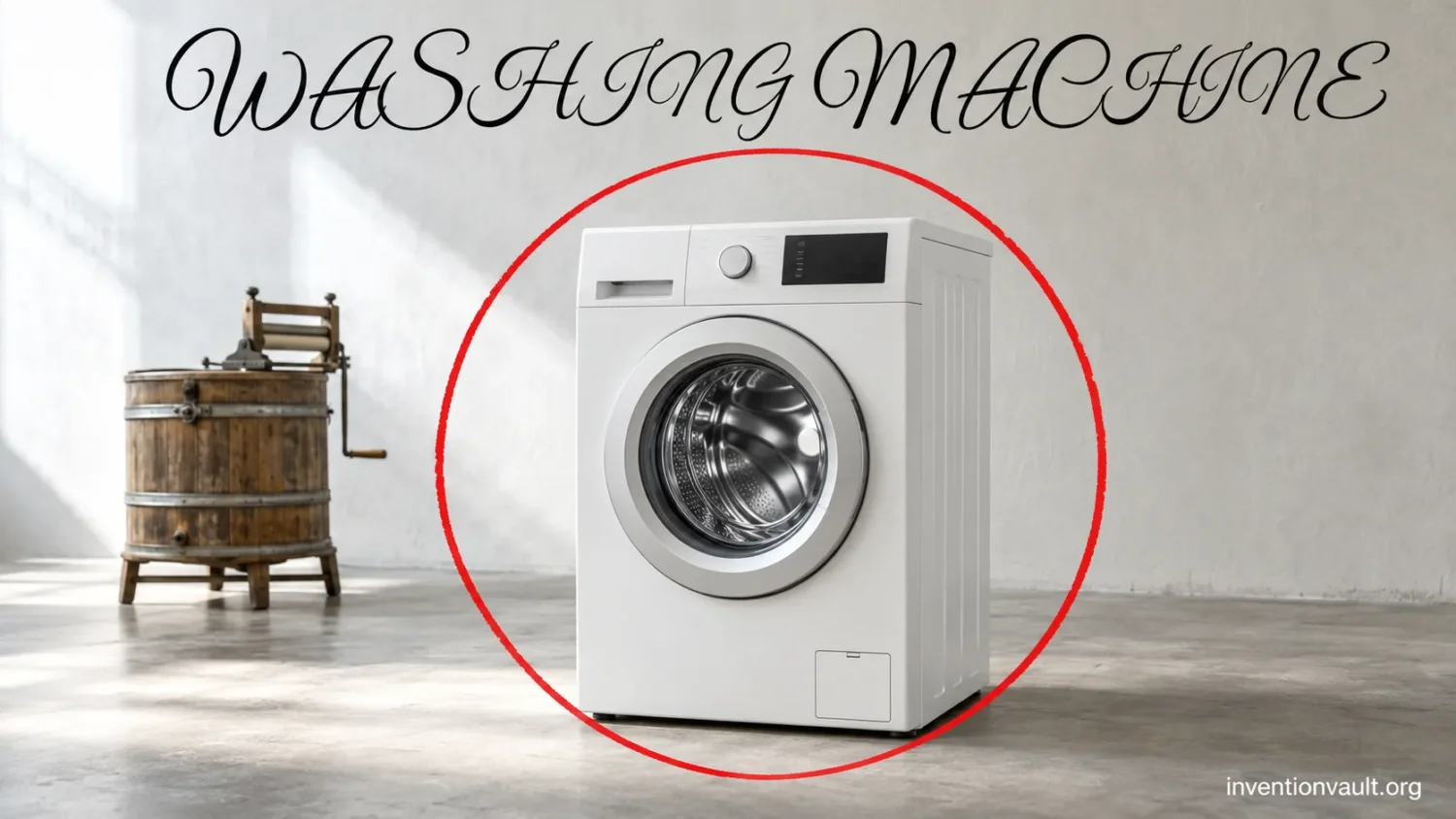
The washing machine was not invented in one step by one person. It developed as designers mechanized separate parts of laundry: moving cloth through soapy water, removing dirty water, rinsing, extracting moisture, and controlling the order of those actions. Hand-powered tubs appeared long before electric washers; electric washers appeared before fully automatic models. The decisive change came in 1937, when the Bendix Home Laundry joined filling, washing, rinsing, draining, and spin extraction into a domestic programmed cycle.
| Development | What it added | What still remained |
|---|---|---|
| Hand tools and washboards | Repeatable rubbing and support for wet cloth | All water, motion, rinsing, and extraction handled by people |
| Hand-powered tubs and drums | Mechanical paddling, plunging, rocking, or rotation | Manual power and water handling |
| Electric washers, early 1900s | Motor-driven wash motion and sometimes a powered wringer | Frequent intervention between stages |
| Bendix automatic washer, 1937 | Timed fill, wash, drain, rinse, and spin in one machine | High price and demanding fixed installation |
| Postwar automatic washers | Improved suspension, controls, materials, and mass production | Uneven access where plumbing or electricity was limited |
| Sensor-controlled washers | Load-responsive water, motion, temperature, and spin | Tradeoffs among time, cleaning, fabric care, and resource use |
Who Invented the Washing Machine?
No single name covers the entire invention. Early records describe washing and wringing mechanisms, while later makers developed tubs, drums, plungers, paddles, wringers, electric drives, transmissions, pumps, timers, and suspended baskets. Each solved only part of the job now performed inside one cabinet.
Jacob Christian Schäffer provides one well-documented early point. In 1767 he published a hand-operated washing machine that used internal paddles in a wooden tub. The Deutsches Museum reports that dozens were produced under his supervision and that closely related designs remained in circulation well into the nineteenth century. His machine mechanized movement, but it did not fill, drain, rinse, or extract water automatically.
The nineteenth century brought many competing mechanisms rather than one accepted blueprint. Hamilton E. Smith’s 1858 U.S. patent, for example, described a reciprocating plunger, yielding diaphragms, and the circulation of heated water through a tub. Other inventors pursued rotary drums, rocking containers, ribbed interiors, and combined washers and wringers. A patent confirms a documented claim to a particular mechanism; it does not by itself prove that the device was built in quantity, worked better than rivals, or reached ordinary homes.
Dating the First
The earliest washing-related patent, the first documented hand-powered machine, the first commercial electric washer, and the first domestic automatic washer refer to different designs. Treating them as one event creates false certainty.
Alva J. Fisher and the Electric-Washer Claim
Alva J. Fisher is often presented as the inventor of the electric washing machine and is closely associated with the Thor washer sold by the Hurley Machine Company. The surviving patent evidence supports a narrower statement. Fisher filed for improvements to a washing-machine drive in 1908 and 1909, and U.S. Patent 966,677 was granted in 1910. It describes a transmission that reversed a perforated cylinder after a set number of turns to reduce bunching.
The patent does not claim electricity itself, nor does it establish that no earlier maker attached a motor to a washer. Electric machines were being advertised and developed by more than one company in the opening years of the twentieth century. Fisher’s documented work belongs in the history of practical powered drives, but the familiar sentence that one man invented the electric washer in one year is too broad for the evidence.
Why Bendix Marks a Different Milestone
Bendix Home Appliances introduced its front-loading Home Laundry in 1937. It is widely credited as the first domestic washer to perform a complete automatic sequence after the user loaded clothes, added cleaning material, selected the controls, and started the machine. Patent filings from the Bendix development program show the engineering behind that claim: timed operation, valves and pumps, low-speed washing, draining, and a much faster spin for centrifugal extraction.
This was not merely an electric washer. It was a controlled system. Early units needed rigid anchoring because they lacked a later washer’s suspended tub and refined imbalance control. Even so, the arrangement made the modern idea of a cycle physically real: one receptacle could wash and then spin the same load without sending wet clothes through a separate wringer.
Electric Is Not Automatic
An electric washer uses a motor for motion. An automatic washer also coordinates water entry, wash action, drainage, rinsing, and extraction. Many early electric models still depended on the user at every transition.
The Work Laundry Required Before Automation
Traditional household laundry was a sequence of water, heat, chemicals, friction, and carrying. The exact routine varied with place, income, fabric, fuel, climate, and access to wells, rivers, washhouses, or piped water. A household might soak clothes, treat stains, boil durable white items, rub fabric against a board or between the hands, rinse it in several changes of water, wring it, and hang it to dry.
The weight of wet textiles made the later stages physically demanding. Water itself was another load. Smithsonian collection notes for a domestic washboard point out that before indoor plumbing, laundering depended on hauling fresh water into the home and dirty water out. A device that reduced rubbing could still leave most of the total job untouched.
Mechanical washers therefore attacked the task in pieces. A tub kept the work contained. Ribs or paddles increased contact between cloth, water, and detergent. A crank or lever repeated movement more evenly than hand rubbing. A wringer extracted water. None of these alone created the modern washer, but each converted an irregular hand action into something a mechanism could repeat.
How a Washing Machine Cleans Clothes
A washer does not clean simply because a drum turns. Soil removal depends on the interaction of wash chemistry, water, temperature, time, and mechanical action. Detergent helps water wet fibers and surround oily or particulate soil. Movement bends fabric and renews the wash liquid at its surfaces. Rinsing then dilutes and carries away the loosened material and remaining detergent.
- Admit and measure waterValves open under controller command. A pressure sensor, flow estimate, or load-sensing routine determines when enough water has entered.
- Wet the loadDrum, agitator, or impeller motion distributes water and detergent through the textiles instead of leaving dry pockets inside the load.
- Apply wash actionProgrammed reversals and pauses expose fabric surfaces to moving wash liquid while limiting tangling, imbalance, and avoidable wear.
- Drain and rinseA pump removes dirty wash liquid. One or more rinse stages add clean water, move it through the load, and drain it again.
- Extract moistureThe basket or drum accelerates to spin speed. Water moves through perforations into the outer tub and is pumped away, leaving the load damp rather than saturated.
The spin stage is an extraction process, not drying in the usual sense. Rotation produces inward acceleration of the drum and clothing; water that is not held tightly by the fibers passes outward through the perforations. A faster final spin generally leaves less water for a clothes dryer or line to remove, although fabric type, balance, and the selected program limit usable speed.
The Outer Tub, Inner Basket, and Suspension
Most automatic washers place a perforated inner basket or drum inside a watertight outer tub. Bearings support the rotating assembly, a door boot or shaft seal keeps water away from the drive, and a pump connects the tub to the drain. Springs and dampers allow the tub assembly to move while reducing the force transmitted to the cabinet and floor.
That suspension solved a problem visible in the early Bendix design. Wet clothes seldom arrange themselves as a perfectly balanced ring. During spin, a heavy cluster creates a repeating off-center force. Modern controls may pause, tumble, and retry distribution; if imbalance remains too high, they reduce speed or stop rather than letting the cabinet absorb the full motion.
Three Main Wash-Action Designs
| Design family | Wash movement | Typical strengths | Engineering limits |
|---|---|---|---|
| Horizontal-axis front loader | A rotating drum lifts and drops clothing through a shallow pool | Low water volume, high spin speed, no center post | Needs a sealed door, flexible boot, and controlled load distribution |
| Vertical-axis agitator washer | A center post oscillates while clothing circulates around it | Direct wash action, easy top access, familiar loading pattern | Agitator occupies basket space and can increase tangling or fabric stress |
| Vertical-axis impeller washer | A low disc or cone creates water currents and garment-to-garment movement | More open basket volume and lower water use than many traditional agitator designs | Load placement and program control strongly affect rollover and cleaning |
No design cleans every load best under every setting. A test result depends on capacity, loading, detergent, soil type, water temperature, cycle selection, and the efficiency target. The broad design family describes how motion is created; it does not predict the performance of every model.
What Made the Automatic Washer Practical
The automatic cycle needed more than a clever tub. It needed components that could survive water, detergent, repeated heating and cooling, vibration, and thousands of starts and stops at a household price.
- Water valves and level controls admitted measured water without constant attention and prevented normal filling from continuing indefinitely.
- Drain pumps moved used water to household plumbing without lowering a hose into a separate container.
- Timers and switches converted the laundry sequence into ordered electrical commands. Later electronic controllers made the order and duration easier to vary.
- Transmissions and variable-speed drives produced slow alternating wash action and much faster spin extraction from one machine.
- Suspension and damping isolated rotating imbalance so washers no longer had to behave like fixed industrial equipment.
- Coated steel, stainless steel, polymers, and elastomers provided corrosion resistance, smooth fabric-contact surfaces, seals, hoses, insulation, and parts that could be formed in quantity.
- Door and lid interlocks kept users away from high-speed rotating parts and, on front loaders, kept a water-bearing door closed during operation.
Household infrastructure mattered just as much. A fully automatic washer assumes a dependable power supply, water under pressure, and a drain that can accept the pump’s discharge. Hot-water supply or an internal heater determines how temperature is controlled. The machine’s spread was therefore uneven: places with limited utilities often favored hand washing, semi-automatic twin tubs, or shared services.
How Washing Machines Changed Domestic Work
The washer reduced direct contact with some of the heaviest parts of laundry, especially repeated rubbing, wringing, lifting between tubs, and supervising each wash stage. Automatic models also created unattended time. The user still sorted, treated, loaded, dosed, unloaded, dried, folded, and stored textiles, but no longer had to power or watch every minute of the wet process.
The change should not be reduced to a single claim that an appliance erased housework. Time-use research finds a more complicated pattern. Household standards, clothing ownership, family routines, paid work, and the division of labor changed alongside appliances. Easier washing could lead to more frequent laundering and higher expectations of cleanliness. The machine altered the timing and physical form of the job even when total household work did not fall in the same proportion.
Access also took several forms. A washer in the home allowed laundry to fit around other tasks. Apartment laundry rooms and laundromats offered powerful machines without private ownership, although they still required travel, waiting, and moving loads. Commercial laundries shifted some work outside the household altogether.
From Mechanical Timers to Load-Responsive Control
Early automatic washers encoded a cycle with cams, contacts, switches, and mechanical timers. A program advanced in a largely fixed order, perhaps with user-selected variations for time, temperature, or water level. Electronic controls made it possible to combine sensor readings with different motor patterns, valve timing, and spin profiles.
A modern washer may estimate load size from motor response before adding much water, measure level through air pressure in a small tube, monitor temperature with a thermistor, and detect imbalance through changing motor speed. The controller can add water, extend a rinse, redistribute the load, or limit final spin. These actions make the machine adaptive, though the quality and purpose of the sensing vary by model.
Efficiency is now measured across the whole laundry system. ENERGY STAR’s Integrated Modified Energy Factor includes washer electricity, water-heating energy, low-power consumption, and the energy associated with moisture left for the dryer. Its Integrated Water Factor relates weighted cycle water use to basket capacity. These measures explain why a high spin speed and a well-controlled low-water wash can matter beyond the electricity consumed by the washer motor.
Lower resource use creates engineering tradeoffs. Less water demands careful wetting and circulation. Lower temperatures can require more time or different detergent chemistry. High spin removes more moisture but raises vibration and fabric-stress concerns. Longer low-energy cycles may use less heating power while holding the load in the machine for more time. Modern development consists largely of managing these linked constraints rather than adding more visible motion.
What the Washing Machine Still Does Not Automate
Most washers cannot reliably decide which garments may be mixed, identify every stain, choose the safest treatment from an incomplete care label, transfer a finished load to a dryer or line, or fold and store it. Automatic dosing, remote status, and washer-dryer combinations extend the sequence, but they do not eliminate judgment or material handling.
The machine also moves environmental burdens rather than making them disappear. Manufacturing requires metals, polymers, electronics, and transport. Each cycle consumes water, energy, and detergent; synthetic textiles can release fibers into wastewater. Product life, repair access, load size, temperature choice, spin performance, and local electricity and water systems all shape the result.
The lasting invention is therefore not one drum or one motor. It is the coordinated cycle that turns several wet, physically demanding operations into a controlled background process. Its history runs through many hands because every stage exposed another task that still needed to be mechanized.
Questions People Ask About Washing Machines
When was the first washing machine invented?
There is no single date that covers every definition. Schäffer published a documented hand-powered design in 1767, electric domestic washers appeared in the early twentieth century, and Bendix introduced a fully automatic domestic cycle in 1937.
Did Alva J. Fisher invent the washing machine?
Fisher developed a documented reversing drive assigned to the Hurley Machine Company, patented in 1910. Calling him the sole inventor overlooks earlier hand-powered machines, rival electric developments, and the later control systems needed for full automation.
What was the first fully automatic washing machine?
The 1937 Bendix Home Laundry is widely credited as the first domestic machine to fill, wash, rinse, drain, and spin through an automatic sequence. Earlier electric washers usually required intervention between operations.
Why does a washing machine reverse direction?
Reversal redistributes laundry, changes fabric movement through the water, and helps limit bunching or tangling. It also assists load distribution before high-speed spin in many drum machines.
References Used for This Article
- Smithsonian National Museum of American History, Washboard – used for the relationship between laundry, water hauling, and life before indoor plumbing.
- Deutsches Museum, Schäffer’s 1767 Washing Machine – used for the published paddle-machine design, production record, and continued use of related forms.
- U.S. Patent 21,909, Washing-Machine – used for Hamilton E. Smith’s 1858 plunger, diaphragm, and heated-water circulation design.
- U.S. Patent 966,677, Drive Mechanism for Washing-Machines – used to define Alva J. Fisher’s documented reversing-drive contribution and patent dates.
- U.S. Patent 2,150,638, Washing Machine – used for the Bendix low-speed wash, high-speed extraction, automatic sequence, and transmission-safety details.
- Consumer NZ, A Brief History of the Washing Machine – used for the 1937 Bendix introduction and the distinction between electric and automatic domestic washers.
- Science Museum Group, Automatic Washing Machine by Bendix – used as museum collection evidence for early Bendix automatic machines.
- Museums Victoria, Washing Machines Collection – used for manual, electric, twin-tub, and postwar design examples across the technology’s spread.
- ENERGY STAR, Clothes Washers – used for modern energy and water metrics, front-loader comparisons, and efficiency terminology.
- National Bureau of Economic Research, Time Spent in Home Production in the 20th Century – used to avoid treating appliance ownership as a one-variable explanation for changes in household labor.