
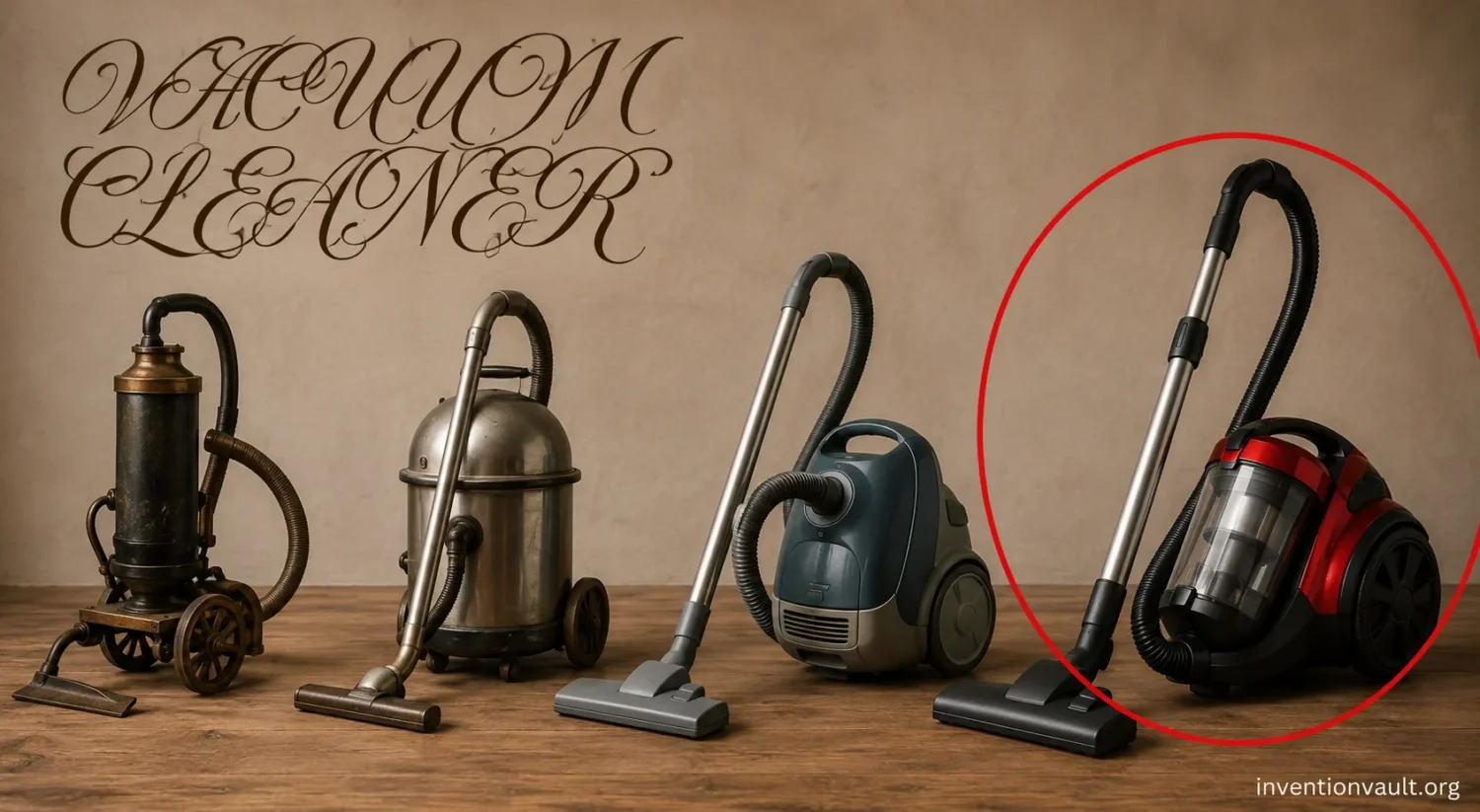
Dust-Control Development File
How Suction Entered the Home
Trace how brushes, airflow, motors, collectors and filters became one practical machine for removing indoor dust.
Household practice
Cleaning Before Suction
Selected file: Cleaning Before Suction. Choose another file to update this evidence card.
Selected
Carpet problem
Woven floor coverings trapped grit below the visible surface. Brooms handled loose debris, but embedded dust often required rugs to be lifted, carried outside and beaten.
Mechanical precursor
Carpet sweepers used wheels and rotating brushes to gather crumbs and larger dirt into a box. They reduced bending and sweeping but did not create a controlled dust-laden airstream.
Missing function
The unresolved task was to loosen fine material, move it away from the floor and hold it inside a machine instead of spreading part of it through the room.
The vacuum cleaner began as a dust-transport problem, not merely a stronger broom.
Patent record
Daniel Hess’s 1860 Carpet Sweeper
Selected file: Daniel Hess’s 1860 Carpet Sweeper. Choose another file to update this evidence card.
Selected
Documented design
U.S. Patent 29,077, dated July 10, 1860, described a wheeled carpet sweeper with a revolving brush and bellows that drew fine dust through the machine.
Wet collection
Dust-laden air was directed into water chambers. The design therefore joined agitation, suction and a form of wet separation in one proposed floor-cleaning apparatus.
Evidence limit
The patent proves a detailed suction concept, yet it does not by itself establish broad manufacture, household sales or routine use of the machine.
Hess recorded the full chain from brush to airflow to dust capture decades before electric household models.
Manual mechanism
Ives McGaffey’s Hand-Cranked Fan
Selected file: Ives McGaffey’s Hand-Cranked Fan. Choose another file to update this evidence card.
Selected
Fan instead of bellows
U.S. Patent 91,145, issued June 8, 1869, used a hand-turned fan to draw dirt upward in an air current while the operator pushed the machine over the floor.
Porous collector
The patent paired the fan with a porous receptacle that retained particles while allowing air to escape, anticipating the dual role later performed by cloth dust bags.
Operating burden
One hand moved the cleaner and the other turned the drive wheel briskly. Suction was portable, but the human operator still supplied both motion and fan energy.
McGaffey brought the fan-and-filter layout closer to later vacuums, though operation remained awkward.
Pressure-cleaning claim
John Thurman’s Pneumatic Renovator
Selected file: John Thurman’s Pneumatic Renovator. Choose another file to update this evidence card.
Selected
1899 patent
U.S. Patent 634,042 covered a device intended to clean carpet without removing it from the floor, an important practical aim for fitted and heavy coverings.
Air-blast method
The apparatus projected pressurized air into and through the carpet, forcing loosened dust toward a collector. Its cleaning action therefore differed from intake suction at the surface.
Historical distinction
Thurman belongs in powered carpet-cleaning history, but calling this patent the first modern vacuum hides the difference between blowing dust out and drawing dusty air inward.
The renovator proved that powered airflow could clean installed carpet, while leaving the direction of airflow unsettled.
Electric floor machine
Corinne Dufour’s Electric Sweeper
Selected file: Corinne Dufour’s Electric Sweeper. Choose another file to update this evidence card.
Selected
1900 patent
Corinne Dufour received U.S. Patent 664,135 on December 18, 1900, for a wheeled electric sweeper and dust gatherer intended for rooms, halls, furniture and other surfaces.
Shared motor drive
An electric motor powered two inward-turning brushes and a suction fan, combining powered agitation and air movement inside a handle-guided floor machine.
Moist collector
The fan directed swept material against a screen holding a moistened sponge or cloth, where dust adhered before the collector was opened for cleaning.
Dufour documented a portable electric brush-and-fan cleaner before powered suction became associated mainly with Booth and Spangler.
Powered suction system
Hubert Cecil Booth’s External Machine
Selected file: Hubert Cecil Booth’s External Machine. Choose another file to update this evidence card.
Selected
Reversed airflow
After seeing compressed air used to dislodge dust, Booth pursued the opposite arrangement: draw air through the surface and retain the dirt before discharging the air.
1901 filing
His British patent filing of August 30, 1901, described dust extraction from carpets and other materials, with dry porous filters and water-based collection among its arrangements.
Service before appliance
The early motor and collector stayed outside on a large mobile unit. Long hoses entered buildings, so customers bought a cleaning service rather than owning a compact machine.
Booth established motor-driven suction cleaning at building scale before the machinery could fit inside an ordinary cupboard.
Domestic configuration
Spangler and Hoover Move Suction Indoors
Selected file: Spangler and Hoover Move Suction Indoors. Choose another file to update this evidence card.
Selected
Integrated head
James Murray Spangler placed an electric motor, fan and revolving sweeper in a floor head, then sent the outgoing air and dirt into a fabric receptacle attached to a handle.
Patent milestone
His application of September 14, 1907, became U.S. Patent 889,823 on June 2, 1908. Related improvements refined carpet protection, brushing and dirt collection.
Manufacturing route
William H. Hoover backed production and used demonstrations and home trials to sell the machine, turning a workable arrangement into a repeatable household product.
Portability, electrification and a sales system mattered as much as suction in making vacuum cleaning domestic.
Air-cleaning refinement
Separation, Sealing and Fine Filtration
Selected file: Separation, Sealing and Fine Filtration. Choose another file to update this evidence card.
Selected
Bagged collection
Fabric and paper bags became both storage containers and filters. As dust loads the material, resistance rises, so airflow depends on bag area, porosity and timely replacement.
Cyclonic separation
Bagless machines spin dusty air so heavier particles move outward into a bin. Cyclones reduce loading on later filters but do not remove the need for fine-particle filtration.
Whole-machine capture
A high-grade filter performs as intended only when the casing and exhaust path prevent bypass leakage. Modern dust control therefore depends on seals as well as filter media.
The modern advance is not suction alone; it is managing every stage of the dusty air path.
The vacuum cleaner was not invented in one step. Daniel Hess patented a hand-powered suction carpet sweeper in 1860; Hubert Cecil Booth developed large motor-driven suction cleaning in 1901; and James Murray Spangler combined an electric fan, rotating brush, handle and dust bag in a portable domestic form in 1907–1908. William H. Hoover then financed, manufactured and marketed that form. Indoor dust removal became practical when agitation, airflow, collection, filtration, portability and electric service could work together in one machine.
| Question | Verified answer |
|---|---|
| What does a vacuum cleaner do? | It loosens or intercepts debris, carries it in moving air, separates the dirt and returns the air through an exhaust path. |
| Earliest detailed U.S. suction patent in this history | Daniel Hess, U.S. Patent 29,077, dated July 10, 1860. |
| Early hand-cranked fan cleaner | Ives W. McGaffey, U.S. Patent 91,145, dated June 8, 1869. |
| Powered air-blast carpet system | John S. Thurman, U.S. Patent 634,042, dated October 3, 1899. |
| Early electric brush-and-fan cleaner | Corinne Dufour, U.S. Patent 664,135, dated December 18, 1900. |
| Powered suction milestone | Hubert Cecil Booth’s British patent filing of August 30, 1901. |
| Parallel building-scale suction filing | David T. Kenney’s U.S. application of November 29, 1901, later patented as 847,947. |
| Portable electric domestic arrangement | James Murray Spangler’s 1907 application, patented as U.S. 889,823 on June 2, 1908. |
| Commercial expansion | William H. Hoover’s manufacturing, demonstrations and in-home sales program after 1908. |
| Core machine elements | Floor tool, brush or agitator, motor-driven fan, air passages, dirt separator, filter or bag, seals and exhaust. |
Dating the First
A patent drawing, a working powered system, a portable electric cleaner and a mass-produced appliance are different milestones. The credited inventor changes when the definition changes.
Why Indoor Dust Was Difficult to Remove
Before suction cleaning, domestic floor care relied on brooms, brushes, cloths, carpet sweepers and outdoor rug beating. Each method addressed a different part of the dirt problem. A broom could move visible debris across a hard floor. A mechanical carpet sweeper could brush crumbs and lint into a container. Neither method reliably carried fine particles from within carpet pile into a closed collector.
Carpets created the engineering demand. Grit settled between fibers, while foot traffic pushed particles deeper. Removing a large rug for beating required space and labor; fitted carpet could not be treated that way. A useful indoor machine had to disturb the pile, maintain enough airflow at the floor, prevent the covering from sealing against the inlet and keep collected material from returning through the exhaust.
This explains why the vacuum cleaner emerged through several overlapping inventions. A brush could loosen dirt without transporting fine dust. A fan could move air without separating particles. A collector could hold debris only if the machine maintained an air path through it. The familiar appliance appeared when these functions were arranged as one controlled circuit.
Manual Suction Before Electric Vacuum Cleaners
Daniel Hess: Brush, Bellows and Water in 1860
Daniel Hess of West Union, Iowa, received U.S. Patent 29,077 for a “carpet-sweeper” on July 10, 1860. Its language is unusually close to the later logic of vacuum cleaning. A revolving brush disturbed the surface, bellows created a continuing current of air, and fine dirt traveled with that air into water chambers. Heavier material remained in the dust box.
The water chambers matter because Hess did not stop at lifting dust. He proposed a place for the dust to leave the airflow. Modern vacuums use bags, bins, cyclones and filters, but the same system question remains: once dirt becomes airborne inside the machine, how is it prevented from leaving again?
The patent is strong evidence of an engineered concept. It is weaker evidence for commercial use. No patent document alone proves that households bought the apparatus in quantity or that its mechanism worked reliably under ordinary conditions. Hess is therefore a sound answer for an early documented suction-based carpet sweeper, not for the first widely adopted electric vacuum.
Ives McGaffey: A Hand-Driven Fan in 1869
Ives W. McGaffey’s U.S. Patent 91,145 replaced bellows with a rotating fan. The operator pushed the cleaner with one hand and turned a wheel with the other. The fan drew dirt upward in an air current, while a porous receptacle retained particles and allowed air to pass out.
That porous container anticipated the cloth bag found on later upright machines. It had to do two jobs at once: store dirt and pass enough air to sustain suction. This remains a basic tradeoff in bagged designs. Finer media can retain smaller particles, yet any restriction also raises resistance to airflow.
McGaffey’s arrangement was portable, but manual power made it cumbersome. The operator supplied the energy for both rolling the cleaner and spinning the fan. The missing step was a compact motor that could produce steady airflow without turning the machine into a service wagon.
Blowing Dust Out Versus Drawing It In
At the end of the nineteenth century, powered airflow entered carpet cleaning before engineers agreed on which direction the air should travel. John S. Thurman’s pneumatic carpet renovator and Hubert Cecil Booth’s suction system are often placed in the same line, but their working principles were not identical.
Thurman’s Air Blast
Pressurized air was projected into or through the carpet to force dust toward a collector. The cleaning force began as positive-pressure airflow directed at the floor covering.
Booth’s Suction
Air was drawn from the carpet into a hose and then through a dust-separation system. The surface became the entry point of a lower-pressure intake path.
John Thurman’s 1899 Pneumatic Carpet Renovator
Thurman filed his application in November 1898 and received U.S. Patent 634,042 on October 3, 1899. The specification described a device that could clean carpet without lifting it from the floor. Air jets forced dust into a collector, addressing a real problem in buildings with heavy or installed floor coverings.
The patent belongs to vacuum-cleaner history because it joined powered airflow, a floor tool and dust collection. Yet its blast action should not be silently converted into suction. The distinction shows why naming one person as the inventor can be misleading: related machines solved the same domestic problem through different airflow arrangements.
Corinne Dufour’s Electric Sweeper and Dust Gatherer
Corinne Dufour of Savannah, Georgia, filed an electric sweeper patent on July 31, 1900, and received U.S. Patent 664,135 on December 18 of that year. Her machine was mounted on small wheels and guided by a handle. An electric motor drove two brushes toward each other and also operated a suction fan above them.
The brushes threw dirt upward, while the fan carried it against a wire screen fitted with a moistened sponge or cloth. The damp material retained dust inside the casing. Dufour also described an adjustable side brush for baseboards and an optional rotating mop for hard floors in hotels, hospitals and similar buildings.
This design is often absent from short invention histories even though it joined an electric motor, powered brushes, a fan and internal dust retention before Booth’s 1901 filing and Spangler’s later upright form. Its existence makes the phrase “first electric vacuum” especially dependent on how suction, portability and demonstrated manufacture are defined.
Hubert Cecil Booth and Powered Suction in 1901
British engineer Hubert Cecil Booth is widely credited with one of the first powered suction cleaners. After observing a compressed-air cleaning demonstration, he reasoned that dust should be drawn through a filter rather than blown into the surrounding space. His British filing of August 30, 1901, described extracting dust from carpets and other materials.
Booth’s patent included several collection arrangements. Dust could gather on flexible porous material, pass through dry filtering media or enter a collector partly filled with water. Baffles and filter surfaces slowed or intercepted particles while the air continued toward the pump.
The machinery was too large to be a normal household possession. A motor, pump and collector remained outside, with hoses routed into the building. The customer paid for operators to clean the premises. This was a service model: centralized equipment served rooms through a temporary hose network.
Booth’s achievement was therefore larger than attaching a motor to a sweeper. He demonstrated that sustained suction could remove dirt from inside occupied buildings and that dusty air required managed separation before exhaust. The next problem was shrinking that system without losing usable airflow.
David T. Kenney’s Building-Scale Suction System
American inventor David T. Kenney filed a separate dust-removal application on November 29, 1901. U.S. Patent 847,947, issued in 1907, described a suction-creating device connected to a narrow-slot cleaning head, with a separator placed between the nozzle and the pump.
Kenney’s layout was suited to houses, offices, factories, railcars and other large spaces. The patent emphasized sucking dirt out of the room and passing dusty air through dry or wet separators. In practice, this line of development supported stationary and centrally piped vacuum installations rather than the self-contained upright form.
Booth and Kenney therefore represent parallel building-scale approaches formed within months of each other. Booth is better remembered in British museum histories; Kenney’s U.S. filings show that powered suction was being engineered independently on both sides of the Atlantic.
The Portable Electric Vacuum Becomes a Household Product
James Murray Spangler’s Integrated Floor Head
In 1907, James Murray Spangler, a janitor in Canton, Ohio, developed an electric carpet cleaner with the main working parts carried by the operator. His patented arrangement placed a motor over a fan chamber, used the fan to create suction, drove a revolving sweeper and directed dirt-laden air into a receptacle.
Spangler filed the application that became U.S. Patent 889,823 on September 14, 1907; the patent was issued on June 2, 1908. The machine’s importance lies in its configuration. The cleaning head, brush, fan and motor traveled together across the floor, while the handle gave the user control and the fabric bag received the exhaust stream and dirt.
Related Spangler patents refined how the machine prevented carpet from being drawn into the mechanism. That detail exposes a less obvious design problem: stronger pressure difference is not automatically better. If the nozzle seals too tightly against a flexible rug, airflow can collapse and the floor covering can obstruct the inlet. Rings, openings and head geometry had to balance pickup with movement.
William Hoover: Production, Trials and Market Reach
Spangler lacked the resources to manufacture at scale. William H. Hoover, a leather-goods manufacturer, supported the venture that became the Electric Suction Sweeper Company. The company refined construction, produced machines in repeatable form and used trained demonstrations and in-home trials to overcome doubts about an unfamiliar appliance.
This commercial work belongs in the invention story. A cleaner could succeed only if motors were dependable, housings could be made consistently, bags and belts could be replaced, sales staff could demonstrate visible results and households had suitable electrical service. Hoover did not originate every technical principle, but his production and sales system helped turn the portable electric suction sweeper into a durable consumer category.
The brand became so dominant in Britain that “hoover” entered everyday speech as a noun and verb for vacuum cleaning. That linguistic result came from market presence, not proof that the company had invented every earlier stage.
How a Vacuum Cleaner Removes Dust
Pressure, Not Empty Space
A household vacuum cleaner does not create a true vacuum. Its fan produces a pressure difference that causes room air to flow through the nozzle and into the machine.
The machine works because air moves from the room toward a lower-pressure region at the fan inlet. Dirt follows when the local airflow and mechanical agitation overcome the forces holding particles to the surface. Large debris, fibers, fine dust and deeply embedded grit do not respond in the same way, so the head, brush and airflow path must work together.
- Loosen the materialA rotating brush, bristles, a hard-floor strip or nozzle edge disturbs particles and exposes them to the intake flow.
- Create an intake flowAn electric motor spins an impeller. The resulting pressure difference draws room air through the opening in the floor tool.
- Carry dust through the air pathMoving air transports loosened particles through the head, hose or internal ducting toward the dirt separator.
- Separate coarse debrisA bag, chamber, water bath or cyclone removes much of the dirt from the moving air and stores it for disposal.
- Capture finer particlesOne or more filters intercept smaller material that was not removed by the first separation stage.
- Return exhaust airThe cleaned airstream passes the motor-cooling and exhaust route, then returns to the room without bypassing the intended filters.
Airflow and Pressure Must Be Balanced
Vacuum performance cannot be described by pressure alone. A sealed nozzle may create a large pressure difference while moving little air. An open nozzle may move plenty of air but exert too little local force to collect heavier debris. Hose diameter, bends, filter loading, leaks and floor-head geometry all change the operating point.
This is why a clogged bag or filter reduces pickup even when the motor still sounds normal. Added resistance lowers the volume of air passing through the machine. It also explains why a crevice tool behaves differently from a wide floor head: the smaller opening concentrates airflow in a narrow area, while the larger head covers more surface.
Why the Brush Roll Matters on Carpet
Air moving over the top of carpet pile may miss grit lodged below. A powered brush bends fibers, strikes or combs the pile and brings particles into the intake region. Spangler’s portable layout was effective because the same motor could support both suction and brushing.
Hard floors often need less agitation. A stiff rotating brush can scatter particles or mark delicate surfaces, so many later cleaners use soft rollers, retractable brushes or floor-specific heads. The vacuum cleaner is therefore a family of surface tools attached to a shared air-moving system, rather than a single nozzle that works equally well everywhere.
From Cloth Bags to Cyclones and HEPA Filters
Bags as Both Collectors and Filters
Early portable electric cleaners commonly sent exhaust air into a cloth bag. The bag caught dirt while allowing air to escape. Disposable paper and synthetic bags later made emptying cleaner and allowed layers with different pore structures.
A bag changes as it fills. A layer of captured dust can improve retention of some particles, yet it also blocks passages through the media. Airflow falls as resistance rises. Larger bag area, pleating and multiple media layers help delay that loss, but no bag can load indefinitely without affecting performance.
Cyclonic Separation and the Bagless Bin
A cyclone introduces dusty air tangentially into a chamber so the flow rotates. Particles with greater inertia move toward the outer wall, lose speed and fall into a bin. Multi-cyclone layouts divide the airflow among smaller chambers to improve separation of finer material before the final filter.
Domestic cyclonic machines appeared long after the basic suction cleaner. The G-Force cyclonic vacuum made in Japan during the second half of the 1980s, followed by later dual-cyclone models, helped establish the bagless form as a visible consumer alternative.
“Bagless” does not mean “filterless.” Fine particles can remain in the outgoing air after cyclone separation, so modern units normally use pre-motor and exhaust filters. Emptying an open bin can also release some collected dust back into the air, a tradeoff avoided by a sealed disposable bag.
HEPA Media and the Sealed Exhaust Path
The U.S. Environmental Protection Agency defines a HEPA filter as a pleated mechanical air filter capable, in theory, of removing at least 99.97 percent of airborne particles measuring 0.3 micrometers in the test condition it describes. The 0.3-micrometer value represents a demanding particle size for the filter; it does not mean the media captures only particles larger than that size.
A filter rating applies to air that passes through the filter. Whole-machine dust control also depends on gaskets, housing joints, bag seating and the route around the motor. If exhaust can leak around the media, installing a fine filter does not produce the same result as a cleaner designed so all outgoing air crosses the final stage.
Hazardous Dust
Ordinary household vacuums should not be used for asbestos debris or renovation dust known to contain lead. These materials require purpose-designed HEPA equipment, containment procedures and applicable professional or agency guidance.
Why the Vacuum Cleaner Took Decades to Spread
A workable electric cleaner did not instantly become a normal household appliance. Early machines were expensive, electrical supply was uneven and many homes still relied on low-cost manual methods. The Science Museum notes that high purchase prices and limited electrical provision kept traditional carpet cleaning common until after the Second World War.
Adoption required an industrial chain around the machine. Small electric motors had to survive dust, vibration and repeated starting. Flexible cords, switches, bearings, belts and insulation needed to be safe enough for domestic use. Manufacturers had to stamp or cast housings, produce bags and attachments, stock spare parts and organize repairs.
Sales methods also solved an information problem. Customers could not judge an invisible pressure difference from a catalogue picture. A live trial could show material collected from a carpet that appeared clean. The dirt in the bag became proof of operation and helped manufacturers justify the cost.
Flooring patterns influenced demand. Upright vacuums fitted homes with large carpeted areas, while canister machines and hoses suited mixed surfaces, stairs, curtains and furniture. Regions where hard floors were more common often had less reason to replace sweeping and mopping with a heavy carpet-focused machine.
Vacuum Cleaner Design Families
| Design | Main arrangement | Dust-removal strength | Tradeoff |
|---|---|---|---|
| Upright | Motor, brush head and collector move as one floor unit. | Direct carpet agitation and a short path from head to separator. | Bulkier on stairs and above-floor surfaces. |
| Canister or cylinder | Motor and collector trail behind a hose-connected tool. | Interchangeable heads reach floors, furniture, corners and curtains. | Longer hose paths add resistance and the body must be pulled. |
| Central vacuum | A fixed motor and collector connect to wall inlets through building ducts. | Large collector and exhaust that may be routed away from occupied rooms. | Requires installed pipework and planned inlet locations. |
| Cordless stick | Compact motor, battery and bin travel with a lightweight wand. | Fast access encourages frequent removal of surface dust and crumbs. | Runtime, bin volume and sustained airflow depend on battery and size. |
| Robotic | A low mobile body combines suction, brushes, sensors and navigation. | Repeated autonomous passes collect routine floor debris. | Limited access to stairs, furniture and deeply embedded carpet dirt. |
| Wet-and-dry | A protected motor system draws debris or liquid into a rigid tank. | Handles workshop material and spills unsuitable for a dry fabric bag. | Filtration and setup must match wet or dry operation. |
What Indoor Suction Cleaning Changed
The vacuum cleaner allowed dust to be removed from installed carpet without carrying the covering outdoors. It extended cleaning to stairs, upholstered furniture, curtains, mattresses, vehicle interiors and narrow gaps by connecting the same fan system to different tools. Large building services evolved into portable appliances, central installations, industrial extraction units and autonomous floor robots.
The change was not simply that households could clean faster. Suction made it practical to clean more often and to target places that brooms could not reach. At the same time, machines created new maintenance work: bags had to be replaced, filters washed or renewed, brush rolls cleared, belts changed and bins emptied without redistributing the contents.
The invention also shifted the meaning of indoor cleanliness. Visible crumbs were no longer the only material a machine claimed to remove. Manufacturers competed over embedded grit, fine dust, edge pickup and exhaust filtration. Each claim depended on a different part of the airflow circuit, which is why motor wattage alone cannot describe cleaning performance.
Who Invented the Vacuum Cleaner?
The most accurate answer depends on the milestone being asked about:
- Daniel Hess documented an early brush-and-suction carpet sweeper with water collection in U.S. Patent 29,077 in 1860.
- Ives W. McGaffey patented a portable hand-cranked fan cleaner with a porous dirt receptacle in 1869.
- John S. Thurman patented a powered pneumatic carpet renovator in 1899, using an air blast rather than surface suction.
- Corinne Dufour patented an electric sweeper in 1900 that combined powered brushes, a suction fan and a moist dust-retaining surface.
- Hubert Cecil Booth developed one of the first powered suction-cleaning systems in 1901 and operated it as a building-cleaning service.
- David T. Kenney filed a parallel U.S. suction-system patent in 1901 for building and industrial dust removal.
- James Murray Spangler created a practical portable electric layout in 1907–1908 with a motor, fan, brush and dust bag moving across the floor together.
- William H. Hoover supplied the manufacturing and sales structure that carried the portable electric cleaner into a broad household market.
No one of these contributions contains the whole invention. The vacuum cleaner is better understood as a linked sequence: mechanical agitation, induced airflow, dust separation, powered suction, portable electrification, industrial manufacture and finer exhaust control.
Questions People Ask About Vacuum Cleaners
Was Hubert Cecil Booth the first vacuum-cleaner inventor?
Booth is a defensible answer for an early powered suction-cleaning system. He was not the first person to patent a device that used suction to collect carpet dust; Hess and McGaffey had earlier U.S. patents for manually powered machines.
Did John Thurman invent the first powered vacuum cleaner?
Thurman patented a powered carpet-renovating system before Booth, but his 1899 patent projected an air blast through the carpet to force dust into a collector. Whether it is called a vacuum depends on whether the term is being used broadly for pneumatic cleaning or narrowly for suction at the floor tool.
Why is a vacuum cleaner called a Hoover?
Hoover became a generic everyday term in Britain because the company’s machines, demonstrations and advertising gained a strong market presence. The word reflects brand dominance rather than sole authorship of the underlying technology.
Do bagless vacuum cleaners still need filters?
Yes. Cyclones remove much of the heavier material before the air reaches a filter, but fine particles can remain. Bagless cleaners usually rely on one or more filters, and their seals must keep exhaust from bypassing those stages.
The Lasting Design Logic
Modern vacuum cleaners vary in size, power source, navigation and collection method, yet their essential task remains the one identified by the earliest inventors: detach dirt, move it in air and stop it from returning. Hess explored bellows and water. McGaffey paired a fan with porous fabric. Thurman used powered pressure to free carpet dust. Booth built a motorized suction service. Spangler and Hoover placed the working system in the user’s hands.
Later designs improved each link rather than replacing the basic sequence. Better floor heads exposed more debris to airflow. Electric motors became smaller and faster. Bags, cyclones and filters divided coarse and fine separation. Sealed housings managed exhaust. Batteries and sensors changed when and where the machine could operate. Indoor dust removal became a mature technology because engineers learned to treat the cleaner as one continuous air path from floor to exhaust.
References Used for This Article
- National Museum of American History — Hoover Upright Vacuum Cleaner: used for Spangler’s portable electric arrangement, Hoover’s manufacturing role and the company’s in-home demonstration strategy.
- U.S. Patent 29,077 — Daniel Hess, Carpet-Sweeper: used for the 1860 brush, bellows, airflow and water-chamber design.
- U.S. Patent 91,145 — Ives W. McGaffey, Improved Sweeping-Machine: used for the hand-driven fan and porous dirt receptacle.
- U.S. Patent 634,042 — John S. Thurman, Pneumatic Carpet-Renovator: used to distinguish the 1899 air-blast method from intake suction.
- U.S. Patent 664,135 — Corinne Dufour, Electric Sweeper and Dust-Gatherer: used for the 1900 electric motor, dual brushes, suction fan and moist dust collector.
- British Patent GB190117433A — Hubert Cecil Booth, Extraction of Dust from Carpets and Other Materials: used for Booth’s 1901 filing and its dry and water-based dust collectors.
- U.S. Patent 847,947 — David T. Kenney, Apparatus for Removing Dust: used for the 1901 U.S. filing, narrow-slot suction head and building-scale separation system.
- U.S. Patent 889,823 — James M. Spangler, Carpet Sweeper and Cleaner: used for the 1907 application, 1908 patent and integrated motor, fan and brush layout.
- Science Museum — The Invention of the Vacuum Cleaner: used for Booth’s service machine, Spangler’s sale to Hoover and the limits on household adoption before wider electrification.
- Science Museum Group Collection — G-Force Cyclonic Vacuum Cleaner: used for the dating and identification of an early domestic cyclonic model.
- U.S. Environmental Protection Agency — What Is a HEPA Filter?: used for the HEPA efficiency definition and interpretation of the 0.3-micrometer test size.
- U.S. Environmental Protection Agency — Protect Your Family from Exposures to Asbestos: used for the warning against ordinary household vacuums on asbestos debris.