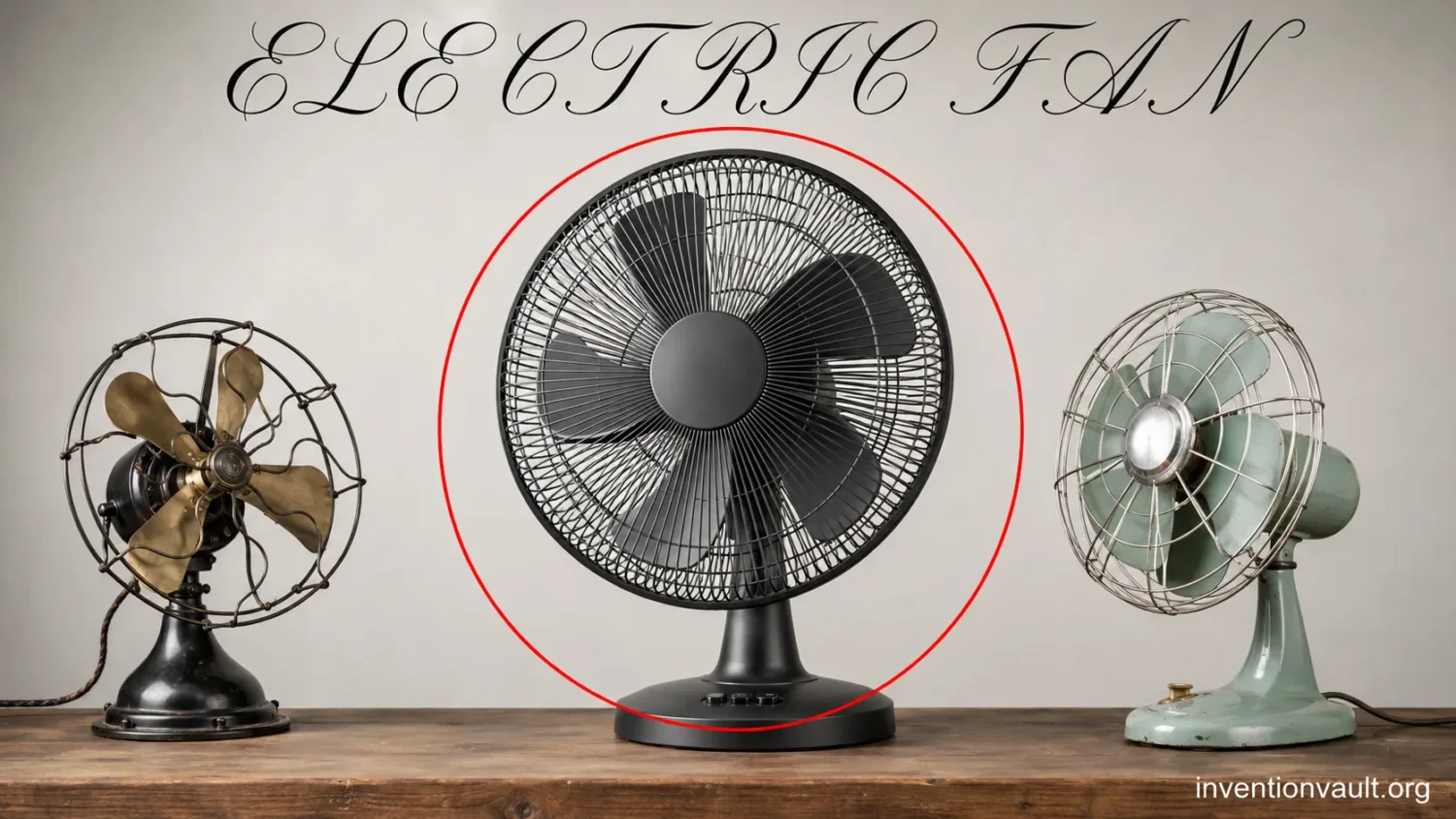
Air-Movement Design Record
How the Electric Fan Took Shape
Trace how compact motors, shaped blades, protective guards, and movement controls turned rotating shafts into practical air circulation.
Pre-electric airflow
Air Movement Before Small Motors
Selected file: Air Movement Before Small Motors. Choose another file to update this evidence card.
Personal cooling
Hand fans and suspended cloth fans created a breeze by repeatedly pushing a broad surface through the air. Their output depended entirely on human effort.
Mechanical ventilation
Larger workshops, mines, furnaces, and ships used bellows or rotary blowers driven by belts, water wheels, or steam machinery when sustained airflow was needed.
The missing component
A self-contained household fan required a motor small enough to sit beside the blades, start reliably, and operate without a remote shaft or belt drive.
Electricity did not invent the fan blade; it supplied the compact, continuous drive that made personal mechanical airflow practical.
Direct-drive milestone
Schuyler Wheeler’s Two-Blade Fan
Selected file: Schuyler Wheeler’s Two-Blade Fan. Choose another file to update this evidence card.
Recorded date
Schuyler Skaats Wheeler is widely credited with producing a recognizable electric desk fan in 1882, when he was about twenty-two years old.
Defining arrangement
Wheeler placed a two-blade propeller directly on an electric motor shaft. Direct drive removed the belts and remote machinery associated with many earlier powered fans.
Documented recognition
The Franklin Institute’s award record identifies Wheeler, the year 1904, and the electric fan as the subject of his John Scott Medal recognition.
Early limitation
The exposed blades, limited speed control, heavy motor, and dependence on an available electrical supply kept early units far from the light household fans sold later.
Wheeler’s compact motor-and-propeller arrangement established the direct mechanical layout retained by many portable fans.
Ceiling design patent
Philip Diehl Moves the Fan Overhead
Selected file: Philip Diehl Moves the Fan Overhead. Choose another file to update this evidence card.
Patent record
Philip Diehl filed his electric-motor fan application on August 12, 1889. U.S. Patent No. 414,758 was granted on November 12 of that year.
Suspended motor
The patent described a motor and short vertical fan shaft carried below a supporting rod, placing broad rotating blades where they could circulate room air.
Adjustable height
One claim covered a telescopic supporting rod. This allowed the fan assembly to hang at a suitable distance beneath ceilings of different heights.
Manufacturing aim
Diehl described a motor arranged for inexpensive construction, convenient assembly, and disassembly, connecting airflow performance with maintenance and production needs.
The ceiling layout expanded the fan from a directed desk appliance into a machine for circulating air through an occupied room.
Household adaptation
More Blades, Guards, and AC Motors
Selected file: More Blades, Guards, and AC Motors. Choose another file to update this evidence card.
Surviving hardware
A Smithsonian fan dated to about 1895 combines a bipolar motor, brass brushes, an armature, four blades, and a surrounding cage.
Guard function
A metal cage reduced accidental contact and protected rotating blades from nearby objects. Early guard openings could still be wider than those accepted on later household products.
Changing electrical supply
Early direct-current fans were joined by alternating-current models as AC distribution spread. Motor designs had to match the current, voltage, frequency, and intended starting method.
Smaller windings
Improved electrical insulation around copper windings permitted tighter coils and more compact motors, reducing some of the bulk associated with early fan drives.
Electrical compatibility, compact windings, and guarded blades helped move the fan toward routine indoor use.
Coverage control
Oscillation and Selectable Speed
Selected file: Oscillation and Selectable Speed. Choose another file to update this evidence card.
Mechanical sweep
An oscillating fan diverts part of the motor’s rotation through reduction gears and a crank linkage, causing the fan head to turn slowly from side to side.
Coverage tradeoff
Oscillation distributes moving air across a wider zone, although each person receives the strongest breeze only while the fan points toward that position.
Speed selection
Multiple winding connections, capacitors, electronic controllers, or motor-drive circuits can change rotational speed. The method depends on the motor fitted to the fan.
Noise control
Blade balance, bearing condition, motor vibration, grille turbulence, and tip speed all influence sound. Slower large blades can sometimes deliver useful airflow with less harsh noise.
The fan became more adaptable when users could choose where the breeze travelled and how strongly it arrived.
Current engineering
Efficient Motors and Shaped Airflow
Selected file: Efficient Motors and Shaped Airflow. Choose another file to update this evidence card.
Motor choices
Current fans may use shaded-pole, permanent-split-capacitor, universal, or brushless DC motors. Size, cost, efficiency, noise, and control requirements determine the selection.
Blade geometry
Pitch, chord, curvature, blade count, diameter, clearance, and rotational speed shape the resulting airflow. Decorative appearance alone does not reveal a fan’s delivery or efficiency.
Electronic control
Brushless motors use electronic commutation instead of brushes. Integrated controls can provide several speeds, timers, remote operation, and lower-speed performance without mechanical switching.
Extended roles
Electric fans now circulate room air, exhaust moisture, ventilate equipment, cool electronic components, move air through heat exchangers, and support large industrial processes.
Modern improvements refine motor losses, sound, control, and blade performance while preserving the original motor-driven airflow principle.
The electric fan emerged when Schuyler Skaats Wheeler placed a two-bladed propeller on the shaft of a small electric motor in 1882. That compact arrangement is commonly treated as the starting point for the recognizable electric desk fan. Philip Diehl later developed a suspended electric-motor fan documented in U.S. Patent No. 414,758, granted in 1889, which helped define the ceiling-fan layout. Neither machine refrigerated air. Each used rotating blades to create airflow, improving comfort by increasing heat transfer and sweat evaporation from the skin.
| Development point | Documented detail |
|---|---|
| Recognizable electric desk fan | Schuyler Skaats Wheeler’s two-blade, direct-drive arrangement, dated to 1882 |
| Ceiling-mounted electric fan | Philip Diehl’s suspended motor and vertical fan shaft |
| Ceiling-fan patent | U.S. Patent No. 414,758, granted November 12, 1889 |
| Operating principle | An electric motor rotates pitched blades that impart momentum to air |
| Comfort effect | Moving air increases convective and evaporative heat loss from the body |
| What it does not do | A circulating fan does not contain a refrigeration cycle or remove room heat |
Who Invented the Electric Fan?
Schuyler Wheeler receives the usual credit for the first recognizable electric fan because his 1882 device joined two elements in a direct and compact form: a small motor and a propeller mounted on its shaft. The motor supplied continuous rotation without a belt running to a distant steam engine, water wheel, or line shaft.
Wheeler’s machine was an early desk-style fan rather than a modern enclosed appliance. It had exposed blades and depended on the electrical systems available during the opening years of commercial electric service. The arrangement nevertheless established a lasting pattern: motor, shaft, hub, and pitched blades aligned along a common axis.
Philip Diehl addressed a different application. His electric-motor fan patent described a suspended assembly with a vertical fan-carrying shaft, stationary field magnet, rotating armature, supporting rod, and lubrication provisions. The design placed broad blades overhead, where they could circulate air through a larger occupied area without taking up floor or desk space.
Dating the First
Wheeler’s 1882 credit, Diehl’s ceiling design, Diehl’s 1889 patent, later commercial models, and eventual household adoption describe different milestones. A patent date should not be substituted automatically for the date of an earlier working device.
What Came Before Electric Air Circulation?
People produced local airflow with hand fans, rigid screens, feathers, and suspended cloth fans long before motors were available. A hand fan repeatedly pushes a surface through still air. A suspended punkah performs a similar task over a wider area when pulled back and forth by a person or mechanism.
Industrial ventilation followed another path. Bellows and rotary blowers supplied furnaces, mines, ships, and workshops. Water, steam, animal power, or a factory’s belt system could drive them. These machines could move large volumes of air, but their drives were too extensive for a portable appliance placed beside a chair or workbench.
The small electric motor changed that constraint. It converted electrical energy into rotation at the point where airflow was required. Once the motor and blades shared one compact assembly, manufacturers could develop table, wall, pedestal, ceiling, window, and equipment-cooling fans around the same mechanical idea.
How an Electric Fan Moves Air
Most familiar desk, pedestal, box, and ceiling fans are axial-flow machines. Air approaches the rotating blades roughly parallel to the shaft and leaves in the same general axial direction. The blades do not scoop fixed packets of air like spoons. Their angled surfaces create pressure and velocity changes as they rotate.
- The motor produces torqueCurrent in the motor windings creates magnetic fields that exert force on the rotor, turning electrical input into shaft rotation.
- The shaft rotates the blade hubThe rotor and shaft carry the hub at a speed determined by the motor design, supply, load, and selected control setting.
- Pitched blades accelerate airEach moving blade develops a pressure difference across its surfaces and gives the surrounding air momentum in the intended flow direction.
- The airflow reaches the occupied zoneThe outgoing stream mixes with nearby air and increases air velocity across skin, objects, heat sinks, or ventilated spaces.
Blade performance depends on more than diameter. Pitch changes how strongly a blade acts on the air, while curvature and width influence pressure, flow, efficiency, and noise. Tip clearance, grille shape, rotational speed, and obstructions near the inlet also affect delivery. An attractive blade set can perform poorly if its motor, geometry, and surrounding housing are mismatched.
Air Movement Is Not Refrigeration
A circulating fan normally leaves the room’s average air temperature almost unchanged and adds a small amount of motor heat. Its cooling sensation comes mainly from faster convection and evaporation at the skin. A window or exhaust fan can lower indoor temperature only when it replaces warmer indoor air with cooler air.
The Parts That Made Fans Practical
A fan contains few visible systems, yet each one affects reliability and comfort. Early development therefore continued well after engineers had proved that a motor could turn a propeller.
| Part | Function | Design concern |
|---|---|---|
| Electric motor | Produces the torque needed to rotate the blades | Starting behavior, efficiency, heat, noise, and supply compatibility |
| Shaft and bearings | Support smooth, aligned rotation | Friction, lubrication, wear, vibration, and service life |
| Hub and blades | Transfer shaft torque to the air | Balance, pitch, stiffness, mass, diameter, and fatigue resistance |
| Guard or housing | Restricts contact and directs or protects the airflow path | Opening size, strength, resistance to airflow, and cleaning access |
| Speed control | Changes motor operation and airflow output | Motor compatibility, electrical losses, low-speed stability, and sound |
| Oscillation mechanism | Sweeps a portable fan head across a wider area | Gear wear, linkage geometry, sweep angle, and disengagement |
| Base, bracket, or downrod | Holds the rotating assembly in its operating position | Stability, vibration isolation, clearance, and structural attachment |
Motors and Electrical Supply
Early fans were often built for direct-current systems. As alternating-current distribution expanded, manufacturers produced motors suited to AC service. The change was more involved than fitting a different plug: the magnetic circuit, windings, starting behavior, insulation, and controls had to suit the available supply.
Many inexpensive AC table fans use shaded-pole motors, while larger portable and ceiling fans often employ permanent-split-capacitor motors. Modern brushless DC fans first rectify or electronically process the electrical supply and then switch current through the motor windings in a controlled sequence. This electronic commutation removes rubbing brushes and permits finer speed control.
Blades, Guards, and Housings
Early blades were commonly metal. Steel and aluminum provided stiffness, although their weight demanded secure hubs and good balance. Later molded plastics lowered mass, allowed complex curves to be formed in one part, and reduced corrosion concerns. Material choice still requires enough stiffness to keep the blade shape stable during rotation.
Guards developed alongside domestic use. A cage must limit access to the rotating blades while allowing air to enter and leave without excessive resistance or grille-generated noise. Box fans and equipment fans go further by placing the impeller inside a surrounding frame or duct.
Bearings, Balance, and Sound
A slightly unbalanced blade assembly generates a repeated centrifugal load on the shaft and bearings. The result may be vibration, rattling, bearing wear, or movement of the fan base. Manufacturers control this through material consistency, accurate hubs, blade matching, rotor balancing, and firm structural support.
Air itself also creates sound. Fast blade tips, abrupt grille bars, separated airflow, and turbulence near obstructions can produce tonal or rushing noise. Larger fans can often deliver a desired breeze at a lower rotational speed, although actual results depend on the whole design rather than diameter alone.
From Electrical Novelty to Household Appliance
The first fans entered a market with limited electrical access. Motors were heavy, copper windings required bulky insulation, and electrical supply characteristics differed between locations. Early ownership therefore depended on far more than the existence of a working blade and motor.
Broader electrical distribution created a larger market. Improved winding insulation allowed copper conductors to occupy less space, while better steel forming, casting, bearings, switches, and production tooling reduced the difficulty of making repeatable units. Protective guards and steadier bases made portable fans more suitable for occupied rooms.
Oscillation addressed another practical weakness: a fixed desk fan directs its strongest airflow into a narrow zone. Reduction gearing slowed part of the motor’s rotation, and a crank converted that rotation into the side-to-side movement of the fan head. The user could then choose between a steady directed stream and a sweeping breeze.
Variable speeds further separated normal use from the single-speed early machine. A lower setting reduced the intensity of the breeze and could lower noise. Higher settings provided greater air velocity when heat or ventilation demands rose. The electrical method used to obtain those settings changed with the motor type.
Main Electric Fan Designs
| Fan type | Airflow arrangement | Typical role |
|---|---|---|
| Desk or table fan | Directed axial stream, often with oscillation | Personal or small-zone comfort |
| Pedestal fan | Elevated axial stream from an adjustable stand | Air movement across beds, seating, or work areas |
| Ceiling fan | Large, slow-moving blades circulate air through a room | Occupant comfort and temperature mixing |
| Box or window fan | Axial flow through a square frame or window opening | Room circulation or indoor-outdoor air exchange |
| Exhaust fan | Moves indoor air through a wall, roof, or duct opening | Removal of moisture, odors, heat, or contaminants |
| Centrifugal fan | Air enters near the shaft and leaves radially through a housing | Duct systems and applications requiring higher pressure |
| Electronics fan | Compact axial or centrifugal airflow through equipment | Carrying heat away from components and heat sinks |
Axial and centrifugal fans serve different flow conditions. Axial designs are suited to moving substantial air along the shaft direction where resistance is relatively low. Centrifugal impellers redirect air outward and can develop the pressure needed to overcome filters, heat exchangers, bends, and duct resistance.
The term blower often suggests a machine designed for greater pressure, but everyday product names are inconsistent. Engineering selection relies on measured airflow, pressure, efficiency, speed, and the resistance of the system in which the machine will operate.
What Electric Fans Changed
In homes and workplaces, the electric fan supplied repeatable airflow without continuous manual effort. A desk fan could serve one workstation; a ceiling fan could cover a broader occupied zone; and an exhaust fan could remove humid or contaminated air from a specific room.
Fans also became parts of other machines. Electric motors, generators, vehicle systems, computers, refrigeration equipment, and industrial controls produce heat that must be transferred to surrounding air or carried to a heat exchanger. Compact fans made forced-air cooling possible where natural convection was insufficient.
Mechanical air conditioning did not make the fan obsolete. Air-conditioning systems themselves depend on fans to move indoor air across cooling coils and through ducts. A separate circulating fan can raise air velocity around occupants, allowing comfort at a higher thermostat setting under suitable conditions.
Ventilation requires a different assessment from comfort circulation. A fan that merely recirculates indoor air does not remove moisture, smoke, carbon dioxide, or other contaminants. Exhaust and supply paths must actually exchange or treat the air, and their capacity must account for ducts, openings, and pressure resistance.
The Modern Fan Retains a Simple Principle
Current fan engineering concentrates on obtaining useful airflow with lower electrical losses, less unwanted sound, and better control. Brushless motors, electronic drives, improved magnetic materials, molded blade profiles, and more accurate balancing refine the machine without changing its basic energy path.
Efficiency cannot be judged from motor wattage alone. A fan may draw little electricity yet deliver poor airflow, while another may move more useful air for each watt. The operating point also matters in ducted systems because filters, grilles, bends, and narrow passages resist flow and alter both delivery and power demand.
Controls now range from simple switches to remote transmitters, timers, temperature sensors, and variable-speed electronics. These additions change how the fan responds, but the physical task remains direct: apply motor torque to shaped blades and transfer momentum to air.
Questions People Ask About the Electric Fan
Did Thomas Edison invent the electric fan?
No. Edison contributed to electrical generation and distribution systems that supported early motor appliances, but the recognizable 1882 electric fan is generally credited to Schuyler Skaats Wheeler.
Was the ceiling fan invented at the same time?
The milestones are separate. Wheeler’s 1882 machine is associated with the early electric desk fan. Philip Diehl developed a ceiling-mounted arrangement and received U.S. Patent No. 414,758 for an electric-motor fan in 1889.
Does running a fan lower room temperature?
A recirculating fan usually does not. It makes occupants feel cooler by moving air across the skin. A window or whole-house fan can reduce indoor temperature when it brings in cooler outdoor air and provides a suitable exhaust route.
Why does an oscillating fan use gears?
The blade shaft rotates too quickly for a comfortable side-to-side sweep. Reduction gears produce a much slower output, while a crank and linkage convert that rotation into repeated angular movement of the fan head.
Why do some modern fans use brushless DC motors?
Electronic commutation allows broad speed control without mechanical brushes. A well-designed brushless drive can reduce motor losses and maintenance while supporting timers, remote controls, and low-speed operation.
References Used for This Article
- The Franklin Institute, “Schuyler S. Wheeler” — award record connecting Wheeler, the electric fan, and the 1904 John Scott Medal.
- American Society of Mechanical Engineers, “Air Movers” — historical identification of Wheeler’s 1882 two-blade electric fan.
- U.S. Patent No. 414,758, “Electric-Motor Fan” — Philip Diehl’s suspended motor, shaft, supporting rod, lubrication, and manufacturing claims.
- Smithsonian National Museum of American History, “Electric Fan with Bi-Polar Motor” — physical evidence for a guarded four-blade fan dated to about 1895.
- U.S. Department of Energy, “Fans for Cooling” — modern guidance on circulating fans, comfort effects, ceiling fans, and window ventilation.
- Air Movement and Control Association International, ANSI/AMCA Standard 99-25 — terminology for axial, centrifugal, tubeaxial, and related fan arrangements.
- Edison Tech Center, “The Electric Fan” — early motor construction, winding insulation, AC adoption, blades, and fan design changes.