
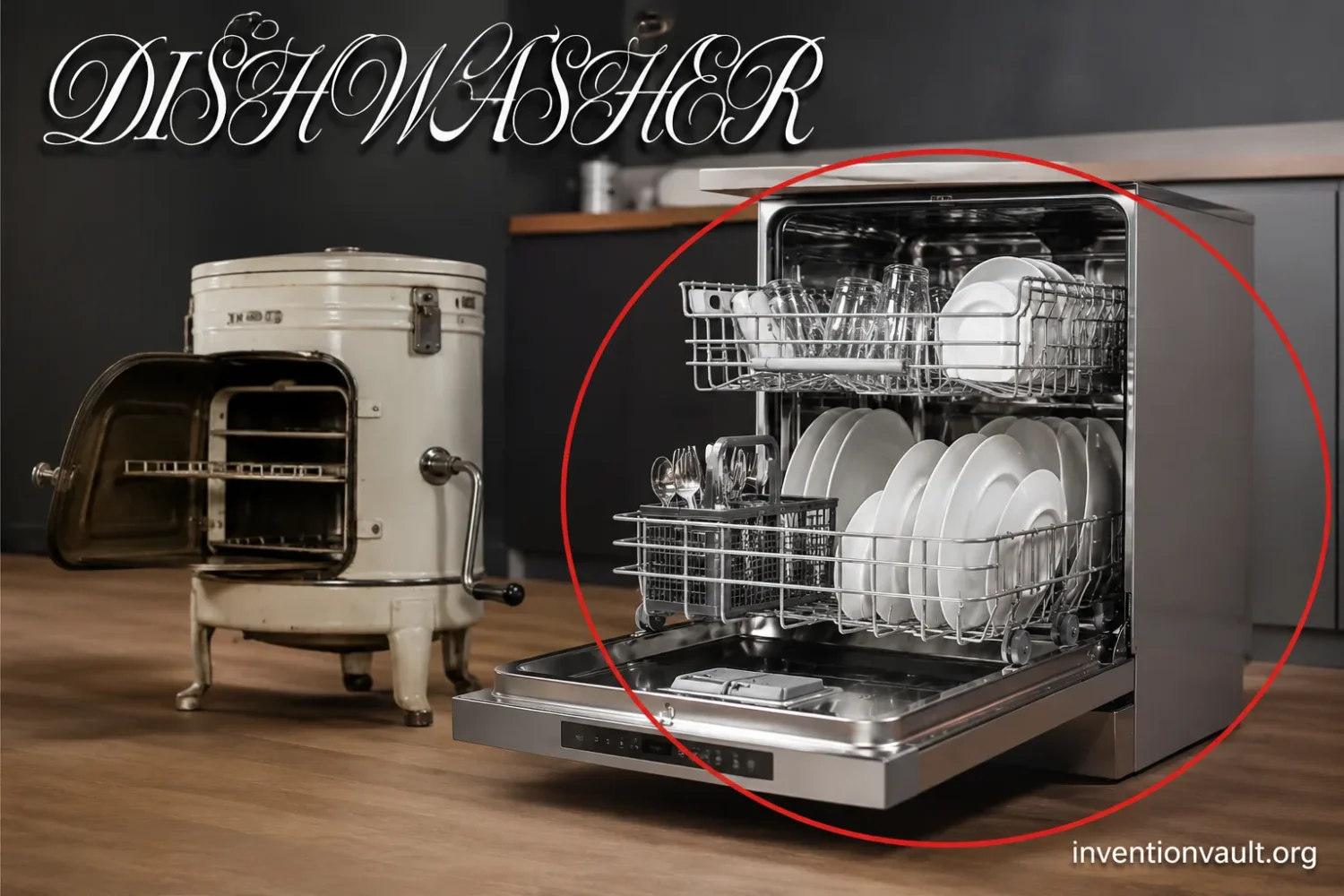
Dishwashing Design Record
How Dishwashing Became Automatic
Follow the shift from hand-cranked vessels to pressure jets, commercial machines, timed household cycles, and sensor-controlled water use.
Patent origin
Joel Houghton’s 1850 Machine
Selected file: Joel Houghton’s 1850 Machine. Choose another file to update this evidence card.
Selected
Recorded claim
U.S. Patent No. 7,365, issued on May 14, 1850, described a vessel holding tableware while a hand-turned shaft and buckets threw water against it.
Human effort remained
The operator still supplied the motion, and the design did not yet provide controlled jets, dedicated wash and rinse circuits, or a protected path for fragile dishes.
What the patent established
Houghton documented the idea that dishes could be cleaned inside a machine by moving water rather than rubbing every surface by hand.
The first patent marked the problem, but not yet a machine suited to dependable service.
Mechanical refinement
Levi Alexander’s Moving Rack
Selected file: Levi Alexander’s Moving Rack. Choose another file to update this evidence card.
Selected
1865 arrangement
U.S. Patent No. 51,000 used gearing to move a rack of dishes through water, giving the load a more organized path than Houghton’s paddle-driven vessel.
Contact pattern
Cleaning still depended heavily on moving the rack through the bath. Water delivery was not yet shaped into a repeatable spray aimed across exposed dish surfaces.
Unsolved problem
A useful machine needed to hold unlike objects securely while forcing wash liquid into cups, around plates, and across utensils without chipping them.
Better load handling prepared the way for racks designed around dish shape rather than a generic basket.
Practical pressure wash
Josephine Cochran’s 1886 Design
Selected file: Josephine Cochran’s 1886 Design. Choose another file to update this evidence card.
Selected
Patent milestone
Josephine G. Cochran filed on December 31, 1885, and received U.S. Patent No. 355,139 on December 28, 1886 for an improved dish-washing machine.
Hydraulic change
Force pumps sent soap solution and clear hot water through jet pipes while a wire crate rotated, bringing loaded racks under the streams.
Protected loading
Separate wire compartments were shaped for plates, cups, saucers, and flatware. The rack became part of the cleaning system rather than a simple container.
Shared workshop work
Cochran directed the design and business; mechanic George Butters helped construct the prototype and later served as foreman in her manufacturing operation.
Pressure jets, fitted racks, and separate wash and rinse water made mechanical dishwashing workable at commercial scale.
Public operating proof
The 1893 Chicago Demonstration
Selected file: The 1893 Chicago Demonstration. Choose another file to update this evidence card.
Selected
Working setting
The Garis-Cochran machine appeared in Machinery Hall at the World’s Columbian Exposition, while additional units handled dishes in fair restaurants.
Judged performance
Exposition judges awarded the machine for its mechanical construction, durability, and fitness for its work, giving Cochran evidence beyond a patent drawing.
Early customers
Hotels, restaurants, hospitals, and colleges could justify the cost because they had large repeated loads, service staff, and stronger hot-water infrastructure than most homes.
Commercial kitchens supplied the workload and utilities that the early household market could not yet provide.
Domestic transition
The Postwar Household Dishwasher
Selected file: The Postwar Household Dishwasher. Choose another file to update this evidence card.
Selected
Electric pumping
Compact electric pumps allowed enclosed machines to circulate water without a hand lever, while timers and valves linked washing, rinsing, draining, and drying into one cycle.
Household readiness
Reliable indoor plumbing, larger hot-water supplies, suitable low-foam detergents, and standardized kitchen cabinets removed barriers that had limited earlier domestic sales.
Built-in form
The under-counter cabinet placed the appliance beside the sink, shortening water and drain connections and making the dishwasher part of planned kitchen construction.
The household dishwasher emerged when machine design and domestic infrastructure became compatible.
Cleaning sequence
The Recirculating Wash Loop
Selected file: The Recirculating Wash Loop. Choose another file to update this evidence card.
Selected
Limited fill
A modern machine admits a measured volume rather than filling the entire tub. A circulation pump repeatedly sends that water through spray arms.
Jet coverage
Angled outlet holes create both cleaning jets and the reaction force that turns many spray arms, exposing changing parts of the load to pressurized water.
Soil removal
Heat, low-sudsing detergent, water impact, and time work together. Filters or food-disposal systems keep larger particles away from the circulation path.
Separate rinse
Dirty wash water is drained before fresh rinse water circulates. Drying may use retained heat, an exposed heater, condensation, a fan, or automatic door opening.
Automation comes from controlling water, chemistry, temperature, and time as one repeatable sequence.
Adaptive control
Sensors and Resource Control
Selected file: Sensors and Resource Control. Choose another file to update this evidence card.
Selected
Soil sensing
Optical or turbidity sensing can estimate suspended soil in the water, allowing controls to alter cycle length, fills, rinses, or temperature within programmed limits.
Water management
Improved filtration, targeted jets, and rack geometry seek more surface coverage from each fill instead of relying on a larger volume of water.
Efficiency testing
Modern residential dishwashers are evaluated for energy use, water consumption, and cleaning performance under defined test procedures rather than judged by cycle time alone.
The modern design problem is not merely washing dishes, but matching cleaning action to the actual load.
Josephine Garis Cochran is credited with inventing the first practical dishwasher. Her U.S. Patent No. 355,139 was granted on December 28, 1886, but the history begins earlier: Joel Houghton patented a hand-cranked dishwashing vessel in 1850, and Levi Alexander patented another rack-based machine in 1865. Cochran’s advance was to secure dishes in fitted wire compartments and clean them with pumped streams of hot wash and rinse water. That combination produced a machine that could move beyond a patent sketch and into hotels, restaurants, hospitals, and colleges.
| Historical question | Best-supported answer |
|---|---|
| Earliest U.S. dishwasher patent | Joel Houghton, U.S. Patent No. 7,365, issued May 14, 1850 |
| Later hand-powered rack design | Levi Alexander, U.S. Patent No. 51,000, issued November 21, 1865 |
| First practical pressure-washing dishwasher | Josephine G. Cochran, U.S. Patent No. 355,139, issued December 28, 1886 |
| Major public operating demonstration | World’s Columbian Exposition in Chicago, 1893 |
| Initial strong market | Hotels, restaurants, hospitals, colleges, and other high-volume kitchens |
| Broad household growth | Mainly after domestic plumbing, hot-water systems, detergents, electric controls, and fitted kitchens matured in the mid-20th century |
Who Invented the Dishwasher?
The answer changes with the definition of “invented.” Houghton holds the earliest widely cited U.S. patent for a mechanical dishwashing device. Alexander added a more organized moving rack. Cochran created the first practical design that established the central logic of automated dish cleaning: hold each item securely, direct pressurized water across its surfaces, separate washing from rinsing, and build the machine for repeated service.
Patent, Practical Machine, and Household Appliance
An early patent proves that a mechanism was described. It does not by itself show dependable operation, commercial manufacture, or household adoption. These are separate stages in dishwasher history.
Cochran’s surname also appears in more than one form. Her patent, company name, and several institutional records use Cochran, while Cochrane is common in later biographies and popular accounts. Both usually refer to the same inventor.
The Cleaning Problem Before Dishwashers
Hand washing combines several actions that a machine must reproduce without fingers or a cloth. Food must be softened or broken apart, loosened from glazed ceramic, glass, metal, or cookware, carried away from the surface, and prevented from settling back onto another item. Fragile pieces must also be held apart so that water movement does not turn cleaning into breakage.
Early inventors therefore faced more than a labor problem. They had to solve load positioning, water delivery, soil removal, drainage, rinsing, heat management, and material durability. A vessel that merely splashed water could wet dishes yet leave shaded areas untouched. A rack that held plates too closely could block the flow. Soap that produced abundant foam could cushion water jets and interfere with pumping.
This explains why the dishwasher did not develop from one isolated idea. Its practical form depended on the coordination of a vessel, racks, pumps, jet openings, valves, drains, suitable detergent, hot-water supply, and later electrical controls.
Early Patents: Mechanical Motion Without a Practical Cycle
Joel Houghton’s 1850 Table-Furniture Washer
Joel Houghton’s patent called the invention an “improvement in machines for washing table furniture,” using the period term for dishes and related items. The machine placed crockery in a rack inside a cylindrical vessel. A hand-turned shaft operated arms and buckets that threw water against the load.
The patent matters because it recorded machine-driven water contact as an alternative to washing each object by hand. Its limitations were equally clear. The operator supplied the power, water distribution was coarse, and the arrangement did not yet create a controlled sequence of detergent wash, clean-water rinse, drainage, and drying.
Levi Alexander’s 1865 Rack System
Levi Alexander’s patent used gearing to move a rack of dishes through the washing vessel. The arrangement offered more control over the load, but movement through a water bath was still not the same as directing high-energy streams into and around differently shaped objects.
Both patents addressed part of the problem. Houghton emphasized moving water; Alexander emphasized moving the loaded rack. Cochran later combined secure dish-specific holding with forced water delivery and separate liquid circuits.
What Different Records Prove
- Patent specificationShows what an inventor claimed and described at a stated date, but does not prove broad manufacture or routine use.
- Working exhibitionShows that a machine could operate before judges or visitors, though exhibition performance may differ from daily service.
- Installed commercial unitsShow that buyers found enough value to use the equipment in kitchens with repeated loads.
- Household salesDepend on cost, plumbing, power, detergent, kitchen layout, maintenance, and social acceptance as well as the machine itself.
Josephine Cochran’s Pressure-Washing Breakthrough
After repeated damage to valued tableware and the death of her husband in 1883, Josephine Cochran pursued a machine that could protect dishes and become a saleable product. She worked with mechanic George Butters to turn the design into a prototype and filed the patent application under the name J. G. Cochran on December 31, 1885.
The patent did not describe a modern front-loading electric appliance. Its importance lay in the wash geometry and hydraulic arrangement. A cylindrical wire crate carried fitted cages for different kinds of tableware. Two force pumps served separate compartments for soap solution and clear hot water. Jet pipes delivered the liquid, and the crate rotated so that more of the load passed beneath the streams.
The machine reused each liquid within its part of the cycle. Soap solution returned to its pump and tank; clear rinse water circulated through the other side. After washing, the mechanism shifted to the rinse circuit. Cochran’s patent also stated that the heat retained by the dishes could allow them to dry after removal without hand wiping.
- Load fitted cagesPlates, cups, saucers, and flatware were placed in wire supports designed to keep them separated and exposed.
- Drive the pumps and crateMechanical motion operated the force pumps while turning the loaded crate through the spray zone.
- Circulate soap solutionJet pipes directed the wash liquid toward the dishes, and the liquid returned to its compartment for reuse.
- Shift to clear hot waterThe machine changed circuits so that rinse water passed over the cleaned load without mixing with the soap-suds tank.
- Unload after heat-assisted dryingHot dishes shed remaining moisture more readily, reducing the need for towel drying.
Why the Racks Were as Important as the Jets
A water jet cleans only the surfaces it can reach. Cochran’s fitted compartments controlled spacing and orientation, which helped the streams enter cups, pass between plates, and reach utensils while limiting collisions. This relationship between rack geometry and spray coverage remains central to dishwasher design. A modern rack is not simply storage; it is part of the fluid path.
The design also shifted the source of cleaning action. Earlier machines relied on paddles, immersion, or moving the load through water. Cochran used pressure to make the liquid perform the work that brushes or hands had previously supplied.
What the Evidence Supports
Cochran did not produce the first dishwasher patent. Her documented achievement was the first practical pressure-washing design that was manufactured, publicly demonstrated, and sold for repeated commercial use.
Why Commercial Kitchens Adopted Dishwashers First
The early market was shaped by economics and infrastructure. A hotel or restaurant produced hundreds of dirty pieces in concentrated meal periods. Faster washing could reduce labor bottlenecks, return tableware to service, and make a costly machine useful throughout the day. Hospitals and colleges also handled large, repeated loads in centralized facilities.
These buyers were more likely than ordinary households to have boiler capacity, plumbing, space, maintenance staff, and a budget tied to operating output. Domestic buyers faced the opposite calculation: the machine was expensive, many homes lacked enough hot water or suitable connections, and a small family might generate only one load in a day.
The World’s Columbian Exposition in 1893 gave Cochran both a display platform and a working test environment. Her machine appeared in Machinery Hall, and other units washed dishes in exposition restaurants. Judges awarded it for mechanical construction, durability, and adaptation to its work. The fair therefore supplied more than publicity; it placed the invention in the type of high-volume service for which it was best suited.
From Workshop to Manufacturing Company
Cochran formed the Garis-Cochran Dish-Washing Company and directed sales toward institutional customers. Butters became the manufacturing foreman, while Cochran handled design decisions, demonstrations, sales, and installation oversight. This division of work matters because the dishwasher’s history is not only a patent story. Building units consistently, adapting them to customer kitchens, and keeping them operating were necessary parts of commercialization.
The business later became connected with KitchenAid. That lineage helped carry the pressure-washing concept into later appliance production, although household machines changed greatly in size, power source, controls, enclosure, and cycle design.
How the Dishwasher Became a Household Appliance
Commercial success did not automatically create a home appliance. The domestic dishwasher needed a sealed cabinet, an electric circulation pump, an automatic fill valve, a drain system, reliable wiring, safer controls, compact racks, and a cycle that could run with little supervision. It also needed a kitchen prepared to receive it.
European manufacturers were experimenting with electrically powered domestic machines by the late 1920s. Miele describes its 1929 model as Europe’s first electric dishwasher. It used an electrically driven propeller to spray water but still required manual filling, showing that electric power and full cycle automation did not arrive at the same moment.
Later machines linked filling, washing, rinsing, draining, and drying through timers, thermostats, switches, and valves. After the Second World War, more homes had dependable electricity, pressurized plumbing, water heaters, and fitted kitchens. Under-counter cabinet dimensions made the dishwasher easier to install beside the sink, and purpose-made detergents improved cleaning without producing foam that disrupted spray action.
| Barrier to home use | Development that reduced it |
|---|---|
| Manual pumping or cranking | Compact electric motors and circulation pumps |
| Weak or irregular hot-water supply | Larger household water heaters and internal heating assistance |
| Uncontrolled soap foam | Low-sudsing automatic dishwasher detergent |
| Separate manual steps | Timers, valves, thermostats, switches, and later electronic controls |
| Difficult installation | Standardized under-counter cabinets, water connections, and drain routing |
| Poor coverage inside mixed loads | Multiple spray arms, adjustable racks, improved nozzles, and loading layouts |
How a Modern Dishwasher Cleans Dishes
A household dishwasher does not normally fill its cabinet like a sink. It admits a measured amount of water into a sump at the bottom of the tub, then recirculates that water many times. The circulation pump converts motor power into water pressure, sending the liquid through spray arms or fixed jets.
Many spray arms turn without a separate drive motor. Their outlet holes are angled so that the escaping jets create reaction torque, causing the arm to rotate. The changing jet position spreads water across the load. Some machines combine rotating arms with ceiling jets, targeted zones, bottle jets, or alternating spray circuits.
- Fill and condition the waterAn inlet valve admits a controlled volume. The appliance may rely on the household hot-water supply, add heat internally, or use both.
- Circulate through spray devicesThe pump draws water from the sump and forces it through nozzles aimed toward the racks and dish surfaces.
- Combine heat, chemistry, impact, and timeDetergent helps detach grease, starch, protein, and mineral-bound soil while repeated jets carry loosened material away.
- Filter and drainA filter or food-particle system limits recirculation of larger debris. The drain pump then removes dirty wash water.
- Rinse and dryFresh water removes remaining detergent and soil. Drying may use retained heat, condensation, a heater, a fan, ventilation, or a door-opening phase.
Why Automatic Dishwasher Detergent Produces Little Foam
Hand dishwashing liquid is designed to foam in a sink. Automatic dishwasher detergent is formulated for a pumped spray system and must remain low-sudsing. Excess foam can cushion the jets, interfere with circulation, trigger leaks, and leave poor results even when plenty of detergent is present.
Detergent supplies chemical action that water impact alone cannot provide. Alkaline ingredients help loosen acidic and greasy residues; surfactants help water spread and carry soil; enzymes may break down protein and starch; oxygen-based bleaching ingredients may attack colored food stains. Formulas differ by market and product, so not every detergent uses every ingredient class.
Do Not Substitute Hand Dish Soap
Hand dishwashing liquid can generate enough foam to disrupt the wash system and overflow from the appliance. Use only detergent labeled for automatic dishwashers and follow the appliance and product instructions.
Why Loading Changes Cleaning Performance
Loading determines whether water can reach the soil. A large pan can shield smaller pieces, a utensil can stop a spray arm, and nested bowls can create dry pockets. The best arrangement depends on the rack and nozzle layout, but the engineering rule is constant: dirty surfaces need an open path to moving water, and hollow items need an orientation that allows both entry and drainage.
This is another link to Cochran’s original insight. The machine and the rack cannot be designed separately. Modern adjustable tines, stemware supports, third racks, cutlery trays, and fold-down sections alter load capacity while preserving spray access.
Main Parts and Materials Inside a Dishwasher
| Part | Function | Common material needs |
|---|---|---|
| Tub and inner door | Contain hot water, detergent, vapor, and sound | Stainless steel or heat-resistant polymer with corrosion and chemical resistance |
| Racks and tines | Position dishes within the spray field | Coated steel or corrosion-resistant wire able to carry repeated loads |
| Circulation pump | Moves wash water through the spray system | Wear-resistant polymers, seals, shaft materials, and motor components |
| Spray arms and nozzles | Distribute water and often create their own rotation | Molded polymer or metal with precise passages that resist heat and detergent |
| Filter | Captures food particles before they return to the pump or dishes | Fine metal mesh and molded supports that tolerate cleaning and abrasion |
| Door gasket and seals | Prevent leakage around moving joints and the cabinet opening | Elastomers that remain flexible through heat, water, and detergent exposure |
| Heater or heat-exchange system | Supports water heating or drying, depending on design | Corrosion-resistant electrical elements, metal surfaces, insulation, and thermal protection |
| Sensors and controller | Measure conditions and operate valves, pumps, heat, and cycle timing | Protected electronics, wiring, thermistors, switches, and optical sensing components |
Stainless-steel tubs can tolerate heat, resist staining, and support condensation drying, while polymer tubs reduce cost and avoid corrosion. Neither material alone determines cleaning quality. Pump design, insulation, spray layout, controls, detergent, loading, and the selected cycle all affect the result.
Domestic and Commercial Dishwashers Follow Different Priorities
A home dishwasher usually balances cleaning, water use, energy use, sound, rack flexibility, and unattended operation. Cycle times can be long because a household can leave the machine running while lower flow rates, soaking periods, and sensor decisions do the work.
A commercial dishwasher may need to return racks of plates or glasses within minutes. Many models separate washing from a fresh final rinse, use powerful heaters or boosted incoming water, and are built for repeated cycles throughout a service period. Door-type, undercounter, rack-conveyor, and flight-type machines serve different kitchen volumes.
Domestic Dishwasher
Designed for mixed household loads, low sound, flexible racks, automated cycles, and reduced resource use across one or a few daily loads.
Commercial Dishwasher
Designed for rapid turnover, repeated rack handling, serviceable components, and sanitation procedures suited to food-service operations.
The difference explains the dishwasher’s unusual adoption path. The first practical machines succeeded where workload was concentrated, then household engineering moved toward convenience, enclosure, quiet operation, and fitted installation.
Water, Energy, and Sensor-Controlled Cleaning
Modern efficiency gains come from circulating a limited fill rather than sending fresh water continuously over the dishes. Better filters keep that water usable during a wash phase, while shaped nozzles and rack layouts improve coverage. Insulation reduces heat loss and sound. Electronic controls coordinate pumps, heaters, valves, and drying devices more precisely than a simple mechanical timer.
Soil sensors can measure changes in the wash water and allow the controller to alter programmed decisions. A lightly soiled load may need fewer rinses or less time than a heavily soiled one. Temperature sensors prevent heating from running without feedback, and water-level or pressure sensing helps the machine verify fill conditions.
Efficiency standards and voluntary labels evaluate dishwashers under repeatable test methods. Current ENERGY STAR information points to soil sensors, improved filtration, efficient jets, and rack designs as ways newer machines reduce water and energy use while maintaining cleaning performance. These systems do not make loading, detergent choice, or maintenance irrelevant; they give the machine better information and more controlled hardware.
Why Shorter Is Not Always More Efficient
Heating water rapidly and driving a pump harder can shorten a cycle but raise peak power or total energy use. Longer programs may rely on soaking time, lower temperatures, or smaller water volumes. Cycle duration alone therefore does not reveal cleaning ability or resource use.
The same tradeoff appears in drying. An exposed electric heater can dry quickly but consumes power and may limit where heat-sensitive plastics can be placed. Condensation drying, fan-assisted drying, heat exchange, and automatic door opening use different routes to remove moisture.
Common Misunderstandings About Dishwasher History
“Josephine Cochran Invented the Very First Dishwasher”
She invented the first practical and commercially used pressure-washing dishwasher, not the earliest patented mechanical device. Houghton’s 1850 patent and Alexander’s 1865 patent came before hers.
“The 1886 Machine Was a Modern Electric Dishwasher”
Cochran’s patent used force pumps, a rotating crate, separate liquid compartments, and mechanical linkage. It established the hydraulic and loading principles, but it did not include the full electric, timed, front-loading architecture of a later household appliance.
“The Dishwasher Cleans by Filling the Tub”
Most modern household machines hold only a limited quantity of water in the sump and pump it through spray arms many times. The cabinet provides space for the load and spray field; it is not filled to rack height like a sink.
“More Foam Means More Cleaning”
Foam is undesirable in an automatic dishwasher because it interferes with pumping and jet impact. Automatic detergent is made to clean with little or no sustained suds.
“The Patent Date Is the Date Households Adopted the Appliance”
The practical patent was granted in 1886, commercial service followed in the 1890s, electric domestic machines appeared later, and broad household use depended on mid-20th-century changes in plumbing, hot water, detergent, controls, and kitchen construction.
The Dishwasher’s Lasting Engineering Idea
The dishwasher did not remove every human task. Dishes still have to be loaded, unsuitable materials kept out, filters maintained where required, detergent supplied, and clean items unloaded. What it automated was the repeatable cleaning cycle between those actions.
Cochran’s enduring contribution was the relationship between a protected load and directed water pressure. Later engineers added electric pumping, sealed cabinets, timed controls, heaters, filters, low-foam chemistry, standardized installation, quieter motors, multiple spray zones, and sensors. The visible appliance changed, but the same question still guides its design: how can a limited amount of water reach every useful surface with enough heat, chemistry, impact, and time to remove soil?
References Used for This Article
- United States Patent and Trademark Office, “I’ll Do It Myself” — used for Cochran’s patent timeline, prototype work, 1893 exposition, judging, and early commercial use.
- U.S. Patent No. 7,365, Joel Houghton — used for the 1850 hand-cranked table-furniture washing mechanism.
- U.S. Patent No. 51,000, Levi Alexander — used for the 1865 geared rack dishwashing arrangement.
- U.S. Patent No. 355,139, Josephine G. Cochran — used for the force pumps, rotating crate, jet pipes, separated wash and rinse circuits, and drying description.
- National Inventors Hall of Fame, Josephine Garis Cochran — used for the inventor’s role, George Butters’s contribution, manufacturing, customers, and barriers to household adoption.
- Miele, Bielefeld Dishwasher Production History — used for the company’s 1929 electric domestic model and the distinction between electric spraying and later full-cycle automation.
- U.S. Department of Energy, Consumer Dishwashers — used for the modern regulatory definition and test-based treatment of washing, rinsing, drying, energy, and water use.
- ENERGY STAR, Dishwashers — used for current design approaches involving soil sensors, filtration, jets, rack design, and resource efficiency.
- American Cleaning Institute, Understanding Dishwashers — used for low-sudsing detergent requirements and the interaction between foam and washing action.