
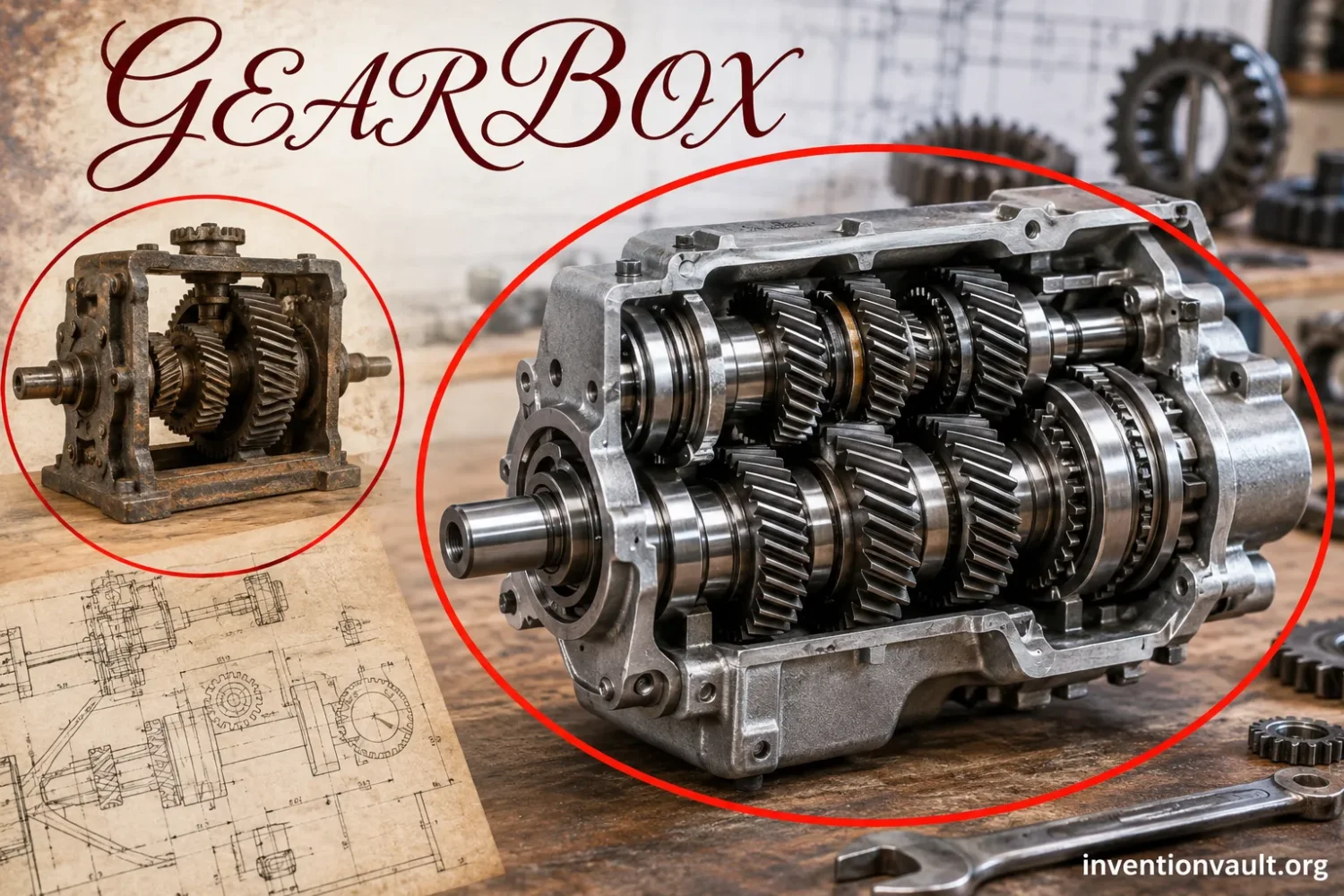
Gearbox Development Map
How the Gearbox Took Shape
Follow the evidence from early geared mechanisms to selectable ratios, synchronized shifting, automatic control, and compact electric-drive gearboxes.
Surviving evidence
Complex Gearing Before the Gearbox
Current stage
Surviving device
The Antikythera Mechanism, dated to roughly the second century BCE, is the oldest surviving complex geared device presently recognized by ASME.
Mechanical complexity
Its surviving and reconstructed arrangement contains dozens of interacting bronze gears used to represent astronomical and calendrical cycles through controlled rotational relationships.
What it does not prove
The mechanism was not an automotive gearbox and was designed mainly to transmit angular motion rather than vehicle-driving power. It establishes the antiquity of sophisticated gear trains.
Complex gear trains existed long before engineers packaged selectable ratios into the machines later called gearboxes.
Mechanical principle
Turning Tooth Counts into Useful Ratios
Current stage
Speed relationship
For two meshing gears, rotational speed changes inversely with the number of teeth. A larger driven gear turns more slowly than the smaller gear driving it.
Torque trade
Ignoring losses, reducing rotational speed through a gear pair raises available output torque by the corresponding ratio. Real transmissions lose some energy through friction and other mechanical losses.
Direction
Two external gears rotate in opposite directions. Additional gears and different gear arrangements can preserve or alter the required direction and axis of rotation.
A gearbox became useful when engineers could choose among ratios instead of accepting one fixed relationship between input and output.
Automotive arrangement
Panhard & Levassor in 1891
Current stage
Drivetrain layout
In 1891, Panhard & Levassor adopted a front-mounted engine followed by a clutch, a centrally positioned gearbox and drive to the rear axle.
Système Panhard
This arrangement organized previously separate drivetrain functions into a layout that became widely copied in rear-wheel-drive automobiles during the following decades.
Historical credit
The 1891 system is an automotive gearbox milestone rather than the invention of gearing itself. Gear trains and geared machines had existed for many centuries.
The Panhard arrangement gave the selectable gearbox a durable place between the engine and driven axle of the automobile.
Manual operation
The Sliding-Mesh Problem
Current stage
Physical engagement
Early manual designs could require rotating gears to be moved into mesh with the gear pair needed for the chosen ratio.
Speed mismatch
If the approaching teeth had unsuitable relative speeds, they could clash rather than engage cleanly. Smooth shifting therefore depended heavily on driver timing and engine-speed control.
Engineering target
The next problem was no longer simply providing several ratios. Engineers needed a way to coordinate rotational speeds before the driving connection was completed.
Multiple ratios solved the vehicle-speed problem but created a new one: changing ratios without damaging or grinding the gear teeth.
Synchronization
Matching Speeds Before Engagement
Current stage
Thompson filing
Earl A. Thompson filed a U.S. patent application on March 9, 1918 for a mechanism intended to synchronize gear pitch-line velocities before meshing and prevent gear clash.
Patent issue
U.S. Patent 1,435,430 was granted on November 14, 1922. The patent described gear selection together with a synchronizing mechanism rather than simply a new tooth shape.
Cadillac adoption
General Motors records Cadillac’s clashless Synchro-Mesh transmission as a 1928 milestone, moving speed matching from a demanding driver task toward a built-in transmission function.
Synchronization changed manual shifting by coordinating speeds before engagement instead of relying almost entirely on driver timing.
Automatic control
Hydra-Matic Removes Manual Shifting
Current stage
Production milestone
General Motors introduced Hydra-Matic on the 1940 Oldsmobile and describes it as the industry’s first fully automatic transmission.
Different gear architecture
Hydra-Matic used planetary gearing, a fluid coupling and hydraulic control rather than asking the driver to slide ordinary gear pairs manually for every ratio change.
Control shift
The gearbox still changed the relationship between engine and road speed, but the decision and actuation of gear changes became functions of the transmission itself.
Automatic transmission did not replace the gear-ratio idea; it changed how suitable ratios were created, selected and engaged.
Electric drive
Fewer Ratios, Gearing Still Required
Current stage
Single-speed design
Electric motors can operate over a broad useful speed range, allowing many electric cars to use a fixed reduction gearbox instead of several driver-selectable ratios.
Current example
Volkswagen’s 2026 description of its APP290 electric-drive installation pairs the motor with a 1-speed gearbox, showing that gearing remains part of current EV architecture.
More than one solution
Porsche’s 2026 Taycan technical specifications retain a two-speed rear transmission on the range, demonstrating that multiple ratios can still serve performance and efficiency targets in an EV.
Electric propulsion often simplifies the gearbox, but the need to convert motor speed into useful wheel speed has not disappeared.
The gearbox has no single universally accepted inventor or invention date. Gears and complex gear trains existed long before motor vehicles, while the recognizable automotive gearbox emerged through a series of mechanical changes. Panhard & Levassor’s 1891 drivetrain layout established an important place for the gearbox in the automobile; later work by Earl A. Thompson addressed synchronization, Cadillac brought Synchro-Mesh into production, and General Motors’ Hydra-Matic moved gear selection into an automatic system. Modern electric vehicles have reduced the number of ratios in many applications, but they still rely on gearing to match motor speed to wheel speed.
| Gearbox history point | What the evidence supports |
|---|---|
| Early complex gearing | The Antikythera Mechanism, roughly 2nd century BCE, is the oldest surviving complex geared device recognized by ASME. |
| Automotive drivetrain milestone | Panhard & Levassor adopted a front engine, clutch, central gearbox and rear drive arrangement in 1891. |
| Synchronizing patent work | Earl A. Thompson filed a gear-shifting and synchronizing patent application on March 9, 1918; U.S. Patent 1,435,430 was granted in 1922. |
| Production Synchro-Mesh milestone | General Motors records Cadillac’s clashless Synchro-Mesh transmission in 1928. |
| Fully automatic production milestone | Hydra-Matic was introduced on the 1940 Oldsmobile. |
| Modern electric form | Many EVs use a fixed 1-speed reduction gearbox, while some performance-oriented designs retain two selectable ratios. |
Why the Gearbox Cannot Be Assigned to One Inventor
The word gearbox covers more than one historical idea. A pair of gears can change speed, torque or direction. A gear train combines several gears. A gearbox packages gearing, shafts, bearings and related parts into a working unit. A multi-speed transmission adds the ability to select different power-flow paths or ratios.
Those developments did not arrive at the same time. Ancient engineers could construct elaborate gear trains without having anything resembling an automobile transmission. Nineteenth-century vehicle designers faced a different problem: connecting an engine with a narrow useful operating-speed range to wheels that had to start from rest, climb, accelerate and cruise.
Gear, Gear Train, and Gearbox
A surviving ancient gear mechanism demonstrates early knowledge of geared motion, but it does not establish the invention date of the selectable automotive gearbox. The historical claim changes according to what is being counted.
This is why statements such as “the gearbox was invented in 1891” need qualification. The year is valuable in automotive history, but it cannot serve as the origin date of gearing itself.
What Different Evidence Can Establish
- Surviving mechanismAn artifact can prove that a working form of a technology existed by a certain period, but it does not always identify its original designer.
- Patent recordA patent provides a documented claim, filing date and technical description. It does not automatically prove first conception, first construction or first commercial adoption.
- Production vehicleA manufactured automobile shows that a gearbox arrangement reached practical use, although related experiments or mechanisms may have appeared earlier.
- Later engineering recordsService literature can reveal how production mechanisms actually worked, including synchronizers, bearings, tooth forms and lubrication requirements that brief historical summaries often omit.
Complex Gears Existed Long Before the Automotive Gearbox
The physical principle behind a gearbox is much older than the automobile. The strongest surviving demonstration is the Antikythera Mechanism, an ancient Greek geared device recovered from a shipwreck near the island of Antikythera.
ASME dates the mechanism to approximately the second century BCE and identifies it as the oldest surviving complex geared device. Its bronze mechanism contained at least 30 gear wheels according to the landmark description; later reconstruction work discussed by ASME has identified or inferred additional gears. Shafts, dials, pointers and interacting gear trains converted one input motion into several calculated astronomical displays.
The device could represent cycles associated with the Sun, Moon, eclipses and calendars. Some of its gearing also incorporated arrangements more complicated than a simple two-gear pair.
That makes the Antikythera Mechanism highly relevant to the history of the gearbox, but only as evidence of advanced geared motion. Its gears were not designed to transmit engine power to wheels, and calling it the first automotive-style gearbox would apply a later machine category too broadly.
The Mechanical Idea That Makes a Gearbox Useful
A gearbox solves a basic mismatch: the rotational speed delivered by a power source is not always the rotational speed required by the load.
For two meshing external gears, the number of teeth determines their speed relationship. If a 20-tooth driving gear turns a 60-tooth driven gear, the reduction is 3:1 under the common input-to-output reduction convention. The smaller input gear must rotate three times for the larger gear to rotate once.
| Example | Input | Output |
|---|---|---|
| Driving gear | 20 teeth | — |
| Driven gear | — | 60 teeth |
| Reduction ratio | 3:1 | |
| Input speed | 3,000 rpm | — |
| Ideal output speed | — | 1,000 rpm |
| Ideal torque relationship | 1× | Approximately 3× before mechanical losses |
| Direction with two external gears | One direction | Opposite direction |
The torque increase in that example does not create extra energy. Output speed falls as ideal torque rises. Bearings, tooth contact, lubricant movement and other losses also mean a real gearbox cannot deliver the ideal calculated output without loss.
A gearbox becomes more versatile when it provides several possible ratios. The same power source can then operate a load under conditions that a single fixed gear pair could not handle efficiently.
Why Early Motor Cars Needed More Than One Ratio
An internal-combustion engine cannot deliver useful torque from zero rotational speed in the manner required to start a stationary vehicle directly. The engine must already be running, while the wheels initially have no road speed. A clutch allows the engine and drivetrain to be temporarily disconnected and then coupled progressively.
Even after the vehicle begins moving, one fixed reduction ratio creates a compromise. A low ratio suitable for starting and hill climbing would force excessive engine speed during faster travel. A taller ratio suitable for cruising would provide poor leverage when starting.
A multi-ratio gearbox lets the drivetrain alter that relationship:
- Lower gear: greater speed reduction and greater torque multiplication at the driven side.
- Intermediate gear: less reduction as vehicle speed rises.
- Higher gear: lower engine speed for a given road speed when less torque multiplication is required.
- Reverse: gearing changes the direction of the output so the vehicle can move backward.
This requirement turned the gearbox into more than an enclosed collection of gears. Ratio selection became part of operating the vehicle.
1891 and the Système Panhard
One of the clearest dates in the early automotive story is 1891. The Science Museum Group records that Panhard & Levassor adopted a layout consisting of a front-mounted engine, followed by a clutch, a centrally mounted gearbox and final drive to the rear axle.
The arrangement became known as the système Panhard. It placed the major drivetrain elements in a logical sequence and became a familiar layout for rear-wheel-drive automobiles.
This is a better way to describe the contribution of René Panhard, Émile Levassor and their company than simply assigning them the invention of all gearboxes. They worked at a moment when automotive engineers were deciding where the engine, clutch, transmission and driven axle should sit and how those elements should interact.
What the 1891 Evidence Establishes
Reliable museum records support the 1891 adoption of the front-engine, clutch, centrally mounted gearbox and rear-drive arrangement by Panhard & Levassor. This does not date the origin of gears themselves.
The distinction matters because the modern gearbox is a product of accumulated mechanical knowledge. Panhard & Levassor provided an influential automotive implementation of that knowledge rather than inventing meshing gears from nothing.
Why Sliding-Mesh Gearboxes Were Hard to Shift
Providing several ratios created another engineering problem. In an early sliding-mesh transmission, the driver could physically move gears or engagement elements so that the required rotating parts connected for a new ratio.
Two gears cannot be forced cleanly together simply because their teeth are the correct size. Their rotational relationship also matters. If the approaching tooth surfaces are moving past each other at unsuitable speeds, engagement can produce grinding instead of a clean mesh.
The driver therefore had to manage several events: release engine torque through the clutch, select the next ratio, and bring the relevant rotating parts close enough in speed for engagement. Techniques such as double-clutching developed around this mechanical limitation.
The gearbox had solved the need for different ratios, but the human operator was still performing part of the synchronization work.
Earl A. Thompson and the Synchronization Problem
A documented step toward easier shifting appears in the patent work of American engineer Earl A. Thompson.
Thompson filed an application on March 9, 1918 for an “Automatic gear-shifting mechanism for sliding gear transmission.” U.S. Patent 1,435,430 was granted on November 14, 1922.
The language of the patent is especially useful because it identifies the exact problem being addressed. Thompson described a means of synchronizing the pitch-line velocity of gears before they were moved into mesh, allowing engagement without gear clash after their speeds had been coordinated.
That is more precise than saying that a synchronizer merely “makes shifting smoother.” The mechanism changes the sequence of events. Instead of demanding that the final locking engagement absorb a large speed difference, synchronization works to reduce that difference beforehand.
- Torque is interruptedThe clutch reduces the driving connection between the engine and transmission so the selected ratio can be changed under much lower transmitted torque.
- A new ratio is selectedThe shift mechanism moves toward the gear or coupling associated with the required transmission ratio.
- Rotational speeds are matchedFriction within the synchronizing mechanism accelerates or slows the relevant rotating member toward the speed required for engagement.
- The gear is locked to the shaftOnce the speed difference is sufficiently reduced, the engaging teeth or dog clutch can complete the driving connection with far less clash.
- Torque resumes through the new pathThe clutch reconnects engine torque and the transmission carries power through the newly selected ratio.
Cadillac Moves Synchromesh into Production
A patent does not by itself establish widespread use. The next part of the story is production engineering.
General Motors records 1928 as the year Cadillac unveiled its clashless Synchro-Mesh transmission. Cadillac material from the period shows how the idea developed into a practical automotive mechanism rather than remaining a patent drawing.
A 1933 Cadillac service publication describes cone-type friction clutches in the synchronizing mechanism. A sliding drum used a bronze ring against a steel cone on the gear. Friction between those surfaces helped bring the rotating members toward compatible speeds before the final connection.
The same historical service material also records other changes that show how far the gearbox had moved beyond exposed or roughly meshing gears. Cadillac used helical gears for quieter running, hardened and finished gear teeth, ball and tapered-roller bearings for alignment and support, and specified transmission lubricant because lubricant condition affected synchronizer behavior.
These details reveal an often overlooked part of gearbox invention history: the usable gearbox depended on manufacturing accuracy, materials, bearings and lubrication as much as on the basic ratio principle.
How a Manual Gearbox Routes Power
Modern manual transmissions vary in layout, but the basic mechanical logic can be explained through the path followed by torque.
Input shaft
The input side receives rotation from the engine through the clutch. When the clutch is engaged, engine torque can enter the gearbox.
Countershaft or layshaft
In a conventional layout, the input drives a countershaft carrying gears that establish possible ratios with gears associated with the output side. Several gear pairs may therefore be rotating even though only one ratio is transmitting torque to the output shaft.
Selectable gears and dog engagement
Later constant-mesh manual designs do not need to slide the main gear teeth in and out of mesh every time the driver shifts. Gear pairs can remain meshed while a dog clutch or synchronizer assembly locks the required rotating gear to its shaft.
Synchronizer
The synchronizer deals with the speed difference before locking. Friction surfaces bring the selected gear and shaft toward matching rotational conditions, then the coupling completes the connection.
Output shaft
Torque leaves the gearbox through the selected ratio and continues through the rest of the drivetrain toward the driven wheels.
The important change from early sliding-mesh practice is that gear teeth can remain in continuous mesh while the transmission selects which gear is coupled to the shaft. The ratio still comes from gear geometry; the method of selecting that ratio has changed.
Reverse Shows That a Gearbox Can Change Direction Too
Speed reduction and torque multiplication are only two functions available through gearing. A gearbox can also reverse rotational direction.
Two external gears that mesh directly rotate in opposite directions. Introducing another external gear between them changes the direction relationship again. In traditional manual reverse arrangements, an idler gear can provide the extra reversal needed to make the output shaft rotate in the opposite direction.
The idler is often misunderstood as the part that automatically determines reverse reduction. Its essential directional function comes from adding another gear mesh. The resulting ratio depends on the complete tooth-count relationship and transmission arrangement.
The Gearbox Became a Precision Manufacturing Problem
Once automobiles became faster, heavier and more widely produced, a workable transmission needed more than correctly chosen ratios. Shafts had to remain aligned, teeth had to carry repeated loads, bearings had to control rotation, and heat and friction had to be managed.
Gear material and heat treatment
Transmission gears are commonly made from steels capable of being hardened so that the tooth surfaces resist wear while the component retains enough toughness for repeated loading. Manufacturing and heat-treatment methods determine whether the gear can preserve its geometry under service loads.
Tooth form
Spur gears have teeth parallel to the axis. Helical gears use angled teeth, causing engagement to develop more progressively across the tooth face. This can reduce noise and produce smoother tooth contact, although helical gearing also produces axial forces that the bearings and housing must accommodate.
Bearings and shaft alignment
Gear teeth are designed to meet at controlled positions. Deflection or poor shaft alignment alters that contact. Bearings therefore do more than reduce friction: they help maintain the geometry required for reliable meshing.
Lubrication
Gear oil separates and protects contacting surfaces, carries heat and influences friction within the transmission. Historical synchronized gearboxes could be sensitive to lubricant characteristics because the synchronizer itself depended on controlled friction.
The enclosure also became part of the machine. A gearbox housing supports bearings and shafts, retains lubricant and helps maintain alignment between parts that must continue to mesh accurately under load.
Automatic Transmission Changed How Ratios Were Selected
Synchromesh reduced the difficulty of manual gear selection, but the driver still chose when to shift. Automatic transmission engineering moved that decision and actuation into the machine.
Earlier vehicles had used various semi-automatic and assisted arrangements, so “automatic” should not be treated as a single jump from manual shifting to one finished design. A particularly well-documented production milestone arrived with General Motors’ Hydra-Matic.
GM introduced Hydra-Matic on the 1940 Oldsmobile and identifies it as the industry’s first fully automatic transmission. Instead of reproducing a conventional manual sliding-gear arrangement with a motorized gear lever, Hydra-Matic used a different architecture built around planetary gearing, hydraulic control and a fluid coupling.
Why planetary gears suit automatic transmissions
A planetary gearset contains a central sun gear, planet gears carried by a planet carrier and an outer ring gear. Different speed relationships become possible according to which member is driven, held or used as the output.
This makes ratio changes possible without sliding ordinary gear wheels laterally into another set of gear teeth. Clutches and other holding or coupling devices can redirect the power path through the planetary system.
Hydraulic control then allowed operating conditions to influence when those changes occurred. The driver no longer had to coordinate a clutch pedal and manually selected gear for every normal upshift and downshift.
Manual Synchromesh
The driver chooses the ratio and moves the shift mechanism. Synchronizers reduce speed differences before the selected gear is locked into the driving path.
Hydra-Matic
Hydraulic control and planetary gearing allow transmission ratios to change automatically without a conventional clutch pedal and manual shift sequence for each change.
Modern Gearboxes Are Not One Mechanical Family
The word gearbox now covers designs that solve the speed-and-torque matching problem in different ways. Manual transmissions, planetary automatics, dual-clutch transmissions and other architectures should not be treated as though they are merely different numbers of gears inside the same mechanism.
A manual transmission can select among permanently meshed gear pairs by synchronizers and dog clutches. A planetary automatic creates ratios by controlling members of planetary gearsets. A dual-clutch transmission can prepare another ratio on a parallel gear path before transferring torque between clutches.
Continuously variable transmissions take the idea even farther by avoiding a small set of fixed stepped ratios in their main ratio-changing mechanism. These branches belong to transmission history, but each is broad enough to require its own technical treatment. The invention history of the gearbox is clearer when they are understood as later solutions to the same original mismatch between source speed and required output speed.
Electric Cars Simplified the Gearbox Without Eliminating It
Electric propulsion changes the conditions that made multi-speed automotive gearboxes necessary. An electric traction motor can produce useful torque from very low rotational speed and operate across a much wider speed range than a conventional combustion engine.
That allows many battery-electric vehicles to operate with a fixed reduction gearbox. There may be no sequence of first, second, third and fourth gears for the driver or control system to select, but motor speed still needs to be reduced before reaching the wheels.
A current Volkswagen example shows that this architecture remains active rather than being a transitional curiosity. Volkswagen’s 2026 description of the APP290 drive system for the near-production ID. Cross places a 1-speed gearbox with the electric motor and pulse inverter.
The gearbox remains necessary because a traction motor can rotate many times faster than the wheels. Fixed reduction converts that high motor speed into a lower axle speed while multiplying wheel-side torque.
One speed is common, but it is not mandatory
The 2026 Porsche Taycan technical specifications demonstrate another solution. The current range retains a two-speed transmission on the rear axle; twin-motor versions combine it with a single-speed front transmission.
The reason for using a second ratio is not that an electric motor suddenly behaves like a combustion engine. A manufacturer can instead use two ratios to divide operating demands: a shorter ratio can favor launch performance, while a taller ratio can serve high-speed operation and efficiency.
Electrification has therefore changed the gearbox question from “how many ratios are required to keep the engine usable?” toward “does an additional ratio provide enough performance or efficiency benefit to justify its mass, control system and mechanical complexity?”
The Development Sequence of the Gearbox
| Period | Development | Problem addressed |
|---|---|---|
| 2nd century BCE | Antikythera Mechanism demonstrates complex interacting gear trains | Calculated conversion of rotational motion into multiple mechanical outputs |
| Pre-automotive machinery | Gear trains become established elements of clocks, machinery and power transmission | Changing rotational speed, torque, direction and timing |
| 1891 | Panhard & Levassor adopt front engine, clutch, central gearbox and rear drive | Organizing engine power and selectable gearing into a practical automotive drivetrain |
| Early automotive period | Sliding-mesh multi-ratio transmissions | Starting, climbing and cruising with one engine |
| 1918–1922 | Earl A. Thompson documents gear-speed synchronization in patent work | Reducing clash when changing ratios |
| 1928 | Cadillac Synchro-Mesh milestone | Making synchronized manual shifting practical in production cars |
| 1940 | Oldsmobile Hydra-Matic | Automating ratio selection and gear changes |
| Current electric era | Fixed reduction gearboxes alongside selected multi-speed EV designs | Matching high electric-motor speed to wheel speed with fewer ratios where possible |
Who Invented the Gearbox?
No single person can accurately be credited with inventing every form of gearbox. The technology developed in layers, and different names belong to different parts of that history.
- Ancient mechanicians demonstrate that sophisticated gear trains existed roughly two millennia before the automobile, although the surviving evidence does not identify one inventor of gearing.
- René Panhard, Émile Levassor and Panhard & Levassor belong to the automotive story because their 1891 drivetrain arrangement placed a clutch and centrally mounted gearbox between a front engine and rear driven axle.
- Earl A. Thompson documented an early automotive solution to gear-speed synchronization in a patent application filed in 1918 and granted in 1922.
- Cadillac brought clash-reducing Synchro-Mesh transmission engineering into production by the late 1920s.
- General Motors’ Hydra-Matic, introduced for the 1940 Oldsmobile, moved the production automobile into fully automatic ratio changing.
The most accurate invention story is therefore not a single name followed by a single year. The gearbox emerged when ancient gear principles were turned into selectable machine ratios, adapted to the automobile, made easier to shift through synchronization, and later combined with automatic control. Electric vehicles have altered that architecture again, often reducing several selectable ratios to one fixed reduction stage while preserving the mechanical purpose that made gearing useful in the first place.
References Used for This Article
- Science Museum Group Collection — Panhard Levassor motor car: used for the documented 1891 front-engine, clutch, central gearbox and rear-drive arrangement known as the système Panhard.
- ASME — The Antikythera Mechanism: used for the dating, surviving geared-device status and construction of the ancient mechanism.
- U.S. Patent 1,435,430 — Earl A. Thompson, Automatic Gear-Shifting Mechanism for Sliding Gear Transmission: used for the March 9, 1918 filing, 1922 grant and synchronization description.
- General Motors — Innovation Milestones: used for Cadillac’s 1928 Synchro-Mesh milestone and the 1940 Hydra-Matic introduction.
- General Motors Heritage Archive — 1933 Cadillac service information: used for historical details on cone-type synchronizers, bronze friction rings, helical gears, bearings and lubricant requirements.
- University of California San Diego, Mechanical and Aerospace Engineering — Gear Ratios: used for the relationships among tooth count, rotational speed, torque and mechanical advantage.
- Volkswagen Newsroom — The Drive System, 2026: used for the current APP290 electric-drive example combining an electric motor with a 1-speed gearbox.
- Porsche Newsroom — 2026 Taycan Technical Specifications: used to verify the current use of a two-speed rear transmission and single-speed front transmission configurations in the Taycan range.