Claims and Manufacturing Milestones
How the Ball Bearing Took Shape
Follow the practical designs, patents, production advances, and bearing geometries that turned loose balls into a precision machine element.
Practical predecessor
Charles Varlo’s 1772 Carriage Bearing
Current stage
Published design
Charles Varlo described a ball-bearing arrangement for carriage axles in his 1772 book on friction, placing a documented practical design before Philip Vaughan’s later patent.
Road use
Varlo reported long-distance carriage trials rather than presenting only a geometric idea. The bearing used freely moving balls around the axle to reduce sliding contact.
What it did not establish
Varlo did not obtain the 1794 patent later associated with Vaughan, and some of his claims about eliminating friction went beyond what modern tribology supports.
The ball-bearing principle had reached practical carriage use before the patent most often cited as the invention milestone.
Patent milestone
Philip Vaughan and British Patent No. 2006
Current stage
Patent year
In 1794, Carmarthen iron-founder Philip Vaughan patented improvements to axle trees, axle arms, and boxes for carriage wheels under British Patent No. 2006.
Bearing arrangement
His drawings placed balls in running paths around the axle assembly so that wheel loads could be carried through rolling elements rather than a plain sliding interface alone.
Historical meaning
The patent is strong documentary evidence for an early engineered ball-bearing arrangement, but it does not erase earlier practical work such as Varlo’s carriage bearing.
Vaughan supplied the enduring patent milestone, while earlier evidence shows that the mechanical idea did not begin with a single document.
Application milestone
Jules Suriray Brings Bearings to Racing Cycles
Current stage
Cycle patent
Parisian mechanic Jules-Pierre Suriray filed a patent on August 2, 1869 for applying ball-bearing technology to the velocipede.
Why bicycles mattered
A bicycle has little power to waste. Lower resistance at rotating parts could be felt directly in speed, effort, and competitive performance.
Race evidence
James Moore chose a Suriray-equipped velocipede for the 1869 Paris-Rouen race and won, giving the bearing arrangement a highly visible real-world demonstration.
The bicycle exposed the value of low-friction rotating parts and created a market that demanded better, more repeatable bearings.
Manufacturing milestone
Friedrich Fischer Solves the Ball Problem
Current stage
1883 breakthrough
Friedrich Fischer developed a grinding machine in 1883 that could produce hardened steel balls with closely controlled size and roundness in large quantities.
Why precision mattered
Balls of unequal diameter do not share load evenly. Repeatable geometry allowed bearings to run more smoothly and made interchangeable production far more practical.
1890 patent
Fischer later received German patent No. 55783 for his ball-milling machinery on July 17, 1890. The patent date and the 1883 production breakthrough describe different events.
Fischer did not originate the 1794 bearing arrangement; he made precision bearing balls practical to manufacture at industrial scale.
Geometry milestone
Sven Wingquist Addresses Misalignment
Current stage
The operating problem
Rigid bearings can suffer when a shaft and housing do not remain perfectly aligned because of installation error, structural movement, or shaft deflection.
1907 design
Sven Wingquist patented a double-row self-aligning ball bearing in 1907, allowing the inner assembly to accommodate angular misalignment relative to the outer ring.
Credit boundary
Wingquist invented an important ball-bearing type rather than the first ball bearing. His contribution solved a later operating problem within an already established bearing family.
Once bearings could be manufactured precisely, geometry became another route for adapting them to harder operating conditions.
Modern machine element
The Ball Bearing Becomes a Precision System
Current stage
Working parts
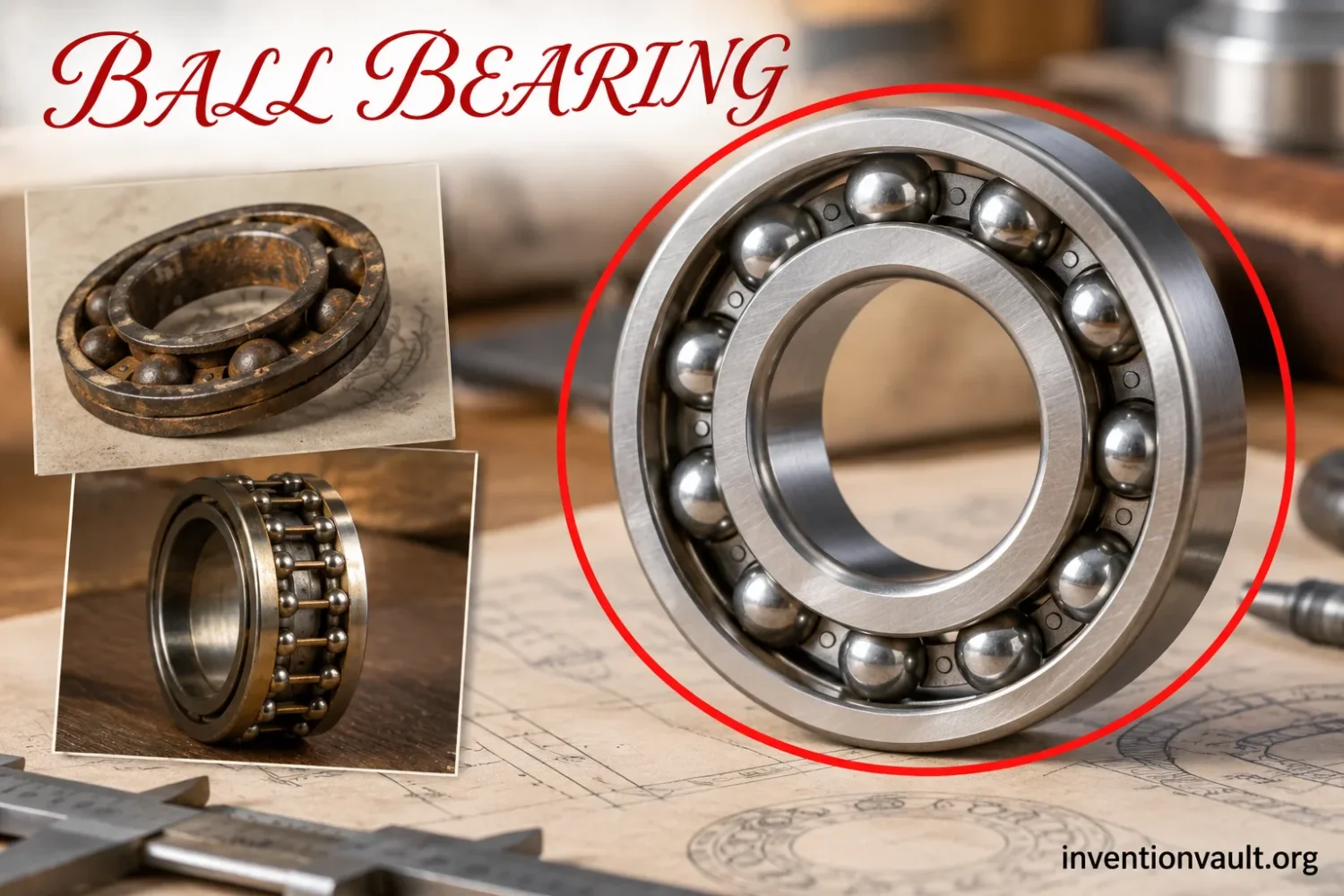
A modern bearing combines inner and outer raceways, accurately formed balls, usually a cage, lubricant, and in many designs shields or seals.
Contact behavior
A ball begins with point-like geometric contact against a raceway, but elastic deformation under load creates a small contact area through which force is transmitted.
What still creates resistance
Rolling bearings reduce friction but do not eliminate it. Rolling deformation, lubricant movement, seals, cage interaction, and small amounts of sliding all consume energy.
The modern bearing preserves the rolling-element idea while depending on materials, surface finish, tolerances, lubrication, and geometry unavailable to early makers.
The invention of the ball bearing cannot be assigned cleanly to one person and one year. Philip Vaughan’s 1794 British Patent No. 2006 is the best-known early patent milestone, but Charles Varlo had described and tested a practical carriage ball bearing in 1772. Jules Suriray applied ball bearings to racing velocipedes in 1869, Friedrich Fischer made accurately ground hardened-steel balls practical to produce in quantity from 1883, and Sven Wingquist patented the self-aligning ball bearing in 1907. These were different answers to different problems: arranging rolling elements, proving their use, manufacturing them accurately, and making bearings tolerate real machinery conditions.
| Ball Bearing Milestone | Date | What It Established |
|---|---|---|
| Charles Varlo | 1772 | Published and road-tested practical ball-bearing carriage arrangement |
| Philip Vaughan | 1794 | British Patent No. 2006 for ball-bearing features in carriage axle assemblies |
| Jules-Pierre Suriray | 1869 | Patented application of ball bearings to the velocipede |
| Friedrich Fischer | 1883 | Machine production of closely uniform, round hardened-steel balls |
| Fischer patent | 1890 | German patent No. 55783 for his ball-milling machinery |
| Sven Wingquist | 1907 | Self-aligning double-row ball bearing |
Dating the Invention
Calling Vaughan, Fischer, Suriray, or Wingquist simply “the inventor of the ball bearing” hides the evidence behind the label. Their documented contributions belong to different stages of the technology.
Why a Ball Bearing Was Needed
A rotating wheel or shaft must be supported while still being free to turn. In a plain bearing or an early axle box, one surface moves directly against another. Lubrication can reduce the resistance and protect the surfaces, but the motion still involves substantial sliding at the supporting interface.
Placing rolling elements between the moving surfaces changes that relationship. Instead of asking a loaded surface to slide continuously across another loaded surface, balls roll along prepared paths. Rolling resistance is normally much lower than comparable sliding resistance, making it possible to support a rotating element with less energy loss and wear.
This does not make the bearing frictionless. A loaded steel ball and its raceway deform slightly where they meet. Lubricant is sheared and displaced. A cage can rub against rolling elements, and seals can create drag. Small amounts of sliding can also occur within the contacts. The mechanical advantage is a large reduction in the sliding motion that would otherwise dominate the axle or shaft support.
How a Modern Ball Bearing Carries a Load
- The shaft loads the inner ringForce entering through a shaft is transferred into the inner ring and its raceway.
- The raceway loads the ballsThe balls contact the curved running surface. Under load, the idealized point contact becomes a small elastically deformed contact patch.
- The balls roll through the loaded zoneAs the rings move relative to one another, successive balls carry force while rolling between the raceways.
- The outer ring transfers the loadForce passes from the balls through the outer raceway into the housing or surrounding machine structure.
The grooves are not merely tracks that stop the balls falling out. Their curvature, spacing, surface finish, and relationship to ball diameter affect contact stress, clearance, load direction, friction, and how smoothly the bearing runs.
1772: Charles Varlo Before the Famous Vaughan Patent
A useful ball-bearing history has to begin before 1794. In 1772, Charles Varlo published Reflections upon Friction, describing what NASA’s historical study characterizes as one of the earliest practical ball bearings for carriage axles. Varlo was not discussing rolling contact only as a mathematical possibility. His arrangement was fitted to a carriage and tested on the road.
Varlo described balls running around the axle so that the wheel assembly was supported through rolling contact. He reported a journey of more than 700 miles in 1772 and observed that the bearing and balls remained usable after the trip. That makes his work especially useful when separating an early concept from an actual mechanism exposed to service conditions.
His understanding still had limits. Varlo attributed much of the remaining resistance to balls rubbing against adjacent balls and made claims that implied the bearing could operate without friction. Modern bearing science does not support a literal friction-free interpretation. Even so, the surviving 1772 record shows that a working carriage ball-bearing arrangement existed before Vaughan’s patent.
What Different Evidence Can Establish
- Published practical descriptionShows that a mechanism was described at the time and, in Varlo’s case, tied to reported road trials. It does not create a patent right.
- Patent recordDocuments what an inventor formally claimed and when the legal record was created. It does not automatically prove the first use of the underlying idea.
- Surviving machine or museum objectCan confirm how a design was physically realized, but the date of the surviving object may not equal the first date the mechanism existed.
- Production recordShows when a design became repeatable enough to manufacture and sell at scale, which may occur decades after an early patent or prototype.
1794: Philip Vaughan and the Patent Milestone
Philip Vaughan was an iron-founder from Carmarthen in Wales. In 1794 he received British Patent No. 2006 for improvements described as relating to axle trees, axle arms, and boxes for light and heavy carriage wheels. The patent drawings show balls incorporated into the axle arrangement as load-carrying rolling elements.
The mechanical purpose was clear. The carriage wheel and axle needed to support substantial weight while allowing relative rotation. Vaughan arranged balls to run in shaped paths around the axle assembly, shifting much of the interface from direct sliding toward rolling contact.
The patent matters because it provides a dated technical record with drawings and a defined mechanical claim. It is therefore reasonable to describe Vaughan as the holder of a major early ball-bearing patent. It is less accurate to state that no practical ball-bearing arrangement existed before him, because Varlo’s 1772 publication supplies earlier evidence.
What the Record Establishes
Philip Vaughan’s British Patent No. 2006 dates to 1794 and documents a carriage axle arrangement using balls as rolling load-carrying elements. That patent milestone is not the same claim as the first known practical use of balls in a bearing.
Why the 1794 Design Did Not Immediately Create a Modern Bearing Industry
The basic geometry of a ball bearing looks simple enough to make with rings and metal balls. The difficulty appears when the bearing must run smoothly under load for thousands or millions of rotations.
If several balls are supposed to share a load but one is slightly larger than the others, the largest ball can carry more than its intended share. Errors in roundness produce changing contact conditions as a ball rotates. Rough surfaces disturb lubrication and concentrate stress. Poorly formed raceways can create uneven motion even when the balls themselves are good.
Early makers therefore faced a manufacturing problem as demanding as the original mechanical idea. They needed:
- balls of nearly identical diameter so that load could be distributed predictably;
- high roundness so the contact geometry did not repeatedly rise and fall as each ball rotated;
- hard, durable material capable of surviving repeated concentrated contact loads;
- smooth raceways whose grooves matched the intended bearing geometry;
- controlled clearance so the bearing was neither loose enough to move inaccurately nor tight enough to bind.
This explains the long gap between eighteenth-century carriage bearings and the later bearing industry. The principle had already been demonstrated. What industry still lacked was a reliable way to manufacture the working surfaces and rolling elements with repeatable precision.
1869: Jules Suriray and the Bicycle Bearing
The bicycle gave ball bearings an unusually demanding and visible application. Human-powered machines have a limited energy supply, so losses at the wheel hubs and other rotating parts directly affect how much effort is required to move.
Jules-Pierre Suriray, a Parisian mechanic and manufacturer, patented the application of ball bearings to the velocipede on August 2, 1869. A surviving racing velocipede associated with Suriray is held by the Musée national de la Voiture at the Château de Compiègne.
The design also gained attention through racing. James Moore selected a Suriray-equipped velocipede for the Paris-Rouen race in 1869 and won. The event did not prove that Suriray had invented the first ball bearing. It showed something else: a ball-bearing arrangement could provide a useful advantage in a machine where resistance at the rotating parts mattered immediately to the rider.
Bicycle demand also placed new pressure on manufacturers. Bearings were no longer isolated carriage experiments that could be hand-fitted for one vehicle. Bicycle makers needed quantities of balls and bearing parts that behaved consistently from one assembly to the next.
1883: Friedrich Fischer Solved the Precision Ball Problem
Friedrich Fischer’s place in ball-bearing history is often described incorrectly. He did not originate the ball-bearing arrangement in 1883. Bearings using balls were already documented long before his work. His breakthrough addressed the manufacturing obstacle that had limited their quality and scalability.
In Schweinfurt, Germany, Fischer developed a ball-grinding machine in 1883 that allowed hardened steel balls to be produced with closely controlled roundness and size in quantity. Schaeffler, which now includes the FAG bearing heritage associated with Fischer, identifies this development as the starting point for industrial rolling-bearing production.
Vaughan: Bearing Arrangement
The 1794 patent documented how balls could be incorporated into a carriage axle assembly to carry load through rolling elements.
Fischer: Precision Manufacturing
The 1883 grinding development addressed how hardened steel balls could be made sufficiently uniform and round, in sufficient quantity, for dependable bearing production.
That distinction explains why both names appear in histories of the ball bearing. Vaughan’s milestone concerns the bearing mechanism and patent record; Fischer’s concerns the production technology that made accurate bearing balls repeatable.
Why Grinding Changed What a Bearing Could Do
A bearing ball must approach a sphere closely enough that its effective radius does not change materially as it rotates. Fischer’s process moved the workpieces against machining surfaces in a manner that continually changed their orientation. High points were progressively removed rather than allowing the same region of the ball to remain against the tool.
With the entire surface brought under repeated machining action, the result could approach a much more uniform spherical form than irregular hand finishing could supply in volume. Schaeffler records that Fischer’s equipment made hardened steel balls with deviations measured in hundredths of a millimeter possible during this early industrial period.
Roundness was only part of the benefit. Large batches could now be produced to similar dimensions. That repeatability allowed bearing manufacturers to match balls with accurately machined raceways and build assemblies whose behavior did not depend as heavily on individual hand fitting.
1883 and 1890 Are Not Competing Dates
The two Fischer dates often appear without explanation. 1883 refers to the development of his ball-grinding machinery and the manufacturing change associated with it. On July 17, 1890, Fischer received German patent No. 55783 for his ball-milling machine.
Development vs. Patent
Using 1890 as the date Fischer first developed the production method would merge two separate events. The manufacturing breakthrough is associated with 1883; patent No. 55783 followed in 1890.
Why Ball Roundness Matters Under Load
A stationary ball touching a raceway can be pictured geometrically as making point contact. Real steel is elastic, however. Under load, the ball and raceway deform slightly, creating a small contact area. The force passing through a bearing can therefore generate very high local stresses even when the total machine load seems modest.
If every ball is nearly the same size and the raceways are accurately formed, the bearing can distribute its load in the intended pattern. Poor geometry changes that pattern.
A ball with excessive form error can alter its contact as it rotates. A ball that is larger than the others can enter the loaded zone earlier and carry more force. Surface irregularities can disturb the lubricant film and increase local stress. Over repeated cycles, these conditions affect vibration, noise, wear, and fatigue life.
Fischer’s manufacturing work mattered because the bearing was becoming a precision assembly rather than merely a collection of metal spheres placed around an axle.
The Cage Solved Another Source of Friction
Early free-running balls could contact one another. Two adjacent balls moving through a bearing do not necessarily have matching surface velocities at their point of contact, so ball-to-ball rubbing can create friction and wear.
Modern bearing cages, also called separators, keep rolling elements spaced apart. According to SKF’s bearing engineering material, a cage can reduce frictional heat by separating the rolling elements, maintain their spacing, guide them through unloaded regions, and retain them in bearing designs that can be separated during assembly.
The cage does not normally carry the main external bearing load. That load travels through the rings and rolling elements. Its job is to control the rolling-element group so the bearing can operate as an organized mechanical system rather than a set of loose balls competing for space.
1907: Sven Wingquist Made the Bearing Self-Aligning
Precision manufacturing solved one class of problems, but machinery introduced another. A shaft and its bearing housings may be intended to share one exact axis, yet foundations move, shafts flex, housings distort, and assembly tolerances accumulate.
A conventional rigid ball bearing can react badly to enough angular misalignment. Load becomes distributed in a way the bearing was not designed to accept, which can shorten operating life and increase resistance.
Sven Wingquist encountered bearing problems associated with misaligned shafting while working at a textile plant in Gothenburg. In 1907 he patented a double-row self-aligning ball bearing. The outer ring used a spherical raceway arrangement that allowed the inner ring and ball assembly to operate at a small angle relative to the outer ring.
This was not a reinvention of Vaughan’s carriage bearing. It was a new bearing geometry addressing a different mechanical fault. The design also became closely tied to the founding history of SKF.
What a Modern Ball Bearing Added to the Early Idea
Vaughan or Varlo would recognize the central principle in a modern bearing: loads pass through balls that roll between supporting surfaces. The modern assembly, however, depends on a level of control unavailable to eighteenth-century makers.
| Part or Feature | Function in the Bearing | Why Precision Matters |
|---|---|---|
| Inner ring | Provides the inner raceway and normally fits around the shaft | Its bore, raceway position, and geometry affect alignment and running clearance |
| Outer ring | Provides the outer raceway and transfers load to the housing | Raceway form controls how balls contact and carry load |
| Balls | Transmit force between the raceways while rolling | Diameter consistency, roundness, hardness, and surface finish affect load sharing and smoothness |
| Cage | Separates, spaces, and guides the balls | Incorrect pocket geometry can interfere with rolling-element motion |
| Lubricant | Reduces direct surface interaction and helps control friction and wear | Viscosity and supply must suit speed, load, temperature, and bearing geometry |
| Seal or shield | Helps control contamination and lubricant retention in applicable designs | Sealing must be balanced against drag and operating conditions |
Balls and Rollers Do Not Behave the Same Way
The terms ball bearing and rolling-element bearing are related but not identical. Ball bearings are one branch of rolling-element bearings. The other large branch uses rollers in cylindrical, needle, tapered, spherical, or related forms.
A ball has point-like geometric contact with a raceway before elastic deformation enlarges the contact area. A roller approaches line contact. The smaller contact zone of a ball generally favors low friction and higher rotational speeds, while rollers can spread force over a larger region and are often selected for heavier loads.
This difference is why the history of the ball bearing should not be treated as the history of every rolling bearing. Earlier roller arrangements existed, and later roller-bearing inventions followed their own paths.
Radial and Axial Loads Changed Bearing Geometry
The direction of force also matters. A radial load acts mainly across the shaft, perpendicular to its axis. An axial or thrust load acts along the shaft axis. Bearing raceways can be shaped and arranged to favor one direction or accept combinations of both.
A common deep-groove ball bearing uses deep raceway grooves that retain the balls and allow useful radial-load capacity along with some axial loading. Angular-contact bearings arrange the contact geometry at an angle so they can handle combined radial and axial forces more deliberately. Thrust ball bearings use a different arrangement for loads acting mainly along the axis.
These later families did not alter the basic idea of transferring load through rolling balls. They refined where the contact forces travel inside the bearing.
From Carriage Axles to Machine Elements
The industrial effect of the ball bearing came from making controlled rotation easier to reproduce across many types of machinery. Once manufacturers could produce accurate balls, raceways, rings, and cages in quantity, bearings no longer had to be treated as bespoke pieces fitted to a single carriage.
Bicycles
Bicycle hubs, pedals, bottom brackets, and steering assemblies benefited from bearings that reduced resistance while keeping rotating parts positioned accurately. The bicycle trade also helped create nineteenth-century demand for repeatable bearing manufacture.
Machine Tools
Lathes, grinders, milling machines, and other machine tools depend on controlled shaft motion. Bearing accuracy influences spindle position, vibration, speed, and the quality of the work produced by the machine.
Electric Motors
An electric motor rotor needs support that keeps it close to its intended axis while allowing continuous rotation. Ball bearings became a common solution where speed, compact size, and manageable loads fit their characteristics.
Automotive Machinery
Motor vehicles created many rotating assemblies in which bearings became useful, including electrical accessories, transmissions, pumps, steering systems, and many wheel-related applications. Not every automotive location uses a ball bearing; roller-bearing forms are chosen where their load behavior is better suited.
High-Speed Equipment
Precision bearings made it possible to design rotating machinery around controlled clearances and known bearing geometry rather than accepting the variability of loosely fitted surfaces. Higher speed then placed more demands on lubrication, balancing, heat control, material cleanliness, and dimensional accuracy.
One Invention, Several Different “Firsts”
| Person | Historical Claim Supported by the Evidence | Claim That Goes Too Far |
|---|---|---|
| Charles Varlo | Documented an early practical carriage ball bearing in 1772 and reported road testing | Invented the fully developed modern bearing industry |
| Philip Vaughan | Received British Patent No. 2006 in 1794 for an important ball-bearing carriage axle arrangement | Was necessarily the first person ever to use balls as bearing elements |
| Jules-Pierre Suriray | Patented a ball-bearing application for the velocipede in 1869 and helped demonstrate it in competitive cycling | Originated all ball bearings in 1869 |
| Friedrich Fischer | Developed machinery from 1883 for producing highly uniform hardened-steel balls in quantity | Invented the first ball-bearing arrangement in 1883 |
| Sven Wingquist | Patented the self-aligning double-row ball bearing in 1907 | Invented every form of ball bearing |
Common Claims About the Ball Bearing, Corrected
Did Leonardo da Vinci invent the ball bearing?
Leonardo da Vinci studied friction and drew mechanisms involving rolling elements and bearing-like arrangements. Those drawings are useful evidence for the early understanding of rolling motion, but a drawing of a mechanical principle is not the same historical category as Varlo’s road-tested carriage arrangement or Vaughan’s 1794 patent. Giving Leonardo sole credit for the modern ball bearing compresses several different stages into one claim.
Did Philip Vaughan invent the ball bearing in 1794?
Vaughan is properly associated with an important early patented ball-bearing arrangement, and 1794 is therefore a defensible date when the question specifically concerns that patent milestone. The broader statement that ball bearings began in 1794 is harder to defend because Varlo documented an earlier practical carriage design.
Did Friedrich Fischer invent the ball bearing in 1883?
No, if “invent” means the first known ball-bearing mechanism. Fischer’s 1883 work belongs to precision manufacturing. His grinding machinery made hardened steel balls much more uniform and suitable for production in quantity, helping turn the bearing into an industrially repeatable component.
Did Sven Wingquist invent the ball bearing?
Wingquist invented the self-aligning ball bearing, not the first ball bearing. His 1907 design addressed angular misalignment and belongs to a later stage of bearing development.
Who Should Be Credited With the Invention of the Ball Bearing?
If a single name is required for the best-known early patent milestone, Philip Vaughan and the year 1794 remain the clearest answer. British Patent No. 2006 provides direct documentation of his carriage axle bearing arrangement.
A fuller historical answer needs more than that one line. Charles Varlo’s 1772 practical bearing predates Vaughan’s patent. Jules Suriray’s 1869 bicycle application connected bearings with a growing high-efficiency machine market. Friedrich Fischer’s 1883 grinding development addressed the manufacturing precision that earlier bearings lacked. Sven Wingquist’s 1907 self-aligning design solved a later problem of shaft and housing misalignment.
The ball bearing therefore emerged through a sequence of mechanical and manufacturing advances. The rolling-ball idea came first. A documented patent gave it a durable technical record. Bicycle use created stronger demand for efficient rotating parts. Precision grinding made uniform steel balls available in quantity. Better raceways, cages, lubrication, materials, and specialized geometries then turned that idea into the machine element used across modern rotating equipment.
References Used for This Article
- NASA Technical Reports Server — History of Ball Bearings: Used for Charles Varlo’s 1772 practical carriage bearing, reported road trials, Philip Vaughan’s 1794 Patent No. 2006, and the broader development of rolling-element bearings.
- Science Museum Group Journal — Science and the City: Valentine Gottlieb: Used for the historical record surrounding eighteenth-century bearing development and references to Varlo’s 1772 work and Vaughan’s 1794 patent.
- Château de Compiègne, Musée national de la Voiture — Vélocipède à roulement à billes: Used for Jules-Pierre Suriray’s August 2, 1869 bicycle-bearing patent, the surviving velocipede, and James Moore’s Paris-Rouen race connection.
- Schaeffler — Pioneering Spirit, Ball Grinding Machine: Used for Friedrich Fischer’s 1883 ball-grinding development and its role in producing hardened steel balls with repeatable roundness and dimensions.
- Schaeffler/FAG — Bearing History and Friedrich Fischer: Used for Fischer’s early grinding machinery, hardened-steel ball accuracy, and the transition toward automated rolling-bearing manufacture.
- SKF Evolution — Driving Innovation: Used for Sven Wingquist’s 1907 self-aligning ball-bearing patent and its place in SKF’s early development.
- SKF — Rolling Bearings, Bearing Basics: Used for modern ball-bearing terminology, ball-versus-roller contact behavior, cage functions, raceways, seals, and rolling-bearing operating principles.