
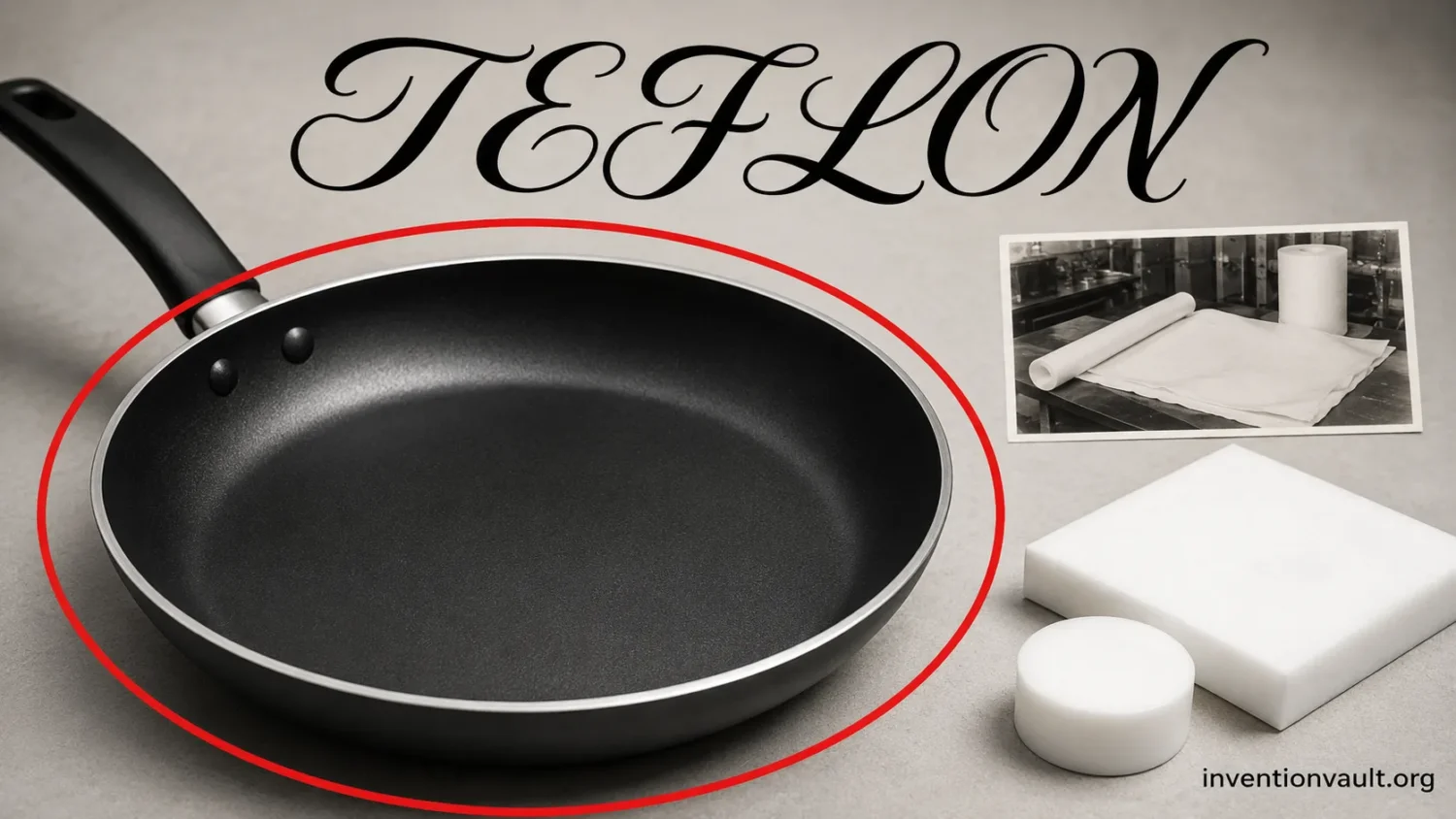
| Detail | Verified Information |
|---|---|
| Common Name | Teflon, a trade name widely associated with polytetrafluoroethylene |
| Scientific Name | Polytetrafluoroethylene, usually shortened to PTFE |
| Inventor | Roy J. Plunkett, an American chemist working for DuPont |
| Discovery Date | April 6, 1938 |
| Place of Discovery | DuPont’s Jackson Laboratory in Deepwater, New Jersey, United States |
| Original Research Aim | Testing tetrafluoroethylene gas while working on refrigerant-related chemistry |
| What Went Wrong | A pressurized cylinder released no gas, yet it still had mass; the gas had changed into a white, waxy solid |
| Monomer | Tetrafluoroethylene, often written as TFE or C2F4 |
| Polymer Repeat Unit | –CF2–CF2– |
| Patent Record | U.S. Patent No. 2,230,654, filed in 1939 and granted in 1941 |
| Commercial Name | Teflon became the public-facing brand name for PTFE-based fluoropolymer products |
| Noted Properties | Low friction, chemical resistance, electrical insulation, heat tolerance, and poor adhesion to many substances |
| Typical Melting Point | About 327°C |
| Common Continuous Service Range | Often cited up to about 260°C, depending on grade, load, and use conditions |
| Known For Today | Nonstick coatings, seals, gaskets, bearings, cable insulation, laboratory parts, and industrial linings |
Teflon began as a failed cylinder of gas. On April 6, 1938, Roy J. Plunkett expected tetrafluoroethylene to flow from a small pressurized container. It did not. The container looked empty by behavior, but not by weight. That mismatch mattered. Plunkett and his assistant did not treat the failed run as waste; they opened the cylinder and found a white, waxy powder that felt unusually slippery. The material was polytetrafluoroethylene, later known around the world by the trade name Teflon.
The discovery is often told as a lucky accident, and that is partly true. Yet the better story is sharper: an alert chemist noticed that the facts did not agree. A cylinder that should have been empty still had mass. A gas that should have stayed gaseous had turned into a polymer. A lab problem became a material with a strange mix of properties: it resisted many chemicals, handled heat, insulated electricity, and allowed surfaces to slide with very little friction.
Teflon’s fame later came from cookware, but the invention did not begin in a kitchen. It began in fluorine chemistry, refrigerant research, pressure cylinders, and polymer science. That difference matters because it explains why PTFE became useful far beyond frying pans.
What Was Actually Invented?
The invention was not a pan coating. It was not a spray. It was not a finished household product. The real invention was PTFE, a fluoropolymer made from tetrafluoroethylene molecules linked together into long chains.
The name Teflon came later as a brand name. PTFE is the material. Teflon is the best-known commercial name tied to it. This distinction clears up a common confusion: not every PTFE part is sold as Teflon, and not every Teflon-branded product is simply a bare sheet of PTFE. Brand names, coatings, fillers, blends, and processing methods all shaped the material’s later life.
Plain definition: PTFE is a synthetic fluoropolymer with carbon atoms shielded by fluorine atoms. That tight carbon-fluorine arrangement gives the material its famous resistance to sticking, reacting, and wearing down under many ordinary conditions.
How the 1938 Accident Happened
Plunkett was working with tetrafluoroethylene gas, a compound used in refrigerant research. The gas was stored under pressure. In the usual experiment, it should have flowed from the cylinder when the valve opened. One cylinder did not behave that way.
The first clue was silence: no gas came out. The second clue was weight: the cylinder had not become as light as an empty one. That small contradiction pushed the investigation forward. When the cylinder was opened, the team found a white solid inside. It was not the expected gas, not a leak, and not an ordinary residue. The tetrafluoroethylene had polymerized.
Polymerization means many small molecules join into a larger chain-like material. In this case, the small molecule was TFE. The product was PTFE. The accident did not invent polymer chemistry, but it revealed a material that behaved in ways chemists could not ignore.
The Prepared Mind Behind the Accident
Calling Teflon an accident should not make the discovery sound casual. Plunkett had the training to notice that a failed experiment still contained information. Many lab errors disappear into notebooks as unusable results. This one survived because the team checked the evidence: pressure, mass, residue, texture, and chemical behavior.
That is one reason Teflon has become a favorite example in invention history. It shows that invention does not always begin with a finished product idea. Sometimes it begins with careful attention to an odd result.
Why PTFE Felt So Different
PTFE stood out because it combined traits that rarely appeared together in one material. It was slippery, resistant to many chemicals, stable under heat for many uses, and a strong electrical insulator. These features made it attractive not just as a coating, but as an engineering material.
The chemistry explains much of that behavior. PTFE’s carbon backbone is surrounded by fluorine atoms. The carbon-fluorine bond is strong, and the fluorine “shield” makes it hard for many other substances to grip or react with the surface. Food, glue, water, oils, and many chemicals have trouble attaching to it.
| Property | What It Means | Why It Mattered |
|---|---|---|
| Low Friction | PTFE surfaces slide easily against many materials. | Useful for bearings, seals, moving parts, and nonstick coatings. |
| Chemical Resistance | PTFE resists many acids, bases, and solvents under ordinary use conditions. | Useful in lab equipment, valves, tubing, gaskets, and chemical handling parts. |
| Heat Tolerance | The material melts at about 327°C and is often used at lower continuous temperatures. | Useful where common plastics would soften too early. |
| Electrical Insulation | PTFE does not conduct electricity easily. | Useful for wire, cable, connectors, and high-frequency insulation. |
| Low Surface Energy | Other substances have difficulty wetting or bonding to PTFE. | Useful for release surfaces, coatings, and parts that need easy cleanup. |
| Processing Challenge | PTFE does not flow like many melt-processable plastics. | Manufacturers often shape it by compression, extrusion methods, and sintering rather than simple melting. |
The Patent and the Move From Powder to Product
Plunkett’s discovery moved into the patent record as U.S. Patent No. 2,230,654, titled “Tetrafluoroethylene Polymers.” The application was filed in 1939 and granted in 1941. The patent record matters because it shows the invention in its early technical form, before the public knew the material mainly as a household coating.
Early PTFE was not easy to manufacture into useful shapes. Many plastics can be melted and pushed into molds. PTFE resisted that simple route. It had to be treated more like a powder-based engineering material: shaped, compressed, and sintered under controlled conditions. This processing difficulty slowed simple consumer use but opened the door to demanding technical uses.
That detail is often skipped in short histories. Teflon did not become famous merely because it was slippery. It became valuable because chemists and engineers learned how to turn a stubborn white powder into coatings, films, rods, sheets, tubes, seals, and lined parts.
Why Cookware Came Later
Many people meet Teflon through nonstick pans, so it is easy to assume cookware was the original purpose. It was not. PTFE first attracted interest because it could survive conditions that defeated many other materials. Its early value came from chemical resistance, insulation, and low friction, not from breakfast.
Cookware required another leap: attaching a material that resists sticking to a surface that manufacturers wanted it to stick to. That sounds almost contradictory. A nonstick material does not naturally bond well. Coating systems, surface preparation, and layered designs helped solve that problem over time.
This delayed path explains why Teflon’s public image is narrower than its real history. The frying pan made the name familiar; industrial engineering made the material valuable first.
Public Image
Most readers associate Teflon with nonstick cookware, easy cleaning, and smooth coated surfaces.
Technical Reality
PTFE also serves in seals, gaskets, cable insulation, bearings, laboratory parts, linings, and precision components.
Main Types and Forms of PTFE
The invention of PTFE did not stop with one powder. Over time, manufacturers developed grades and forms suited to different tasks. Some are pure PTFE. Others use fillers to improve wear resistance, strength, or dimensional stability.
| Type or Form | Description | Common Uses |
|---|---|---|
| Virgin PTFE | Unfilled PTFE with strong chemical resistance and low friction. | Laboratory parts, seals, gaskets, insulators, and general machined components. |
| Filled PTFE | PTFE mixed with materials such as glass fiber, carbon, graphite, or bronze. | Wear parts, bearing pads, valve seats, and components under higher load. |
| Expanded PTFE | A stretched form with a porous structure. | Gasket tapes, filtration materials, vents, and membrane uses. |
| PTFE Coatings | Thin layers applied to metal or other prepared surfaces. | Cookware, industrial release surfaces, molds, and machine parts. |
| PTFE Tape | Thin sealing tape, often used on threaded pipe joints. | Plumbing, fittings, and sealing applications where compatibility is suitable. |
| FEP | A related fluoropolymer with easier melt processing than PTFE. | Wire insulation, films, tubing, and coatings. |
| PFA | A related fluoropolymer with high purity and strong heat and chemical performance. | Semiconductor, laboratory, and chemical handling equipment. |
| ETFE | A tougher fluoropolymer often used as film or coating. | Architectural films, cable insulation, and protective layers. |
A Timeline of the Teflon Invention
Teflon’s development moved through several stages: discovery, patenting, processing, technical use, and later public recognition. The dates below keep the story grounded without turning it into brand folklore.
| Year | Event | Why It Matters |
|---|---|---|
| 1938 | Roy J. Plunkett discovers PTFE after tetrafluoroethylene gas polymerizes inside a cylinder. | The material’s unusual low-friction and resistant behavior is first recognized. |
| 1939 | The patent application for tetrafluoroethylene polymers is filed. | The discovery enters the formal invention record. |
| 1941 | U.S. Patent No. 2,230,654 is granted. | The invention gains legal and technical documentation. |
| 1940s | PTFE moves into demanding industrial applications. | Its chemical resistance and insulation make it useful before cookware fame. |
| 1950s | Processing and coating techniques become more practical. | The material begins moving from specialized use toward wider commercial products. |
| 1960s | Nonstick cookware helps make the name Teflon familiar to the public. | A technical polymer becomes a household name. |
| 1985 | Plunkett is inducted into the National Inventors Hall of Fame. | The discovery receives formal recognition in invention history. |
Technical Data That Explains Its Use
PTFE became useful because its data matched real engineering problems. It could help when a part needed to slide, resist chemical attack, separate electrical conductors, or work in heat that would trouble common plastics.
| Technical Point | Commonly Cited Value or Range | Practical Meaning |
|---|---|---|
| Melting Point | About 327°C | Higher than many everyday plastics. |
| Continuous Use Temperature | Often up to about 260°C, depending on grade and load | Useful for hot mechanical and electrical environments. |
| Coefficient of Friction | Often cited around 0.05–0.10, depending on conditions | Helps parts slide with low resistance. |
| Density | Roughly 2.1–2.3 g/cm³ | Denser than many familiar plastics. |
| Water Interaction | Very low water absorption | Useful where moisture stability matters. |
| Electrical Behavior | Strong dielectric insulation | Useful in wire, cable, and connector systems. |
Why the Material Resists Sticking
PTFE’s nonstick behavior comes from surface chemistry, not from a simple “smoothness” alone. A polished metal surface may look smooth and still allow food, glue, or residues to cling. PTFE acts differently because many substances do not wet its surface well.
The fluorine atoms around the carbon chain create a low-energy surface. Other molecules have little reason to spread across it or bond to it. That is why PTFE can work as a release surface and why coating it onto another material requires special preparation.
This also explains a useful paradox: the same property that makes PTFE valuable can make it hard to manufacture into coated products. Making a nonstick material stick to a pan, mold, or machine part is an engineering problem of its own.
Uses Beyond Nonstick Pans
Cookware gave Teflon its public identity, but PTFE’s invention changed many quiet parts of technology. It often appears where failure would be annoying, expensive, or hard to reach. Many of its uses are hidden inside machines and systems.
- Seals and gaskets: PTFE can help seal joints exposed to chemicals or heat.
- Bearings and sliding parts: Low friction allows movement with less wear in selected designs.
- Wire and cable insulation: PTFE’s electrical insulation and heat tolerance suit demanding cable systems.
- Laboratory equipment: Stir bars, tubing, liners, and vessels use PTFE when chemical resistance matters.
- Industrial linings: Tanks, pipes, and fittings may use PTFE-lined surfaces for chemical compatibility.
- Medical and precision parts: Certain grades and forms serve in controlled technical products where smoothness and stability are needed.
- Textile and membrane uses: Expanded PTFE and related materials can appear in filtration, vents, and protective layers.
What Short Histories Often Leave Out
Many short articles repeat the same simple version: a chemist invented Teflon by mistake and it later became a nonstick pan coating. That version is easy to remember, but it misses several useful details.
The Cylinder’s Weight Was the Real Clue
The discovery did not come from a random glance at powder. It came from a contradiction: the cylinder would not release gas, yet it still seemed to contain something. Observation of mass guided the investigation. That small measurement-style clue deserves more attention because it shows how invention often depends on noticing what does not fit.
PTFE Was an Industrial Material Before It Was a Kitchen Name
The public remembers the pan, but engineers valued PTFE first for its chemical, thermal, and electrical behavior. That broader use explains why the invention belongs in material history, not only consumer product history.
The Hard Part Was Not Only Discovery
Finding the polymer was only the start. PTFE’s resistance to sticking and melting behavior made it difficult to process. Turning it into reliable coatings, shapes, tapes, and engineered parts required another layer of invention. The material’s success came from discovery plus manufacturing skill.
The Teflon Name and the PTFE Material
The word Teflon became so familiar that many people use it as a general name for nonstick coatings. Strictly speaking, Teflon is a brand name, while PTFE is the polymer. This difference helps readers understand product labels and material discussions more clearly.
A PTFE gasket, a Teflon-coated pan, a PTFE cable insulator, and a filled PTFE bearing part may share the same chemical family, yet they are not identical products. Thickness, fillers, coating layers, surface treatment, and use temperature can all change performance.
Material Naming Note
PTFE is the polymer name. Teflon is a trade name strongly tied to that polymer and related fluoropolymer products. Using both terms carefully makes the history more accurate.
How Teflon Fits Into Modern Material Discussions
Modern readers often meet PTFE inside wider discussions about fluoropolymers and PFAS. This topic can become confusing because the terms do not all mean the same thing. PTFE is a high-molecular-weight fluoropolymer. PFAS is a broad chemical category that includes many different substances with different structures, uses, and risk profiles.
For an invention-history article, the useful point is naming accuracy. Teflon’s 1938 discovery belongs to fluoropolymer history. Any discussion of present-day safety, regulation, manufacturing emissions, disposal, or replacement materials should use precise terms rather than treating every fluorinated substance as identical.
2026 Regulatory Status
As of October 14, 2026, the European Union has not adopted a general ban on Teflon or PTFE. Under the proposed EU-wide PFAS restriction, ECHA’s Risk Assessment Committee adopted its final opinion in March 2026, while the Committee for Socio-Economic Analysis published a draft opinion supporting a broad restriction with specific derogations and emission controls. PTFE and other fluoropolymers are part of the wider PFAS restriction discussion, but the proposal does not mean that every fluoropolymer use would automatically disappear under one identical rule. A public consultation on the SEAC draft opinion closed on May 25, 2026, and ECHA reported more than 3,500 comments while SEAC continued work toward its final opinion. The restriction therefore remained under the REACH evaluation process rather than being a completed EU-wide prohibition on PTFE.
In everyday use, readers should follow product labels, temperature limits, and manufacturer instructions for coated cookware or technical parts. PTFE’s invention story explains the material; it does not replace product-specific guidance.
Why the Invention Still Matters
Teflon remains one of the clearest examples of accidental invention because the accident did not end the story. Plunkett’s team recognized a material that deserved study. The patent record preserved the discovery. Engineers later learned how to shape it, bond it, fill it, stretch it, and apply it to real problems.
The most useful lesson is not “luck creates inventions.” Luck opened the door. Careful investigation kept it open. The white powder inside that cylinder became a named polymer because someone asked why the experiment had failed in such a strange way.
That makes the invention of Teflon more than a kitchen story. It is a material story: a gas became a polymer, a failed test became a patent, and a difficult powder became one of the best-known engineering plastics of the twentieth century.
References Used for This Article
- The Ohio State University — Roy J. Plunkett, Chemistry: A university profile confirming Plunkett’s 1938 PTFE discovery and scientific background.
- Science History Institute — Roy J. Plunkett: A trusted biography describing the accidental discovery and Plunkett’s role in polymer history.
- National Inventors Hall of Fame — Roy J. Plunkett: A recognized inventor profile listing Teflon, the patent number, and Plunkett’s 1985 induction.
- Teflon Brand — The History of Teflon™ Fluoropolymers: A brand history page giving the April 6, 1938 discovery date and the PTFE origin story.
- Google Patents — US2230654A Tetrafluoroethylene Polymers: The patent record for Roy J. Plunkett’s tetrafluoroethylene polymer invention.
- American Physical Society — Discovery of Teflon: A science-history article explaining the failed cylinder, polymer formation, and later importance of PTFE.
- OECD — Per and Poly-Fluorinated Chemicals: An international resource useful for careful modern terminology around fluorinated chemicals.
- European Chemicals Agency — ECHA Supports PFAS Restriction with Targeted Derogations: Reports the March 2026 RAC and SEAC positions on an EU-wide PFAS restriction, including specific derogations and emission controls.
- European Chemicals Agency — Per- and Polyfluoroalkyl Substances (PFAS): Tracks the 2026 restriction evaluation, SEAC consultation, and continuing EU process.