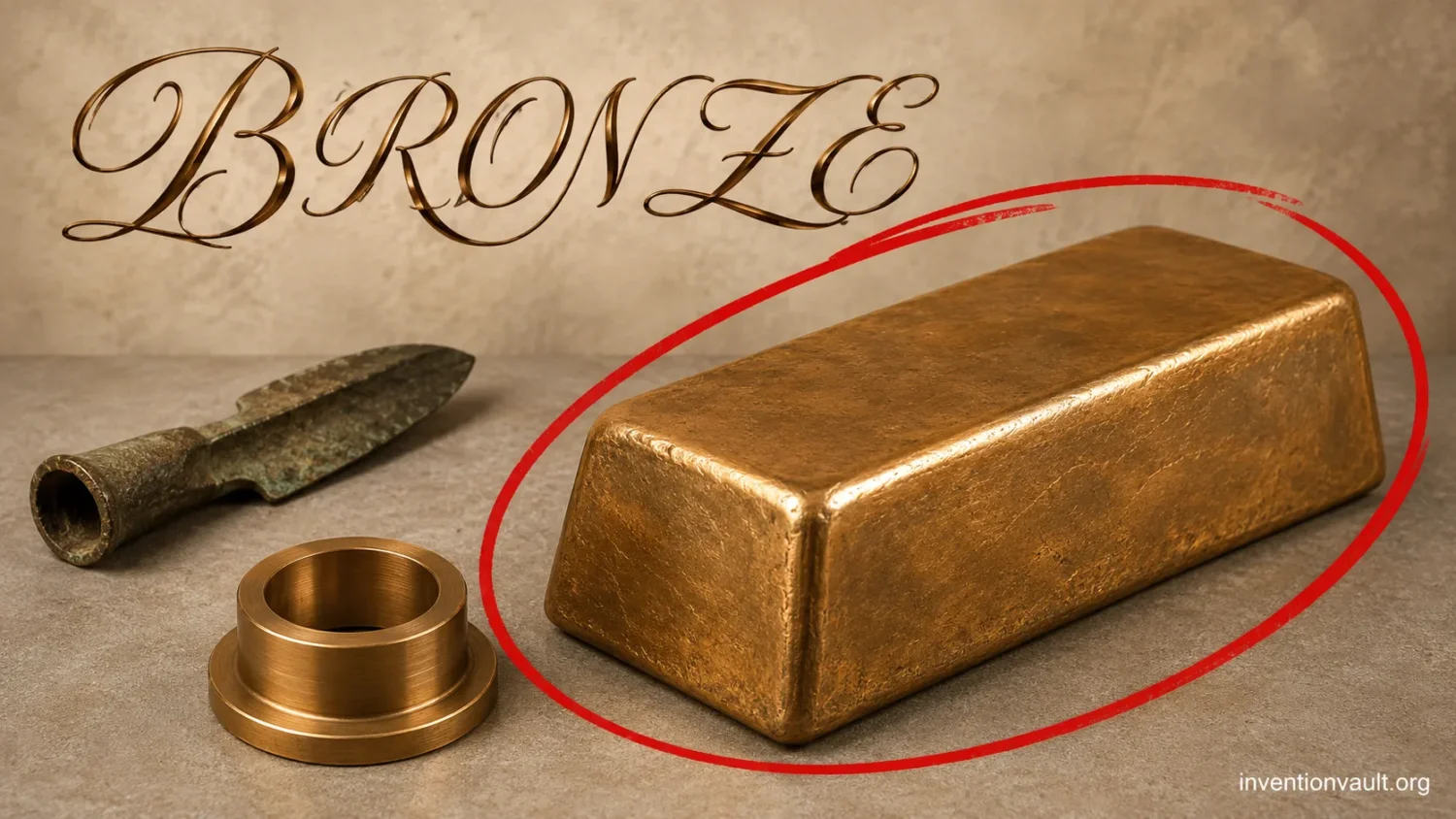
| Detail | Information |
|---|---|
| Invention Type | Metal alloy, usually based on copper with tin as the main added metal. |
| Common Formula | Bronze is not one fixed formula, but a familiar modern reference mix is about 88% copper and 12% tin. |
| Chemical Symbols | Cu for copper and Sn for tin. |
| Known Inventor | No single inventor is known. Bronze developed through regional metalworking experiments, ore selection, smelting practice, and repeated casting. |
| Earliest Secure Tin-Bronze Evidence | A tin-bronze foil from Pločnik, Serbia, dated to around 4650 BC, is often cited as the earliest securely dated tin-bronze artifact known so far. |
| Wider Bronze Age Use | In the Near East and eastern Mediterranean, the Bronze Age is often placed roughly between 3000 and 1200 BC, though dates vary by region. |
| Main Technical Advance | Bronze gave metalworkers a material that was harder than copper, easier to shape, more castable, and often more durable in use. |
| Common Historical Objects | Vessels, fittings, mirrors, sculpture, bells, tools, ritual objects, decorative plaques, and household items. |
| Major Production Methods | Casting in molds, lost-wax casting, piece-mold casting, hammering, finishing, and controlled surface patination. |
| Modern Uses | Bearings, bushings, gears, valves, marine hardware, musical instruments, sculpture, architectural details, and conservation study. |
Bronze changed metalworking because it solved a practical problem: pure copper was useful, but it was often too soft for demanding objects. By adding tin, early craftspeople learned to create a stronger copper-based alloy that could be cast into shapes with cleaner edges, better surface detail, and greater durability. Bronze was not just a new material. It was a new way of thinking about matter: two metals could be combined to make a third material with its own behavior.
What Bronze Is
Bronze is a family of alloys, not a single recipe. In its classic meaning, it is an alloy of copper and tin. In museum labels, workshop records, and older books, the word can stretch wider and include copper alloys with lead, zinc, arsenic, nickel, aluminum, silicon, or phosphorus. That is why careful researchers often use the broader term copper alloy when the exact composition is unknown.
The usual story says bronze is simply copper plus tin. That is true enough for a beginner, but it leaves out an important detail: small changes in composition can change the whole personality of the metal. A little more tin can change color, hardness, brittleness, sound, and casting behavior. Added lead can help molten metal flow into fine detail. Phosphorus can improve spring behavior in some modern bronzes. Aluminum bronze, a later alloy family, belongs to a different technical branch altogether.
Bronze matters because it was one of the earliest materials made by design rather than simply found, shaped, or polished.
Why Bronze Was Not a Single-Person Invention
Bronze has no named inventor. It was not born in one workshop on one day. The invention was more gradual, and more human: miners noticed different ores, smelters saw different metal colors, craftspeople learned which mixtures poured well, and communities repeated the methods that worked.
Some early bronze may have come from mixed ores that already contained copper and tin. In that case, the first makers may not have started with a clean formula. They may have selected unusual ore because it behaved well in the furnace or produced an attractive yellow metal. Later metalworkers learned to control alloying more deliberately by adding tin to copper or by smelting copper ore with tin ore.
This matters for the history of invention. Bronze was not only an object. It was a repeatable technical method. Once people could recognize, melt, mix, cast, repair, and remelt copper alloys, they had moved beyond simple metal use into early materials engineering.
How Tin Changed Copper
Copper already had real advantages. It could be hammered, polished, and shaped more easily than stone. Yet pure copper bends and deforms under stress. Tin changed that balance. When tin atoms enter the copper structure, they disturb the regular metal lattice. That disturbance helps explain why bronze can be harder and more wear-resistant than copper alone.
Tin also helped casting. Bronze could flow into molds with better reliability than pure copper, especially when the alloy was tuned for casting. This opened the door to hollow vessels, detailed sculpture, thin fittings, musical bells, mirror backs, and repeated forms. The invention was not only about strength. It was also about control of shape.
| Material Feature | Effect on Bronze | Historical Value |
|---|---|---|
| Hardness | Tin makes copper alloys harder than pure copper. | Objects kept their shape better during regular handling and use. |
| Castability | Bronze could fill molds more effectively than copper in many workshop settings. | Metalworkers could make hollow, detailed, and repeatable forms. |
| Color Range | Bronze can shift from reddish brown toward golden or pale tones depending on composition. | Objects could carry visual value as well as practical value. |
| Wear Behavior | Tin bronzes can offer good resistance to friction and wear. | The alloy later became useful in bearings, gears, bushings, and fittings. |
| Corrosion Resistance | Many tin bronzes resist corrosion well, especially compared with some other copper alloys. | Bronze objects could survive long use, burial, and conservation study. |
| Sound | High-tin bronze can produce a clear ringing tone. | Bells, cymbals, and other sound-making objects relied on bronze’s acoustic behavior. |
The Earliest Strong Evidence
The earliest secure story of tin bronze is not the simple Near Eastern origin story often repeated in short summaries. Archaeological work at Pločnik in Serbia identified a tin-bronze foil from a Vinča culture layer dated to around 4650 BC. That find pushed the record of tin bronze much earlier than older textbook timelines.
The Pločnik foil was not a massive industrial product. It was small, unusual, and possibly linked with a ceramic vessel. Still, its importance is large because it shows that people in the Balkans were experimenting with copper-tin metallurgy far earlier than many older models allowed. It also reminds us to be careful with invention dates. A material can appear in one place, vanish or remain rare, and then become widespread much later somewhere else.
Bronze became common at different speeds in different regions. In the Near East and eastern Mediterranean, bronze objects gave their name to a broad archaeological period, yet that label is imperfect. Pure copper and other copper alloys also remained in use. The phrase Bronze Age is useful, but it should not be read as if every metal object from that period was true tin bronze.
What the Name Bronze Can Hide
One of the most common errors in bronze history is treating every old copper-colored object as the same material. In reality, ancient metal objects can vary widely. Some are true copper-tin bronze. Some contain lead. Some are closer to brass because zinc is present. Some are arsenical copper, an early copper alloy that could be harder than pure copper but belongs to a different technical story.
This is why museum descriptions often say copper alloy instead of bronze. The label may look less dramatic, but it is often more accurate. It leaves room for chemical analysis and avoids pretending that a historic object has a neat modern formula.
| Term | Main Meaning | Why the Difference Matters |
|---|---|---|
| Copper | Mostly copper, with little or no deliberate alloying. | Soft, workable, and earlier in use than bronze in many regions. |
| Tin Bronze | Copper with tin as the main added metal. | The classic bronze alloy; harder than copper and often better for casting. |
| Leaded Bronze | Copper-tin bronze with added lead. | Often useful for casting detail and, later, machinability; not the same as simple tin bronze. |
| Arsenical Copper | Copper with arsenic present naturally or through ore selection. | An early hard copper alloy that overlaps with bronze history but is chemically different. |
| Brass | Copper with zinc as the main added metal. | Older objects once called bronze may, after analysis, turn out to be brass or mixed copper alloy. |
| Copper Alloy | A broad museum and conservation term. | Useful when the exact recipe is unknown or when several added elements are present. |
Bronze and the Tin Problem
Copper ores were available in many regions. Tin was not. This uneven geography shaped the history of bronze as much as the chemistry did. To make tin bronze on a large scale, communities needed access to tin ore, especially cassiterite. That meant mining, transport, exchange, storage, and trust between distant communities.
Bronze therefore tells a story about movement. A finished vessel or bell may look like a local object, but its metal could contain material from far away. Recent archaeometric research has made this point sharper. Isotope and trace-element studies of tin ingots have connected some Bronze Age Mediterranean finds with tin sources in Cornwall and Devon, showing that metal supply lines could stretch across remarkable distances.
This does not mean every bronze object used British tin. It means the old question “Where did the tin come from?” has become a scientific question with better tools. Researchers now compare trace elements, lead isotopes, tin isotopes, ore geology, and shipwreck cargoes. Bronze history is still being rewritten by laboratory evidence.
Main Bronze Alloy Families
The word bronze covers several alloy families. Some belong to early metallurgy. Others are modern engineering materials that kept the bronze name because they are copper-based and share certain behaviors with older bronzes.
| Alloy Family | Typical Composition | Common Qualities | Typical Uses |
|---|---|---|---|
| Tin Bronze | Copper plus tin. | Hard, castable, corrosion-resistant, and often visually warm. | Historic vessels, sculpture, fittings, bells, bearings, gears, valves. |
| Leaded Tin Bronze | Copper, tin, and lead. | Improved machinability and casting behavior in many technical alloys. | Bearings, bushings, pressure fittings, mechanical parts. |
| Phosphor Bronze | Copper, tin, and a small amount of phosphorus. | Good spring behavior, wear resistance, and fatigue resistance. | Springs, contacts, clips, precision parts. |
| Bell Bronze | High-tin bronze. | Hard, resonant, and able to produce a clear ringing tone. | Bells, cymbals, gongs, tuned sound objects. |
| Aluminum Bronze | Copper with aluminum as a main added element. | Strong, corrosion-resistant, and useful in demanding environments. | Marine hardware, pump parts, industrial components. |
| Silicon Bronze | Copper with silicon, often with other minor elements. | Strong, workable, and valued for corrosion resistance. | Fasteners, sculpture, architectural metalwork. |
How Bronze Objects Were Shaped
Bronze rewarded people who understood heat, molds, surface finishing, and repair. The technical descriptions below are historical and educational, not workshop instructions. The point is to understand the invention, not to copy a casting process.
Casting in Molds
Molten bronze could be poured into prepared molds to make repeated shapes. This allowed metalworkers to create vessels, fittings, plaques, and sculptural forms with detail that would be hard to hammer from a flat sheet.
Lost-Wax Casting
In lost-wax casting, a wax model helped define the final metal form. The method became especially useful for hollow sculpture and fine surface detail. Many later bronze sculptures depended on this method.
Piece-Mold Casting
Early Chinese bronze casting developed a distinctive piece-mold method. A clay model was used to create sections of a mold, which were reassembled around a core before casting. This method could produce crisp decoration and complex vessel forms.
Hammering and Finishing
Not all bronze objects were simply poured and left alone. Metalworkers could hammer, chase, polish, engrave, join, and patinate bronze. These finishing choices often turned a strong alloy into a refined cultural object.
Bronze in Different Regions
Bronze did not follow one straight path. It appeared, faded, returned, and spread through different routes. Its story looks different in the Balkans, the Near East, the eastern Mediterranean, China, Europe, Africa, and the Americas. That regional variety is one reason bronze remains so useful for historians of technology.
Balkans: The Pločnik foil suggests very early copper-tin experimentation. These early bronzes were rare, but they complicate older timelines.
Near East and Eastern Mediterranean: Bronze became part of a wide material culture that included vessels, tools, ornaments, fittings, and exchange networks linked to tin supply.
China: Bronze casting became highly organized, with large workshops and refined piece-mold casting for vessels, bells, and ritual objects.
Later Europe: Bronze remained central to sculpture, bells, decorative metalwork, and architectural details long after iron and steel entered wider use.
Why Bronze Stayed Useful after Iron
Iron and steel did not make bronze disappear. They changed its role. Bronze survived because it can do things that iron does not always do as well. It resists corrosion in many settings, slides well against other metals in bearing applications, casts into detailed shapes, and produces a valued tone in bells and cymbals.
In industry, bronze alloys are still chosen for wear resistance, low friction against steel, corrosion resistance, machinability, and pressure-tight castings. In art, bronze remains valued because it can hold a surface, accept patination, and preserve detail. In museums, bronze gives conservators a metal record of workshop skill, trade, repair, and long-term aging.
Bronze as a Sound Material
Bronze does not only cut, hold, support, or decorate. It can sing. High-tin bronzes became closely linked with bells, cymbals, gongs, and other resonant objects because the alloy can combine hardness with a clear sustained tone. The same material principle that made bronze useful for durable objects also made it useful for sound.
This acoustic side is often treated as a footnote, but it shows how broad the invention really was. Bronze changed storage vessels, sculpture, mechanical parts, and music. A strong alloy became a cultural material.
Bronze and Surface Color
Fresh bronze can show warm golden, brown, reddish, or pale tones depending on its mix. Over time, bronze surfaces change through oxidation, burial chemistry, handling, and conservation. The green and blue surface layers often seen on old copper alloys are not the original color of the metal; they are products of surface change.
That surface history matters. A patina can carry evidence of age, environment, repair, and display. It also explains why bronze has such a strong visual identity. Even when the underlying alloy is technical, the surface can feel almost alive: polished in one place, dark in another, green at the edge, golden where touched.
What Makes Bronze an Invention
Bronze is sometimes listed as a material discovery rather than an invention. That distinction is too narrow. A natural ore may be discovered, but bronze required selection, fire control, mixing, mold design, judgment, and memory. People had to learn which mixtures worked and which failed. They had to teach the method, repeat it, and improve it.
That is why bronze deserves a place among the great early inventions. It shows one of humanity’s first clear steps into designed materials. The maker did not merely reshape nature. The maker altered composition to get new properties.
Open Questions in Bronze Research
Bronze is well studied, but it is not finished as a research subject. The old material still raises hard questions. Which early bronzes were accidental, and which were deliberate? How often did metalsmiths recycle broken objects? How far did tin move before it became part of a finished object? When ancient texts use words later translated as bronze, do they mean tin bronze, brass, copper, or copper alloy?
Modern analysis helps answer these questions without damaging rare objects more than necessary. Researchers use microscopy, X-ray methods, isotope analysis, trace-element chemistry, and careful study of workshop marks. Each method adds another layer to the story, and sometimes it corrects the label placed on an object generations ago.
References Used for This Article
- The Metropolitan Museum of Art — Ancient Greek Bronze Vessels: Shows how tin and copper create a stronger, more workable alloy and alter bronze color.
- Getty Museum — Guidelines for the Technical Examination of Bronze Sculpture: Explains why technical researchers often distinguish true copper-tin bronze from broader copper-alloy labels.
- Cambridge University Press — Tainted Ores and the Rise of Tin Bronzes in Eurasia: Supports the Pločnik tin-bronze foil date and its place in early Eurasian metallurgy.
- Penn Museum — Tin in the Ancient Near East: Details the role of tin in Near Eastern bronze production and why the Bronze Age label is not exact.
- Copper Development Association — Copper Tin Alloys: Summarizes tin-bronze microstructure, corrosion resistance, wear behavior, and common industrial uses.
- National Museum of Asian Art — Anyang: China’s Ancient City of Kings: Documents bronze production at Anyang and the use of copper, tin, and lead in early Chinese casting.
- Cambridge University Press — From Land’s End to the Levant: Reports recent isotope and trace-element research on tin sources for Bronze Age Mediterranean ingots.
- Encyclopaedia Britannica — Bronze: Provides a general reference for bronze composition and common modern ratios.