
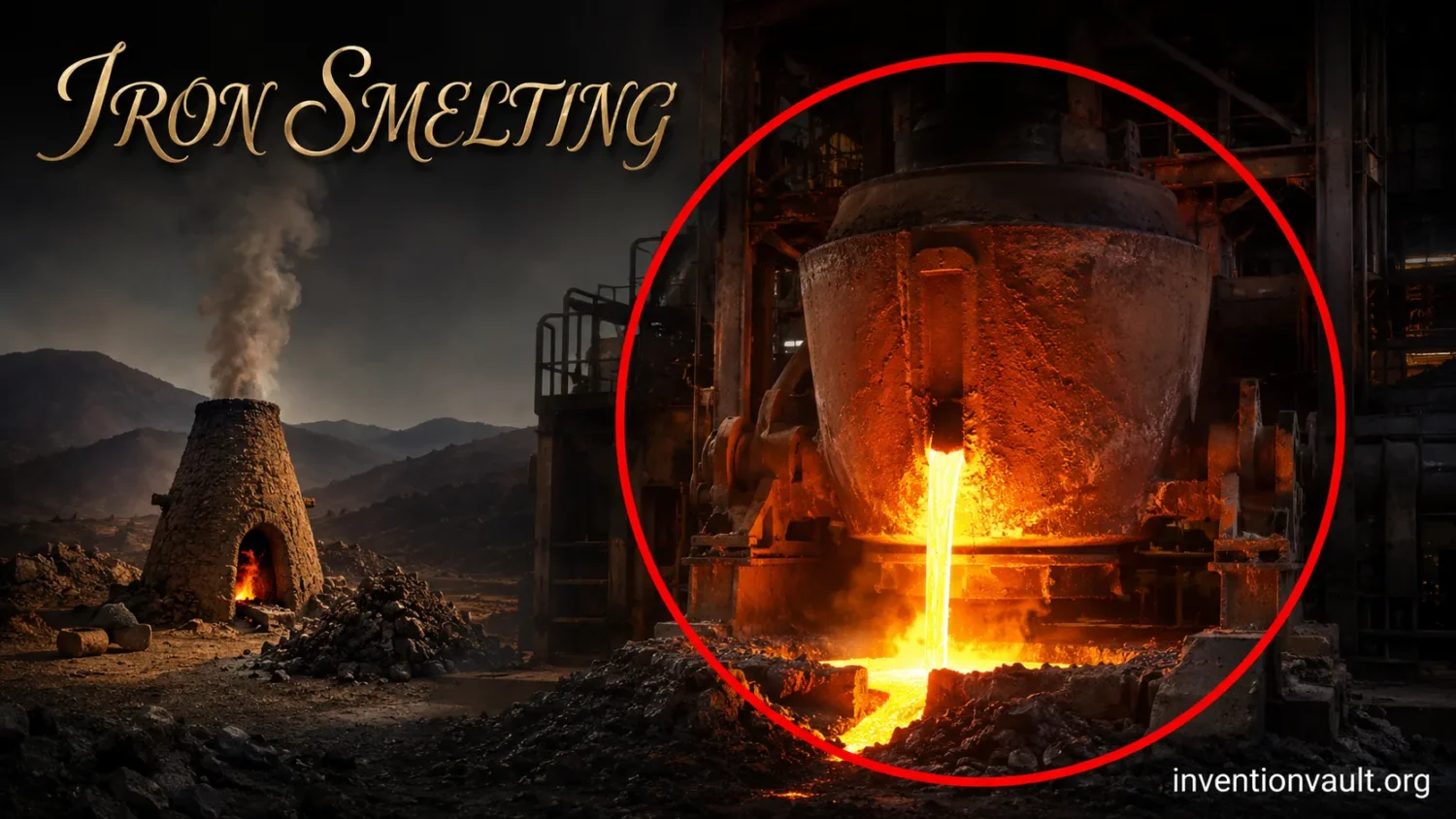
Ironmaking Evidence Map
How Ore Became Usable Iron
Trace the evidence from meteoritic iron and bloomeries to blast furnaces, industrial refining, direct reduction, and modern steel-scale output.
Evidence distinction
Iron Use Came Before Ore Smelting
Natural metal
Some early objects were made from meteoritic iron, which arrived already metallic and could be shaped without extracting iron from ore.
What it proves
An early iron object proves that people used iron, but it does not by itself prove that local workers had learned ore smelting.
Stronger evidence
Furnace remains, slag, tuyeres, ore residues, charcoal dates, blooms, and metallographic evidence provide firmer evidence for smelting.
Separating natural iron from smelted iron prevents the oldest objects from being mistaken for the invention of ore reduction.
Direct ironmaking
Bloomeries Reduced Ore Without Melting Iron
Reduction chemistry
Carbon-rich gases removed oxygen from iron oxides, allowing metallic iron particles to form inside the furnace.
Temperature boundary
Early bloomeries generally worked below iron’s melting point. Slag softened or flowed while the iron collected as a solid porous bloom.
After the furnace
Smiths reheated and hammered the bloom to expel slag, weld iron particles together, and turn the rough mass into useful metal.
The bloomery solved iron extraction through chemical reduction and consolidation rather than through a stream of molten iron.
Archaeological expansion
Ironmaking Developed Across Regional Traditions
Dating problem
Early ore-smelting dates are uneven and depend on whether the evidence is an iron object, slag, a furnace, a bloom, or a securely dated workshop context.
Wider adoption
Bloomery production becomes clearer through the late second and early first millennia BCE and later appears across several metallurgical regions.
Local variation
Ore type, charcoal, clay, air supply, furnace geometry, and working traditions produced different smelting systems rather than one universal furnace design.
Iron smelting is better described as accumulated workshop knowledge than as a single invention with one named originator.
Indirect ironmaking
Blast Furnaces Made Liquid Pig Iron
Stronger air blast
Taller furnaces and stronger air supply raised temperature and changed furnace reactions enough to produce high-carbon liquid iron.
New product
Pig iron could be cast, but its high carbon content made it too brittle for many forged uses without a separate refining stage.
Process chain
Ironmaking therefore split into linked operations: ore reduction in the blast furnace followed by refining, casting, forging, rolling, or later steel conversion.
The blast furnace increased output by making liquid iron, but it also made downstream refining a normal part of the iron industry.
Industrial expansion
Fuel and Mechanization Raised Output
Coke fuel
Coke reduced dependence on charcoal in large ironworks and supported furnaces designed for sustained high-volume operation.
Powered equipment
Water power and later industrial machinery strengthened air blast, hammering, rolling, and material handling across iron production.
Steel connection
Large pig-iron output became the feedstock for puddling, converter steelmaking, open-hearth production, and later basic oxygen furnaces.
Industrial ironmaking turned the ancient reduction reaction into a continuous supply chain for mass steel production.
Modern reduction
Direct Reduction Reuses an Old Chemical Logic
Solid-state route
Direct reduced iron is made by reducing iron ore without first melting the iron, producing a porous metallic feed often called sponge iron.
Modern reducing gases
Industrial systems can use carbon monoxide and hydrogen-rich gases, while hydrogen-based projects aim to reduce direct carbon dioxide formation from ore reduction.
Downstream use
DRI commonly feeds electric arc furnaces, where it can be combined with scrap and other iron-bearing inputs to make steel.
The equipment changed, but modern direct reduction still depends on the old task of removing oxygen from iron oxide.
Latest full-year scale
The Downstream Steel System Reached 1.85 Billion Tonnes
2025 world total
World crude steel production was about 1.85 billion tonnes in 2025, providing a current full-year measure of the industrial system supplied by ironmaking.
Why steel is used here
Crude steel output is a downstream scale marker rather than a direct measure of ore smelting because modern steel can also contain recycled scrap and direct reduced iron.
Historical contrast
The scale differs radically from early bloomeries, which produced individual solid blooms that needed extensive forging before they became useful iron.
Using the same 2025 full-year steel baseline keeps the modern scale of iron smelting connected to its downstream industrial system without confusing the two measures.
| Invention | Iron smelting, the controlled extraction of metallic iron from iron ore inside a furnace. |
|---|---|
| Single Inventor | No single named inventor is known. The process developed through craft knowledge, furnace control, ore selection, charcoal use, and repeated experimentation. |
| Earliest Reliable Setting | Early evidence is debated, but regular iron smelting belongs mainly to the late second millennium BCE and early first millennium BCE in parts of western Asia and nearby regions. |
| Earlier Iron Use | People shaped meteoritic iron before ore smelting. That was metal from nature, not iron extracted from rock. |
| Main Early Furnace | Bloomery furnace, a furnace that produced a spongy iron bloom rather than fully liquid iron. |
| Main Inputs | Iron ore such as hematite or magnetite, charcoal, controlled air flow, and sometimes flux-bearing minerals. |
| Core Technical Action | Carbon-rich gases removed oxygen from iron oxides. This is called reduction, not simple melting. |
| Early Product | A hot, porous iron bloom mixed with slag, later hammered into wrought iron or low-carbon steel. |
| Later Branch | The blast furnace created liquid pig iron and opened the path to cast iron, finery refining, puddling, and modern steelmaking. |
| Modern Link | Blast furnaces, direct reduced iron, electric arc furnaces, and hydrogen-based ironmaking all trace part of their logic back to this invention. |
| Modern Scale | The downstream steel system produced about 1.85 billion tonnes of crude steel in 2025; this is a steel-output scale marker rather than a direct measure of ore smelting. |
Iron smelting was not the first time humans touched iron. It was the moment people learned how to make iron on purpose. Before that, rare pieces of meteoritic iron could be hammered into small objects. Smelting changed the story because it pulled metal from ordinary-looking ore, using heat, charcoal, air, and close furnace control. That shift turned iron from a scarce natural find into a material that could be made, worked, traded, repaired, and improved.
Plain meaning: iron smelting is the invention of a controlled chemical process. The furnace did not simply “melt a rock.” It created the right conditions for oxygen to leave the ore, leaving metallic iron behind.
What Iron Smelting Actually Invented
The real invention was a repeatable way to separate iron from iron-bearing minerals. In an ore, iron usually sits locked to oxygen and other minerals. A furnace had to create heat, hold a reducing atmosphere, and let waste minerals collect as slag.
This makes iron smelting different from ordinary heating. Pure iron melts at about 1,538°C, a temperature early furnaces did not need to reach. Bloomery smelting worked below that point. The slag could soften and flow, while metallic iron gathered as a solid, spongy bloom.
That detail matters. Many short histories say early people “melted iron ore.” In the bloomery stage, that wording is usually wrong. Early smelters made iron through solid-state reduction. The metal stayed solid, even though parts of the furnace charge became fluid.
Iron smelting was a furnace skill before it was a factory process. Its success depended on ore, fuel, air, timing, and the craft judgment of people who could read a fire by color, sound, and slag behavior.
The Problem Iron Smelting Solved
Copper and bronze were easier to melt and cast. Iron was more stubborn. Its ores were common in many landscapes, yet the metal itself stayed hidden unless people could master higher furnace temperatures and a more demanding chemical environment.
Once iron smelting became dependable, communities could work with a material that was abundant in the ground. The change did not happen overnight. It moved through trial, failed batches, improved furnaces, stronger air blast, better charcoal preparation, and better understanding of ore quality.
Ore
Iron ore supplied the metal-bearing minerals. Hematite and magnetite were common sources, while bog iron served many local iron industries because it could form near wetlands.
Charcoal
Charcoal provided heat and carbon-rich gases. Those gases helped strip oxygen from the ore, turning iron oxide into metallic iron inside the furnace.
Air Flow
Air entered through openings, pipes, or bellows. Too little air made the fire weak. Too much could change the furnace behavior and waste fuel.
How the Early Bloomery Worked
A bloomery furnace was usually a small shaft, bowl, pit, or clay-lined structure. Its shape varied by region. The basic task stayed the same: keep ore and charcoal hot enough, long enough, in the right atmosphere.
Inside the furnace, charcoal burned and formed carbon monoxide. That gas reacted with iron oxides in the ore. Oxygen left the ore and bonded with carbon, while metallic iron particles formed. Waste minerals joined with iron oxides, ash, clay, and other material to form slag.
The early bloom was not a clean bar. It was a hot mass of iron, slag, and charcoal fragments. Smiths reheated and hammered it to squeeze out slag and weld iron particles together. That work turned the bloom into usable wrought iron or, when carbon entered in the right amount, steel-like material.
- Reduction: oxygen leaves iron oxide.
- Slag formation: waste minerals gather into a glassy or stony byproduct.
- Consolidation: hammering compacts the bloom and removes trapped slag.
- Refining by working: repeated heating and forging improve the metal’s shape and texture.
Who Invented Iron Smelting?
No reliable record names one inventor. Iron smelting was not like a patented machine with a signature. It grew through workshop knowledge. Many people had to notice how ore, charcoal, clay furnaces, and air behaved together.
That makes the origin question hard. Archaeologists must separate iron objects from iron smelting evidence. An iron bead or blade proves iron use, but it may not prove local smelting. Stronger evidence includes furnace remains, slag, tuyere fragments, ore residues, charcoal dating, and microscopic analysis of metal and waste.
Some early iron objects may have come from meteoritic iron. Other finds show experimental or limited smelting. Routine ore-based iron production became much clearer later, especially as bloomery debris and ironworking sites appear across wider regions.
Careful wording matters: it is safer to say that iron smelting was developed by skilled metalworkers in more than one early metallurgical zone, with the strongest dates depending on the type of evidence being discussed.
Verified Milestones in Iron Smelting History
| Period | Development | Why It Matters |
|---|---|---|
| Before ore smelting | Meteoritic iron was shaped into small objects in some early cultures. | This proves iron use, but not the invention of smelting. |
| Late second millennium BCE | Early experiments with ore-based iron production appear in parts of western Asia and nearby regions. | The evidence is uneven, so careful sources avoid naming one fixed birthplace. |
| Early first millennium BCE | Bloomery smelting becomes more visible in the archaeological record. | Iron begins to move from rare material to workable production metal. |
| First millennium BCE | Ironworking spreads across regions of western Asia, Europe, South Asia, and Africa. | Local ore, fuel, and craft traditions shaped different furnace types. |
| First millennium BCE in China | Cast iron and high-temperature iron production develop on a separate technical path. | China’s cast iron tradition shows that ironmaking did not follow one universal route. |
| Medieval period | Blast furnaces and water-powered air systems expand iron output in parts of Europe. | The indirect process created liquid pig iron before later refining. |
| 18th and 19th centuries | Coke-fueled blast furnaces, puddling, rolling, and later steelmaking methods reshape iron production. | Ironmaking becomes more closely tied to industrial-scale steel. |
| 20th and 21st centuries | Blast furnace-basic oxygen routes, direct reduced iron, and electric arc furnaces dominate modern production. | The old chemistry of reduction remains central, even when the equipment changes. |
Direct Process and Indirect Process
Iron smelting history becomes clearer when two routes are separated: the direct process and the indirect process.
Direct Process
The direct process produced solid iron directly from ore. Bloomery furnaces belong here. The product was a bloom, not liquid iron. After forging, the bloom could become bar iron, wrought iron, or steel-like material depending on carbon and working conditions.
Indirect Process
The indirect process first made high-carbon liquid iron, often called pig iron, in a blast furnace. That metal was easier to cast but too brittle for many worked objects. It needed refining to lower carbon and adjust impurities.
This shift changed the scale of ironmaking. It allowed larger output, more regular furnace operation, and a new chain of refining steps. Iron production became less about one bloom and more about linked stages: smelting, casting, refining, forging, rolling, and later steel conversion.
Main Types of Iron Smelting and Ironmaking
| Type | Main Product | Typical Feature | Historical Role |
|---|---|---|---|
| Bowl Furnace | Small bloom | Simple hearth or bowl-shaped furnace area. | One of the earliest furnace forms for small-scale reduction. |
| Pit or Slag-Pit Furnace | Bloom with slag below | Slag collected in a pit beneath the furnace zone. | Used in several early ironmaking traditions where slag handling mattered. |
| Shaft Bloomery | Larger bloom | Vertical shaft improved heat concentration and charge control. | Allowed more repeatable bloomery production. |
| Slag-Tapping Bloomery | Bloom plus tapped slag | Molten slag could be released during smelting. | Helped manage waste and maintain furnace space. |
| Blast Furnace | Pig iron or cast iron | Stronger air blast and higher heat made liquid iron possible. | Opened the indirect process and larger output. |
| Finery and Chafery System | Refined bar iron | Pig iron was remelted, oxidized, and worked. | Converted brittle cast iron into more workable iron. |
| Puddling Furnace | Wrought iron | Molten pig iron was stirred in an oxidizing furnace. | Helped expand iron production before mild steel replaced most wrought iron. |
| Direct Reduced Iron | Sponge iron | Iron ore is reduced in solid form, often with gas. | A modern route that echoes the old idea of reducing ore without melting iron. |
Why the Bloomery Did Not Melt Iron
The bloomery’s genius was not brute heat. It was control. Iron’s melting temperature was too high for many early furnace systems, yet the chemistry of reduction could still work below that point.
As the furnace heated, iron oxides lost oxygen. Tiny particles of metal formed and stuck together. Slag softened around them. The result looked nothing like a clean stream of molten metal. It was a rough bloom, often dark, heavy, and full of trapped waste.
Only after repeated reheating and hammering did the bloom become useful. That extra labor explains why smelting and smithing were linked crafts. The furnace made the metal; the hammer made it dependable.
Iron, Wrought Iron, Cast Iron, and Steel
Iron smelting did not create one single material. It created a family of iron-based materials, and the differences came mostly from carbon, impurities, heat, and refining.
| Material | Carbon Level | Usual Production Link | Basic Character |
|---|---|---|---|
| Bloomery Iron | Low but uneven | Direct bloomery smelting | Spongy iron mass that needs consolidation. |
| Wrought Iron | Very low | Forged bloom or refined pig iron | Workable, fibrous, and shaped by hammering or rolling. |
| Cast Iron | High | Blast furnace or cast iron smelting | Flows when molten and casts well, but can be brittle. |
| Pig Iron | High | Blast furnace output | Intermediate metal usually refined before further use. |
| Steel | Controlled range | Refining, carburizing, decarburizing, or modern steelmaking | Stronger balance of hardness, toughness, and workability. |
Iron Smelting Outside a Single Origin Story
Iron smelting did not spread as a neat line from one inventor to the rest of the world. It moved through local craft systems. Some regions used bloomery furnaces for centuries. Others developed cast iron, larger furnaces, or special refining methods.
In western Asia and nearby regions, early iron use and smelting evidence appear in complex layers of trade, craft, and local ore access. In Africa, iron smelting traditions show strong regional variety, including furnaces with refined air and heat control. In China, cast iron smelting took an early and distinctive path, linked with high-temperature furnace practice and later refining.
This regional variety is one reason iron smelting deserves more careful treatment than a short “who invented it” answer. The better question is: which communities learned to control iron-bearing minerals, and how did their furnaces work?
How Archaeologists Recognize Iron Smelting
Ancient iron production often leaves more waste than finished objects. A tool might be moved, traded, repaired, or melted again. Slag tends to stay near the furnace. That makes slag one of the best clues.
- Slag: glassy or dense waste from smelting, often rich in iron compounds.
- Tuyeres: clay or ceramic nozzles that carried air into the furnace.
- Furnace lining: burnt clay walls altered by high heat.
- Ore fragments: partly reacted pieces that show what material entered the furnace.
- Charcoal remains: fuel residues that can help date a smelting event.
- Metal microstructure: microscopic patterns showing carbon, slag inclusions, and forging history.
These clues help separate an ironworking site from an iron smelting site. A workshop that shaped imported iron may leave hammerscale and smithing debris. A smelting furnace leaves stronger signs of ore reduction and slag production.
The Chemistry in Simple Terms
Iron ore is often iron plus oxygen. Charcoal provides carbon. When charcoal burns with controlled air, it can make carbon monoxide. That gas pulls oxygen away from iron oxide. The simplified reaction often appears as:
Fe2O3 + 3CO → 2Fe + 3CO2
In plain English: iron oxide plus carbon monoxide can become metallic iron plus carbon dioxide.
Real furnaces were more complicated. Ore quality, furnace clay, ash, moisture, air speed, charcoal size, and slag chemistry all changed the result. A successful smelt was not just a matter of reaching one temperature. It required a stable furnace environment.
The Move From Bloomery to Blast Furnace
The blast furnace changed ironmaking by making liquid iron. Stronger air flow raised heat and changed furnace chemistry. Instead of a bloom, the furnace produced high-carbon pig iron that could run from the furnace and solidify in molds or channels.
That was useful, but it created a second problem. Pig iron carried too much carbon for many worked forms. Refining became a separate stage. The result was a broader iron industry: one process to make iron, another to adjust it, and more steps to shape it.
Water-powered hammers and bellows later helped increase output in parts of Europe. Coke fuel, improved furnace design, and better refining methods then moved ironmaking toward industrial steel production. The invention kept changing, but its oldest chemical idea stayed alive: remove oxygen from ore to make iron.
Modern Descendants of Iron Smelting
Modern steel plants look far removed from clay bloomeries, yet the link is direct. Iron ore still needs reduction before it becomes iron for steel. The main difference is scale, fuel, equipment, and environmental control.
World crude steel production reached about 1.85 billion tonnes in 2025. That figure is a downstream measure of the modern iron-and-steel system, not a direct count of ore smelted, because steel can also be made with recycled scrap and direct reduced iron. Even with that distinction, the scale shows how far ironmaking grew from individual furnace blooms to material flows serving buildings, transport, machinery, energy systems, appliances, and infrastructure.
| Modern Route | Iron Source | Main Furnace or Unit | Connection to Smelting History |
|---|---|---|---|
| Blast Furnace-Basic Oxygen Furnace | Iron ore, coke, flux | Blast furnace plus basic oxygen furnace | Large-scale indirect ironmaking followed by steel refining. |
| Electric Arc Furnace | Scrap steel, direct reduced iron, or pig iron | Electric arc furnace | Melts and refines iron-bearing inputs rather than always starting from ore. |
| Direct Reduced Iron | Iron ore pellets or lump ore | Shaft furnace or related reactor | Reduces ore in solid form, echoing the direct logic of bloomery iron. |
| Hydrogen-Based Direct Reduction | Iron ore plus hydrogen | Direct reduction unit and often electric arc furnace | Uses hydrogen as a reducing agent so the waste gas can be water rather than carbon dioxide. |
Modern note: hydrogen-based direct reduction is one of the current research and industry paths for lower-emission ironmaking. It does not erase the old principle of reduction; it changes the reducing agent.
Common Misreadings of Iron Smelting
Iron smelting often gets compressed into a few lines. That creates errors. The following distinctions keep the story accurate.
- Iron use is not the same as iron smelting. Meteoritic iron can be shaped without extracting metal from ore.
- Bloomery smelting is not simple melting. Early smelters usually made a solid bloom below iron’s melting point.
- Cast iron is not wrought iron. Cast iron has much more carbon and behaves differently.
- Steel is not only modern. Some early bloomery processes could produce steel-like zones when carbon entered the metal.
- The Iron Age was not one date everywhere. Regions adopted iron at different speeds and in different forms.
- No single inventor can be named with confidence. The invention sits inside workshop traditions, not one surviving biography.
Why Iron Smelting Became One of the Great Inventions
Iron smelting joined chemistry, geology, heat control, and skilled handwork. It asked people to read materials that did not explain themselves: dull ore, charcoal, furnace clay, slag, sparks, color, smoke, and the stubborn bloom at the end.
The invention also changed how later inventions could be built. Stronger tools improved woodworking, stone cutting, transport parts, pumps, presses, rails, engines, bridges, and machines. Iron did not act alone, but it became the material behind many other technical advances.
The most durable lesson is practical: iron smelting turned a common mineral resource into a controllable material. That required more than fire. It required observation, shared craft memory, and the courage to improve a process that could fail after hours of labor.
References Used for This Article
- U.S. National Park Service — Iron Making: Introduction: Explains bloomery ironmaking, direct process, blast furnaces, and later refining stages.
- Penn Museum — Adventures in Experimental Smelting: Describes bloomery smelting as a small-scale process that produces an iron bloom rather than liquid iron.
- Penn Museum — The Emergence of Iron Use at Hasanlu: Provides archaeological detail on early iron use, production evidence, blooms, slag, and regional ore questions.
- UNESCO Digital Library — The Beginning of the Iron Age: Supports the broader historical discussion of early ironworking and the shift from rare iron to smelted iron.
- ScienceDirect — Iron in Copper Metallurgy at the Dawn of the Iron Age: Reviews recent archaeometallurgical evidence on iron oxides, copper smelting, and theories of iron invention.
- The Metropolitan Museum of Art — The Age of Iron in West Africa: Gives museum-based background on West African iron smelting and forging traditions.
- World Steel Association — 2025 Global Crude Steel Production Totals: Supplies the updated full-year 2025 crude steel total used as a downstream scale marker for modern ironmaking.
- U.S. Geological Survey — Mineral Commodity Summaries 2024: Iron and Steel: Provides production, capacity, and furnace-route data for the iron and steel industry.
- World Steel Association — Hydrogen (H2)-Based Ironmaking: Explains direct reduction of iron and hydrogen-based reduction chemistry.
- International Energy Agency — Steel: Provides current information on steel production routes, direct reduction, scrap use, and low-emission ironmaking pathways.