
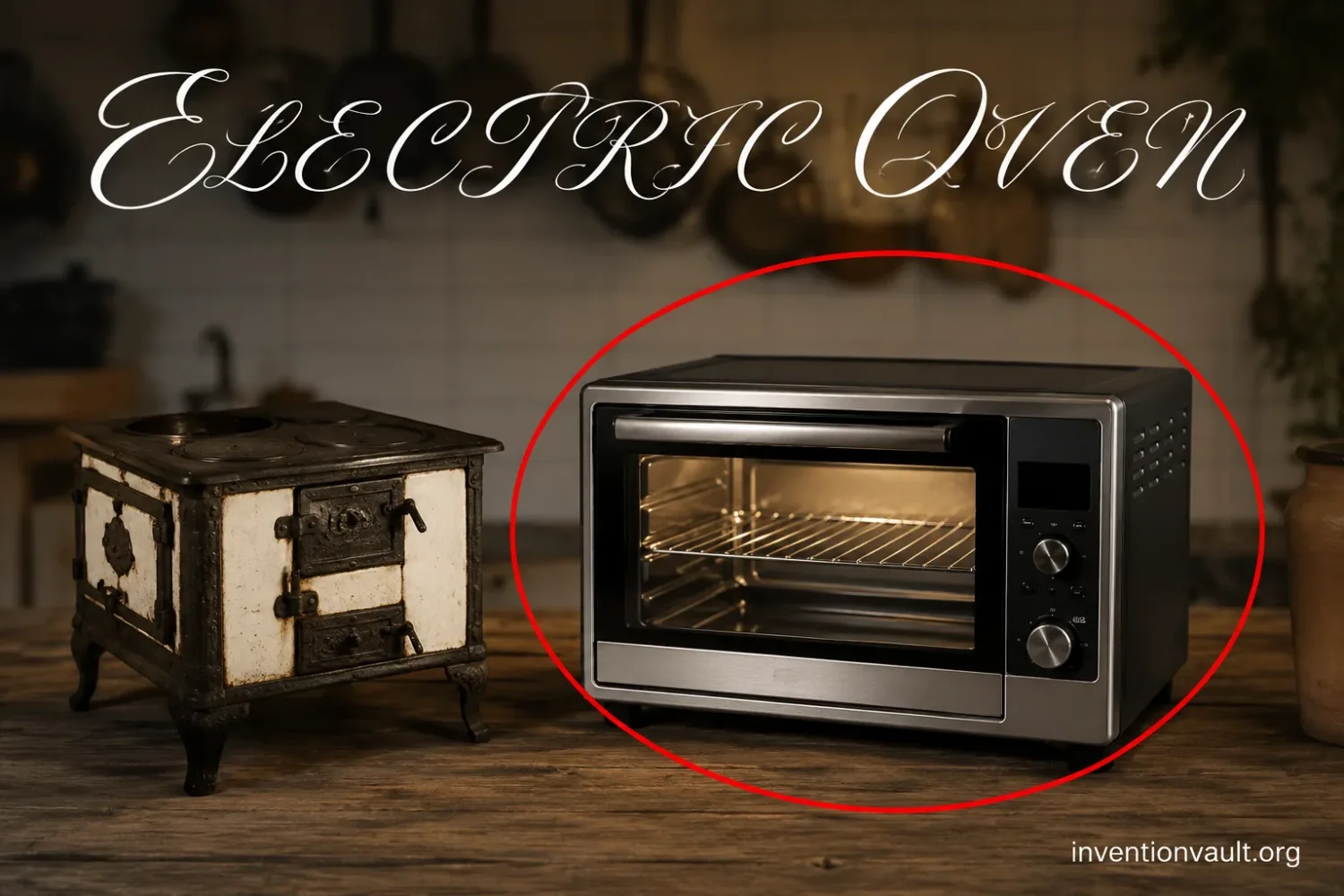
Heat Control Record
How Electric Baking Became Repeatable
Follow the shift from fuel-tended ovens to resistance heat, automatic switching, household wiring, and fan-managed baking.
Pre-electric baking
Fire Heat Required Constant Judgment
Selected file: Fire Heat Required Constant Judgment. Choose another file to update this evidence card.
Selected
Heat source
Wood and coal ovens depended on combustion, draft, fuel quality, ash removal, and the cook’s timing. Heat output could not be selected with a calibrated dial.
Temperature reading
Many household cooks judged readiness by experience, hand tests, flour browning, or simple oven thermometers. The oven and the fire changed together rather than through feedback control.
Kitchen burden
Fuel had to be stored, carried, lit, and replenished. Smoke, soot, chimney draft, and residual heat shaped both baking results and the layout of the room.
Electric baking mattered only when controllable heat replaced the cook’s repeated adjustment of fuel and draft.
Public demonstration
Thomas Ahearn’s 1892 Cooking Installation
Selected file: Thomas Ahearn’s 1892 Cooking Installation. Choose another file to update this evidence card.
Selected
Documented event
In Ottawa in 1892, Thomas Ahearn promoted electric cooking through a meal prepared on a large electrically heated installation and served to invited guests.
Physical form
The apparatus was a brick structure rather than a compact domestic wall oven. Glass-covered viewing openings reduced the need to open the chamber while food cooked.
What it proved
The event showed that electricity could supply enough sustained heat for a varied meal. It did not by itself solve household size, cost, wiring, element life, or automatic regulation.
The demonstration established capability, while later engineers had to turn that capability into a manageable kitchen appliance.
Automatic regulation
Hadaway Linked Temperature to the Circuit
Selected file: Hadaway Linked Temperature to the Circuit. Choose another file to update this evidence card.
Selected
Patent record
William S. Hadaway Jr. applied in 1896 for an automatically controlled electric oven; U.S. Patent 574,537 was issued on January 5, 1897.
Control action
A temperature-responsive mechanism moved electrical contacts so sections of the heating conductor could be removed from or restored to the circuit.
Adjustable target
The design allowed a chosen temperature range rather than a single fixed output. That connected baking instructions to a physical setting the appliance could maintain.
Not a modern thermostat
The patent used a thermal motor, mechanical linkage, and segmented conductors. Later thermostats became smaller, simpler, and better suited to factory-built household ranges.
The control loop—not electrical heat alone—made repeatable baking a practical engineering goal.
Heating hardware
Resistance Elements Made Heat on Demand
Selected file: Resistance Elements Made Heat on Demand. Choose another file to update this evidence card.
Selected
Electrical conversion
Current passing through a resistive conductor produces heat. Coiling the conductor packs useful resistance into a compact space and spreads the source across part of the cavity.
Material problem
Early elements could oxidize, sag, or fail after repeated heating. Nickel-chromium and related resistance alloys offered longer service at red-hot temperatures.
Electrical isolation
Ceramic supports, vitreous enamel, mineral insulation, and later metal-sheathed elements kept live conductors separated from the steel cavity while allowing heat to pass.
Long-lived elements reduced maintenance and allowed manufacturers to design heat placement instead of merely producing heat.
Domestic temperature control
Thermostats Turned Dials into Baking Temperatures
Selected file: Thermostats Turned Dials into Baking Temperatures. Choose another file to update this evidence card.
Selected
Sensing
A thermostat responds to cavity temperature through a sensing bulb, bimetal strip, or later an electronic sensor rather than relying on elapsed time alone.
Cycling
When the sensed temperature crosses a control threshold, the circuit changes state. The oven then cools slightly before heat is restored, creating a controlled temperature band.
Recorded household form
A 1933 Creda cooker in the Science Museum Group collection carries an automatic Credastat oven thermostat, showing feedback control in a factory-made domestic appliance.
The thermostat made recipe temperatures reproducible enough to travel between cookbooks, kitchens, and appliance models.
Household adoption
The Oven Needed a Power System
Selected file: The Oven Needed a Power System. Choose another file to update this evidence card.
Selected
Supply capacity
Lighting circuits alone did not guarantee enough current for cooking. Homes needed suitable service, wiring, switches, connectors, and protective devices for sustained high-power loads.
Manufacturing base
Sheet-steel cabinets, enamel coatings, formed elements, insulation, stamped controls, and assembly-line production lowered the cost of a complete range.
Uneven adoption
Electric ranges reached urban and wealthier households before many rural homes. Wider electrification, postwar housing, and utility promotion later expanded the market.
A practical electric oven was both an appliance and the endpoint of a household energy network.
Air distribution
Fans Reduced Cavity Temperature Differences
Selected file: Fans Reduced Cavity Temperature Differences. Choose another file to update this evidence card.
Selected
Natural circulation
Without a fan, hot air rises and cooler air sinks. Element position, rack level, pan size, and wall temperature can create zones that bake at different rates.
Forced circulation
A fan moves heated air around the load, reducing stagnant zones and improving heat transfer at food surfaces. Some designs add a heater around the fan.
Changed recipe settings
Because moving air transfers heat more rapidly, fan modes often use a lower set temperature or shorter time than still-air baking, depending on the food and oven.
Modern control extends beyond temperature sensing to the deliberate movement and timing of heat inside the cavity.
An electric oven bakes by sending current through resistance elements, converting electrical energy into heat inside an insulated cavity while a thermostat cycles the circuit around a selected temperature. No single inventor produced the complete household appliance in one step. Thomas Ahearn demonstrated a large electric cooking installation in Ottawa in 1892; William S. Hadaway Jr. patented an automatic temperature-control system in the United States in 1897; and later manufacturers combined longer-lived elements, insulated steel cavities, thermostats, safer wiring, and mass production into the familiar domestic oven.
| Question | Evidence-based answer |
|---|---|
| What is an electric oven? | An enclosed cooking chamber heated by electrical resistance elements, usually regulated by a thermostat or electronic temperature controller. |
| Who invented it? | There is no single uncontested inventor of the whole domestic system. Ahearn, Hadaway, element makers, thermostat designers, utilities, and appliance manufacturers supplied different parts of the development. |
| Early public demonstration | Thomas Ahearn’s electrically cooked Ottawa meal in 1892 showed that electric heat could prepare a varied menu. |
| Automatic-control patent | William S. Hadaway Jr., U.S. Patent 574,537, applied for May 4, 1896 and issued January 5, 1897. |
| Domestic thermostat evidence | A surviving 1933 Creda cooker used an automatic Credastat oven thermostat. |
| What enabled mass use? | Household electrification, durable resistance elements, thermal insulation, standardized controls, safer circuits, lower production cost, and factory distribution. |
Appliance Terms
An oven is the enclosed baking chamber. A range combines an oven with surface cooking units. A cooktop has surface units but no oven. Induction describes a cooktop heating method, not the usual heating method inside an electric oven.
What Controlled Home Baking Meant
Baking asks more of a heat source than boiling a pot. Water limits its own temperature near the boiling point under normal household conditions, but bread, cakes, pies, biscuits, and roasted foods respond to the temperature of the oven air, radiant energy from hot surfaces, pan material, evaporation, and the timing of crust formation. A fire-heated oven could bake well, yet the cook had to manage the fire, draft, door, and loading sequence as one linked task.
Electric resistance heat separated the production of heat from combustion inside the kitchen. Turning a switch could energize an element immediately, with no fuel to ignite and no ash to clear. That alone did not guarantee accurate baking. An unregulated element can continue raising the cavity temperature until heat loss balances electrical input, and that balance changes when the door opens, cold food enters, air moves, or room conditions change.
The decisive step was therefore controlled electrical heat: a sensor or thermal mechanism had to detect temperature, a switch had to change power, and the insulated cavity had to hold enough heat that cycling did not create extreme swings. The result was not perfectly constant temperature. It was a repeatable operating band that a recipe writer and a household cook could both use.
Before Electricity: Baking by Fire and Draft
Nineteenth-century household baking commonly relied on wood, coal, or gas. Wood and coal ranges combined a firebox, flues, iron cooking surfaces, and an oven compartment. Heat traveled around or beside the chamber before leaving through a chimney. The cook regulated output by adding fuel, moving dampers, clearing ash, and judging how the stove responded. Fuel species, coal grade, chimney draw, wind, and soot deposits could alter the result.
Gas removed much of the solid-fuel handling and made flame adjustment faster. By the late nineteenth century, gas cooking had become a serious competitor in cities with distribution networks. Yet an oven burner and a hand valve still did not automatically hold a selected temperature. Thermostatic regulation would later improve both gas and electric ovens, so the history of controlled baking is not a simple contest in which one fuel possessed control from the start.
Electric ovens offered a different path. Their heat source could be distributed as wire coils, plates, or concealed elements. Power could be switched rapidly without managing combustion air. The same electrical circuit could also support indicators, timers, lamps, fans, and later electronic controls. Those added functions became part of the appliance because electricity supplied both heat and control energy.
Why the First Electric Oven Has No Single Date
Searches for the inventor of the electric oven often compress several milestones into one claim. Historical records instead show overlapping work: electric heaters existed before practical ranges; public demonstrations proved cooking capacity; patents described particular control systems; surviving appliances show what factories produced; and household adoption depended on power networks that arrived at different times in different places.
Thomas Ahearn and the 1892 Demonstration
Thomas Ahearn was an Ottawa electrical entrepreneur whose companies worked in lighting, street railways, and power. In 1892 he promoted electric cooking through a multi-course meal prepared on an electrically heated apparatus and served at the Windsor Hotel. The cooking equipment itself was housed at his company’s car shed. Contemporary descriptions presented it as a large brick installation with heaters and viewing openings protected by thick glass.
This was powerful evidence that electric heat could bake, roast, and cook more than a novelty snack. It was not yet the compact enamelled range that would fit a standard kitchen. The installation’s size and setting also show why a demonstration date cannot be treated automatically as the birth date of the domestic electric oven.
William Hadaway and Automatic Temperature Control
William S. Hadaway Jr. addressed a problem that remains central to oven design: full electrical input is useful for heating quickly, but lower average input is needed to hold a baking temperature. His U.S. patent application of May 4, 1896 described an automatically controlled electric oven, and Patent 574,537 was issued on January 5, 1897.
The design divided the heating conductor into sections. A temperature-responsive mechanism moved contacts so sections could be taken out of or returned to the circuit. Hadaway also described an adjustable target, allowing the oven to maintain a temperature suited to a chosen baking or cooking operation. The apparatus used glazed tile, mineral wool, enamelled surfaces, and coiled conductors, joining control, insulation, and heat distribution in one proposal.
Dating the First
Ahearn’s 1892 demonstration and Hadaway’s 1897 U.S. patent answer different questions. The first shows an operating electric cooking installation; the second records a defined automatic-control design. Neither date alone marks broad household adoption.
What Each Record Can Establish
- Public mealShows that an installation cooked a varied menu for an audience; it does not prove that ordinary homes could buy or power the same apparatus.
- Patent specificationShows what the applicant described and claimed at a recorded date; it does not prove factory production, market success, or sole invention of the wider appliance.
- Surviving cookerShows the materials, controls, dimensions, and manufacturing form of a real product from a stated period.
- Utility and housing recordsShow when households gained the supply capacity and kitchen arrangements needed for regular electric cooking.
How an Electric Oven Controls Heat
A modern electric oven is a feedback system wrapped around a heated cavity. The user selects a temperature. A sensor reports the cavity’s thermal state to a mechanical thermostat or electronic controller. The controller switches one or more elements, sometimes at full power and sometimes through programmed combinations. Insulation slows heat loss, while the food, pans, racks, and cavity walls absorb and release energy throughout the cycle.
- Current enters the elementElectrical resistance converts part of the current’s energy into heat within a coiled, ribbon, or sheathed conductor.
- Heat spreads through the cavityRadiation from hot elements and walls, natural or fan-driven convection, and conduction through pans transfer energy toward the food.
- The sensor tracks temperatureA mechanical bulb, bimetal device, resistance sensor, or thermocouple responds to temperature at a chosen location in the oven.
- The controller changes powerWhen the measured value crosses a threshold, contacts, relays, or solid-state devices reduce, stop, or redirect element power.
- The cycle repeatsAs the cavity loses heat, power returns. The controller keeps temperature within a band rather than freezing it at one exact number.
Radiation, Convection, and Conduction Work Together
An oven does not heat food through “hot air” alone. The exposed or concealed elements and the hot cavity walls emit thermal radiation. Air carries heat by convection, either through buoyancy or fan movement. The pan conducts heat into the dough or food where it touches. A dark metal pan, a glass dish, a baking stone, and a shiny aluminum sheet can therefore produce different browning and base textures at the same dial setting.
Element placement also matters. A lower element supplies strong energy to the floor and lower cavity; an upper element supports top browning and broiling. During ordinary baking, the controller may alternate elements or use them in set proportions. In fan ovens, a rear element can heat air immediately before the fan distributes it.
Why the Temperature Moves Above and Below the Setting
Thermostats need a switching difference. If a mechanical contact opened and closed at the same exact value, tiny changes could make it chatter rapidly, shortening its life. Instead, the oven heats to one threshold, turns down or off, cools to another threshold, and heats again. The food experiences the average effect of those cycles together with heat stored in the walls and pans.
Electronic controllers can use finer sensing and programmed element pulses, but they still work with thermal delay. An element remains hot after power stops, and a cold load can pull down local temperature before the sensor fully responds. Good design anticipates this lag rather than pretending it does not exist.
Materials That Made Electric Ovens Practical
Resistance Alloys
A heating element needs enough electrical resistance to generate useful heat in a manageable length. It must also survive repeated expansion, red-hot operation, and contact with air. Ordinary wire can oxidize, weaken, or require an impractical geometry. Nickel-chromium and related heating alloys resist oxidation and retain useful strength at high temperature, allowing compact coils with longer service life.
Many later elements place resistance wire inside a metal tube packed with electrically insulating, heat-conducting mineral powder. The sheath protects the wire, provides a durable shape, and separates live conductors from the cavity. Concealed bake elements place that assembly beneath the oven floor, improving cleanability but adding material between the source and the food.
Ceramics, Enamel, and Electrical Separation
Early exposed coils needed ceramic supports because the support had to tolerate heat without carrying current into the metal cabinet. Vitreous enamel served several purposes in historic and later ovens: it created a cleanable surface, resisted food acids better than bare steel, and could provide electrical separation in selected assemblies. Firebrick or tile could support exposed elements and store heat, though heavy refractory construction slowed warm-up and added weight.
Insulation and Door Sealing
Without insulation, a powerful element would spend much of its output heating the kitchen and outer cabinet. Mineral wool and later insulation systems reduced heat flow through the walls. Door construction, hinges, latches, glazing, and gaskets became equally important because the front opening is a large path for heat loss. Better sealing shortened recovery after preheating and helped the thermostat maintain a narrower operating band.
Insulation also made new layouts possible. Once the outer cabinet could remain within safer temperature limits, ovens could sit beside cupboards, fit into standardized ranges, or be mounted in walls. Thermal design therefore changed kitchen furniture and architecture as well as baking performance.
From Demonstration Apparatus to Household Range
Early electric cooking faced a network problem. A town might have electric streetlights while many homes still lacked service, or a home might have wiring intended only for lamps. An oven is a sustained high-power load. Practical adoption required generating capacity, distribution, meters, suitable branch circuits, heat-resistant internal wiring, switches, connectors, fuses or breakers, and installation practices that could support the appliance safely.
Manufacturing had to mature at the same time. Foundry-built stoves were heavy and labor-intensive. Sheet-steel cabinets, stamped parts, enamelled liners, standardized elements, molded control parts, and assembly lines made ranges easier to transport and sell. By the 1920s and 1930s, electric appliance industries expanded alongside urban electrification. Adoption remained uneven because electricity prices, housing stock, rural service, and competition from gas differed by region.
| Period | Recorded development | What remained unresolved |
|---|---|---|
| 1892 | Ahearn’s Ottawa demonstration showed high-capacity electric cooking and reduced door opening through viewing ports. | Domestic size, household supply, element durability, purchase cost, and automatic control. |
| 1896–1897 | Hadaway applied for and received a U.S. patent for adjustable automatic control of an electric oven. | Simple factory production, compact controls, service networks, and broad consumer demand. |
| 1905–1910 | A surviving British electric oven used removable coiled elements embedded in firebrick, with separate heat switches. | Exposed-element protection, faster warm-up, easier cleaning, and calibrated thermostat control. |
| 1919 | The compact Belling “Modernette” combined an oven, hotplate, griller, and plate warmer for a small house or flat. | Lower cost, longer element life, wider wiring capacity, and more automatic operation. |
| 1920s–1930s | Factory production expanded with electrical distribution, steel and enamel industries, and utility-backed appliance sales. | Uneven regional access and competition from established fuel systems. |
| 1933 | The Creda New Series cooker used an automatic oven thermostat in a domestic factory-built appliance. | More uniform cavity temperature, simpler calibration, and lower heat loss. |
| Postwar decades | Ranges and wall ovens became common in new housing, with timers, oven lamps, improved seals, and later fan circulation. | Hot spots, calibration drift, cleaning, idle losses, and differences between recipe and actual food temperature. |
How Temperature Control Changed Baking
A calibrated oven dial allowed recipes to specify a temperature rather than only a fire condition such as “moderate” or “quick.” Those older terms did not disappear at once, and early thermostats were not equally accurate, but the dial created a shared reference between cookbook, appliance maker, and household. Baking instructions could become more portable because the cook no longer had to translate every recipe into the behavior of one particular stove.
Control also changed workflow. A cook could preheat while mixing, load the oven without adding fuel, and spend less attention on draft and ash. Timers later separated start time, cooking duration, and shutoff. Oven lamps and glazed windows reduced the need to open the door. None of these functions guaranteed good baking, but together they shifted the task from fire management toward ingredient control, pan choice, rack position, and timing.
The effect was especially visible in foods with narrow thermal tolerances. Cakes can set unevenly if one side receives more heat; pastry depends on controlled melting, steam formation, and starch setting; bread needs enough stored heat for oven spring without scorching the crust too early. A regulated cavity made those processes easier to repeat, though bakers still learned the behavior of their own oven.
Main Electric Oven Design Families
Conventional Still-Air Oven
A conventional electric oven usually places one element below the cavity and another above it. Natural convection circulates air as warmer air rises and cooler air descends. The walls and elements provide a large share of radiant heating. Rack level can strongly affect browning because the food’s distance from the elements and cavity surfaces changes.
Fan-Assisted and True Convection Oven
A fan-assisted oven moves air heated by the main upper and lower elements. A “true convection” or European-style design usually adds an element around the fan at the rear. Moving air reduces some temperature differences and can improve multi-rack cooking. It also increases heat transfer at the food surface, which is why recipes may call for a lower setting or shorter time.
Range Oven and Wall Oven
A range places the oven beneath surface units in one freestanding or slide-in cabinet. A wall oven separates baking from the cooktop and can raise the cavity to a more convenient height. The thermal process can be similar, but ventilation, cavity size, control layout, installation, and electrical connection differ.
Compact and Countertop Oven
Countertop ovens heat a smaller cavity, often with exposed upper and lower elements. Lower thermal mass and short element-to-food distance can produce rapid preheating and strong browning, but also sharper hot spots. Their small chamber can save energy for small loads because less metal and air must be heated.
Multifunction and Electronic Oven
Electronic ovens coordinate several elements, fans, sensors, dampers, and timers. Modes may favor bottom heat for a crust, upper heat for browning, fan circulation for several racks, or a staged sequence that changes heat during cooking. The mode name alone does not reveal the exact element pattern, so performance can differ between manufacturers.
Why Two Ovens at the Same Setting Bake Differently
The dial setting is a control target, not a complete description of the thermal environment. Sensor placement may be close to a wall while food sits near the center. One cavity may have more thermal mass, stronger radiant output from a lower element, faster fan speed, or a wider thermostat cycle. A large dark pan can block airflow and absorb radiation differently from a small shiny tray.
Opening the door releases hot air, but the larger loss can come from cooling the inner door, walls, racks, and food-facing surfaces. The thermostat may respond after a delay, then apply high power during recovery. Repeated checking can therefore alter both average temperature and the balance between top, bottom, and surface heating.
Calibration also changes with age. Mechanical thermostats can drift, sensor mounting can loosen, door seals can wear, and an element can fail partly or completely. An inexpensive oven thermometer can reveal broad error, but it also has response delay and position sensitivity. For detailed baking work, repeated tests with the same rack, pan, and load often tell more than a single empty-oven reading.
Oven Setpoint
The controller’s target for the cavity sensor. It governs element cycling but does not state the exact temperature at every rack position or surface.
Food Temperature
The temperature inside the food, which changes slowly according to size, moisture, composition, pan contact, evaporation, and heat transfer from the cavity.
Limits and Tradeoffs That Remain
Electric ovens remove combustion from the cavity, but they do not remove every source of unevenness. Still-air cavities stratify. Fans can create stronger flow near the rear or edges. Concealed elements improve cleaning but may lengthen preheat or alter bottom browning. Large windows improve visibility but demand careful glazing and sealing to limit heat loss.
Faster preheating usually requires higher element power, yet the cavity must avoid excessive overshoot. Heavy walls and baking stones stabilize temperature after they heat, but they increase warm-up energy and time. Thick insulation lowers heat loss, while cabinet dimensions and cooling requirements limit how much insulation can fit. Designers balance warm-up, recovery, exterior temperature, usable volume, cost, and serviceability.
Modern controls can display precise numbers without measuring the food itself. Most household ovens still regulate cavity temperature in an open-loop relationship to the recipe: they control the environment and rely on the cook to choose time, rack, and doneness test. Probe-assisted modes move closer to closed-loop food control by measuring internal temperature, but they suit roasts and similar foods better than many baked goods.
Common Misunderstandings About Electric Ovens
“One Person Invented the Modern Electric Oven”
A single-name answer hides the difference between producing electrical heat, demonstrating an oven, patenting a control method, designing a compact range, developing durable elements, adding a domestic thermostat, and supplying homes with enough power. Ahearn and Hadaway belong in the history, but neither independently created every feature of the later household oven.
“A Patent Date Is the Invention Date”
A patent has several dates, including application and issue. It records a claimed design, not automatic proof of first conception, first working apparatus, first sale, or widespread use. Hadaway’s 1896 application and 1897 issue date should therefore be identified precisely rather than collapsed into one vague “invented in 1896” statement.
“Electric Ovens Bake at One Fixed Temperature”
Most ovens cycle around a target. The element temperature, cavity air, walls, pan, and food all move on different time scales. The useful achievement is controlled variation within an expected range, not a perfectly flat temperature line.
“Convection Is Always Better”
Forced air can improve multi-rack uniformity and speed surface heat transfer, but delicate cakes, custards, and some breads may respond poorly to strong airflow or early surface drying. The suitable mode depends on the food, pan, load, and oven design.
The Lasting Invention Was a Controlled System
The electric oven became a household baking tool when several technologies began working as one system. Resistance alloys produced repeatable heat. Ceramic and mineral materials separated electricity from the metal cavity. Insulation and door seals retained energy. Thermostats linked measured temperature to switching. Utilities and household wiring delivered sustained power. Factories made the assembly small, cleanable, and affordable enough for ordinary kitchens.
That system changed the meaning of a baking instruction. A temperature on a recipe could correspond to a dial, and the oven could perform most of the repeated correction once handled by the cook. Modern fans, electronic sensors, timers, and programmed modes refine the same basic arrangement: generate heat, measure the cavity, adjust power, and manage how energy reaches the food.
Questions People Ask About Electric Ovens
Who is most often credited with the electric oven?
Thomas Ahearn is often credited because of his 1892 Canadian work and the well-publicized Ottawa electric meal. A balanced account also names William S. Hadaway Jr. for his 1896 application and 1897 U.S. patent on automatic electric-oven control, then separates both milestones from later domestic manufacture.
When did electric ovens become common in homes?
There was no universal date. Factory production expanded during the 1920s and 1930s in electrified markets, while broad household ownership grew later as wiring, utility service, housing, and appliance prices changed. Rural and urban adoption followed different schedules.
Does an electric oven use induction?
Ordinary electric ovens use resistance elements. Induction cooktops create heat in compatible cookware through an electromagnetic field. A range may combine an induction cooktop with a resistance-heated oven, but the two sections use different methods.
Why do electric oven elements turn red?
An exposed resistance element can reach a temperature high enough to emit visible red light. The glow comes from thermal radiation. Concealed or sheathed elements may operate hot without being visible from inside the cavity.
Why does an electric oven click on and off?
The sound often comes from a thermostat contact or relay changing the element circuit. Cycling is how the controller keeps the cavity near the selected temperature instead of applying full power continuously.
References Used for This Article
- Ingenium, “The World’s First Electric Meal” — used for Thomas Ahearn’s Ottawa demonstration, the cooking location, and the documented form of the large brick apparatus.
- Google Patents, U.S. Patent 574,537 — used for Hadaway’s application and issue dates, segmented heating conductors, adjustable automatic control, insulation, and cavity construction.
- Science Museum Group, Creda New Series electric cooker — used for the 1933 domestic cooker and its automatic Credastat oven thermostat.
- Science Museum Group oven collection — used for the Beeton electric oven, Belling Modernette, early exposed coils, firebrick supports, heat switches, and later cooker forms.
- Ingenium, “From the Stove to the Electric Range” — used for fuel-stove operation, Canadian electrification, manufacturing change, materials, and household adoption.
- Smithsonian Magazine, oven invention timeline — used to cross-check the placement of Ahearn’s 1892 demonstration within the wider oven chronology.
- U.S. Department of Energy, energy-efficient commercial ovens — used for forced convection, insulation, gaskets, advanced controls, preheat, cooking, and idle-energy behavior.