
Browning Mechanism Record
How the Toaster Became Automatic
Trace the material, heating, timing, and bread-handling changes that turned watched wire racks into automatic slot toasters.
Heating Material
Nickel-Chromium Resistance Wire
Selected file: Nickel-Chromium Resistance Wire. Choose another file to update this evidence card.
Selected
Electrical requirement
A toaster needed a conductor with enough resistance to become hot when current passed through it, yet enough durability to survive repeated heating and cooling in air.
Material change
Albert Marsh developed a nickel-chromium heating alloy in 1905. The wire tolerated repeated red heat better than many earlier conductors and did not require a vacuum enclosure.
Appliance consequence
The alloy allowed compact exposed elements to radiate heat toward bread, making a tabletop electric browning appliance technically workable.
The toaster began as a materials problem: dependable radiant heat had to exist before bread handling or timing could be automated.
Commercial Electric Form
General Electric Model D-12
Selected file: General Electric Model D-12. Choose another file to update this evidence card.
Selected
Market milestone
General Electric introduced the Frank Shailor-designed D-12 in 1909. Museums commonly describe it as the first commercially successful electric toaster.
Bread position
The slice sat beside an exposed heating element in a wire holder. Early versions browned one face, so the user had to turn the bread.
Unsolved control
The D-12 supplied repeatable electric heat, but it did not decide when the toast was finished or remove the slice from the hot zone.
Electricity replaced the flame, but attention and hand turning still controlled the result.
Exposure Control
Automatic Bread Turning
Selected file: Automatic Bread Turning. Choose another file to update this evidence card.
Selected
Manual bottleneck
Single-sided electric racks created uneven results unless the slice was turned at the right moment without touching the hot element or frame.
Copeman approach
The Copeman Electric Stove Company marketed an automatic-turning toaster in 1913, reducing the need to remove and reverse the bread by hand.
Remaining task
Changing which face met the heat improved exposure, but the operator still had to judge browning and stop the cycle.
Turning mechanisms addressed two-sided browning before timing mechanisms addressed unattended operation.
Timed Control Patent
Charles Strite’s Adjustable Cycle
Selected file: Charles Strite’s Adjustable Cycle. Choose another file to update this evidence card.
Selected
Patent filing
Strite filed a bread-toaster application on May 29, 1919. U.S. Patent 1,387,670 was granted on August 16, 1921.
Selected duration
A dial let the operator choose a time interval. At the end of that interval, the mechanism opened the electrical switch and stopped heating.
Partial release
The patent also described a cover and linked trays that lifted the toasted bread partly out of the casing after the heat was cut.
The decisive change was not hotter wire; it was a repeatable endpoint built into the machine.
Automatic Ejection
Cutoff, Carriage, and Pop-Up
Selected file: Cutoff, Carriage, and Pop-Up. Choose another file to update this evidence card.
Selected
Second patent record
Strite’s later application, filed in 1920 and granted as U.S. Patent 1,394,450 in October 1921, described automatic cutoff and removal of bread from an enclosed oven.
Mechanical sequence
The bread carrier stayed down while current heated the elements. Release of the control ended power and allowed the carrier to rise.
Consumer form
The automatic toaster that browned both sides and popped up the finished slice debuted in 1926 under the Toastmaster name.
Timing and lifting combined to make toast without continuous watching, the feature set associated with the modern slot toaster.
Household Adoption
Standard Slices and Daily Use
Selected file: Standard Slices and Daily Use. Choose another file to update this evidence card.
Selected
Appliance sales
Americans bought more than one million electric toasters during the 1920s, often using them directly on the breakfast table.
Machine-cut bread
Commercial machine-sliced loaves appeared locally in 1928, followed by wider national distribution in 1930. Regular slices suited fixed toaster slots and timed cycles.
Two-slice layout
Two-slice Toastmaster models arrived in 1930, aligning the automatic mechanism with faster household serving rather than one-slice operation.
The toaster became routine when appliance control, household electrification, and consistently sliced bread began to reinforce one another.
The electric toaster was developed through several linked inventions rather than one isolated event. Frank Shailor’s General Electric D-12 made electric bread browning commercially workable in 1909. Charles Strite’s patent applications of 1919 and 1920 added adjustable timing, automatic current cutoff, and bread lifting. The familiar appliance that browned both sides and popped the slice upward reached consumers in 1926 under the Toastmaster name.
| Record | Verified detail |
|---|---|
| Primary purpose | Brown sliced bread rapidly with radiant electric heat |
| Enabling material | Nickel-chromium resistance wire developed by Albert Marsh in 1905 |
| Early commercial model | General Electric D-12, designed by Frank Shailor and introduced in 1909 |
| Timed toaster patent | Charles Strite filed in 1919; U.S. Patent 1,387,670 granted in 1921 |
| Automatic toaster patent | Charles Strite filed in 1920; U.S. Patent 1,394,450 granted in 1921 |
| Consumer pop-up debut | Toastmaster automatic toaster, 1926 |
| Browning process | Mostly Maillard reactions between reducing sugars and amino compounds at the bread surface |
Who Invented the Toaster?
No single name covers every meaning of “toaster.” Metal forks, hinged racks, and wire cages had long been used to hold bread near a fire. The electrical appliance required a heat-resistant conductor, an insulated support, a bread holder, and a practical connection to household power. The automatic pop-up version required additional timing, switching, latching, and lifting mechanisms.
George J. Schneider filed a 1905 patent for an electric cooker with heating conductors placed behind gratings. The patent described a broiler rather than a dedicated slice toaster, but it belongs to the early resistance-heating record. Frank Shailor’s later design was made specifically useful for bread and became a commercial product as the General Electric D-12.
Shailor therefore fits the question “Who designed the first commercially successful electric toaster?” Charles Strite fits the narrower question “Who developed the automatic timed pop-up toaster?” His two 1921 patents document related stages: one centered on adjustable time, cutoff, a moving cover, and partial bread lifting; the other described an enclosed automatic electric toaster that removed the bread when the cycle ended.
Dating the First
A patent filing, a granted patent, a factory model, and a product sold to households mark different events. A claim can be accurate under one definition and misleading under another.
The Heating Wire That Made Electric Toasting Practical
An electrical conductor becomes hot because it resists the movement of current. The energy lost by moving charge appears as heat, a process called resistive or Joule heating. A toaster element needs more than electrical resistance. It must remain mechanically stable while repeatedly heating to a visible glow, cooling, and meeting oxygen in the surrounding air.
Many early conductors oxidized, weakened, or failed too quickly for a small domestic heater. In 1905, metallurgist Albert Marsh developed a nickel-chromium alloy that could be drawn into resistance wire and used repeatedly at high temperature. The material later became widely known through names such as Nichrome or Chromel, depending on composition and trade usage.
Nickel-chromium wire offered a useful combination of electrical resistance, high-temperature strength, and oxidation tolerance. When current passed through a properly sized length, the wire heated strongly without needing combustion or a sealed bulb. That made it suitable for toasters, irons, hot plates, and other compact appliances.
The wire alone did not make a toaster. It had to be separated from the metal case and arranged close enough to the bread for rapid radiant heating. Early manufacturers used ceramic or porcelain insulation. Later slot toasters commonly wound thin resistance ribbon or wire around heat-resistant mica sheets, creating broad glowing element surfaces on either side of the slice.
From an Open Rack to an Automatic Pop-Up Appliance
The early design problem was divided into three tasks: expose the bread evenly, stop heating before burning, and move the slice away from the element. Each task produced a different family of mechanisms.
| Date | Development | What changed | What still depended on the user |
|---|---|---|---|
| 1905–1906 | Durable resistance alloys and early electric cooker patents | Electric heat could be produced close to a metal grating | Bread placement, turning, and stopping |
| 1909 | General Electric D-12 | A dedicated electric bread toaster reached the market | Watching and turning the slice |
| 1913 | Copeman automatic-turning designs | The bread could present both faces to the heat with less handling | Judging the endpoint |
| 1919–1921 | Strite timed toaster | A selected interval controlled automatic current cutoff | Loading and selecting the desired cycle |
| 1920–1921 | Strite automatic toaster patent | Cutoff and upward bread movement were linked | Choosing a setting suited to the bread |
| 1926 | Toastmaster consumer automatic toaster | Both sides browned and the finished slice popped up | Loading, shade choice, and removal |
| 1930 | Two-slice Toastmaster | Automatic operation served more than one slice per cycle | Matching the setting to slice condition |
The General Electric D-12
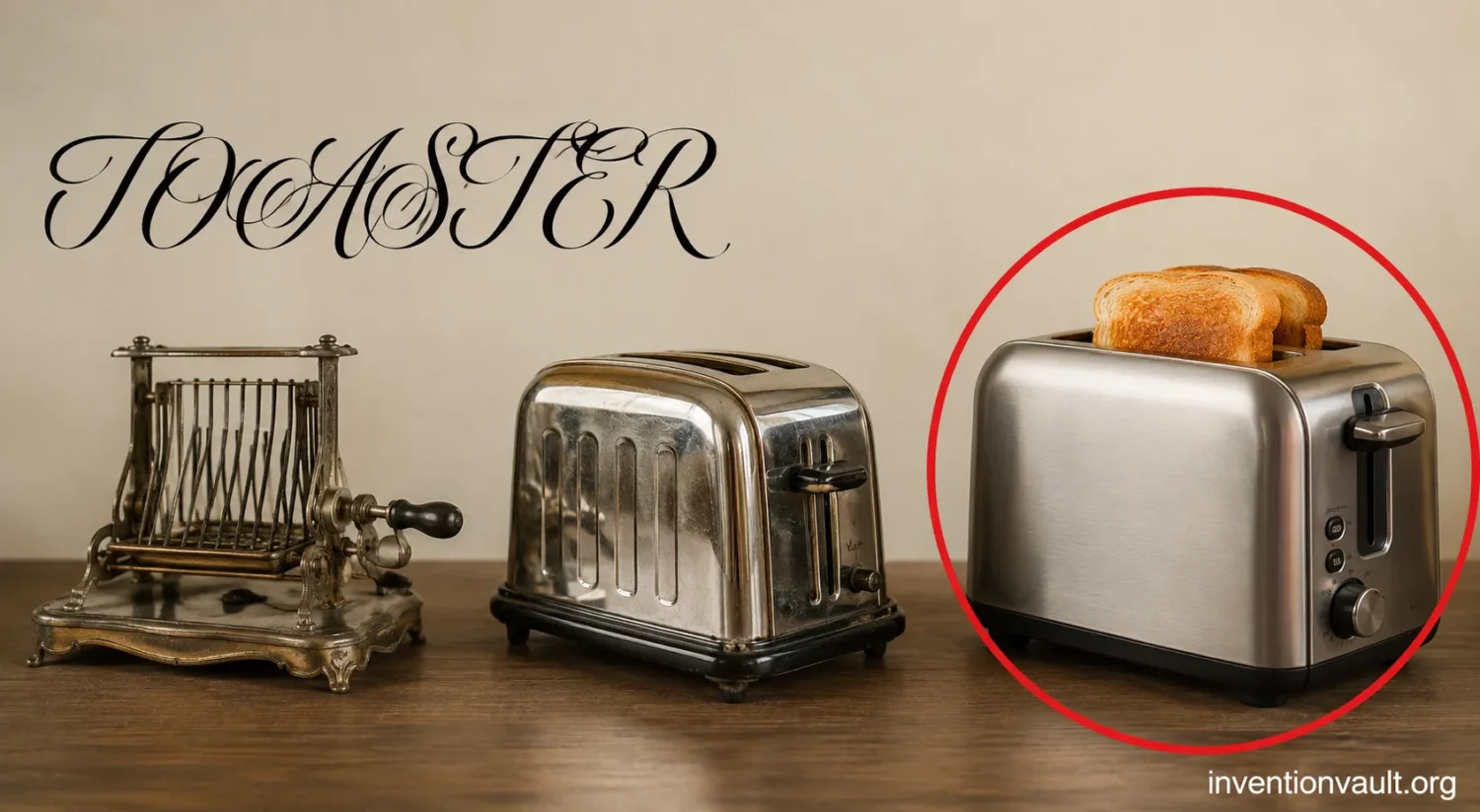
The D-12 was upright, open, and visually closer to a heated rack than to a modern enclosed toaster. A slice rested in a wire pocket beside a resistance element. The user watched the surface, turned the bread, and removed it when the second face looked ready. There was no automatic shade control, no enclosed slot, and no spring-loaded pop-up carriage.
This simplicity was useful. The machine proved that a compact electric element could brown bread at the table without a stove or open flame. It also exposed the next engineering targets. One-sided heating produced extra handling, while an uncontrolled cycle could move from pale bread to scorched toast within a short interval.
Automatic Turning Before Automatic Timing
One route to more even toast was mechanical turning. Copeman designs introduced in 1913 moved or reversed the bread so both faces could meet the heat. This reduced the awkward act of pulling a slice from a hot rack and placing it back in the opposite direction.
Automatic turning did not by itself detect color or cut the current. It solved exposure geometry, not completion. A truly unattended toaster needed a control that could end the heating cycle and a mechanism that would move the bread away from the hot elements.
Strite’s Timer and Bread Lift
Charles Strite’s 1919 application described a toaster that could be set for different durations. Moving a handle selected a point on a numbered dial. The timing mechanism later opened the electrical switch, ending the heat supply. Linked trays and a spring-assisted cover moved the bread upward after cutoff.
His later patent refined the automatic arrangement around a substantially enclosed oven, vertically moving bread carriers, insulated element supports, a switch, and a release system. The bread did not have to stay beside glowing wire after the selected interval. The machine ended the cycle and removed the slice from the main heat zone.
What the Patent Record Supports
Strite’s applications document adjustable time, automatic electrical cutoff, and mechanical bread lifting before the Toastmaster consumer pop-up toaster appeared in 1926.
How a Modern Pop-Up Toaster Works
A basic slot toaster still follows the sequence established by early automatic designs. The user supplies the bread and selects a shade. The appliance lowers the slice, energizes the elements, holds the carriage in place, ends the current after a controlled interval, and releases the spring-loaded carriage.
- Lower and centerThe lever moves the bread carriage downward while guides position the slice between opposing heating elements.
- Close the circuitAt the bottom of travel, contacts close and current flows through the resistance wire or ribbon.
- Radiate heatThe elements become hot and emit strong infrared radiation toward the bread surfaces; hot air and direct conduction from guides contribute less.
- Measure the cycleA mechanical timer, bimetal control, electronic circuit, or sensor arrangement determines when the selected browning interval has ended.
- Cut power and releaseThe switch opens, the latch disengages, and stored spring force raises the bread away from the elements.
The Heating Elements
Most slot toasters use nickel-chromium resistance wire or thin ribbon supported on mica. The element is shaped into a long path so its total resistance produces the intended heat at the appliance voltage. The wire is distributed across a broad area to reduce cold stripes and bring both faces of the bread under similar radiant exposure.
The visible red-orange glow is not the only useful radiation. Hot elements emit a wider band of infrared energy, much of which is invisible. The metal interior and element supports influence how this radiation reaches the bread. Distance also matters: a slice closer to one element can develop darker bands before the opposite face catches up.
The Carriage, Guides, and Latch
The carriage supports the lower edge of the bread. Side guides often move inward as the lever descends, helping center slices of different thicknesses. A latch holds the carriage down against the force of a spring. In many designs an electromagnet keeps the latch engaged while the circuit is active; other designs use different mechanical or thermal release arrangements.
When the control ends the cycle, power to the holding device is removed or a mechanical release is triggered. The spring raises the carriage. The upward movement is deliberately limited so the toast becomes reachable without being thrown from the appliance.
Timing and Shade Control
A shade dial usually does not measure the final color directly. In many toasters it changes cycle duration or alters the response of a thermal control. Older mechanisms often used clockwork timing or a bimetal strip that bent as it warmed. Electronic designs can use a small timing circuit and may compensate for whether the toaster is already warm.
Some appliances add optical or temperature sensing, but a numbered shade setting should not be treated as an absolute color scale. It is a control input for that toaster under particular conditions. Bread moisture, slice thickness, recipe, starting temperature, element spacing, and line voltage can all shift the result.
Why Bread Browns So Quickly
The toaster directs intense heat toward a thin surface layer. Water near the exterior first evaporates. As the surface dries and its temperature rises, reducing sugars react with amino groups from proteins and other compounds. This network of reactions creates brown pigments and many aroma molecules associated with toast.
The process is called the Maillard reaction. It is related to heat-driven browning but is not identical to caramelization. Caramelization concerns the thermal breakdown and rearrangement of sugars, while Maillard chemistry begins with sugars and amino compounds. Both can occur in heated food, yet the familiar crust-like aroma of toast is strongly tied to Maillard products.
Browning Chemistry
Toast color is not simply “burned sugar.” Drying, Maillard reactions, and—at stronger heating—some sugar caramelization occur together, followed by charring if heating continues too far.
A toaster works quickly because the elements are close to the bread and deliver radiant energy to both broad faces. The interior crumb does not need to reach the same temperature as the surface. This differs from baking a loaf, where heat must travel much farther into wet dough before the structure sets.
Very moist bread spends more of the early cycle evaporating water, so it may brown more slowly. Thin, dry bread can heat rapidly and pass from golden to dark within a small additional time. Added sugars, milk solids, malt, and proteins also change the available reactants and therefore the browning rate and flavor.
Why the Same Setting Produces Different Toast
A shade number is a repeatable control only when the bread and starting conditions remain similar. Small changes can move the browning endpoint enough to be visible.
- Moisture: Fresh or frozen bread uses more energy to warm and evaporate water before strong surface browning begins.
- Thickness: A thick slice may sit closer to the elements, yet its larger moisture load can slow temperature rise. The net result depends on the slot geometry and bread recipe.
- Composition: Sugar, amino compounds, milk, eggs, malt, and surface toppings alter browning chemistry.
- Starting temperature: A second cycle in a basic toaster may run darker because the case, supports, and surrounding air are already warm.
- Position: Bent guides, uneven element spacing, or an off-center slice can create dark vertical bands.
- Surface condition: A cut face, crust, bagel interior, or compressed bread surface absorbs and loses heat differently.
Defrost and bagel controls address some of these differences. Defrost mode usually extends or alters the cycle so frozen bread can warm before full browning. Bagel mode commonly reduces or disables heat on the outer-facing elements, concentrating browning on the cut faces. The exact operation varies by manufacturer.
Parts That Define the Slot Toaster
| Part | Function | Design issue it addresses |
|---|---|---|
| Resistance element | Converts electrical energy into radiant heat | Fast surface heating without flame |
| Mica or ceramic support | Holds hot wire while electrically isolating it | Prevents the element from contacting the case |
| Bread carriage | Lowers and raises the slice | Places bread in the heating zone and removes it afterward |
| Centering guides | Positions the slice between elements | Reduces one-sided or striped browning |
| Latch | Holds the carriage down during heating | Works against the lifting spring |
| Timer or thermal control | Determines the cycle endpoint | Replaces constant visual watching |
| Switch contacts | Start and stop element current | Links carriage position and control state to power |
| Spring | Raises the carriage after release | Moves toast away from residual heat |
| Crumb tray | Collects particles falling from bread | Allows cleaning without opening the appliance body |
Pop-Up Toaster, Conveyor Toaster, and Toaster Oven
The word “toaster” now covers appliances with different heat paths and control goals. The household pop-up toaster is optimized for one or a few vertical slices. Commercial kitchens often need continuous throughput, while toaster ovens trade speed for a larger chamber and wider food range.
Pop-Up Toaster
Narrow slots place bread close to opposing elements. The short radiant path produces fast browning, while the carriage and spring automate removal.
Toaster Oven
A horizontal rack sits inside a larger heated chamber. It accepts varied shapes and toppings, but more air and metal must warm before the food browns.
A conveyor toaster uses moving belts or chains to carry bread past fixed elements. Instead of a pop-up release, speed and heater output set the browning level. This arrangement suits restaurants because slices can enter continuously and emerge in sequence.
The Alan MacMasters Toaster Story Is a Hoax
Some books, websites, and institutional pages once claimed that a Scottish inventor named Alan MacMasters created the electric toaster in Edinburgh in 1893. The story began as a Wikipedia prank in 2012 and accumulated circular citations until it was exposed in 2022. MacMasters should not be listed as the toaster’s inventor.
The real record is less tidy but better documented. It includes Marsh’s heating alloy, Schneider’s electric cooker patent, Shailor’s commercial bread toaster, Copeman turning mechanisms, Strite’s timed and automatic patents, and the Toastmaster product introduced in 1926. These records show a sequence of material, electrical, and mechanical changes rather than a missing Victorian inventor.
Why the Toaster Stayed Mechanically Simple
The pop-up toaster reached a durable layout early because its task is narrow. It must hold a slice at a controlled distance from two hot surfaces, stop after a selected exposure, and lift the bread. Later models improved insulation, centering, crumb removal, cycle compensation, slot width, and electronic control without changing that basic sequence.
This narrow task also explains the toaster’s speed. It does not heat a large cooking chamber or cook the bread through. It concentrates radiant energy on two surfaces, drives off a small amount of water, and produces browning compounds in a thin outer layer. The appliance’s history is therefore a story of controlling heat already available: first with a durable alloy, then with bread geometry, timing, switching, and automatic release.
Questions People Ask About Toasters
Was the toaster invented in 1893?
There were late nineteenth-century electric heating experiments and bread-toasting devices, but the widely repeated 1893 Alan MacMasters story is false. The strongest commercial record begins with early twentieth-century resistance-heating designs and the General Electric D-12 of 1909.
Who invented the pop-up toaster?
Charles Strite is credited with the automatic timed pop-up toaster because his 1919 and 1920 applications documented timed cutoff and bread lifting. His patents were granted in 1921, and the Toastmaster consumer automatic toaster debuted in 1926.
Why does toaster wire glow red?
The wire has high electrical resistance. Current passing through it produces heat, raising the element temperature until it emits visible red-orange light along with a larger amount of infrared radiation.
Does a toaster detect toast color?
Many models do not directly read color. They use time, temperature-responsive parts, electronic control, or a mixture of these. A few designs use additional sensing, but the numbered dial usually represents a relative setting rather than a measured shade.
Why does toast pop up after the electricity stops?
A spring is compressed when the carriage is lowered. A latch holds the carriage during heating. When the timer or control opens the circuit and releases the latch, the spring raises the carriage and bread.
References Used for This Article
- National Museum of American History — Model D-12 Electric Toaster: used for Albert Marsh’s heating wire, the D-12 record, and early toaster construction.
- Hagley Museum and Library — The History of Making Toast: used for early electric toaster milestones, the Copeman turning design, and the transition to Strite’s automatic controls.
- U.S. Patent 825,938 — George J. Schneider, Electric Cooker: used to distinguish the 1905 filing and 1906 broiler patent from a dedicated slice toaster.
- U.S. Patent 950,058 — Frank E. Shailor, Electric Heater: used for the D-12 heating and bread-pocket design record.
- U.S. Patent 1,387,670 — Charles P. Strite, Bread-Toaster: used for the 1919 filing, adjustable timing, automatic cutoff, moving cover, and bread lift.
- U.S. Patent 1,394,450 — Charles P. Strite, Bread-Toaster: used for the enclosed automatic design, moving carriers, heating-element supports, and crumb tray.
- National Museum of American History — What Hath Toast Wrought?: used for the 1926 automatic toaster debut, 1920s sales, and the relationship with machine-sliced bread.
- National Museum of American History — Toastmaster Two-Slice Electric Toaster: used for the August 1930 introduction of the two-slice Toastmaster format.
- American Chemical Society — Maillard: The Most Delicious Chemical Reaction in the World: used for the chemistry of bread browning and flavor formation.
- BBC News — How the Great Online Toaster Hoax Was Exposed: used to verify that the Alan MacMasters inventor story was fabricated.