
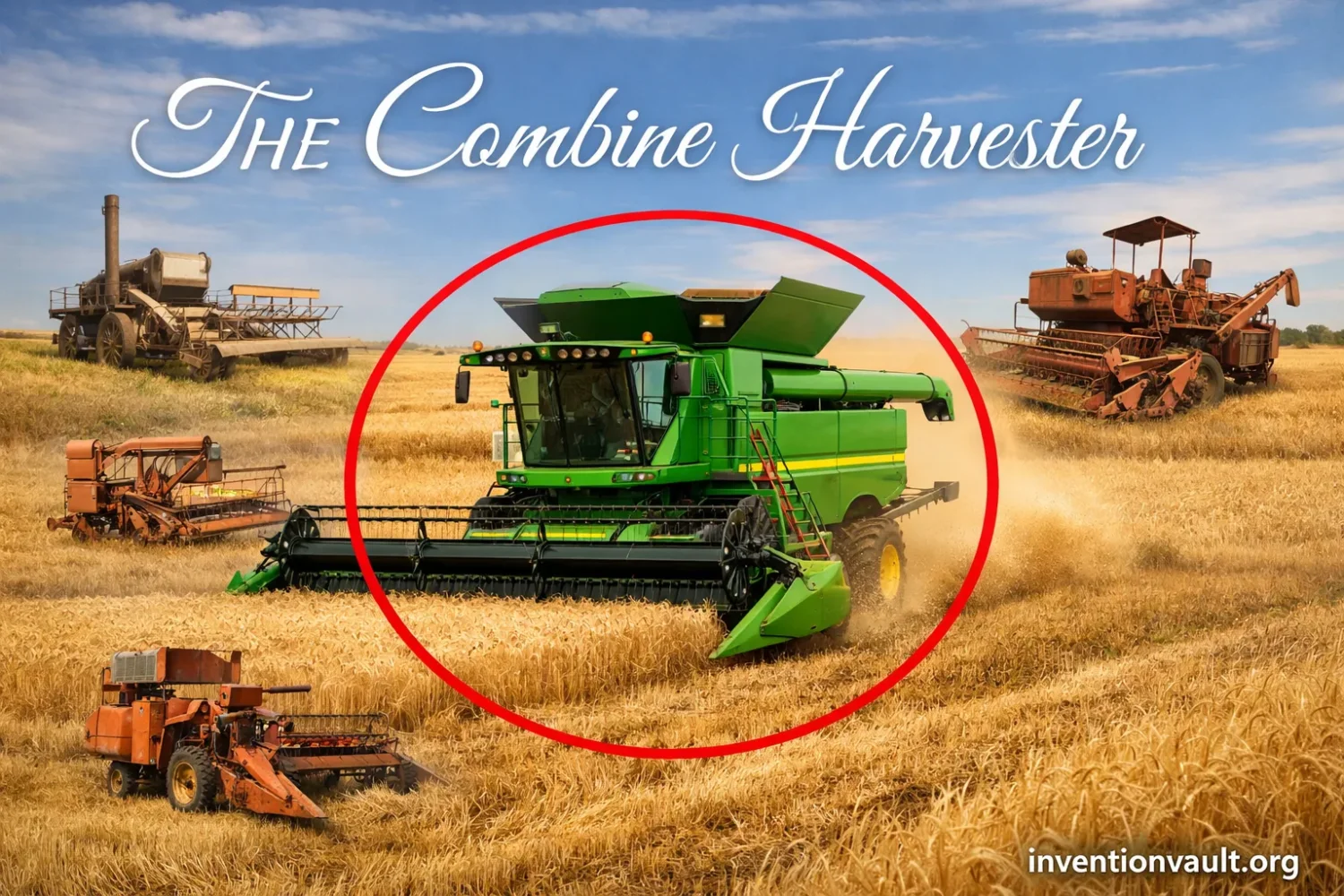
| Detail | Information |
|---|---|
| Machine Type | The first successful grain combined harvester-thresher. |
| People Most Closely Linked to It | Hiram Moore and John Hascall. |
| First Practical Use | Near Climax, Michigan, in 1834. |
| Patent Record | U.S. Patent 9,793X, granted on June 28, 1836. |
| Main Jobs United in One Machine | Cutting, threshing, separating, and cleaning, with grain handling added through later designs. |
| Early Power and Movement | First large models were horse- or mule-drawn; later versions used steam, tractors, and then self-propelled layouts. |
| California Expansion | Commercially successful combines were refined there in the early 1880s; by 1888, wheat was harvested on about 3 million acres in California. |
| Terrain Milestone | Holt’s successful hillside combine appeared in 1893, helping harvest on sloped grain land. |
| Self-Propelled Milestones | George S. Berry introduced a self-propelled combine in 1886; Massey-Harris brought the first commercially available self-propelled combine to market in 1938. |
| Modern Layer | GPS-linked yield monitors, autosteer, automatic header functions, residue spread control, and digital yield mapping. |
The combine harvester did not appear as a neat, finished machine. It grew out of a long effort to remove the slowest part of grain farming: cutting the crop, separating the kernels, and cleaning the grain before weather or labor delays spoiled the harvest. Its real break with earlier tools was the joining of several field jobs into one moving system, a shift that changed farm labor, machine design, and the scale of grain production.
Where the Combine Harvester Began
The combine harvester is usually tied to a short historical line: Hiram Moore invented it, and the story ends there. The fuller version is more useful. Moore and John Hascall are linked to the first successful grain combined harvester put to practical use near Climax, Michigan, in 1834, with the patent following in 1836. Early machines were still cumbersome. They were large, animal-drawn, and fit only a narrow set of field conditions. Even so, the central idea was already present: one machine could cut grain, thresh it, and clean it in the same pass.
That machine did not arrive from nowhere. Farmers and inventors had already learned that harvest work could be mechanized in pieces. Reapers cut standing grain. Separate threshers removed kernels from heads. Cleaning devices removed lighter material. The combine mattered because it fused those earlier steps into a single workflow. That fusion is what made the invention last.
Why California Changed the Machine
California turned the concept into a large-acreage machine. Its wide wheat fields, dry harvest weather, and pressure to save labor rewarded equipment that could keep moving for long stretches. By 1888, wheat was harvested on about 3 million acres in the state. In that setting, makers such as Holt refined commercially successful combines in the early 1880s, and by 1893 a successful hillside combine had appeared. The invention became practical at scale there, not just clever on paper.
When Self-Propulsion Changed Daily Work
Self-propulsion was the next big turn. George S. Berry introduced a self-propelled combine in California in 1886, showing that the machine did not have to remain a dragged platform behind teams of animals. The market shift came later. In 1938, Massey-Harris developed the first commercially available self-propelled combine. That step changed visibility, transport, operator control, and the amount of ground one machine could cover in a normal day.
A combine is not one frozen invention. It is a machine family that kept absorbing new problems—terrain, crop type, power source, grain handling, and then data.
How the Machine Actually Worked
The name combine makes sense only when you follow the crop through the machine. A classic grain combine brings together cutting, threshing, separating, cleaning, and grain handling. Each stage solves a different part of the old harvest bottleneck.
- The header cuts the standing crop and feeds it inward.
- The threshing unit loosens grain from heads, pods, or cobs.
- The separating system divides heavier grain from lighter straw and chaff.
- The cleaning shoe uses sieves and air to leave a cleaner grain sample.
- Augers and elevators move clean grain to a bin, bagging area, or unloading system.
This internal flow matters because later improvements were not cosmetic. The header often decides whether the crop enters cleanly at all. The threshing unit must strike hard enough to free grain, but not so hard that it damages kernels or overloads the cleaning system. Conventional machines used straw walkers; later rotary designs used centrifugal separation to handle grain and residue differently. Every redesign tried to steady this chain of movement inside the machine.
| Type | Era of Growth | Typical Use | What Made It Different |
|---|---|---|---|
| Animal-Drawn Grain Combine | 1830s to early 1900s | Large grain farms | United harvesting steps, but stayed bulky and depended on teams of animals. |
| California Sidehill Combine | 1890s onward | Rolling wheat land | Helped keep the machine level on slopes and reduced loss on uneven ground. |
| PTO or Tow-Behind Combine | 1930s to 1960s | Mixed farms | Used tractor power and lowered the barrier for farms that did not need a very large self-propelled unit. |
| Self-Propelled Combine | Late 1930s onward | Broad grain harvesting | Placed propulsion, harvesting, and operator control in one machine. |
| Rotary Combine | Late 20th century growth | High-throughput grain harvest | Used rotary separation and changed machine layout, crop flow, and residue handling. |
| Rice Full-Feed and Semi-Feed Combines | Modern rice mechanization | Paddy systems and double-cropping areas | Changed how much of the plant entered the machine, which mattered for wet straw, smaller fields, and harvest timing. |
| Peanut Combine | Mid-20th century onward | Peanut harvesting | Applied combine logic to a crop with very different plant structure and handling needs. |
Main Combine Types and Their Uses
The combine did not stay a wheat machine for long. Once the harvesting chain proved itself, the machine split into branches shaped by crop biology, field size, moisture, and terrain. That branching is one of the most overlooked parts of its history. The invention survived because it could be adapted, not because one early pattern solved every field problem.
Headers and Terrain
Header design quietly changed what a combine could harvest. A grain platform works well for many small grains. A pickup header is useful where crops are cut first, left to dry, and then lifted from the ground. Corn heads changed the crop entry system again. Soybean and seed harvest pushed designers toward different cutting heights, feeding habits, and loss control. Terrain forced another branch: hillside combines, built so sloped ground would not make the whole machine unstable or waste grain.
Crop-Specific Machine Families
Rice and peanuts show how far the idea could travel. In rice systems, full-feed and semi-feed combines differ in how much of the plant enters the machine. That detail affects field size, straw handling, and harvest timing. In peanuts, James Shepherd developed and tested the first peanut combine harvester in 1949, and commercial production followed in 1950. The combine had become less a single machine than a harvest logic that could be reshaped around a crop.
The divide between conventional and rotary combines also matters. Conventional machines rely on straw walkers after threshing. Rotary systems use centrifugal force and usually fit more of the harvesting path into a compact internal layout. That was not a stylistic change. It affected crop flow, residue distribution, power demand, and how much material the machine could process before losses climbed.
The Invention’s Modern Layer
Today’s combine still performs the old harvest sequence, but it also measures it. Modern machines carry GPS-linked yield monitors, moisture sensors, autosteer, and automatic header functions. One North Dakota State University extension source notes that more than 70% of U.S. farmers have GPS-linked yield monitors on their harvest equipment, while another 18% have yield monitors without GPS links. A Purdue-led analysis adds a sharper figure: in 2016, about 68% of U.S. maize area was harvested with a combine equipped with a yield monitor, but only 45% of that area was yield mapped.
That modern data layer shows how far the invention has traveled. The combine is still judged by old standards—how cleanly it cuts, how much grain it saves, how evenly it leaves residue, and how steadily it handles crop flow—but now it also leaves a digital record of the harvest. Automatic controls help hold header performance closer to target speeds and heights. Yield maps turn the combine into a field sensor. The machine that once merged separate harvest jobs now merges harvesting and measurement.
The combine harvester endured because it answered three farm pressures at the same time: a short harvest window, the cost of repeated handling, and the need to move more grain with fewer separate machines. Every later version—California giants, hillside units, tow-behind models, self-propelled machines, rotary systems, and crop-specific combines—kept that same promise while changing the hardware around it.
References Used for This Article
- Smithsonian Institution — Hiram Moore Collection | NMAH.AC.1429: Primary archival record for Moore’s early machine and its patent date.
- ASABE — Moore Haskall Combine – 1978: Historic engineering marker for the first successful grain combined harvester-thresher.
- The Henry Ford — A Combined Harvester in a California Grain Field, 1895-1912: Museum record showing how early combines worked and where they fit best.
- University of California Agriculture and Natural Resources — A History of California Agriculture: Academic history used for California scale, Holt development, and hillside combine milestones.
- University of California, Merced — Timeline of Development of Ag Technology: University timeline used for California acreage and self-propelled combine milestones.
- The Museum of English Rural Life — Massey-Ferguson (UK) Ltd Archive: Archive source for the first commercially available self-propelled combine in 1938.
- Washington State University Extension — Field Equipment for Grain Production on Small Farms: Extension publication used for combine functions, headers, and older machine capacities.
- North Dakota State University Agriculture — Site-specific Farming: Yield Mapping and Use of Yield Map Data: Source for yield monitor adoption and the digital role of modern combines.
- Iowa State University Digital Repository — System of Field Operations for Double-Cropped Paddy Rice: Thesis source for full-feed and semi-feed rice combine distinctions.
- University of Georgia Tifton — James Shepherd: University page used for the first peanut combine harvester milestone.