
Mobile System Evolution Map
How Cellular Coverage Became Scalable
Seven files connect frequency reuse, handover, commercial networks, digital standards, 5G-Advanced, satellite links, and 6G research.
CAPACITY DESIGN
Frequency Reuse Divides Coverage Into Cells
Selected file: Frequency Reuse Divides Coverage Into Cells. Choose another file to update this evidence card.
Selected
Coverage Pattern
A service area is divided into smaller radio zones served by base stations rather than one transmitter attempting to cover an entire region.
Repeated Spectrum
The same frequencies can be used again in sufficiently separated cells when antenna direction, transmit power, scheduling, and interference are controlled.
Capacity Effect
Adding cells can increase the number of simultaneous connections without requiring a separate frequency for every subscriber.
Cellular scale comes from planned reuse, not unlimited radio spectrum.
MOBILITY CONTROL
Handover Keeps a Connection Moving
Selected file: Handover Keeps a Connection Moving. Choose another file to update this evidence card.
Selected
Radio Measurements
The device and network monitor serving and neighboring cells, including signal strength, signal quality, interference, and availability.
Target Selection
The network chooses another cell when radio conditions, movement, policy, or congestion make a transfer useful.
Traffic Redirection
The radio connection and network path are updated so a call or data session can continue with little or no visible interruption.
Coverage becomes mobile only when the network can transfer active sessions between cells.
EARLY SYSTEM PLAN
Bell Labs Describes the Cellular Concept
Selected file: Bell Labs Describes the Cellular Concept. Choose another file to update this evidence card.
Selected
Documented Date
Federal Communications Commission historical material places the Bell Laboratories cellular radio concept, including frequency reuse and handoff, in 1947.
System Requirement
The idea required many coordinated sites, switching equipment, suitable radio channels, automatic call transfer, and enough computing control to manage moving users.
Deployment Delay
The concept appeared decades before commercial cellular service because spectrum allocation, electronics, switching, antennas, and network investment still had to mature.
The early concept defined the network architecture before the supporting infrastructure was ready.
COMMERCIAL DEPLOYMENT
Cellular Service Reaches Paying Users
Selected file: Cellular Service Reaches Paying Users. Choose another file to update this evidence card.
Selected
Handheld Demonstration
Motorola publicly demonstrated a portable cellular telephone and supporting system in New York on April 3, 1973.
Network Launch
NTT opened a commercial cellular mobile service in metropolitan Tokyo in 1979, beginning the first-generation analog commercial era.
Different Milestones
A public handheld call proved portability. A commercial network required licensed spectrum, installed sites, billing, switching, maintenance, compatible phones, and subscriber service.
The handset demonstration and the first commercial network were related but separate achievements.
DIGITAL STANDARD FILE
2G Converts Mobile Service to Digital
Selected file: 2G Converts Mobile Service to Digital. Choose another file to update this evidence card.
Selected
Digital Radio
Second-generation systems encoded voice digitally, allowing more efficient channel use and stronger support for authentication and network control.
Messaging Layer
GSM networks helped make text messaging a standard mobile service rather than a separate paging system.
Roaming Value
Shared technical specifications allowed compatible devices and networks to exchange identity, signaling, voice, and later data across operator boundaries.
Digital standards turned regional mobile systems into interoperable service families.
CURRENT STANDARD PATH
5G-Advanced Extends Deployed 5G
Selected file: 5G-Advanced Extends Deployed 5G. Choose another file to update this evidence card.
Selected
Release 18
3GPP identifies Release 18 as the first 5G-Advanced release, adding radio, core, positioning, energy, device, service, and non-terrestrial network improvements.
Release 19
Release 19 forms the second 5G-Advanced phase and develops further changes across the radio access network, core network, and service architecture.
Work During 2026
Release 20 continues 5G-Advanced work while beginning studies that will inform later 6G specifications.
Current network development remains focused on extending 5G rather than replacing it immediately.
EMERGING NETWORK FILE
Satellite Links Join the 6G Research Path
Selected file: Satellite Links Join the 6G Research Path. Choose another file to update this evidence card.
Selected
Non-Terrestrial Networks
3GPP Release 17 introduced standardized support for New Radio and IoT communication through satellites, with further NTN work in later releases.
Direct-to-Device Limits
A satellite connection to an ordinary-looking phone still depends on supported bands, modem features, operator agreements, satellite capacity, regulation, and sky visibility.
6G Status
In 2026, 6G remains a standards and research program. ITU uses the name IMT-2030, while 3GPP plans studies in Release 20 and specification work in Release 21.
Future mobile coverage is being designed as a coordinated mix of terrestrial and non-terrestrial systems.
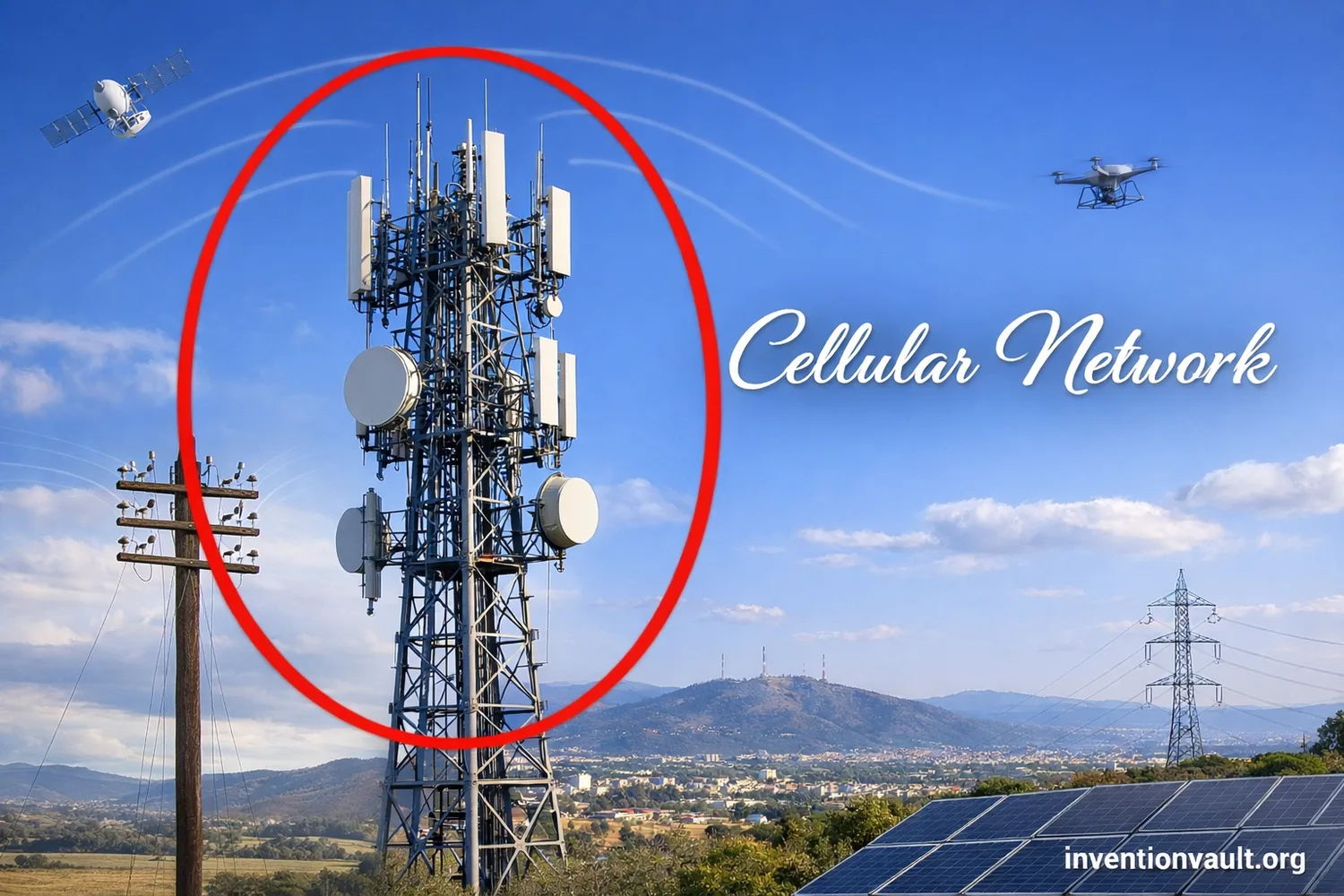
A cellular network provides mobile voice and data by dividing a region into radio coverage areas called cells. Base stations serve those cells, frequencies are reused across separated areas, and active connections can be handed from one cell to another as devices move. The network also requires transport links, subscriber authentication, routing, switching, spectrum licenses, standards, and a core system that keeps track of each connected device.
| Detail | Cellular Network Notes |
|---|---|
| Core invention | Frequency reuse across coordinated cells, combined with automatic mobility and handover. |
| Early documented concept | Bell Laboratories cellular radio planning associated with 1947. |
| Handheld milestone | Motorola publicly demonstrated a portable cellular telephone system on April 3, 1973. |
| Commercial network milestone | NTT opened commercial cellular service in metropolitan Tokyo in 1979. |
| Main network sections | Radio Access Network, transport network, and mobile core. |
| Coverage unit | A cell served by a base station, often divided into directional sectors. |
| Current standards direction | 5G-Advanced development through 3GPP Releases 18, 19, and 20. |
| Emerging coverage layer | Non-terrestrial networks using satellites or high-altitude platforms. |
| 6G status in 2026 | Research, performance requirements, spectrum work, prototypes, and early standards studies; not a finished commercial generation. |
What Makes a Mobile Network Cellular
Older mobile radio systems often tried to cover a large area with a small number of high-powered transmitters. That approach provided reach but supported relatively few simultaneous calls. Cellular design changes the layout. It uses many smaller coverage areas whose radio channels can be reused when enough distance or interference control separates them.
A cell is not a permanent hexagon drawn on the ground. Hexagons are useful planning symbols, but real coverage changes with terrain, buildings, antenna height, frequency, transmit power, weather, device position, and network load. Two users standing close together may even connect to different cells or frequency layers.
- Frequency reuse allows the same spectrum to serve users in different locations.
- Sector antennas divide a site into directional coverage areas and reduce unwanted radiation in other directions.
- Scheduling allocates radio time and bandwidth among active devices.
- Power control reduces unnecessary interference and battery use.
- Handover transfers an active session when another cell becomes more suitable.
Cell, Site, and Tower
A cell is a radio coverage area. A base station is the equipment serving it. A tower is only one possible structure used to hold antennas; antennas can also be installed on rooftops, poles, walls, indoor ceilings, and concealed street fixtures.
How Handover Keeps a Connection Alive
A moving device does not wait until its current signal disappears. It measures nearby cells and reports radio conditions according to network rules. The network then decides whether a transfer is needed. A weak serving signal, stronger neighboring signal, interference, congestion, or a change between frequency layers can all affect that decision.
- Measure Nearby CellsThe device monitors its serving cell and suitable neighbors using signal-strength and signal-quality measurements.
- Evaluate the ConnectionThe network considers radio conditions, movement, cell load, service policy, and the device’s supported bands.
- Prepare the TargetResources may be reserved in the target cell before the device is instructed to move.
- Switch the Radio LinkThe device changes to the target cell and completes the required signaling exchange.
- Update the Traffic PathThe network redirects voice or data packets through the new base station while preserving the session.
A handover can fail when the target signal is too weak, a cell is congested, interference is high, or the device moves through the overlap area too quickly. Coverage planning therefore needs controlled overlap rather than isolated circles of signal.
RAN, Transport, and Core Network
The visible antenna site is only the radio edge of a larger system. A cellular connection must travel from the device through the Radio Access Network, across transport links, and into a core network that handles identity, mobility, routing, policy, and service access.
| Network Section | Main Work | What Can Affect the User |
|---|---|---|
| Radio Access Network | Radio transmission, scheduling, beam control, handover, channel coding, and connection signaling. | Signal quality, speed, latency, and stability while moving. |
| Transport | Carries traffic between radio sites, processing locations, and the mobile core through fiber, microwave, or other links. | Congestion, delay, and the ability of a site to carry its available radio capacity. |
| Mobile Core | Authentication, mobility tracking, session control, policy, routing, voice integration, and internet access. | Network registration, roaming, call setup, service availability, and data routing. |
Modern radio sites often depend on high-capacity fiber-optic connections. Faster radio alone cannot remove a bottleneck in the link carrying traffic away from the site. Microwave transport remains useful where fiber installation is difficult, but its capacity, path clearance, weather behavior, and spectrum planning must match the deployment.
Spectrum Bands Change Coverage and Capacity
Cellular systems operate within assigned frequency bands. Operators commonly combine several bands because no single frequency range provides ideal reach, indoor performance, capacity, and antenna size.
Low-Band Spectrum
Lower frequencies generally travel farther and pass through many building materials more effectively. They support broad rural coverage, highway service, and an indoor coverage layer, but available bandwidth may be limited.
Mid- and High-Band Spectrum
Mid-band often balances reach and capacity. Higher bands can provide wide channels and dense-area capacity, but usually require shorter cell spacing, clearer paths, and more careful blockage control.
Signal strength alone does not determine speed. A phone can show a strong signal while receiving slow service because many users are sharing the same cell, the transport link is congested, interference is high, or the available channel is narrow.
How Networks Add Capacity
- Densification: more sites and smaller cells shorten radio distances and divide traffic among additional coverage areas.
- Sectorization: directional antennas let one location serve separate areas with controlled interference.
- MIMO: multiple antenna paths can carry more data or improve reliability when radio conditions support them.
- Carrier aggregation: compatible devices can use several radio channels together.
- Beamforming: antenna arrays shape radio energy toward selected users rather than transmitting equally in every direction.
- Traffic scheduling: the base station assigns resources according to channel quality, service needs, fairness, and network policy.
- Small cells and indoor systems: localized equipment moves radio capacity closer to users in streets, offices, stations, airports, and venues.
Indoor coverage often requires its own design. Exterior walls, coated glass, concrete, steel, underground spaces, and crowded rooms can weaken radio links. Small cells and distributed antenna systems address this problem by placing controlled coverage inside the structure rather than relying entirely on an outdoor macrocell.
Wi-Fi can carry part of the indoor data load, but it is not another cellular generation. Wi-Fi uses local access points and mostly unlicensed spectrum, while cellular service relies on operator-managed mobility, licensed spectrum layers, subscriber identity, and a mobile core.
From Concept to Commercial Cellular Service
| Date or Period | Development | What It Established |
|---|---|---|
| 1947 | Bell Laboratories work describes cellular radio using frequency reuse and handoff. | The system concept for serving many mobile users through coordinated coverage areas. |
| April 3, 1973 | Motorola publicly demonstrates a portable handheld cellular telephone and system. | A cellular subscriber device no longer has to remain installed in a vehicle. |
| 1979 | NTT launches commercial cellular service in metropolitan Tokyo. | First-generation analog cellular enters public operation. |
| 1980s | Analog cellular networks spread into additional national and regional markets. | Commercial mobile calling expands, though systems remain fragmented. |
| 1990s | Second-generation digital systems, including GSM, expand voice capacity, messaging, authentication, and roaming. | Mobile service moves from analog regional networks toward digital standard families. |
| 2000s | 3G networks make packet data and practical mobile internet access more widely available. | The phone becomes a data terminal as well as a voice device. |
| 2010s | 4G LTE adopts an all-IP broadband design and supports app-centered smartphones. | Streaming, cloud applications, video calls, and high-volume mobile data become ordinary services. |
| 2019 onward | 5G deployment adds new radio bands, wider channels, advanced antennas, lower-latency options, and a redesigned core. | Networks gain more flexibility for dense broadband, connected equipment, private systems, and specialized service control. |
Concept, Phone, and Network
The 1947 cellular concept, the 1973 handheld demonstration, and the 1979 commercial network answer different historical questions. Treating all three as the same “first” hides the work required to move from an architecture to a public service.
From 5G Deployment to 5G-Advanced
5G did not stop changing when the first commercial networks opened. 3GPP organizes cellular specifications into releases, allowing compatible improvements to be introduced without naming every update as a new generation. Release 18 is identified as the first 5G-Advanced release. Release 19 forms its second phase, while Release 20 continues work on deployed 5G systems during 2026.
The updates cover more than peak speed. They include positioning, energy use, antenna operation, device classes, immersive traffic, network automation, satellite integration, industrial communication, multicast, security, and service control. Whether a feature reaches users depends on operator deployment, spectrum, network equipment, device hardware, software, and local regulation.
The smartphone remains the most visible cellular device, but modern networks also serve vehicles, sensors, utility equipment, private industrial systems, fixed-wireless terminals, wearables, and low-power connected devices. These uses do not all need the same bandwidth, latency, mobility, or battery behavior.
From Cell Towers to Satellites: Direct-to-Device Networks
Non-terrestrial networks extend cellular architecture beyond ground-based towers. 3GPP uses the term NTN for network sections carried through satellites or high-altitude platforms. Release 17 introduced standardized support for New Radio and cellular IoT operation over NTN, while Releases 18 and 19 continued the work.
Direct-to-device service can allow a compatible handset or sensor to communicate with a satellite without a separate satellite-phone terminal. The phrase covers several service levels. One deployment may provide emergency text messaging. Another may support narrowband sensor data. A later system may offer broader voice or data service. These capabilities should not be treated as interchangeable.
- The device must support the required modem functions and radio bands.
- The operator and satellite network need compatible agreements and core-network integration.
- Regulators must authorize the spectrum arrangement in the service area.
- Buildings, terrain, foliage, and poor sky visibility can block or weaken the link.
- Satellite beam capacity is shared across a much larger area than a typical terrestrial cell.
- Propagation delay and moving satellite geometry change timing, frequency correction, and handover behavior.
The satellite does not remove the need for terrestrial cellular sites. Ground networks provide far more localized capacity and stronger indoor service. NTN is better understood as an additional coverage layer for remote areas, maritime routes, aviation, emergency communication, logistics, and locations where installing towers or fiber is difficult.
What 6G Means in 2026
Commercial 6G service does not exist in 2026, and a finished global 6G specification has not been released. The International Telecommunication Union uses IMT-2030 for the next generation of international mobile systems. In February 2026, ITU experts agreed on draft technical performance requirements for evaluating future 6G radio interfaces, with formal approval expected after further ITU review.
3GPP has separated its work into stages. Release 20 combines continuing 5G-Advanced development with 6G studies. Release 21 is planned to begin the normative specification work that can define interoperable 6G technology. A research demonstration completed before that process is not automatically a commercial standard.
Current research includes terrestrial and satellite integration, communication combined with sensing, more precise positioning, AI-assisted radio and network control, new antenna arrays, energy-aware operation, and experimental use of very high frequencies. ITU has also studied the feasibility of mobile systems in bands above 100 GHz. Such frequencies may support specialized short-range or high-capacity links, but blockage, atmospheric loss, semiconductor performance, antenna packaging, heat, and deployment cost limit where they can be useful.
New radio generations also depend on infrastructure outside the radio link. Denser antennas require transport capacity, precise timing, processing hardware, power systems, cooling, and suitable semiconductor materials. The 6G research race is therefore not just a contest for a faster air interface. It is a coordinated effort across devices, radio sites, satellites, fiber networks, core software, spectrum rules, and manufacturing.
What Is Established
IMT-2030 requirements and 3GPP studies are moving forward, but research papers, testbeds, spectrum trials, and company labels do not by themselves establish a commercial 6G standard.
Common Misunderstandings About Cellular Networks
More Signal Bars Do Not Always Mean More Speed
Signal bars mainly represent a simplified radio measurement. Speed also depends on channel width, interference, cell congestion, scheduling, device capability, transport capacity, and the server supplying the content.
A Taller Tower Is Not Always Better
A high site can extend coverage but may also create interference or serve too many users. Dense areas often benefit from lower-power sites, directional sectors, indoor systems, and carefully controlled overlap.
5G Does Not Require High-Band Spectrum Everywhere
5G can operate in low-, mid-, and high-frequency bands. Low-band 5G can provide broad coverage, while mid- and high-band deployments can add capacity where more spectrum and denser sites are available.
Satellite Connectivity Will Not Replace All Ground Networks
Satellites can extend geographic reach, but terrestrial cells offer greater localized capacity, easier indoor coverage, and shorter radio paths. The two systems are being designed to work together.
6G Is Not Simply a Faster Version of 5G
Speed is only one research target. Standards work also considers sensing, positioning, coverage continuity, energy use, reliability, network intelligence, device diversity, and links between terrestrial and non-terrestrial systems.
References Used for This Article
- Federal Communications Commission — A Short History of Radio: Used for the 1947 Bell Laboratories cellular concept, frequency reuse, and handoff history.
- Motorola — 1973 Portable Telephone Demonstration Release: Used for the April 3, 1973 handheld cellular demonstration.
- NTT DOCOMO — 5G Evolution and 6G: Used for NTT’s 1979 commercial cellular service milestone and later network evolution context.
- ETSI — Global System for Mobile Communication: Used for GSM standardization and second-generation digital cellular development.
- 3GPP — 5G System Overview: Used for the relationship among the radio access network, mobile core, services, and earlier cellular generations.
- 3GPP — Release 18: Used for the first 5G-Advanced release and its technical development areas.
- 3GPP — Release 19: Used for the second 5G-Advanced phase and its 2026 status.
- 3GPP — Release 20: Used for continuing 5G-Advanced work, 6G studies, and the planned transition toward Release 21 specifications.
- 3GPP — Non-Terrestrial Networks: Used for satellite and high-altitude platform terminology, architecture, device support, and NTN development.
- International Telecommunication Union — IMT-2030: Used for the official name, standards process, and next-generation mobile system timeline.
- International Telecommunication Union — IMT-2030 Technical Requirements: Used for the February 2026 agreement on draft 6G radio-interface performance requirements.