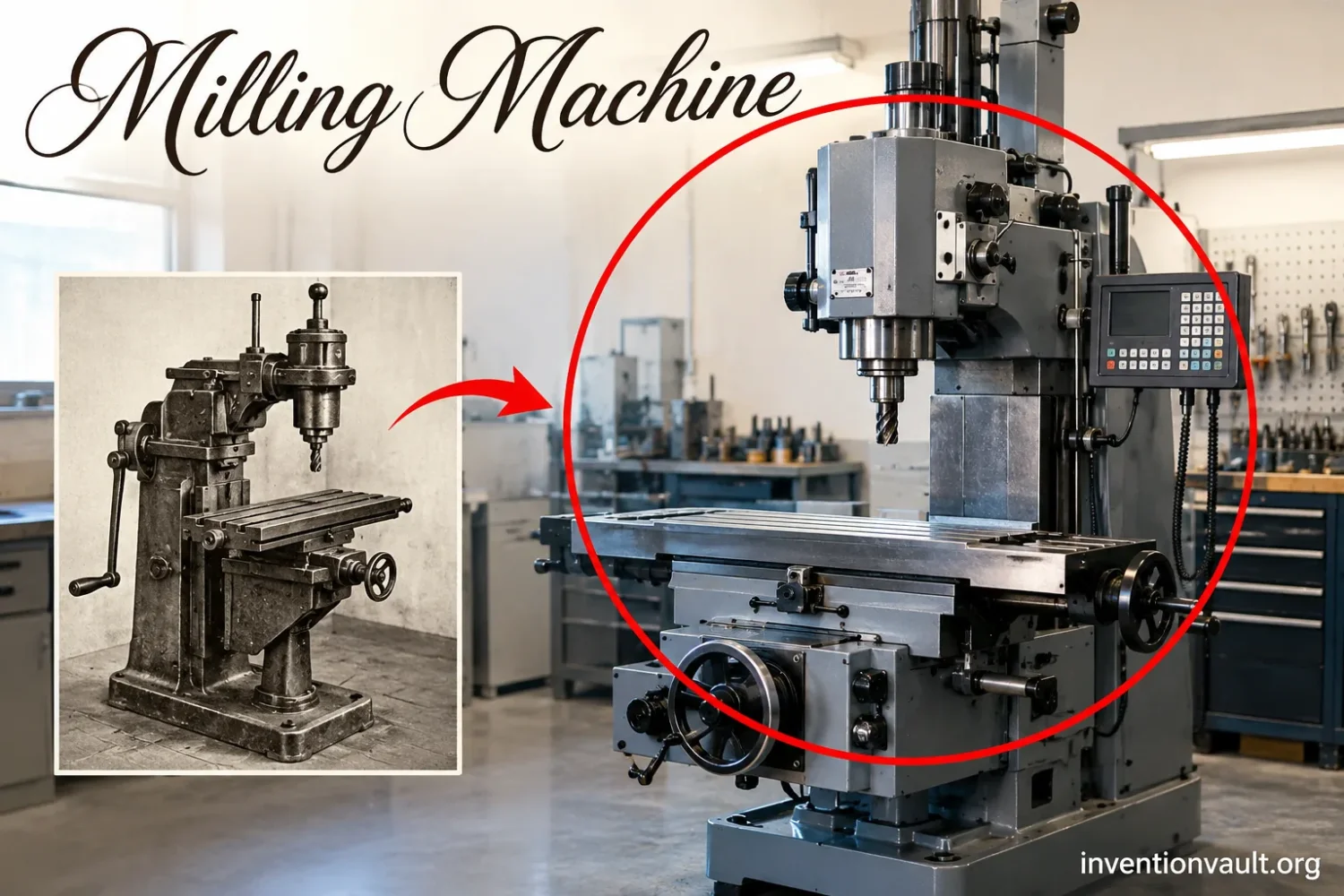
Claims and Machine Evolution
How Milling Became a Machine Tool
Follow the evidence from rotary filing and early armory machines to universal milling, the Bridgeport layout, and numerical control.
Mechanical precursor
Rotary Filing Before Milling
Current stage
Earlier method
Metal parts were often brought to final form with hand files. The result depended heavily on the worker’s skill, especially when several parts had to match the same dimensions.
Rotating cutters
Machinists could mount circular, file-like cutters in rotating equipment such as lathes. This removed metal mechanically but did not yet create the controlled table-and-cutter relationship associated with a distinct milling machine.
Missing element
The harder problem was controlling how the workpiece moved past the cutter so that a surface, slot, or profile could be reproduced at a predictable position.
Milling emerged when rotary cutting was joined to guided workholding and repeatable feed rather than hand-directed shaping.
Early machine evidence
The Middletown Machine Around 1818
Current stage
Strong early claim
Simeon North is generally credited by the American Precision Museum with the invention of the milling machine, and a known machine was in use by about 1818.
Manufacturing setting
North’s Connecticut arms production required large groups of firearm parts to conform closely enough for interchangeability, creating a direct reason to replace slow corrective filing with controlled machinery.
Robert Johnson connection
The well-known Middletown machine has also been associated with Robert Johnson. Later historical accounts connect Johnson with the dating and provenance of the machine rather than providing a simple single-inventor record.
The evidence points to an armory production network, with North holding one of the strongest claims rather than an uncontested one-man invention.
Precision production
John Hall Makes Motion Repeatable
Current stage
Harpers Ferry work
John H. Hall developed specialized cutting machines at Harpers Ferry while pursuing firearms whose components could be exchanged without individual hand fitting.
Guides and stops
Hall used guides, stops, fixtures, and gauges so the machine constrained where a cut began and ended. Accuracy depended less on the operator steering a tool by eye.
Straight-cutting machine
The National Park Service describes Hall’s straight-cutting machine as a forerunner of the versatile milling machine used to produce precision metal firearm components.
Hall’s contribution shows why milling history is also a history of controlling position, not merely making a cutter spin.
Attribution record
Why the Whitney Story Changed
Current stage
Traditional account
Eli Whitney was long credited with building the first milling machine around 1818, and that account became common in twentieth-century machine-tool histories and teaching material.
What the inventory shows
Whitney’s 1825 probate inventory includes milling-related tools, but the Eli Whitney Museum notes that little is known in detail about the exact machinery used during his lifetime.
Surviving machine
An early milling machine later found at the Whitney site was traditionally linked to Whitney, yet the museum tentatively places it in the period after his death, when his nephews managed the armory.
Whitney belongs in the story of mechanized arms production, but the surviving record does not securely establish him as the sole inventor of the first true mill.
Machine redesign
Brown & Sharpe’s Universal Mill
Current stage
Production problem
Frederick W. Howe needed a practical way to make spiral flutes in twist drills. Hand filing the grooves was slow and poorly suited to heavy armory demand.
Coordinated movement
Joseph R. Brown’s machine could couple table travel with rotation of the work through an indexing head, letting a stationary-position cutter generate a controlled helix.
Recorded delivery
The American Precision Museum records the first Brown & Sharpe universal milling machine as delivered to Providence Tool on March 14, 1862.
The universal mill expanded milling from specialized production work toward a machine that could be configured for many different geometries.
Workshop flexibility
The Bridgeport Layout
Current stage
Design path
Rudolph Bannow developed the Bridgeport turret mill around a versatile milling head after Bridgeport Pattern & Model Works had already sold high-speed milling attachments.
First shipment
The first complete Bridgeport mill was shipped in 1938. Its movable ram, swiveling head, quill, knee, saddle, and table made repositioning easier than on many production-oriented mills.
What it did not invent
The Bridgeport was not the first vertical milling machine. Its importance was the practical combination and packaging of adjustments that suited toolrooms, repair shops, prototypes, and short production runs.
Bridgeport made flexible manual milling unusually accessible without changing the basic cutter-and-controlled-feed principle established much earlier.
Automatic position control
Numerical Control Arrives
Current stage
New control input
The MIT Servomechanisms Laboratory developed a milling machine whose movements were commanded by numerical information encoded on punched paper tape rather than direct handwheel operation.
Three controlled motions
Electronic processing and servomechanisms converted numerical commands into machine-axis movement while feedback helped keep the commanded position and actual motion aligned.
1952 milestone
MIT announced the operating machine on August 3, 1952. It was numerical control, or NC; later computer-based CNC systems developed from this control approach.
Milling no longer depended on an operator continuously steering each axis; stored numerical instructions could now define the motion.
The milling machine does not have one securely documented inventor and one unquestioned invention date. Purpose-built milling machines emerged in the American arms-making network during the 1810s, and Simeon North has one of the strongest early claims, with a known machine in use by about 1818. Robert Johnson is also associated with the Middletown machine. Eli Whitney was credited for decades with inventing the machine around the same time, but the surviving records do not support that simple attribution. The history becomes clearer when the invention is treated as a sequence: rotary filing, guided milling, precision production, the universal mill, the flexible vertical mill, and finally numerical control.
| Detail | Best-supported interpretation |
|---|---|
| Invention | Milling machine |
| Basic function | Removes material with a rotating multi-edge cutter while controlled motion positions the work relative to the cutter. |
| Earliest emergence | Purpose-built milling machines appeared during the 1810s; a known Middletown machine was in use by about 1818. |
| Strong early attribution | Simeon North, with Robert Johnson also connected to the Middletown evidence. |
| Traditional attribution | Eli Whitney, although the familiar claim that he alone invented the first true mill around 1818 is not securely supported. |
| Precision-production developer | John H. Hall at Harpers Ferry in the 1820s and 1830s. |
| Universal milling milestone | Joseph R. Brown and Brown & Sharpe; first machine delivered March 14, 1862. |
| Manual vertical-mill milestone | Bridgeport turret milling machine, first shipped in 1938. |
| Numerical-control milestone | MIT Servomechanisms Laboratory, operating NC milling machine announced in 1952. |
Dating the First
1818 is not a clean patent date for a universally accepted first machine. It is part of a reconstructed history based on surviving machines, later descriptions, armory records, and changing definitions of what should count as a true milling machine.
Why Milling Had to Replace More Than Hand Filing
Early metalworking already had lathes, drills, boring machines, files, grinders, and other ways to shape iron and steel. The difficulty was not simply removing metal. A skilled worker could file a gun component to fit. The harder problem was making the next component match the first one without repeating the same cycle of fitting, checking, filing, and correcting by hand.
This mattered strongly in firearms production. Locks, receivers, levers, slots, shoulders, and other metal features had to be placed at controlled locations. If every component was finished individually, parts from two nominally identical weapons might still require fitting before they could be exchanged.
A milling machine offered a different way to control the cut. Instead of allowing a worker to shape the surface mainly by feel and visual judgment, the machine could constrain the position of the work and move it through a defined path. Repeatable geometry became part of the machine setup.
Rotary Filing Was the Mechanical Step Before True Milling
The immediate ancestor of milling was rotary filing. A circular cutter with file-like teeth could be rotated in a lathe or related machine so that its edges removed material from a workpiece. This already transferred some of the labor from the worker’s arm to a powered spindle.
That alone did not create the machine tool later recognized as a mill. A rotating cutter could still be used in a setup where positioning remained awkward, limited, or strongly dependent on hand guidance. The deeper change came when the cutter, workholding system, and feed mechanism became one controlled arrangement.
What Makes It Milling?
A rotating file or cutter is only part of the idea. A recognizable milling machine combines the rotating cutting tool with constrained workholding and controlled relative feed, allowing the same geometric operation to be repeated with much less dependence on freehand shaping.
How a Milling Machine Actually Produces a Controlled Surface
In milling, the cutter rotates while the machine controls how the workpiece and cutter move relative to each other. Each cutting edge removes a chip as it enters the work. Several teeth can therefore share the cutting action during one revolution.
- Hold the workThe workpiece is fixed in a vise, fixture, chuck, dividing head, or another workholding device so its position can be controlled.
- Rotate the cutterThe spindle drives a cutter with one or more cutting edges. Cutter geometry determines what kind of surface or feature can be produced.
- Apply controlled feedThe table, saddle, knee, spindle head, or later servo-controlled axes establish motion between the work and cutter along a defined path.
- Set the next positionDepth, lateral position, indexing, or another axis is changed in a measurable way so further cuts can reproduce the intended geometry.
The arrangement differs across horizontal, vertical, universal, turret, bed-type, and CNC machines, but the underlying relationship remains recognizable: rotating cutter plus controlled relative motion.
The Middletown Machine and Simeon North’s Claim
Simeon North was already solving a manufacturing problem that made milling especially useful. His 1813 government pistol contract required a high level of standardization and interchangeability. His Middletown, Connecticut factory used water-powered machinery for firearms production, and surviving institutional records describe milling machines among its equipment.
The American Precision Museum states that North is now generally credited with the invention of the milling machine and that the first known machine was in use by 1818. That wording is useful because it preserves two separate ideas: North has a strong claim, while the surviving record is not complete enough to reduce the entire development to one documented invention event.
Why Robert Johnson Appears in the Story
The early Middletown machine is also associated with Robert Johnson. Historical descriptions of the machine and later reconstructions of its origin link Johnson to the evidence used to date it to about 1818. This makes the machine a poor fit for a simplified label such as “North’s patented invention of 1818.” No such clean documentary chain defines the event.
There is also a broader reason for caution. Early American armories, private contractors, machinists, and tool builders exchanged workers and practical knowledge. New cutting machines could be assembled from familiar mechanical elements, altered for a particular component, then copied or reworked elsewhere without leaving the documentary trail expected from a later commercial machine-tool industry.
John H. Hall Showed What Controlled Milling Could Do
John H. Hall’s work at Harpers Ferry demonstrates why the milling machine mattered beyond cutting speed. Hall had contracted with the War Department to produce his breech-loading rifle and spent years developing machinery that could make its components to controlled dimensions.
The National Park Service records Hall’s use of specialized straight-cutting, lever-cutting, and curve-cutting machines. His straight-cutting machine is described as a forerunner of the versatile milling machine. Hall also relied on guides, stops, fixtures, and gauges to constrain operations.
The purpose was not simply to let an unskilled worker run a fast cutter. The machine had to determine the geometry closely enough that a component did not need to be individually filed until it matched one particular firearm. This is where milling became tightly connected with interchangeable manufacture.
Interchangeability Required a System, Not One Machine
The milling machine should not be credited with creating interchangeable parts by itself. Accurate gauges were needed to check dimensions. Fixtures had to locate work consistently. Drilling, boring, turning, forging, and other operations also had to stay within controlled limits.
Milling solved one part of that system especially well: it could create flat surfaces, slots, shoulders, and profiles at mechanically constrained positions. When combined with gauges and other precision machinery, it reduced the amount of corrective hand fitting required between nominally identical parts.
Did Eli Whitney Invent the Milling Machine?
The safest historical answer is no—not as a proven sole inventor of the first true milling machine in 1818. Whitney’s armory was deeply involved in mechanized firearms manufacture, and evidence shows that milling-related tools and powered metalworking equipment existed there. That does not establish the older textbook story in its familiar form.
The Eli Whitney Museum notes that surprisingly little is known in detail about the machinery used during Whitney’s own management of the armory from 1798 to 1825. His probate inventory lists equipment including lathes, drilling machinery, screw machinery, polishing equipment, and an entry for “milling tools & nitching Machine.” The wording proves that milling-related work belonged to the shop vocabulary, but it does not describe a surviving machine closely enough to settle who built the first true mill.
The Surviving Whitney Machine Creates Another Dating Problem
An old milling machine found at the Whitney site in 1912 was traditionally remembered as a machine made and used by Eli Whitney himself. The museum treats that provenance cautiously and tentatively associates the surviving machine with the period after Whitney’s death, when his nephews and later trustees managed the armory.
That distinction matters. A machine found at Whitney’s factory is evidence for the armory’s technological history; it is not automatically evidence that Whitney personally designed it, built it, or used that exact machine in 1818.
What the Whitney Evidence Can and Cannot Establish
- 1825 probate inventoryShows milling-related terminology and mechanized metalworking at the Whitney Armory, but does not provide a complete technical description of a first true milling machine.
- Surviving early machineShows that an early milling machine existed at the Whitney site, but its dating and authorship do not securely place it in Whitney’s lifetime.
- Later historical attributionExplains why Whitney became the familiar inventor in older accounts, but repetition of the attribution does not replace contemporary evidence.
Whitney therefore remains relevant to the development of mechanized arms production. The narrower claim that he alone invented the milling machine around 1818 is much harder to defend.
The Early Mill Was Usually a Production Machine, Not a Universal Workshop Tool
Modern machinists often imagine a milling machine as equipment that can be reset for many unrelated jobs. That flexibility should not be projected backward onto every early machine.
Many early milling arrangements were built around a particular factory operation. A fixture might hold one gun component. Feed travel might suit one type of surface. Adjustment could be limited because the machine did not need to accommodate the range of work expected from a later toolroom mill.
This explains a major direction in nineteenth-century milling-machine design. Once the cutting principle worked, builders had to make setup itself more flexible: more travel, easier vertical adjustment, better workholding, indexing, controllable feeds, stronger support, and ways to relate several motions to one another.
Brown & Sharpe Turned the Mill into a More Versatile Machine
A later development can be dated much more securely. In 1861, Frederick W. Howe of Providence Tool Company faced a production problem involving twist drills. Their helical flutes were laborious to form by hand filing. Howe approached Joseph R. Brown of Brown & Sharpe about a machine solution.
The resulting universal milling machine coordinated motions that earlier mills did not combine as effectively. The work could be supported by an indexing head, while gearing linked its rotation to the table feed. Because the cutter remained in a controlled position while the cylindrical work both rotated and translated, the tool generated a helical groove.
Why the Machine Was Called “Universal”
The term described versatility, not merely the ability to cut one type of drill. The table could swivel, and the work could be positioned or indexed through specialized attachments. Together with improved feed and the column-and-knee arrangement, the design supported a wider range of machine-shop operations than a narrowly dedicated production mill.
Specialized Early Mill
Often arranged around one recurring factory operation, with limited adjustment because the same family of parts was produced repeatedly.
Universal Mill
Added adjustable work positioning, indexing, coordinated movement, and a layout suited to a broader range of surfaces, angles, tapers, and spiral forms.
1861 Design, 1862 Delivery, 1865 Patent
These dates describe different events and should not be collapsed into one “invention year.” Historical material from the American Precision Museum places Joseph Brown’s design work in 1861 and records the first Brown & Sharpe universal mill as delivered to Providence Tool on March 14, 1862.
Brown later received U.S. Patent No. 46,521 in February 1865 for improvements in milling machines. The patent described an arrangement combining an elevating knee, sliding elements, a swivel plate, carriage, cutter head, and mechanisms for governing the work. The patent is useful evidence for the developed design, but it came after the first machine was already operating.
Recorded Milestone
The first Brown & Sharpe universal milling machine is recorded as delivered to Providence Tool on March 14, 1862. This is a delivery and use milestone, not the date of the first milling machine of any kind.
Why the Universal Mill Changed the Type of Work a Mill Could Perform
The mechanical advance is easiest to understand through the twist-drill problem. A straight table feed alone creates a straight path. Rotating a cylindrical workpiece alone creates rotation around its axis. Link the two motions at a fixed ratio and the cutter traces a helix.
This principle opened more than one drill-making operation. Indexing could divide a circumference into equal angular positions. A swiveling table could present work at an angle. Controlled vertical adjustment let the operator establish cutter height without rebuilding the entire setup.
The machine was becoming less like a purpose-built fixture with a cutter and more like a configurable platform for controlled metal removal. That direction led toward the general-purpose knee mills familiar in later machine shops.
The Bridgeport Mill Made Manual Milling Far More Flexible
By the twentieth century, milling machines already existed in horizontal, vertical, production, and toolroom forms. The Bridgeport therefore belongs to a later design chapter, not to the original invention of milling.
Bridgeport Pattern & Model Works initially produced high-speed milling attachments. According to the American Precision Museum, Rudolph Bannow conceived a complete machine around the versatile head in 1936. The first Bridgeport mill was shipped in 1938.
Its usefulness came from the way several adjustments were combined in a relatively compact machine. The knee provided vertical movement, the saddle and table provided cross and longitudinal positioning, the ram could shift the head, the head could swivel, and the quill offered short controlled spindle travel.
A part that would have demanded awkward fixturing on a less adjustable machine could often be approached by repositioning the head or work. This suited tool-and-die work, maintenance, prototypes, repair jobs, and small batches where setup flexibility mattered as much as production rate.
Bridgeport Did Not Invent Vertical Milling
This distinction avoids another common compression of machine-tool history. Vertical milling machines existed before the Bridgeport. Bannow’s machine became influential because of its practical arrangement, adjustability, and wide adoption, not because it introduced the idea of a vertical spindle for the first time.
1952 Moved Milling Control from Handwheels to Numbers
The next major change did not replace the milling cutter or the basic geometry of the machine. It changed who—or what—determined the axis motion.
Numerical-control work grew from the need to manufacture complex aircraft shapes using calculated coordinates. John T. Parsons had developed methods that used numerical coordinate data in aircraft-related manufacturing, and U.S. Air Force support led to work involving the MIT Servomechanisms Laboratory.
MIT’s operating machine used numerical information punched into paper tape. Electronic equipment interpreted the commands, and servomechanisms converted them into controlled machine movements. Feedback connected commanded position with the physical motion of the axes.
MIT announced on August 3, 1952 that a numerically controlled milling machine, believed at the time to be the first of its kind, was operating at the Institute. The machine controlled three motions and could reuse a prepared tape to produce duplicate parts.
NC Is Not the Same Date as CNC
The 1952 MIT machine was an NC, or numerical-control, milling machine. Modern CNC developed later as computers and digital controllers took over functions that early NC systems handled with dedicated electronics and punched media.
What Stayed the Same from the 1810s to CNC Milling
The control technology changed far more than the cutting principle. An early mill used mechanical slides, screws, stops, and fixtures. A universal mill added adjustable geometry, indexing, and linked motions. A Bridgeport-style mill made manual repositioning unusually flexible. NC and CNC machines transferred axis commands into numerical programs, servos, feedback devices, and computer control.
Through all of those changes, the same physical relationship survives:
- The cutter rotates. Its cutting edges remove chips from the material.
- The work and cutter are constrained. Their positions are determined by the machine rather than freehand movement.
- Relative motion creates geometry. Straight feeds make planes and slots; coordinated axes can create angles, contours, pockets, and complex surfaces.
- Position can be repeated. Mechanical stops, indexing devices, scales, digital readouts, or programmed coordinates let a chosen relationship be reproduced.
A modern multi-axis machining center therefore contains a recognizable descendant of the same idea that made the early milling machine valuable: remove metal with a rotating cutter while controlling exactly where the cut occurs.
Milling Machine Invention Timeline
| Date or period | Development | What changed |
|---|---|---|
| Before purpose-built mills | Hand filing and rotary filing | Rotating cutters reduced manual filing effort, but work positioning was not yet organized into the later milling-machine form. |
| 1810s | Purpose-built milling emerges | Guided work movement and rotary cutting begin to form a distinct machine-tool process. |
| By about 1818 | Middletown machine | An early machine associated with Simeon North and Robert Johnson enters the historical record. |
| 1820s–1830s | John H. Hall’s precision machinery | Guides, stops, fixtures, gauges, and specialized cutting machines help make interchangeable production practical at Harpers Ferry. |
| 1861 | Brown & Sharpe universal-mill design work | Machine layout is developed for spiral cutting and a broader range of workshop operations. |
| March 14, 1862 | First Brown & Sharpe universal mill delivered | Coordinated work rotation, table feed, indexing, and adjustable geometry enter recorded production use. |
| February 1865 | Joseph R. Brown’s milling-machine patent | The patent records developed arrangements for holding, positioning, and presenting work to the cutter. |
| 1938 | First Bridgeport mill shipped | The turret-style vertical knee mill provides unusually convenient manual positioning for varied workshop jobs. |
| 1952 | MIT numerical-control milling machine | Punched numerical instructions and servomechanisms take over coordinated axis positioning. |
| Later development | Computer numerical control | Electronic and computer control expands into programmable multi-axis machining, tool changing, compensation, and automated production. |
So Who Invented the Milling Machine?
A single-name answer hides too much of the evidence. Simeon North is one of the strongest candidates for the earliest true milling machine and is generally credited with the invention by the American Precision Museum. A Middletown machine was in use by about 1818, and Robert Johnson is also associated with that early machine’s history.
Eli Whitney remains part of the background because his armory used mechanized production methods and milling-related tools, but the surviving evidence does not securely prove the familiar claim that he personally invented the first true milling machine in 1818.
John H. Hall then demonstrated how guided cutting machinery, gauges, and controlled stops could support genuinely interchangeable manufacture. Joseph R. Brown’s universal mill of the early 1860s made milling far more adaptable, and the Bridgeport design later refined manual versatility. MIT’s 1952 NC machine changed the control method again by converting numerical instructions into axis motion.
The invention of the milling machine is therefore best understood as an emergence followed by identifiable engineering milestones, rather than a single patented device appearing fully formed on one date.
Questions People Ask About the Milling Machine
Was the milling machine invented in 1818?
About 1818 is a defensible date for an early known milling machine in the United States, especially the Middletown evidence associated with Simeon North and Robert Johnson. It should not be treated as a universally documented patent date or an uncontested birth date for the entire milling process.
Why is Eli Whitney often listed as the inventor?
Older machine-tool histories widely repeated an attribution connecting Whitney with an early milling machine. Later study of the Whitney Armory records and the provenance of its surviving machine made that simple attribution much less secure.
What did Joseph R. Brown invent?
Brown is associated with the development of the universal milling machine, not the first milling machine of any type. His design joined adjustable table geometry, indexing, work rotation, and feed so operations such as helical-flute cutting could be performed mechanically.
What was different about the Bridgeport milling machine?
The Bridgeport combined a knee-and-table layout with a ram, adjustable vertical head, and quill in a form that made many manual setups convenient. It did not introduce vertical milling itself.
Was the 1952 MIT machine CNC?
It is more accurate to call it an NC milling machine. Its motions were commanded numerically using punched tape and dedicated electronic control. Computer numerical control developed from the wider adoption of digital computers and later electronic controllers.
References Used for This Article
- American Precision Museum — Simeon North: used for North’s milling-machine attribution, the c. 1818 machine, his interchangeability work, and the relationship between milling and arms production.
- Smithsonian National Museum of American History — Model 1813 Army Contract Pistol: used for the Middletown factory context, North’s government arms production, and the machinery recorded at the site.
- U.S. National Park Service — John H. Hall: used for Hall’s Harpers Ferry machinery, straight-cutting machine, interchangeable production, guides, and precision manufacturing.
- Eli Whitney Museum & Workshop — Arms Production at the Whitney Armory: used for the 1825 probate inventory, limits of the surviving founder-era evidence, and dating of the surviving early milling machine.
- American Precision Museum — Brown & Sharpe Universal Mill: used for the twist-drill problem, universal-mill mechanism, Frederick W. Howe, Joseph R. Brown, and the March 14, 1862 delivery date.
- U.S. Patent No. 46,521 — Joseph R. Brown, Improvements in Milling-Machines: used to distinguish Brown’s later patent record from the earlier design and delivery of the universal mill.
- Science Museum Group — Brown and Sharpe First Universal Milling Machine: used for the machine’s column-and-knee arrangement, improved feed, rigidity, and general-purpose development.
- American Precision Museum — Bridgeport Serial No. 1: used for Rudolph Bannow, the 1936 design story, Bridgeport milling attachments, and the first 1938 shipment.
- MIT Institute Archives — August 3, 1952 Numerical Control Milling Machine announcement: used for the operating NC machine, punched-tape instructions, servomechanisms, feedback, and three-motion numerical control.