
Scan-Speed Development Map
How QR Code Became Fast
Seven stages connect a factory scanning bottleneck to the square code, open use, international standards, and camera-phone adoption.
Factory constraint
Barcodes Became a Workflow Bottleneck
Current stage
Production change
Japanese automotive plants were moving toward high-mix, lower-volume production, which meant that parts and shipments needed more detailed information than earlier production routines had required.
Scan burden
A conventional barcode could carry only a small amount of information. DENSO later recalled workers having to read roughly ten barcodes in sequence for a product.
Dirty labels
Oil and contamination could make linear barcodes difficult to read in factory conditions, so the replacement had to increase capacity without becoming fragile in the environment where it was used.
The invention began as a throughput problem: more production data had to be captured with fewer, faster scans.
Development start
DENSO Started a New Code Project in 1992
Current stage
Initial team
DENSO’s corporate history records that the new-code project began in 1992 with only two people. Masahiro Hara led the development effort that followed.
Design target
Higher capacity alone was not enough. The team wanted a compact code that could hold Japanese characters and be located and decoded much faster than existing two-dimensional symbols.
Existing field
Two-dimensional codes already existed, especially in U.S. development work. QR Code therefore was not the first 2D barcode; its identity came from a different balance of speed, capacity, and readability.
The project did not start with the square pattern; it started with measurable requirements that existing codes did not meet well enough.
Recognition design
The Finder Pattern Solved the Location Problem
Current stage
Rare ratio
Hara examined printed material to find a black-and-white pattern unlikely to appear by accident. The resulting 1:1:3:1:1 ratio became part of the corner finder design.
Three corners
Position markers placed at three corners let a reader detect the symbol’s location and orientation rapidly instead of searching an image for an undifferentiated square matrix.
Scan direction
Because the characteristic ratio can be detected across different reading directions, the reader can recognize the code without requiring the label to be lined up like a conventional linear barcode.
Fast scanning depended on helping the machine find the code before it tried to decode the data inside it.
Working symbol
QR Code Was Released in 1994
Current stage
Name
The letters QR stand for Quick Response. The name described the engineering goal: rapid recognition and decoding rather than merely packing more data into a printed symbol.
Industrial purpose
The early system was aimed at automotive production and parts handling, where a compact label had to survive imperfect conditions while replacing repeated barcode scans.
Data modes
The design could handle numerals, alphanumeric text, byte data, and Kanji, giving Japanese industrial users a more practical data carrier than a code optimized only for Latin characters.
1994 marks the QR Code’s release; later patent grants, standards, and consumer adoption should not be mistaken for the invention date.
Deployment decision
Patent Control Did Not Become a Usage Toll
Current stage
Patent reality
QR Code was patented. DENSO WAVE identifies Japanese Patent No. 2938338 for the standardized code, while the European Patent Office lists EP0672994 among the team’s patent records.
Usage policy
DENSO WAVE states that it waived enforcement of the patent rights it held for standardized QR Codes, allowing compatible implementations to spread without a per-use patent barrier.
Why openness mattered
Scanners, printers, software, and later phones all needed to read the same symbol. Broad implementation was easier when manufacturers could build around a published, standardized specification.
The code was patented, but its deployment model favored interoperability over exclusive control of every standardized use.
Standardization
Industry Rules Became an International Standard
Current stage
1997–1999
QR Code moved through AIM International in 1997, JEIDA in 1998, and Japan Industrial Standards in 1999, establishing common rules before the ISO step.
June 2000
QR Code was adopted as an ISO international standard in 2000. Standardization defined how independent encoders and readers should represent and interpret the same symbol.
Current edition
ISO/IEC 18004:2024, published in August 2024 as Edition 4, is the current published core QR Code symbology specification; ISO already lists a later revision as under development.
Standardization turned a company-developed code into a symbol that unrelated hardware and software makers could implement consistently.
Consumer adoption
Camera Phones Changed Who Could Scan
Current stage
2002 shift
DENSO records 2002 as the year mobile phones with QR-reading capability went on sale, moving scanning beyond dedicated industrial readers and into consumers’ hands.
New action
A printed square could now hand a phone a URL or other encoded data, creating a short physical-to-digital step for coupons, mobile websites, tickets, and later many other services.
Different invention layer
The phone did not create QR Code. It supplied a mass-market scanner and network connection for a symbol that had already spent years solving industrial identification problems.
The consumer boom came after the invention: camera-equipped phones changed the reader, not the original logic of the code.
The QR Code was developed at DENSO in Japan and released in 1994 after a project led by engineer Masahiro Hara. It was created for an industrial problem, not for smartphones: automotive production sites needed to capture more information without forcing workers to scan a row of separate barcodes. The solution combined two-dimensional data storage with distinctive corner patterns that let a reader locate the symbol quickly from different directions. Its name stated the goal plainly: QR means Quick Response.
| Invention record | Verified detail |
|---|---|
| Invention | QR Code (Quick Response Code) |
| Development began | 1992 |
| Released | 1994 |
| Lead developer | Masahiro Hara |
| Named team members in EPO records | Masahiro Hara, Motoaki Watabe, Tadao Nojiri, Takayuki Nagaya, Yuji Uchiyama |
| Organization at development | DENSO Corporation; the QR business later became associated with DENSO WAVE |
| Development location | Kariya, Aichi Prefecture, Japan |
| Original need | Faster, higher-capacity identification for automotive production and parts handling |
| Current published core standard | ISO/IEC 18004:2024, Edition 4 |
Why Ordinary Barcodes Became Too Slow for the Job
DENSO had been working with barcode readers since the 1970s, including systems that automated information carried on kanban in the Toyota production environment. By the early 1990s, however, the information burden on the production floor was changing. High-mix, lower-volume manufacturing meant that more product types, part numbers, destinations, and process details had to be tracked.
A linear barcode stores information along one main direction. Adding more data generally makes the symbol longer, and the amount of information that can be carried remains limited compared with a two-dimensional matrix. DENSO’s own history recalls that a conventional barcode held only about 20 characters in the relevant factory workflow and that workers could be required to scan roughly ten barcodes for one product. A label contaminated by oil could also become difficult to read.
The engineering target was therefore more exact than “make a bigger barcode.” The new code had to hold far more information in a compact area, support Japanese characters, tolerate imperfect labels, and let a reader detect it rapidly without careful alignment.
What QR Code Was First At
QR Code was not the first two-dimensional barcode. Other matrix and stacked codes already existed. Its 1994 design addressed a different target: high data capacity paired with very fast location, orientation, and decoding in industrial use.
The 1992 Project: A New Code Rather Than a Longer Barcode
DENSO launched its new-code project in 1992. Its corporate history describes a two-person start, with Hara leading the work. Other two-dimensional codes were already being developed, especially in the United States, but reading speed remained a problem. A dense matrix could store more data; that did not automatically mean a scanner could find and decode it fast enough on a moving production floor.
This distinction shaped the QR Code. The code needed data cells, but it also needed visual structures whose job was not to carry the payload. Those structures would tell the reader where the code was, how it was oriented, how its grid was spaced, and how to compensate for distortion. The familiar square corners came from that recognition problem.
The Three Corner Squares Were the Main Speed Breakthrough
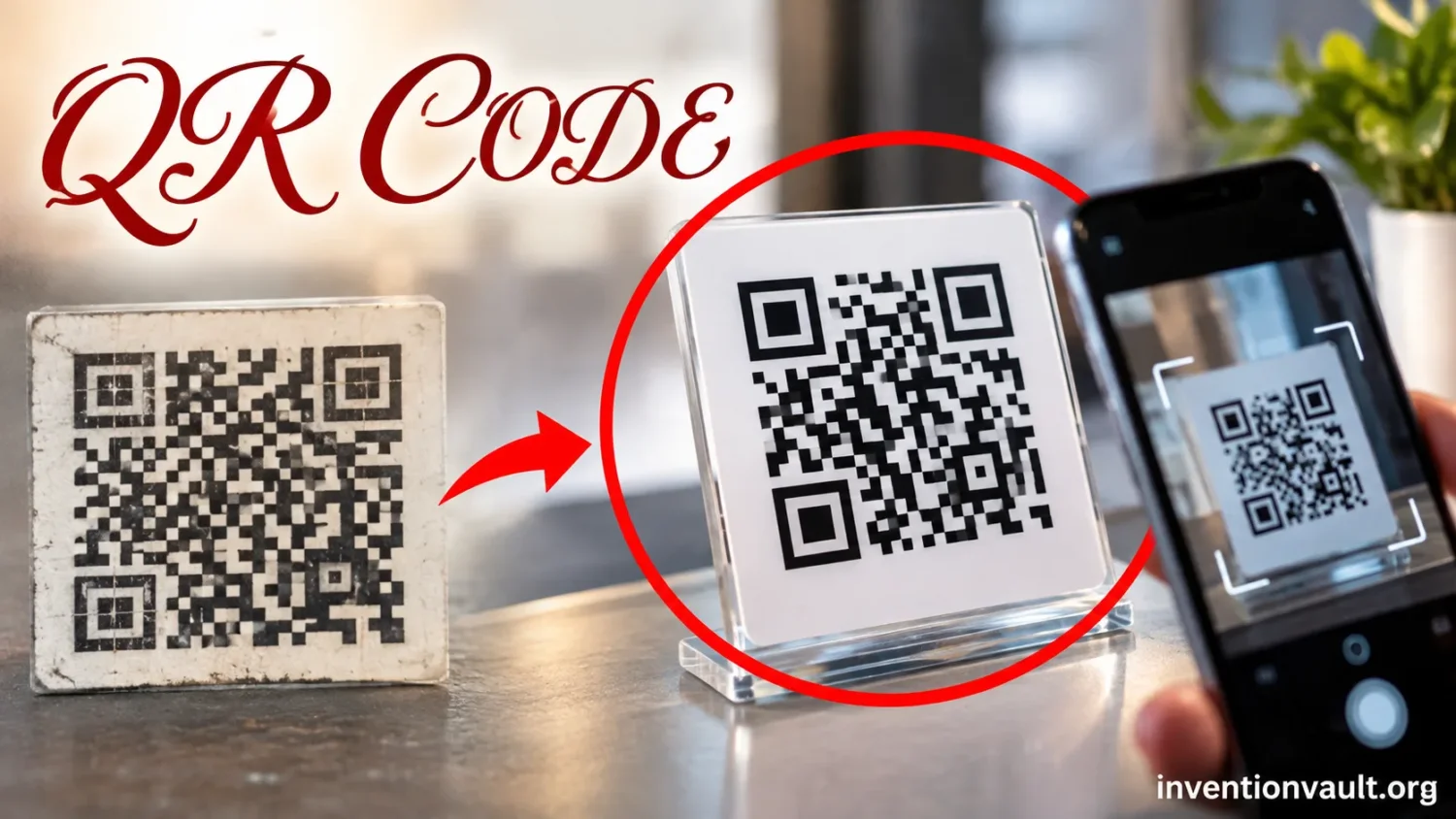
The most recognizable parts of a QR Code are the three large square targets in its corners. They are finder patterns, also called position detection patterns. Their job is to let imaging software find the symbol rapidly inside a larger scene and determine its orientation before decoding the message.
Hara’s team searched printed material for a black-and-white sequence that rarely appeared by accident. The pattern they settled on has a characteristic 1:1:3:1:1 ratio when read across the finder structure. DENSO and the Japan Patent Office both describe this ratio as the product of studying printed shapes to reduce false recognition. With matching targets at three corners, the reader can identify a QR Code from different directions rather than requiring the label to be presented in one narrow orientation.
What the rest of the visible pattern does
| QR element | Function |
|---|---|
| Finder patterns | Identify the symbol’s position and orientation. |
| Timing patterns | Alternating dark and light modules help the reader establish the grid spacing between position markers. |
| Alignment patterns | Help correct geometric distortion, especially in larger symbols or when the code is viewed at an angle or printed on a curved surface. |
| Format information | Carries information needed for decoding, including the error-correction level and mask pattern. |
| Data and error-correction area | Stores the encoded message together with redundant information used to recover damaged or unreadable codewords. |
| Quiet zone | A clear margin around the symbol separates the code from surrounding print. |
How a Scanner Turns the Square Pattern Back Into Data
A QR Code is not a picture of a web address. It is a structured grid of light and dark modules. A URL is only one type of payload that can be encoded. The same symbol system can carry numerals, alphanumeric text, byte data, Kanji, or combinations allowed by the specification.
- Locate the symbolThe reader searches the image for the three finder patterns and uses them to establish the code’s position and orientation.
- Reconstruct the gridTiming and alignment information helps map the captured image back onto the intended rows and columns of modules, compensating for perspective or moderate distortion.
- Read format and version dataThe decoder identifies parameters needed to interpret the symbol correctly, including error-correction and masking information.
- Recover codewordsThe data modules are interpreted and Reed–Solomon error correction can reconstruct a limited amount of missing or damaged encoded information.
- Interpret the payloadThe recovered data is converted into its encoded content, such as text, a URL, an identifier, or binary information.
Why QR Code Could Carry So Much More Than a Linear Barcode
A one-dimensional barcode uses changes along a line. A QR Code uses a matrix, so data can be distributed across rows and columns. That does not make every QR symbol equally dense: capacity depends on the version, data mode, and chosen error-correction level.
| Maximum Model 2 capacity | Amount |
|---|---|
| Numeric | 7,089 digits |
| Alphanumeric | 4,296 characters |
| 8-bit byte data | 2,953 bytes |
| Kanji | 1,817 characters |
Model 2 runs from Version 1 at 21 × 21 modules to Version 40 at 177 × 177 modules, adding four modules per side with each version step. The largest figures above are specification maxima, not a promise that every 177 × 177 symbol can hold the same amount of every data type under every correction setting.
Kanji support was part of the original industrial context
The ability to represent Japanese characters efficiently mattered in the environment where QR Code was born. A system that forced Japanese production information through an inefficient character representation would have lost some of the space advantage it was trying to create. QR Code therefore was designed with a Kanji mode as one of its data options rather than treating Japanese text as an afterthought.
Damage Tolerance: What the 7%, 15%, 25%, and 30% Figures Mean
QR Code includes Reed–Solomon error correction. Redundant codewords are added so that some missing or corrupted information can be reconstructed during decoding. Four correction levels trade capacity for recovery ability.
| Error-correction level | Approximate codewords that can be restored |
|---|---|
| L | 7% |
| M | 15% |
| Q | 25% |
| H | 30% |
Damage Percentage Check
These percentages refer approximately to codewords that can be restored, not a guarantee that the same percentage of any visible area may be covered. Damage location, symbol structure, print quality, and the selected correction level all affect whether decoding succeeds.
Model 1 and Model 2 Are Not the Same QR Code Design
The 1994 invention did not remain frozen in its earliest layout. DENSO distinguishes the original Model 1 from Model 2, the improved form that became the usual meaning of “QR Code.”
Model 1
The original QR Code design. It reaches Version 14, measuring 73 × 73 modules at its largest size, and can encode up to 1,167 numerals.
Model 2
An improved design that adds alignment patterns for better reading when the captured code is distorted. It extends to Version 40, or 177 × 177 modules, and up to 7,089 numerals.
The alignment pattern matters because a camera or industrial imager rarely sees a mathematically perfect square. Labels can bend around packaging, a camera can view them obliquely, and perspective can stretch one region of the grid more than another. Alignment references help the decoder correct that geometry before it reads the data modules.
Who Invented the QR Code?
Masahiro Hara is the engineer most closely associated with the invention because he led the development project and has given the best-known technical accounts of the work. The historical record, however, supports a team credit rather than a lone-inventor story.
The European Patent Office lists Masahiro Hara, Motoaki Watabe, Tadao Nojiri, Takayuki Nagaya, and Yuji Uchiyama together in its QR Code inventor record. Hara and his team later received the Popular Prize at the 2014 European Inventor Award. DENSO’s own corporate history adds another useful distinction: the project began with only two people in 1992, while the named inventor team associated with later patent and award records was larger.
Established Credit
Masahiro Hara led the QR Code development at DENSO, but the invention is properly described as a DENSO engineering-team development. The two-person project start and the later five-name inventor record describe different stages of the work.
1994 Is the Release Date, Not the Patent or ISO Date
The QR Code was released in 1994. That date is often blurred with later legal and standards milestones. The European Patent Office lists patent EP0672994 in connection with the team, while DENSO WAVE identifies Japanese Patent No. 2938338 in its explanation of standardized QR Code rights. Patent events occurred after the development work had already produced the 1994 code.
Standardization came later still. An invention can exist before outside organizations publish common rules for implementing it. Keeping those events separate makes the chronology much clearer.
Patent vs. Open Use
“QR Code was never patented” is inaccurate. DENSO held patent rights, but DENSO WAVE states that it waived enforcement of its patent rights for standardized QR Codes. Open implementation and absence of a patent are not the same thing.
How Standardization Turned a Factory Code Into Shared Infrastructure
Fast reading was only useful at large scale if independent equipment could agree on how a QR symbol was built. Standardization supplied that common technical language. DENSO’s standardization record traces the code through several organizations before and after its ISO adoption.
| Date | Milestone | Why it matters |
|---|---|---|
| 1994 | QR Code released | The working DENSO-developed code entered use. |
| October 1997 | AIM International standard | QR Code entered an international automatic-identification industry specification. |
| March 1998 | JEIDA-55 | Japan’s electronics industry adopted a formal specification. |
| January 1999 | JIS X 0510 | QR Code became a Japanese Industrial Standard. |
| June 2000 | ISO/IEC 18004 | The symbology became an ISO international standard. |
| November 2004 | Micro QR added to JIS | A smaller member of the QR family received Japanese standardization. |
| May 2022 | ISO/IEC 23941:2022 | Rectangular Micro QR Code, or rMQR, received its own international symbology standard. |
| August 2024 | ISO/IEC 18004:2024 | Edition 4 became the current published core QR Code specification. |
ISO/IEC 18004:2024 specifies QR Code characteristics, data encoding methods, symbol formats, dimensions, error correction, reference decoding, production quality, and application parameters. ISO currently marks the 2024 edition as published while also showing a future revision under development. That means the QR Code is not merely a historical artifact with a fixed 1990s specification; its formal technical definition is still maintained.
The First Life of QR Code Was Industrial
QR Code’s early value was measured in production and logistics. It could place more information on a smaller label, reduce repeated scans, and still be read when the printing environment was less than ideal. Automotive parts management was the first mission described in DENSO’s historical material.
The code soon moved outside that setting. DENSO WAVE’s 30th-anniversary history identifies contact lens packaging as the first use on general commercial products. That example is useful because it shows why QR Code could travel beyond car factories: a small package also benefits from a compact symbol that can carry more data than a long linear barcode.
2002 Put the Scanner in the Consumer’s Hand
The next change did not alter the printed symbol. It altered the reader. DENSO records that mobile phones with QR-scanning capability went on sale in 2002. Once a camera phone could decode the symbol, a printed QR Code could hand data directly to a personal networked device rather than only to industrial equipment.
This made one payload especially attractive: the URL. A poster, package, magazine, ticket, or sign could encode a web address that the phone interpreted after scanning. Coupons and mobile websites were early uses. Later smartphones reduced the friction further by integrating QR recognition into common camera software.
That sequence explains why the QR Code is sometimes misremembered as a smartphone-era invention. The consumer use was highly visible, but the code itself was already eight years old when QR-reading mobile phones appeared.
QR Code vs. Linear Barcode: What Actually Changed
| Design question | Traditional linear barcode | QR Code Model 2 |
|---|---|---|
| Data layout | Primarily one-dimensional | Two-dimensional matrix |
| Capacity | Relatively small | Up to thousands of characters depending on mode and version |
| Orientation handling | Reader generally follows bar direction | Finder patterns support rapid detection from different orientations |
| Japanese text | Not a defining capability of common linear formats | Dedicated Kanji encoding mode |
| Damage recovery | Depends on the barcode type and check mechanisms | Four Reed–Solomon error-correction levels |
| Distortion correction | Format-dependent | Model 2 uses alignment patterns in larger versions |
| Original QR design priority | Simple identification | High capacity combined with fast image-based recognition |
This does not make QR Code a universal replacement for every linear barcode. Linear symbols remain efficient where only a short identifier is needed and the existing scanner infrastructure is built around them. QR Code solved a different data-and-reading problem and later found many situations where that tradeoff was useful.
The QR Family Kept Adapting to Different Shapes and Spaces
The familiar square Model 2 is only one member of the wider QR family. Micro QR reduces the footprint for applications where only a small amount of data is needed. SQRC adds a reading-restriction feature for controlled information use. FrameQR reserves a canvas region that can contain letters or an image while preserving the code’s scanning structure.
A later branch addressed a geometric limitation of the square itself. rMQR, or Rectangular Micro QR Code, is designed for narrow spaces where a conventional square QR Code does not fit well but Micro QR does not provide enough capacity. ISO/IEC 23941:2022 defines rMQR as a separate barcode symbology. Its existence shows that the design problem first tackled in 1992—how to fit machine-readable information into real physical spaces—did not end with the original square.
What QR Code History Often Gets Wrong
“Masahiro Hara invented it alone.”
Hara led the project and is the central named engineer in the development story, but the European Patent Office credits a five-person DENSO team. A lone-inventor description removes part of the engineering record.
“QR Code was invented for smartphones.”
The original target was automotive production and parts handling. Camera phones became an adoption channel years later.
“QR Code was the first 2D barcode.”
Two-dimensional codes predated it. QR Code’s distinguishing engineering choices centered on rapid recognition, higher capacity, Japanese character handling, damage recovery, and practical industrial scanning.
“It was invented in 2000.”
2000 is the ISO international-standard milestone. The code was released in 1994 after development beginning in 1992.
“Thirty percent of a QR Code can always be covered.”
The highest standard error-correction level is described as restoring about 30% of codewords. That is not a blanket guarantee for covering any 30% of the visible square, especially if structural patterns or concentrated regions are damaged.
The Lasting Idea Was Fast Machine Recognition
QR Code succeeded because several decisions supported one practical goal. Two-dimensional storage raised capacity. Kanji support suited the environment where the code was developed. Finder patterns let the scanner locate the symbol quickly. Alignment and timing structures helped recover the grid. Error correction made real labels more tolerant of damage. Open implementation and standardization then allowed printers, scanners, software, and phones from unrelated makers to work with the same symbol.
That combination explains the title “Quick Response” better than the modern habit of treating every QR Code as a shortcut to a website. The code was invented to reduce the time between a physical label and usable digital information. Automotive factories supplied the original pressure; standardized machine-readable geometry made the idea portable far beyond the factory floor.
References Used for This Article
- DENSO 75-Year History — Proliferation of QR Codes: used for DENSO’s barcode-reader background, the 1992 two-person project start, the 1994 release, and the manufacturing problem that prompted development.
- DENSO — QR Code Technology: used for finder-pattern, alignment-pattern, timing-pattern, and error-correction functions.
- Japan Patent Office — QR Code: used for the development account of the finder pattern and the 1:1:3:1:1 black-and-white ratio.
- DENSO interview with Masahiro Hara: used for the 1992 development context, the roughly 20-character barcode limitation described by Hara, repeated scanning on factory sites, and the search for the 1:1:3:1:1 finder ratio.
- DENSO WAVE — QR Code Standardization: used for the 1997–2000 standards sequence, Patent No. 2938338 policy, symbol dimensions, maximum capacities, and error-correction levels.
- DENSO WAVE — QR Code Model 1 and Model 2: used for the Model 1 and Model 2 version limits, module dimensions, capacities, and alignment-pattern distinction.
- DENSO WAVE — QR Code 30th Anniversary: used for the first general commercial use on contact lens packaging and the 2002 arrival of QR-reading mobile phones.
- European Patent Office — Masahiro Hara and QR Code team: used for the five named inventors, EP0672994, team credit, and the 2014 European Inventor Award record.
- ISO — ISO/IEC 18004:2024: used for the current published QR Code symbology edition, its August 2024 publication, and the specification scope.
- ISO — ISO/IEC 23941:2022: used for the Rectangular Micro QR Code (rMQR) standard and its 2022 publication.
- MIT CSAIL course paper — QR Codes: used as an academic technical reference for QR matrix structure, version sizing, payload area, and Reed–Solomon-based error correction.