
Interior Wall Evolution Map
How Drywall Took Its Modern Form
Follow the shift from wet plaster construction to factory-made gypsum panels, then to tested wall systems.
Previous construction method
Lath and Plaster Made Walls on the Jobsite
Current stage
Wall base
Narrow wooden laths were fastened across studs, leaving gaps that allowed wet plaster to form mechanical keys behind the strips.
Wet application
Plaster was mixed and applied at the building rather than arriving as a finished wall surface. Multiple operations and drying periods separated framing from final decoration.
The production problem
The wall surface depended heavily on site labor. A factory-made panel promised to transfer much of that work from the building to a controlled manufacturing process.
Drywall emerged from an attempt to replace a labor-heavy wet construction sequence with a panel that arrived ready to fasten.
Material experiment
Sackett Replaced Tar with Plaster
Current stage
Earlier laminated sheets
Augustine Sackett had experience making laminated material from alternating straw paper and tar. The construction method suggested that a layered sheet might also serve architectural surfaces.
1888 material change
USG’s historical account dates Sackett’s idea of substituting plaster of Paris for hot tar to 1888, removing the highly combustible ingredient from the proposed wall panel.
Why paper remained
Gypsum plaster provided a rigid mineral layer while paper helped hold thin layers together, producing a composite sheet that could survive handling better than unsupported plaster.
The material substitution turned a laminated-sheet concept into a plausible interior wall product.
Documented invention
The 1894 Inside-Wall Covering Patent
Current stage
Patent record
Sackett filed his application on May 23, 1890. U.S. Patent No. 520,123, titled Inside-Wall Covering, was granted on May 22, 1894.
Stated purpose
The specification describes boards or plates intended as a substitute for lath and plaster and large enough to avoid excessive numbers of joints.
Direct fastening
The patented material was intended to arrive ready for use and remain soft enough for nails to pass through it into the wooden studding behind.
The patent documented the defining construction idea: make the wall covering as a transportable sheet and nail it directly to the structure.
Industrial development
USG Acquired the Sackett Business
Current stage
1909 acquisition
United States Gypsum Company purchased the Sackett Plaster Board Company in 1909, bringing Sackett’s panel into a larger gypsum manufacturing organization.
Unfinished evolution
The acquired product was not yet identical to modern drywall. It still used a laminated construction and required further work on edges, core structure and surface finishing.
Production mattered
The history of drywall therefore includes both the original panel concept and the manufacturing changes that made large quantities of consistent board practical.
Ownership changed, but more importantly the panel entered a period of rapid engineering refinement.
Edge engineering
Wrapped Edges Reduced Crumbling
Current stage
Exposed-edge weakness
Early gypsum boards left vulnerable mineral material at their edges. Handling and installation could damage these areas before the panel reached its finished position.
1910 change
A folded-edge process wrapped the board edge with paper, giving the perimeter better protection during transport and fastening.
Panel thinking
Once board edges became engineered parts of the product, wallboard design had moved beyond simply laminating plaster and paper into a repeatable panel geometry.
A small-looking edge change addressed one of the practical weaknesses that separated an experimental board from a dependable construction product.
Core redesign
The Multilayer Board Became a Gypsum Core
Current stage
1913 redesign
USG records that the two interior paper plies were eliminated in 1913, leaving a solid gypsum core between exterior paper surfaces.
Structural simplification
This was a major departure from Sackett’s alternating paper-and-plaster laminate. The familiar paper-faced gypsum-core architecture was now taking shape.
Manufacturing direction
The redesigned board was better suited to continuous production in which gypsum slurry could be formed between moving paper surfaces rather than assembled as several internal layers.
Removing the internal paper layers brought wallboard much closer to the basic cross-section used by modern paper-faced gypsum board.
Ready-to-finish wallboard
Flush Joints and the Sheetrock Name
Current stage
1916 edge geometry
Square-edge development allowed adjacent panels to meet more cleanly, helping produce a surface that could be decorated without covering the entire wall in a new plaster coat.
1917 product identity
USG adopted the Sheetrock name in 1917 for its wallboard product. Sheetrock became a well-known brand name, not the generic technical name for drywall.
Original board ends
Industry histories place the end of original Sackett Board production around 1917, by which time the product had evolved far beyond the patented multilayer form.
By 1917, the product had become recognizable as wallboard rather than merely a prefabricated plaster substitute.
Tested wall systems
Drywall Became More Than a Sheet
Current stage
Fire research
The Gypsum Association was formed in 1930 and arranged fire testing with the National Bureau of Standards beginning in 1931 as wallboard systems became more formally studied.
1947 milestone
Association records state that a one-hour fire-rated gypsum system was achieved in 1947, reflecting the shift from judging a sheet alone to evaluating complete wall construction.
Postwar use
Wartime construction, constrained material supplies and the later expansion of fast-built housing helped gypsum wallboard move from an alternative interior finish toward routine construction.
The mature technology was a tested assembly of boards, framing, fasteners and joints rather than a panel considered in isolation.
Modern drywall traces directly to Augustine Sackett’s late-19th-century plasterboard work, especially U.S. Patent No. 520,123, granted in 1894. Yet calling 1894 the date when today’s drywall appeared hides an important part of the story. Sackett patented a layered paper-and-plaster wall covering meant to replace lath and plaster. The familiar sheet with a continuous gypsum core, paper facings and edges designed to join into a finished surface emerged through a series of changes between 1909 and 1917. Drywall was therefore both an invention and an engineering transition: it moved much of interior wall construction from wet work performed at the building to standardized panels made in a factory.
| Record | Drywall history |
|---|---|
| Direct precursor | Sackett Board |
| Inventor most closely associated with it | Augustine Sackett |
| Early material concept | Paper layers combined with plaster of Paris |
| Patent application | May 23, 1890 |
| Patent granted | May 22, 1894 |
| Patent number | U.S. Patent No. 520,123 |
| Patent title | Inside-Wall Covering |
| USG acquisition of Sackett Plaster Board Company | 1909 |
| Modern paper-faced solid-core form develops | 1910s |
| Sheetrock brand name introduced | 1917 |
| Current general U.S. material standard | ASTM C1396/C1396M-24 |
Dating the Invention
The 1894 Sackett patent is the clearest early landmark for the drywall lineage, but its laminated construction was not identical to today’s gypsum board. The modern form resulted from later edge, core and finishing changes.
Before Drywall, an Interior Wall Was Largely Made on Site
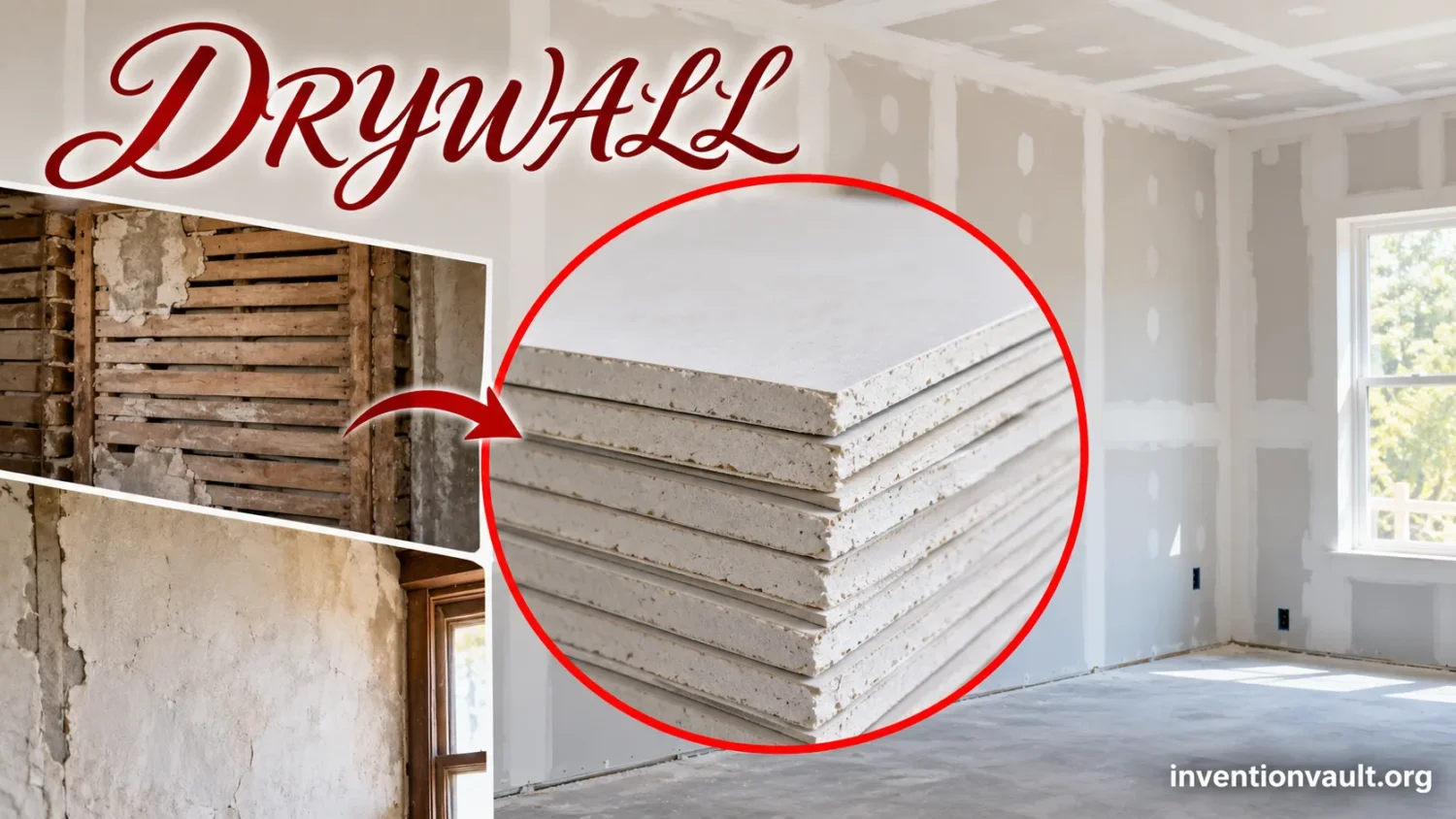
The construction problem that drywall solved becomes clearer when compared with the wall system it replaced. Traditional lath-and-plaster construction started with the structural studs, but the visible wall surface did not arrive as a large finished panel.
Carpenters first attached narrow wooden laths across the studs. Wet plaster was then pressed over the lath so that some of the material squeezed through the gaps and hardened behind them. These protrusions, commonly called plaster keys, helped lock the coating to its support.
Building a finished surface could require a base coat, additional plaster work and a final finish, with moisture leaving the material as it set and dried. The method could produce durable walls, so the attraction of drywall was not that plaster had somehow failed as a material. The opportunity was to change where and how the wall surface was made.
Lath and Plaster
The supporting lath and much of the wall surface are assembled at the building. Wet plaster must be mixed, applied and allowed to set before the finish sequence is complete.
Drywall
The main wall surface arrives as factory-made sheets. Crews fasten the panels to framing and concentrate wet finishing work mainly at joints, fastener heads and corners.
This difference explains the phrase dry wall. The mature system did not eliminate wet compounds altogether, but it removed the need to create the entire wall face as layers of wet plaster.
Augustine Sackett’s First Breakthrough Was a Material Substitution
Sackett did not begin with the exact board sold today. USG’s account of the product’s origins describes his earlier experience with laminated sheets made from alternating straw paper and tar. That construction suggested that several thin materials could be combined into a stiff sheet, but a paper-and-tar panel presented an obvious problem for an interior wall product: combustibility.
In 1888, according to the same company history, Sackett arrived at the idea of substituting plaster of Paris for the hot tar. The choice connected two useful properties. The mineral material supplied a hard, rigid body; paper helped reinforce and contain thin plaster layers so that the material could be handled as a board.
The inventive step was therefore not the discovery of gypsum. Gypsum plaster had a long history in construction. Sackett’s contribution was to put plaster into a factory-made laminated sheet intended to take the place of site-built lath-and-plaster wall covering.
What the 1894 Patent Actually Claimed
The surviving patent record makes Sackett’s goal unusually clear. He filed his application on May 23, 1890, and received U.S. Patent No. 520,123 on May 22, 1894. Its title was simply Inside-Wall Covering.
The specification describes boards or plates that could serve as a substitute for lath and plaster in the interior walls of houses or rooms. Sackett wanted sheets large enough to reduce the number of joints, rigid enough to function as wall covering and still soft enough for nails to pass through them into the studs.
The patent claims alternating webs of paper and layers of plaster or a similar hard-setting material. In other words, the defining form was a laminated composite, not the single uninterrupted gypsum core between two principal paper surfaces that characterizes ordinary paper-faced gypsum board today.
That distinction also explains why several dates can appear in histories of drywall. The patent establishes the early wallboard concept. Later manufacturing changes establish the form recognizable as modern gypsum board.
Patent, Product and Modern Form Are Three Different Milestones
| Milestone | What it establishes | What it does not establish |
|---|---|---|
| 1888 material concept | Sackett’s reported substitution of plaster for tar in a laminated sheet idea | A finished modern gypsum board product |
| 1894 patent | A documented nailable paper-and-plaster interior wall covering | The later solid-core board construction |
| 1910s redesigns | Wrapped edges, simplified core construction and improved joining | Immediate universal adoption |
| Later fire testing and building use | Drywall as part of standardized wall and ceiling assemblies | A new invention of gypsum board itself |
Sackett Board Was the Ancestor of Drywall, Not the Final Design
Early Sackett Board solved the basic prefabrication problem: plaster could be turned into boards and transported to a building. It did not solve every problem created by panel construction.
Edges had to survive shipping and installation. The core needed a simpler, more efficient structure. Adjacent sheets had to meet cleanly enough for a finished wall. Manufacturing also needed to move away from assembling several internal paper layers toward forming long, consistent sheets.
| Feature | Early Sackett concept | Modern paper-faced gypsum board |
|---|---|---|
| Internal structure | Alternating paper and plaster layers | Continuous gypsum core |
| Paper arrangement | Paper used within the laminate | Paper primarily forms the face and back surfaces |
| Edges | Early exposed edges were vulnerable to damage | Long edges are formed for protection and finishing |
| Wall function | Could replace lath and also serve as a plaster base in early practice | Commonly forms the finish substrate itself after joints are treated |
| Manufacturing logic | Layered composite board | Continuous high-volume board forming |
1909–1917: The Design Changes That Produced Modern Wallboard
United States Gypsum Company purchased the Sackett Plaster Board Company in 1909. What followed was not merely a change in ownership. Within less than a decade, the panel’s physical construction changed enough that the original Sackett Board and the later product can be treated as distinct stages in the same invention line.
1910: Paper Was Folded Around the Edge
The exposed gypsum at the perimeter of early board was vulnerable to chipping and crumbling. USG records a folded-edge design in 1910. Wrapping paper around the edge protected an area repeatedly exposed to loading, unloading, positioning and fastening.
The development seems modest compared with the invention of the board itself, but panel systems depend heavily on their edges. A sheet that reaches the wall with a damaged perimeter is harder to align and finish.
1913: The Interior Paper Layers Were Removed
A larger redesign came in 1913. USG records that the two interior paper plies were eliminated, leaving a solid gypsum body between the outer sheets. The product was associated with the Adamant Board name during this transition.
This change created the basic cross-section familiar in ordinary gypsum board: facing material / gypsum core / facing material. The board no longer depended on Sackett’s original sequence of alternating internal paper and plaster layers.
1916: Adjacent Panels Could Form a Smoother Surface
Square-edge improvements recorded in 1916 helped adjacent boards meet flush. That altered the role of the product. Earlier plasterboard could function mainly as a base beneath plaster. A panel system with better joints could serve as the principal wall surface after localized finishing.
The construction sequence was becoming recognizably modern: attach large boards, treat their seams and fasteners, then decorate the resulting surface.
1917: Sheetrock Became the Brand Name
USG adopted the Sheetrock name in 1917 after sales representative D. L. Hunter proposed it for the company’s wallboard. The name later became so familiar that it is sometimes used conversationally as though it meant every form of drywall.
Brand and Generic Name
Sheetrock® is a USG brand. Drywall and gypsum board are generic terms. A gypsum panel made by another manufacturer is not technically Sheetrock.
| Year | Development | What changed |
|---|---|---|
| 1888 | Plaster substituted for tar in Sackett’s laminated-sheet concept | A non-tar wall panel became practical |
| 1890 | Patent application filed | The inside-wall covering entered the patent record |
| 1894 | U.S. Patent No. 520,123 granted | Paper-and-plaster boards were formally described as a lath-and-plaster substitute |
| 1909 | USG purchased Sackett Plaster Board Company | Development continued within a large gypsum producer |
| 1910 | Folded paper edge | The board perimeter gained protection against crumbling |
| 1913 | Interior paper plies eliminated | A solid gypsum core between outer paper layers emerged |
| 1916 | Improved edge geometry | Panels could meet more cleanly as a finished wall surface |
| 1917 | Sheetrock name introduced | The evolved wallboard received the brand name still used by USG |
The Real Speed Advantage Was Moving Work into the Factory
Describing drywall merely as a faster material misses the manufacturing change behind that speed. Lath-and-plaster construction makes much of the wall face after the framing is already standing. Drywall arrives with most of its surface area already formed.
The jobsite operation therefore changes from manufacturing a wall surface in place to installing a manufactured wall surface. Joint compound is still applied wet, but only a fraction of the total wall area needs this treatment.
That transfer has several practical effects. Large sections can be closed rapidly, material thickness becomes more consistent, fewer separate wet-plaster operations are required, and scheduling is less dependent on waiting for broad wall surfaces to dry between coats.
This is why the drywall story fits into the wider history of prefabrication. Sackett did not prefabricate an entire wall. He prefabricated the part of wall construction that had previously demanded a large amount of on-site finishing labor.
Why Gypsum Was Well Suited to a Factory-Made Wall Panel
Gypsum is calcium sulfate dihydrate, written chemically as CaSO4·2H2O. About 21 percent of its mass is chemically combined water. Both characteristics that matter to drywall manufacture—its ability to be calcined and later reset, and its behavior during heating—come from this hydrated mineral structure.
Gypsum Can Be Dehydrated and Then Re-Formed
Manufacturers heat gypsum to remove much of its chemically combined water. The resulting calcined material can then be mixed with water to form a workable slurry. As the board travels along the manufacturing line, calcium sulfate recrystallizes and the core sets between its facing materials.
The process makes it possible to start with a mineral powder, form it continuously as a wet core between paper sheets, allow it to harden and then dry away excess free moisture.
- Calcine the gypsumNatural or suitable synthetic gypsum is prepared and heated so that much of its chemically combined water is removed.
- Prepare the slurryCalcined gypsum is mixed with water and formulation additives to create material that can be continuously formed.
- Form the boardThe slurry is deposited between continuous facing sheets while the edges and thickness are shaped by the production line.
- Allow the core to setThe calcium sulfate rehydrates and recrystallizes, hardening the core and bonding it to the facings.
- Cut and dryThe continuous board is cut to required lengths and passed through dryers to remove excess free moisture before finishing and shipment.
This modern continuous process also explains why the 1913 removal of internal paper layers mattered so much. A solid core between continuous outer facings is far better suited to high-volume board forming than a laminate that requires several separate internal layers.
Gypsum Also Slows Heat Transfer During Fire Exposure
The water bound within gypsum crystals gives the material a useful thermal behavior. When a gypsum panel is heated strongly, part of that chemically combined water is released as steam through a process associated with calcination. Energy is consumed as the material loses this water, delaying temperature rise through the protected assembly.
That does not mean an ordinary sheet of drywall should be assigned a fire-resistance duration by itself. Modern fire ratings belong to tested assemblies whose performance depends on the panel type, number of layers, framing, fastener pattern, joints and other specified details.
Panel vs. Fire-Rated Assembly
A phrase such as “one-hour drywall” is misleading when applied to a sheet alone. Fire-resistance ratings are assigned to complete tested assemblies; the gypsum panel is one part of that construction.
This systems approach developed over decades. The Gypsum Association was formally established in 1930. Its history records cooperation with the National Bureau of Standards on fire tests beginning in 1931, while National Bureau of Standards records from that period describe fire tests of light interior partitions using wood and metal studs with wallboard and other finishes.
By 1947, according to the association’s historical record, research had produced a gypsum system with a one-hour fire-resistance rating. Drywall was no longer being evaluated only as a convenient sheet. Framing, panels, attachment and construction details were becoming an engineered fire-tested assembly.
Why Drywall Took Decades to Replace Plaster
A patent does not create instant adoption. The construction industry already had established plaster trades, supply networks, familiar specifications and expectations about what a finished interior wall should look like. Early wallboard also did not yet have the refined edges, joint treatment and manufacturing consistency of later products.
Several stages separated Sackett’s patent from broad acceptance. Panel design improved during the 1910s. Manufacturers expanded production. Fire testing gave designers more data about complete wall systems. Large construction programs created conditions in which installation speed and material availability mattered greatly.
World War II was one of those periods. USG supplied large quantities of gypsum wallboard for military bases and industrial facilities, while the National Inventors Hall of Fame notes that wartime lumber restrictions helped contractors turn toward drywall. The postwar expansion of tract housing then gave fast interior finishing an even larger market.
The result was gradual rather than instantaneous. Drywall first had to become easier to manufacture, transport, join, finish and specify before its labor-saving advantage could reshape ordinary interior construction.
The Name “Drywall” Covers Several Related Terms
Terminology can make the invention history appear more confusing than it is because different periods and regions use different names for closely related products.
| Term | Meaning |
|---|---|
| Drywall | A common North American generic term for the panel-based interior wall construction method and, informally, for the gypsum boards used in it. |
| Gypsum board | The technical product name commonly used for a board with a gypsum core and facing material. |
| Wallboard | A broader historical construction term that has been applied to sheet materials used to form wall surfaces. |
| Plasterboard | A common generic term in Britain and many other markets for gypsum-core board used in walls and ceilings. |
| Sackett Board | The early paper-and-plaster product in the direct development line leading to modern drywall. |
| Sheetrock® | A USG brand introduced in 1917, not the generic name for every gypsum board. |
Who Should Receive Credit for Inventing Drywall?
Augustine Sackett has the strongest claim to the defining early invention in the American drywall lineage. His 1894 patent directly described large paper-and-plaster sheets intended to replace lath and plaster, arrive ready for installation and be nailed to wall studs. The National Inventors Hall of Fame recognizes Sackett for drywall and identifies U.S. Patent No. 520,123 with his work.
Giving Sackett that credit does not require pretending that the product stopped evolving in 1894. The later industrial story matters because several features that define modern drywall were not part of the original patent.
- Sackett established the prefabricated paper-and-plaster wall-covering concept.
- Later manufacturing work protected the edges and simplified the panel structure.
- The 1913 redesign moved the product toward a continuous gypsum core between exterior facings.
- Improved joints allowed the panels themselves to serve as the principal finish substrate.
- Fire testing and standardized assemblies turned the board into one component of engineered wall and ceiling systems.
For that reason, the most accurate short history is not “drywall was invented in one finished form in 1894.” It is that Sackett invented its defining precursor, patented it in 1894, and the modern gypsum-board form emerged through manufacturing changes in the following decades.
Modern Drywall Still Preserves Sackett’s Central Idea
Today’s gypsum board is far more controlled than Sackett’s early laminated product, but the invention principle remains visible. A mineral wall material that would otherwise be mixed and applied wet is formed into a transportable sheet, carried to the building and mechanically attached to framing.
The product family has also expanded far beyond one general-purpose board. The active ASTM C1396/C1396M-24 specification covers categories including gypsum wallboard, predecorated gypsum board, backing board, coreboard, shaftliner board, water-resistant backing board, exterior soffit board, gypsum sheathing, gypsum base for veneer plaster, gypsum lath and gypsum ceiling board.
That variety should not obscure the historical line. The decisive change was the shift from constructing most of the wall surface wet on the jobsite to installing a standardized surface manufactured elsewhere. Edge design, solid-core construction, continuous production, joint finishing and tested assemblies made that idea practical on a large scale.
Drywall’s invention was therefore less about discovering a new mineral than about reorganizing interior construction. Gypsum moved from the plasterer’s wet mix into a manufactured panel. Once that happened, a wall could be closed with sheets rather than built up across its entire surface coat by coat.
References Used for This Article
- U.S. Patent No. 520,123, Augustine Sackett, “Inside-Wall Covering” — used for the filing date, grant date, patent claims and Sackett’s stated aim of replacing lath and plaster with nailable boards.
- USG, “The Origins of USG Sheetrock® Brand” — used for the 1888 material substitution account and the 1910, 1913, 1916 and 1917 product-development sequence.
- USG Company History — used for the 1909 acquisition of the Sackett Plaster Board Company and USG’s entry into gypsum board manufacturing.
- National Inventors Hall of Fame, “Augustine Sackett” — used for Sackett’s inventor attribution and historical context on wartime and postwar drywall adoption.
- Gypsum Association, “Making Gypsum Board” — used for the modern calcining, slurry forming, rehydration, cutting and drying process.
- Gypsum Association, “Why Gypsum?” — used for gypsum chemistry, chemically combined water and the heat-transfer mechanism during fire exposure.
- Gypsum Association, “History of the Gypsum Association” — used for the association’s 1930 formation, 1931 fire-testing program and 1947 one-hour-rated system milestone.
- National Institute of Standards and Technology, “Standards Yearbook 1931” — used for period evidence of National Bureau of Standards fire testing of wall and partition constructions including wallboard.
- ASTM International, ASTM C1396/C1396M-24, “Standard Specification for Gypsum Board” — used for the current active gypsum-board specification and the modern product categories it covers.