
Patent-to-Checkout Timeline
How the Barcode Reached Retail
Follow the separate steps from a supermarket problem and 1949 patent filing to UPC standardization, the first checkout scan, and 2D retail codes.
Retail problem
A Grocery Industry Request
Current stage
Problem being raised
A supermarket operator wanted a way to identify products automatically at checkout rather than relying only on manually entered prices and labor-heavy stockkeeping.
Drexel connection
Bernard Silver learned of the request at Drexel Institute of Technology and brought the problem to Norman Joseph Woodland, who had studied engineering there.
Real design target
The task was larger than drawing a symbol. A useful system needed a mark that encoded identity and a machine able to distinguish that mark reliably.
The barcode began as an automation problem: make an ordinary package carry information a machine could recognize.
Encoding idea
Morse Logic Becomes Printed Lines
Current stage
Concept source
Woodland later described Morse code as an influence. The useful leap was to turn discrete coded marks into extended lines that could be detected optically.
Orientation problem
A straight-line pattern works best when its direction is controlled. Woodland and Silver also developed a circular form so the target could be scanned without requiring one package orientation.
Patent filing
The pair filed their U.S. application for “Classifying Apparatus and Method” on October 20, 1949, well before the familiar UPC symbol existed.
The early invention joined a coded printed target to optical sensing rather than defining the later retail UPC standard.
Patent record
US 2,612,994 Is Granted
Current stage
Grant date
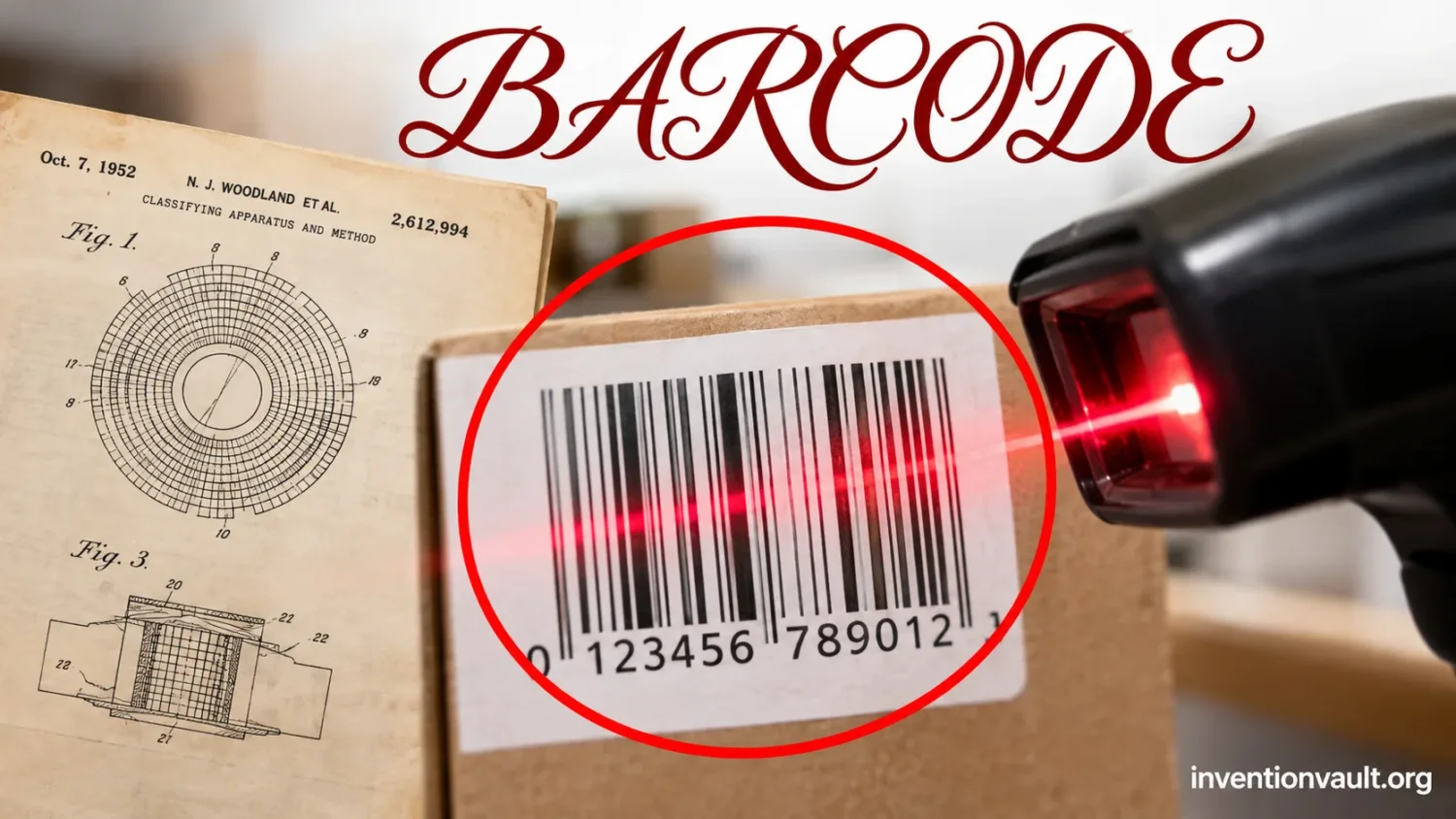
U.S. Patent 2,612,994 was granted on October 7, 1952 to Norman J. Woodland and Bernard Silver, nearly three years after the application was filed.
What it protected
The patent described classifying articles through identifying patterns, photosensitive scanning, conversion of reflected-light changes into electrical impulses, and circuitry that interpreted those impulses.
Two pattern ideas
The specification discusses a straight-line pattern and a concentric circular target. The circular version addressed the need to read items without carefully aligning the target first.
1952 fixes a patent milestone, not the first supermarket checkout scan and not the birth date of the modern UPC symbol.
Industry coordination
Retailers Ask for One Common Code
Current stage
Why one symbol mattered
Automated checkout could not scale if manufacturers and retailers used incompatible identification schemes. Grocery companies needed a shared numbering and scanning approach.
1970 effort
U.S. grocery-industry leaders organized a formal effort to choose a uniform product coding system and invited technology companies to develop machine-readable symbols.
System requirement
The chosen symbol had to survive ordinary package printing, fit many products, scan rapidly, and work with computerized point-of-sale equipment.
A useful retail barcode required agreement across manufacturers, stores, printers, scanners, numbering rules, and checkout computers.
Retail standard
The UPC Symbol Is Selected
Current stage
IBM team
George J. Laurer led IBM’s work on the rectangular UPC symbol. Woodland, by then at IBM, also contributed to the company’s barcode effort.
Why linear bars won
Laurer rejected a bull’s-eye proposal in favor of a rectangular bar pattern that could be printed and scaled more reliably on commercial packaging.
Selection year
The grocery industry adopted the UPC symbol in 1973. This was a standardization milestone built on decades of earlier work in coding, optical sensing, electronics, and computing.
The modern grocery barcode was not simply the 1952 patent drawing placed on a package; it was a later standardized symbol.
Commercial use
The First UPC Checkout Scan
Current stage
Date and place
On June 26, 1974, a Marsh supermarket in Troy, Ohio put its new scanning installation into service.
First item
Cashier Sharon Buchanan scanned a multipack of Wrigley’s Juicy Fruit chewing gum purchased by Clyde Dawson, a Marsh research and development executive.
Checkout hardware
Spectra Physics supplied the laser scanner and NCR supplied the computerized register system. The code identified the product; stored computer data supplied the matching product information.
The 1974 event was the first retail use of the standardized UPC at checkout, more than two decades after the patent grant.
Current standards
Retail Scanning Expands to 2D
Current stage
Sunrise 2027
GS1’s retail program aims for point-of-sale systems to be able to scan and process approved two-dimensional barcodes by the end of 2027.
More than identity
2D symbols can carry or resolve additional data such as lot identifiers, expiration dates, serial data, and web-linked product information.
UPC after 2027
The target does not make the familiar UPC unreadable or invalid overnight. GS1 US states that UPC barcodes will continue to be accepted after the 2027 sunrise date.
The retail code is gaining more data capacity, while the original checkout function—identifying a product reliably—remains part of the system.
The barcode was not invented in a single moment in 1952 and then immediately used at supermarket checkouts. Norman Joseph Woodland and Bernard Silver filed their barcode-related patent application in 1949, received U.S. Patent 2,612,994 in 1952, and described an optical classification system using printed patterns. The standardized Universal Product Code came later, in 1973. The first retail UPC scan followed on June 26, 1974, when a pack of Wrigley’s Juicy Fruit gum passed over a scanner at a Marsh supermarket in Troy, Ohio.
| Milestone | Verified detail |
|---|---|
| Early developers | Norman Joseph Woodland and Bernard Silver |
| Patent application | October 20, 1949 |
| Patent grant | October 7, 1952 |
| Patent | US 2,612,994, “Classifying Apparatus and Method” |
| Retail standard | Universal Product Code (UPC), selected in 1973 |
| UPC design work | IBM team led by George J. Laurer, with Woodland involved in IBM’s effort |
| First retail UPC scan | June 26, 1974, Marsh Supermarket, Troy, Ohio |
| First scanned purchase | Wrigley’s Juicy Fruit chewing gum |
Patent, Standard, and First Use
The 1952 patent, the 1973 UPC standard, and the 1974 first retail scan are separate milestones. Calling any one of them the entire invention story hides how the technology moved from concept to an operating retail system.
The Grocery Checkout Problem Behind the Barcode
The barcode story began with a practical supermarket problem. In 1948, a grocery executive asked Drexel Institute of Technology in Philadelphia whether product information could be captured automatically at checkout. Bernard Silver learned of the request and discussed it with Norman Joseph Woodland. The goal was not merely to create an unusual printed mark. A successful solution had to connect a printed identifier on an ordinary package with equipment that could detect and interpret it.
That distinction explains why the barcode took decades to reach the checkout lane. A symbol alone could not replace manual entry. Stores also needed dependable scanners, electronic circuitry, computers, a common product-numbering system, packaging that reproduced the symbol accurately, and a database able to connect an identifier with a product record.
From Morse Code to Machine-Readable Lines
Woodland later described Morse code as an influence on his thinking. Morse conveyed information through short and long signals; Woodland’s insight was to extend coded marks into lines that an optical device could detect as it moved across a pattern. Accounts from Drexel and later historical sources place much of this development during Woodland’s stay in Florida in the winter of 1948–49.
The familiar story of Woodland drawing lines in beach sand captures only part of the engineering problem. A linear pattern can be read reliably when its orientation relative to the scanner is controlled. Packages at a checkout or sorting point do not naturally arrive with a code aligned in one perfect direction. Woodland and Silver therefore explored a circular form as well.
Why the early bull’s-eye design mattered
The 1952 patent explains the reason for changing the straight-line pattern into a circular target: the circular arrangement reduced the need to orient the pattern before scanning. The specification describes concentric black-and-white circles used as a recognizable target and other lines carrying coded classification information. A scanning element could pass across the circular pattern and generate electrical pulses from changes in reflected light.
This makes the bull’s-eye more than an odd historical ancestor of the modern barcode. It was an attempted answer to a real reading problem: how to extract coded information when an item was not carefully lined up for the sensing apparatus.
What the 1952 Patent Actually Covered
Woodland and Silver filed their application on October 20, 1949. U.S. Patent 2,612,994 was granted on October 7, 1952 under the title Classifying Apparatus and Method. The document describes automatic article classification through patterns made from lines, reflective differences, and in some variants colors. It also describes photosensitive detection and electronic circuits that convert optical changes into electrical impulses and interpret the resulting pattern.
The patent therefore covered more than the visual appearance of a code. Its claims and examples linked three parts of a machine-readable identification system: a pattern attached to an article, a scanning method, and electronic interpretation of the resulting signal.
1952 Woodland–Silver Patent
Described article-classification patterns, including straight and concentric forms, together with photosensitive scanning and electronic interpretation. It was not the retail UPC symbol later standardized for grocery checkout.
1973 Universal Product Code
Created a common retail symbol and numbering approach intended for reliable package printing and rapid point-of-sale scanning across manufacturers and supermarkets.
The patent’s straight and circular patterns served different needs
In the patent, the straight-line version could represent information through fixed line positions. A line present in a position could represent one state and a missing line another. The specification then explains that the straight arrangement was useful where the target could be oriented with respect to the photosensitive apparatus. The circular modification removed that requirement by presenting a readable target across different rotational positions.
Dating the Invention
October 7, 1952 is the patent grant date. The application had been filed in 1949, and the underlying work began earlier. Patent grant, first conception, standardization, and first commercial scan are not interchangeable dates.
How Woodland and Silver’s Reader Worked
The patented apparatus was built around differences in reflected light. The exact circuitry belongs to an era of photocells, vacuum-tube electronics, counters, and amplifiers, but its information path is easy to follow.
- A coded target is placed on the articleThe package carries a printed pattern whose line positions or reflective regions represent classification information.
- The target is illuminatedLight strikes the package while the article moves through the reading area.
- A photosensitive device scans the patternBright and dark or differently reflective regions cause the amount of received light to change during the scan.
- Light changes become electrical impulsesThe photocell converts those optical variations into pulses that can be amplified and processed electronically.
- The circuit interprets the pulse patternThe apparatus uses the timing and presence of pulses to activate the appropriate classification output.
This is the enduring technical idea behind optical codes: printed contrast is converted into a signal, and the signal is decoded into information. The hardware and encoding rules changed greatly after 1952, but the chain from mark → optical reading → electrical signal → interpreted identity remained recognizable.
Why the Patent Did Not Produce an Instant Supermarket System
The 1952 patent proved that a printed target could be paired with photosensitive electronics, but commercial grocery checkout demanded more. Early optical systems were bulky, electronics were expensive, computers were not yet ordinary supermarket equipment, and stores lacked a universal product code that every manufacturer could print and every retailer could interpret.
The economics changed during the 1960s and early 1970s. Minicomputers became practical enough for retail experiments, laser scanning offered a concentrated moving light source, and electronic point-of-sale systems could compare a scanned identifier with stored product data. At the same time, grocery companies were trying to reduce manual price entry and gain better sales and inventory records.
Standardization was the remaining coordination problem. A scanner is valuable only if the packages passing over it follow a shared coding rule. By 1970, grocery-industry leaders were formally seeking a common machine-readable product symbol.
The UPC Was a Standardization Project, Not a Reprint of the 1952 Patent
Technology companies submitted competing ideas for a uniform grocery code. IBM’s effort was led by engineer George J. Laurer. Woodland was also working at IBM and contributed to the company’s barcode work, but the rectangular UPC that emerged was not simply the earlier bull’s-eye redrawn.
Laurer favored a linear arrangement of vertical bars that could be reproduced reliably by commercial printing processes. Printing quality mattered because a symbol distorted by ink spread, smearing, or scaling could become difficult to read. A supermarket standard also needed to fit a wide range of package sizes and support fast checkout without asking a cashier to place every package in one exact position.
The grocery industry selected the UPC symbol in 1973. That event established a shared retail language: manufacturers could mark products according to one system, while stores could buy scanners and point-of-sale computers designed to interpret the same identifiers.
What the Records Support
Woodland and Silver are named inventors on the 1952 patent. George J. Laurer led IBM’s development of the later UPC symbol. These are related contributions at different stages, not competing names for the same event.
June 26, 1974: The First UPC Checkout Scan
The standardized code became a live retail system on June 26, 1974, at a Marsh supermarket in Troy, Ohio. The store had ten Spectra Physics Model A scanners. At checkout, cashier Sharon Buchanan scanned a multipack of Wrigley’s Juicy Fruit chewing gum for Clyde Dawson, who worked in research and development for Marsh.
The Smithsonian’s National Museum of American History records the Troy installation as the first supermarket scanner installation to enter service and identifies a Wrigley’s chewing-gum package as the first purchase made using scanners able to read the new UPC. Spectra Physics provided the laser scanning equipment, while NCR supplied the computerized cash-register system.
Why Juicy Fruit became the first scanned item
The gum was not important because chewing gum had any special role in the barcode system. A later account published by Smithsonian Magazine reports that Dawson said he chose it deliberately because there had been doubt about printing a readable code on something as small as a gum package. Wrigley had managed to print a usable symbol, making the small package a fitting test of the new checkout setup.
That explanation comes from later recollection rather than the 1952 patent or a technical standard, so it belongs to the story of the 1974 event rather than to the engineering definition of the barcode.
What happened when the gum crossed the scanner
- The scanner projected laser lightA helium-neon laser sent a beam to a rotating mirror, which directed the light through the glass plate at the top of the scanner.
- The UPC reflected light backBlack bars and light spaces produced different reflected-light levels as the beam moved across the symbol.
- A photodiode detected the patternThe detector converted the changing reflected light into an electrical signal representing the scanned code.
- The computer identified the productThe computerized register matched the decoded identifier with a stored product record.
- The checkout system retrieved the sale informationProduct data held by the store, including the price used for the transaction, could then be applied at the register.
The Barcode Did Not Store the Shelf Price
The UPC identified the product. The checkout computer used that identifier to find the corresponding store record. This separation allowed a retailer to change a price in its system without printing a new UPC for the product.
The First Scanned Gum Pack Is Not the Smithsonian Artifact Many Accounts Imply
The Smithsonian preserves one of the first Spectra Physics Model A supermarket scanners, but its catalog record makes an unusually useful correction: the actual package of gum scanned in the first transaction remained with Clyde Dawson and never entered the Smithsonian collection.
This matters because the phrase “the first barcode is in the Smithsonian” can blur several different objects. The museum can preserve early scanner hardware and barcode-related packaging without the displayed or cataloged package necessarily being the exact physical pack that crossed Sharon Buchanan’s checkout on June 26, 1974.
Why 1974 Worked When 1952 Could Not
By 1974, several previously separate technologies had become one operating retail system. The printed UPC gave each packaged item a standardized machine-readable identifier. Laser scanners read the symbol at speed. Photodetectors converted reflected light into electronic signals. Store computers matched codes with product records. Point-of-sale terminals recorded the transaction, and industry rules kept the identifiers consistent across companies.
No single component could have produced the same result on its own. A perfect symbol without affordable scanners would have remained unused. A fast scanner without a common code would have faced incompatible labels. A readable code without a computerized product database would still have left stores with much of the old manual workflow.
| System element | What it contributed to retail use |
|---|---|
| UPC symbol | A standardized visual pattern that scanners could decode |
| Product numbering | A consistent identifier for manufacturer and item records |
| Commercial printing | Repeatable symbols on large numbers of packages |
| Laser scanner | Fast optical reading at the checkout counter |
| Photodetection and electronics | Conversion of reflected light into machine-readable signals |
| Computerized POS | Lookup of product descriptions, prices, and transaction records |
| Retail adoption | Enough participating stores and suppliers for the standard to be useful |
What Barcodes Changed Inside Retail
The most visible change was at checkout: cashiers no longer had to enter every product price manually when a scanned identifier could call up a stored record. But the larger operational gain came from using the same transaction to create data about what had actually sold.
That connection improved several tasks at once. Stores could record unit sales more consistently, compare sales with inventory, update centralized price records, study demand by product identifier, and support automated replenishment systems. Manufacturers and distributors gained a common identifier that could also be used beyond the checkout lane.
The barcode therefore became useful not because black lines were faster than printed numbers, but because the identifier joined the physical product to a computer record. The checkout scan was the point where packaging, optics, electronics, and data management met.
From UPC to International and 2D Retail Codes
The UPC did not remain only a U.S. grocery standard. In 1977, the European Article Numbering Association was established, and its EAN barcode system was designed to be compatible with the U.S. UPC system. Later GS1 standards extended machine-readable identification into logistics, healthcare, shipping, and other supply-chain uses.
Retail scanning is now moving toward two-dimensional symbols such as GS1 DataMatrix and QR Codes using GS1 standards. A 2D code can carry or connect to more data than a traditional 1D UPC, including batch or lot identifiers, expiration dates, serial information, and online product data.
What Sunrise 2027 actually means
GS1’s Sunrise 2027 program is aimed at point-of-sale systems being able to scan and process suitable 2D barcodes by the end of 2027. During the transition, packages may carry both a traditional UPC and a 2D symbol while retailers update scanners and software.
The date should not be described as the day the UPC disappears. GS1 US states that UPC barcodes will continue to be accepted and scanned after the 2027 sunrise date. The change expands what a retail code can do; it does not erase the 1D system on a single deadline.
Four Dates That Define the Barcode Invention Story
| Date | What happened | What the date does not mean |
|---|---|---|
| October 20, 1949 | Woodland and Silver filed the U.S. patent application | Not the first retail scan |
| October 7, 1952 | US 2,612,994 was granted | Not the creation date of the standardized UPC |
| 1973 | The UPC symbol was selected for U.S. grocery retail | Not yet the first live supermarket UPC transaction |
| June 26, 1974 | Wrigley’s Juicy Fruit became the first purchase scanned with the new UPC system at Marsh in Troy, Ohio | Not the date the barcode concept was first invented |
Questions People Ask About the Barcode Invention
Who invented the barcode?
Norman Joseph Woodland and Bernard Silver are the named inventors on the foundational U.S. patent granted in 1952. George J. Laurer later led IBM’s development of the standardized UPC symbol selected for grocery retail in 1973. The roles belong to different phases of the technology’s development.
Was the first barcode circular?
The Woodland–Silver patent included both straight-line coding patterns and a concentric circular design. The circular version addressed orientation during scanning. The later UPC adopted for retail used the familiar rectangular arrangement of vertical bars.
What was the first item scanned with a barcode?
The first purchase scanned with the new UPC system was a pack of Wrigley’s Juicy Fruit chewing gum at a Marsh supermarket in Troy, Ohio, on June 26, 1974.
Did the first UPC contain the product’s price?
No. The UPC identified the product. The computerized checkout system used that identity to retrieve the corresponding product information from stored data, including the price used by the store.
Will 2D barcodes replace UPCs in 2027?
Not on a universal cutover date. Sunrise 2027 is a capability target for retail point-of-sale systems to process 2D barcodes. GS1 US says UPC barcodes will continue to be accepted after the sunrise date.
Why 1952 and 1974 Both Belong in the Barcode Story
The 1952 patent established an early machine-readable article-classification system built around coded visual patterns, optical sensing, and electronic interpretation. It showed how a package could carry information that a machine could recognize without depending on the package’s natural appearance.
The 1974 Troy supermarket scan proved something different. By then, a standardized symbol, commercial printing, laser optics, photodetection, computerized registers, stored product records, and industry coordination had been assembled into a system that could handle a real purchase. The pack of Juicy Fruit did not mark the birth of the barcode idea; it marked the point at which decades of invention and standardization finally worked together at a retail checkout.
References Used for This Article
- U.S. Patent 2,612,994 — “Classifying Apparatus and Method” — filing and grant dates, inventors, straight and concentric patterns, photosensitive scanning, and electrical pulse interpretation.
- Drexel University — Barcode 60th Anniversary — Woodland and Silver’s early work, the grocery-checkout problem, Morse-code influence, and development background.
- IBM History — George Laurer — IBM’s UPC development, Laurer’s role, the move away from the circular proposal, and the 1973 retail standard.
- Smithsonian Institution, National Museum of American History — Supermarket Scanner — June 26, 1974 first scanner installation, Spectra Physics Model A hardware, NCR system, scanning mechanism, and the museum’s note about the original gum package.
- Smithsonian Magazine — The History of the Bar Code — Sharon Buchanan, Clyde Dawson, and Dawson’s later explanation for choosing the Juicy Fruit package.
- GS1 Historical Timeline — 1974 first scan, 1977 EAN organization, and later development of GS1 barcode standards.
- GS1 US — GS1 Digital Link for Retailers — Sunrise 2027 transition, dual marking, point-of-sale 2D capability, and continued UPC acceptance after 2027.