
| Detail | Information |
|---|---|
| Invention Name | Hydroponics |
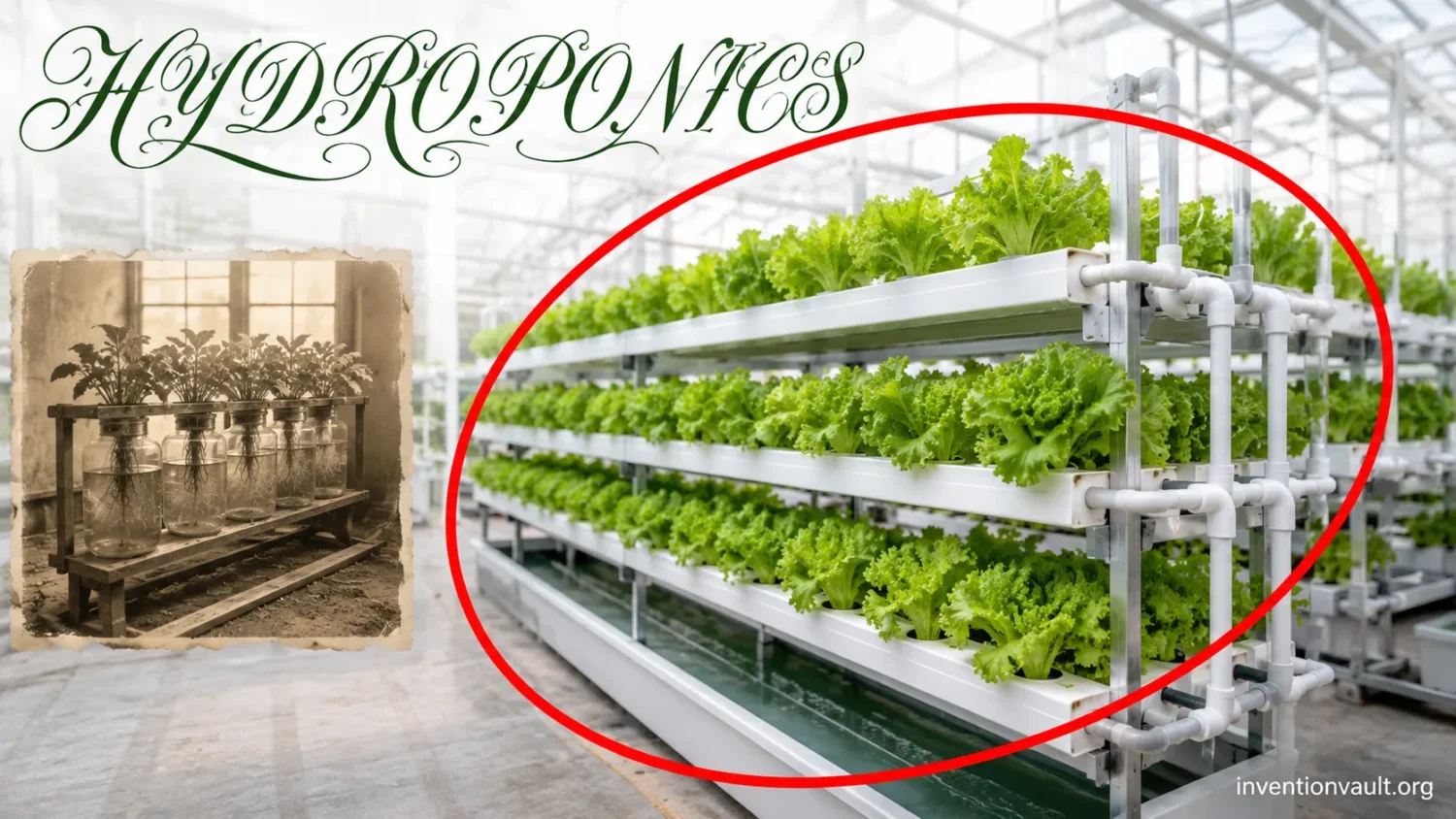
| Basic Meaning | Growing plants without soil by supplying water, oxygen, and dissolved mineral nutrients directly to the roots. |
| Main Inventive Idea | Controlled plant nutrition outside soil, not simply “plants in water.” |
| Modern Name Popularized By | William Frederick Gericke, University of California plant physiologist, in the 1930s. |
| Scientific Roots | Water-culture experiments by John Woodward in 1699; mineral-nutrient solution work by Julius von Sachs and Wilhelm Knop in the mid-19th century. |
| Named in Scientific Literature | Gericke’s article Hydroponics—Crop Production in Liquid Culture Media appeared in Science in 1937. |
| Related Term | The word combines Greek roots linked to water and labor. |
| Common System Families | Deep water culture, nutrient film technique, ebb and flow, drip systems, wick systems, Dutch bucket systems, substrate culture, and aeroponics. |
| Typical Crops | Lettuce, basil, leafy greens, herbs, tomatoes, peppers, cucumbers, strawberries, and ornamental plants. |
| Main Technical Controls | pH, electrical conductivity, dissolved oxygen, water temperature, nutrient balance, light, humidity, and root support. |
| Modern Use | Greenhouses, indoor farms, vertical farms, research labs, space-crop studies, small home systems, and water-conscious food production. |
Hydroponics is often described as growing plants in water. That is true, but it is too small. The real invention is the ability to separate plant growth from soil and give roots a measured supply of water, minerals, and oxygen. Once growers learned that roots do not need soil itself, they could design farms around the needs of the plant rather than the limits of the ground beneath it.
Important distinction: hydroponics was not born in one dramatic moment. It grew from laboratory water-culture experiments, plant-nutrition science, and Gericke’s push to turn a research method into a practical crop-production system.
What Hydroponics Actually Invented
Soil does many jobs at once. It holds roots upright, stores water, contains minerals, hosts microbes, buffers pH, and gives roots air spaces. Hydroponics takes those jobs apart. A grower can use one material for root support, a separate reservoir for nutrients, pumps or air stones for oxygen, and sensors or tests to manage the chemistry.
This is why hydroponics belongs in the history of invention. It did not invent plant growth. It invented a more controlled way to deliver the conditions that plants require. Soil became optional. Measurement became central.
Before Hydroponics
- Plant nutrition was tied to soil.
- Crop growth depended heavily on local ground conditions.
- Researchers could not easily isolate one mineral at a time.
- Root-zone chemistry stayed difficult to measure.
After Hydroponics
- Roots could grow in a known nutrient solution.
- Growers could test and adjust water chemistry.
- Plant nutrition became easier to study.
- Food production could move into greenhouses, rooftops, indoor farms, and closed environments.
Who Invented Hydroponics?
The clean answer is this: William Frederick Gericke is the name most closely linked with modern hydroponics, especially the word itself and its public use for crop production. The fuller answer is more interesting. Hydroponics has several parents.
John Woodward’s 1699 spearmint experiments showed that plants in water were not all behaving the same way. The difference came from what the water carried. Later, in the mid-19th century, Julius von Sachs and Wilhelm Knop helped turn water culture into a serious plant-nutrition method by showing that plants could grow when essential mineral elements were supplied in solution.
Gericke entered at a different point. He did not merely ask whether plants could grow without soil. He asked whether commercial crops could be grown that way. In 1937, his Science article gave hydroponics a modern public identity. His 1940 book, The Complete Guide to Soilless Gardening, pushed the idea beyond the laboratory bench.
Hydroponics is better understood as a chain of invention: early water culture proved the possibility, mineral-nutrient science explained the mechanism, and Gericke helped turn the method into a named crop-production technology.
Development Timeline
| Period | Person or Group | Development | Why It Mattered |
|---|---|---|---|
| 1699 | John Woodward | Published water-culture experiments with spearmint. | Helped show that dissolved matter in water affected plant growth. |
| Mid-19th Century | Julius von Sachs and Wilhelm Knop | Advanced mineral-nutrient solution work for plants. | Moved soilless growth from curiosity to plant-nutrition science. |
| Late 1920s to 1930s | William F. Gericke | Promoted soil-free crop production using nutrient solutions. | Linked laboratory water culture with practical farming. |
| 1937 | Gericke and academic colleagues | The term hydroponics appeared in scientific discussion of crop production in liquid culture media. | Gave the method a name that the public and growers could use. |
| 1938 and 1950 | D. R. Hoagland and D. I. Arnon | Published and revised The Water-Culture Method for Growing Plants Without Soil. | Helped standardize research methods and nutrient-solution practice. |
| Late 20th Century | Greenhouse and research growers | Expanded use of rockwool, perlite, coir, drip systems, and controlled environments. | Made hydroponics more adaptable for fruiting crops, leafy greens, and ornamentals. |
| 21st Century | Greenhouses, indoor farms, and space-crop researchers | Use hydroponics with sensors, LED lighting, vertical layouts, and closed-loop water management. | Connected the invention to urban food production, water-saving systems, and controlled environment agriculture. |
How Hydroponics Works
A hydroponic system has one basic task: keep roots supplied with the right balance of water, nutrients, oxygen, and support. The plant still photosynthesizes through its leaves. It still needs light, carbon dioxide, and the right temperature range. The difference sits below the stem.
In soil, roots search through a mixed environment. In hydroponics, roots meet a prepared solution. That solution contains mineral elements such as nitrogen, phosphorus, potassium, calcium, magnesium, sulfur, iron, manganese, zinc, boron, copper, molybdenum, and chlorine in plant-available forms. The exact recipe changes by crop, growth stage, water source, and system design.
A simple hydroponic setup may use a container, water, nutrients, a support medium, and an air pump. A commercial greenhouse may add dosing equipment, reservoirs, filters, sensors, backup power, climate control, and automated irrigation. The principle stays the same. Roots receive a managed environment instead of a hidden one.
The Four Core Parts
- Reservoir: stores the nutrient solution.
- Root zone: holds or exposes the roots, depending on the system.
- Delivery method: moves the solution by wick, pump, flow channel, drip line, spray, or passive water contact.
- Support medium: may include rockwool, coconut coir, expanded clay, perlite, vermiculite, or no medium at all.
Soilless does not always mean medium-free. Many hydroponic systems use inert or low-nutrient materials to hold roots in place. The nutrients still come mainly from the solution, not from the medium.
Main Types of Hydroponic Systems
The word hydroponics covers several designs. Some are passive and simple. Others depend on pumps, channels, timers, sprayers, and constant monitoring. The right system depends on the crop, the scale, the climate, the grower’s skill, and the tolerance for mechanical risk.
| System Type | How It Works | Works Well With | Main Limit |
|---|---|---|---|
| Deep Water Culture | Roots hang in an aerated nutrient solution. | Lettuce, herbs, leafy greens. | Needs enough oxygen in the water. |
| Nutrient Film Technique | A shallow moving film of solution flows along channels. | Leafy greens and smaller herbs. | Roots can dry fast if flow stops. |
| Ebb and Flow | A tray floods with solution and drains back to a reservoir. | Plants in clay pebbles, perlite mixes, or other media. | Depends on pump timing and drainage. |
| Drip System | Emitters deliver solution to the base of each plant. | Tomatoes, peppers, cucumbers, strawberries, larger crops. | Emitters can clog if filtration and maintenance are weak. |
| Wick System | Wicks move solution upward by capillary action. | Small herbs and low-demand plants. | Too slow for heavy-feeding or fast-growing crops. |
| Dutch Bucket | Individual buckets hold media; drip lines feed each plant and drain excess solution. | Tomatoes, cucumbers, peppers, and vining crops. | Requires support, pruning, and careful irrigation balance. |
| Aeroponics | Roots hang in air and receive misted nutrient solution. | Propagation, research, leafy crops, some high-control systems. | Nozzles and pumps must work reliably. |
| Substrate Culture | Roots grow in media such as rockwool, coir, perlite, or mineral wool while nutrient solution is applied. | Greenhouse fruiting crops and many ornamentals. | Media choice affects water holding, aeration, and disposal. |
The Nutrient Solution Is the Real Engine
The most overlooked part of hydroponics is not the plastic channel or the tower shape. It is the nutrient solution. A good solution must carry the right minerals, at the right strength, in a form roots can take up. Too weak, and plants show deficiency. Too strong, and roots may struggle to draw water. The grower is not only watering plants; the grower is managing a small chemical environment.
This is why pH and electrical conductivity matter so much. pH affects whether mineral elements stay available to roots. Electrical conductivity gives a practical reading of dissolved salts in the solution. Neither number tells the whole story, but both give growers a fast way to see whether the root zone is moving out of range.
| Variable | What It Means | Why It Matters |
|---|---|---|
| pH | Acidity or alkalinity of the nutrient solution. | Many soilless solutions are managed near pH 5 to 6 so nutrients remain available to roots. |
| Electrical Conductivity | A reading linked to the total dissolved salts in the solution. | Helps growers judge whether the nutrient solution is too weak or too concentrated. |
| Dissolved Oxygen | Oxygen available in the water around the roots. | Roots need oxygen for respiration; stagnant water can stress plants. |
| Water Temperature | Temperature of the root-zone solution. | Affects oxygen levels, root activity, and the speed of plant uptake. |
| Alkalinity | The water’s capacity to push pH upward, often linked to bicarbonates. | High-alkalinity water can make pH drift and require closer testing. |
| Nutrient Ratio | The balance among nitrogen, potassium, calcium, magnesium, and trace elements. | Crops need different ratios by species and growth stage. |
| Light | Natural sunlight or artificial lighting for leaf growth. | No nutrient solution can replace light; indoor systems often spend heavily on lighting. |
Why Hydroponics Became Useful
Hydroponics became useful because it solved several practical problems at once. It allowed researchers to study plant nutrition without the noise of soil. It gave growers a way to produce crops where soil was poor, scarce, contaminated, or simply unavailable. It also made crop production easier to place inside greenhouses and controlled environments.
The method has a natural fit with lettuce, herbs, basil, microgreens, and other fast-cycle crops because these plants can grow with compact roots and short production times. Fruiting crops such as tomatoes, peppers, cucumbers, and strawberries also grow hydroponically, but they require more support, pruning, pollination planning, and long-term nutrient management.
Research Value
Hydroponics lets scientists isolate nutrients, test deficiencies, and observe roots in a controlled way. That made it a major tool in plant physiology.
Production Value
Hydroponics can support year-round crop production in greenhouses and indoor farms, especially when climate, water, and light are managed well.
Water Value
Closed hydroponic systems can recirculate nutrient solution, which reduces discharge and can cut water loss when the system is designed and maintained well.
Open and Closed Hydroponic Systems
One important divide is often missed: some hydroponic systems are open, while others are closed. In an open system, nutrient solution drains away after it passes through the root zone. In a closed system, the solution returns to the reservoir and is reused.
Closed systems can save water and reduce fertilizer discharge, but they require more monitoring. As plants take up water and minerals at different rates, the reservoir changes. The solution may need testing, adjustment, dilution, or replacement. A closed loop is not a “set and forget” machine; it is a living root-zone system that changes every day.
| Design | Nutrient Flow | Main Strength | Main Trade-Off |
|---|---|---|---|
| Open Hydroponics | Solution is applied once and not reused. | Easier nutrient consistency at each irrigation event. | More water and fertilizer may be lost unless runoff is managed. |
| Closed Hydroponics | Solution returns to the reservoir and recirculates. | Can reduce water use and nutrient discharge. | Requires testing because salts, pH, and nutrient ratios change over time. |
| Passive Closed Systems | Water stays in a container or moves by wick action. | Simple, low-energy design for small crops. | Limited for larger or heavy-feeding plants. |
| Active Closed Systems | Pumps move solution through channels, buckets, trays, or sprayers. | Good control at larger scale. | Mechanical failure can affect roots quickly. |
Hydroponics and Vertical Farming
Hydroponics helped make vertical farming possible because roots no longer needed deep soil beds. Crops could grow in stacked layers, channels, towers, trays, and shallow benches. This changed the shape of farming. A crop area no longer had to be flat, outdoor, and soil-based.
Modern controlled environment agriculture often combines hydroponics with LED lighting, climate control, sensors, and automation. USDA researchers describe vertical farming as indoor production in stacked layers using methods such as hydroponics, aquaponics, and other soilless systems. They also note an honest limit: artificial lighting and climate control can cost a lot of energy.
That balanced view matters. Hydroponics can save water and land in many settings, yet it is not automatically low-impact. The energy source, building design, crop choice, local climate, and distribution distance all affect the final result. A greenhouse tomato crop and a stacked indoor lettuce farm may both use hydroponics, but their technical demands are not the same.
Common myth: hydroponics does not make every crop faster, cheaper, or greener by default. It gives growers more control. Control only helps when the system is designed, monitored, and powered responsibly.
Hydroponics in Space Research
Hydroponics also became useful in space-related plant research because soil is heavy, messy, and hard to manage in closed spacecraft environments. NASA has studied plant growth as part of closed ecological life-support ideas, where plants may help provide food, recycle materials, and remove carbon dioxide in controlled settings.
The same logic later influenced indoor farming. The goal was not simply to grow plants indoors; it was to understand how plants behave when light, root-zone water, nutrients, air, and space are tightly managed. Hydroponics fits that research because it makes the root environment easier to control than soil.
Crops That Fit Hydroponics
Hydroponics works well when the crop matches the system. Short-cycle leafy greens are popular because they grow quickly, need less physical support, and fit channels or floating rafts. Herbs fit small systems because they have strong market demand and compact root zones. Fruiting crops can produce well, but they ask for more structure and skill.
| Crop Group | Examples | Helpful System Traits | Notes |
|---|---|---|---|
| Leafy Greens | Lettuce, spinach, pak choi, arugula. | Shallow channels, rafts, or deep water culture. | Often used in commercial hydroponics because crop cycles are short. |
| Herbs | Basil, mint, parsley, cilantro. | Good light, stable moisture, clean harvest handling. | Basil is a common teaching crop because it responds visibly to root-zone conditions. |
| Fruiting Vegetables | Tomatoes, peppers, cucumbers. | Drip irrigation, substrate culture, trellising, pruning support. | Longer crops need closer nutrient and structural management. |
| Small Fruits | Strawberries. | Drip-fed substrate, troughs, or vertical systems with careful moisture control. | Flowering and fruit quality depend on climate and pollination planning. |
| Ornamentals | Roses, foliage plants, freesia. | Media-based systems and greenhouse climate control. | Hydroponics is not limited to food crops. |
Hydroponics, Aeroponics, and Aquaponics
Several soilless methods are often mixed together. They are related, but they are not identical. Hydroponics uses a prepared nutrient solution. Aeroponics exposes roots to air and feeds them with a mist. Aquaponics joins plant production with aquaculture, using fish waste that bacteria convert into plant-available nutrients.
The difference matters because each method has its own risks. A hydroponic reservoir must keep nutrient ratios in range. Aeroponic roots can suffer quickly if misting stops. Aquaponics must protect plants, fish, and beneficial bacteria at the same time. They all avoid soil, but they do not solve the same engineering problem.
| Method | Nutrient Source | Root Environment | Main Control Challenge |
|---|---|---|---|
| Hydroponics | Prepared mineral nutrient solution. | Water, moist substrate, channels, buckets, trays, or rafts. | pH, EC, oxygen, nutrient balance, and water quality. |
| Aeroponics | Misted nutrient solution. | Roots hang in air. | Nozzle reliability, mist timing, and root drying risk. |
| Aquaponics | Nutrients from aquaculture waste converted by bacteria. | Usually hydroponic-style beds, rafts, or media. | Balancing fish health, bacteria, plant uptake, and water chemistry. |
| Soilless Substrate Culture | Usually prepared nutrient solution. | Roots grow in coir, rockwool, perlite, peat blends, or other media. | Water-holding capacity, drainage, salinity, and media reuse or disposal. |
Materials and Growing Media
Hydroponics can use no solid medium, but many systems do. The medium gives roots support and helps manage moisture and air. It should not decompose too fast, compact too tightly, or release unpredictable nutrients. Growers choose media based on crop weight, irrigation style, drainage, cost, handling, and disposal.
Common materials include rockwool, coconut coir, expanded clay, perlite, vermiculite, peat-based mixes, sand, and mineral wool. Each material changes the root zone. Coir holds water well. Perlite improves air space. Rockwool can offer uniformity in greenhouse production. Expanded clay drains quickly and is easy to handle in many small systems.
What Hydroponics Changed in Agriculture
Hydroponics changed agriculture by moving part of farming from field knowledge into controlled design. Growers still need skill, observation, and crop experience, but the system gives them direct access to variables that soil often hides.
- Root-zone control: nutrients, pH, oxygen, and moisture can be tested and adjusted.
- Location flexibility: production can move into greenhouses, rooftops, containers, warehouses, and research chambers.
- Water recirculation: closed systems can reuse solution and reduce discharge.
- Faster feedback: nutrient or pH mistakes may show quickly, which helps research but also demands attention.
- Cleaner separation: root support, nutrition, irrigation, and environment can be designed as separate parts.
That separation is the quiet genius of hydroponics. A farmer working in soil improves the whole field. A hydroponic grower improves the root-zone recipe, flow, oxygen, media, light, and climate. Both methods require knowledge. They simply place the grower’s attention in different places.
Limits of Hydroponics
Hydroponics has real limits, and honest history should include them. A pump failure, blocked emitter, wrong pH reading, warm reservoir, poor sanitation, or power outage can affect plants quickly. Soil buffers mistakes. Hydroponics often exposes them.
The method also shifts cost. Instead of preparing soil, a grower may pay for reservoirs, pumps, channels, lighting, media, sensors, water testing, nutrients, filters, and climate control. In outdoor soil farming, sunlight is free. In indoor hydroponics, light may become one of the largest operating costs.
Technical caution: hydroponic systems reward precision. They also punish neglect faster than many soil systems. The invention gives control, not immunity from plant stress.
Why the Invention Still Matters
Hydroponics remains relevant because water, land, labor, and reliable local food supply shape modern crop production. The invention does not replace all soil farming, and it should not be treated as a universal solution. Its value is more specific: it allows plants to grow where soil is absent, unsuitable, or less practical, and it gives researchers and growers direct control over root nutrition.
That makes hydroponics one of the most practical agricultural inventions of the last few centuries. It began as plant science. It became a production method. Today it sits inside greenhouse farming, vertical farming, small home systems, laboratory research, and space-crop experiments. The method’s lasting idea is simple and bold: when roots receive what they need, soil is no longer the only place a plant can live.
Terms Often Confused With Hydroponics
| Term | Plain Meaning | How It Relates to Hydroponics |
|---|---|---|
| Soilless Culture | Growing plants without field soil. | Hydroponics is one major form of soilless culture. |
| Water Culture | Growing roots in water or nutrient solution. | An older research term closely tied to hydroponic history. |
| Controlled Environment Agriculture | Growing crops inside managed environments. | Often uses hydroponics, but also includes lighting, climate, and automation. |
| Vertical Farming | Growing crops in stacked layers. | Often uses hydroponics because soil is heavy and hard to stack efficiently. |
| Hydroculture | A broad term for growing plants in water-based systems. | Sometimes used for ornamental houseplants; not always the same as crop hydroponics. |
| Aquaponics | Plant production linked with fish or aquatic animal systems. | Related to hydroponics, but nutrient management depends on biology as well as minerals. |
References Used for This Article
- PubMed — Hydroponics: Crop Production in Liquid Culture Media: Supports the 1937 Gericke publication and the modern naming of hydroponics.
- Internet Archive — The Water-Culture Method for Growing Plants Without Soil: Supports the role of Hoagland and Arnon in standardizing water-culture methods.
- Internet Archive — The Complete Guide to Soilless Gardening: Supports Gericke’s 1940 book and the public spread of soilless gardening.
- Oklahoma State University Extension — Hydroponics: Supports the definition, Greek roots, crops, and basic system types.
- Oklahoma State University Extension — Electrical Conductivity and pH Guide for Hydroponics: Supports pH, EC, alkalinity, and nutrient-solution management details.
- University of Minnesota Extension — Small-Scale Hydroponics: Supports system descriptions such as ebb and flow, nutrient film technique, and drip systems.
- New Mexico State University — Hydroponics: Water-Saving Farming for New Mexico’s Arid Environment: Supports closed-system water reuse and reduced nutrient discharge.
- USDA Agricultural Research Service — Vertical Farming: No Longer a Futuristic Concept: Supports the link between hydroponics, vertical farming, land use, and energy limits.
- NASA — NASA Research Launches a New Generation of Indoor Farming: Supports the connection between plant-growth research, closed environments, and indoor farming.