
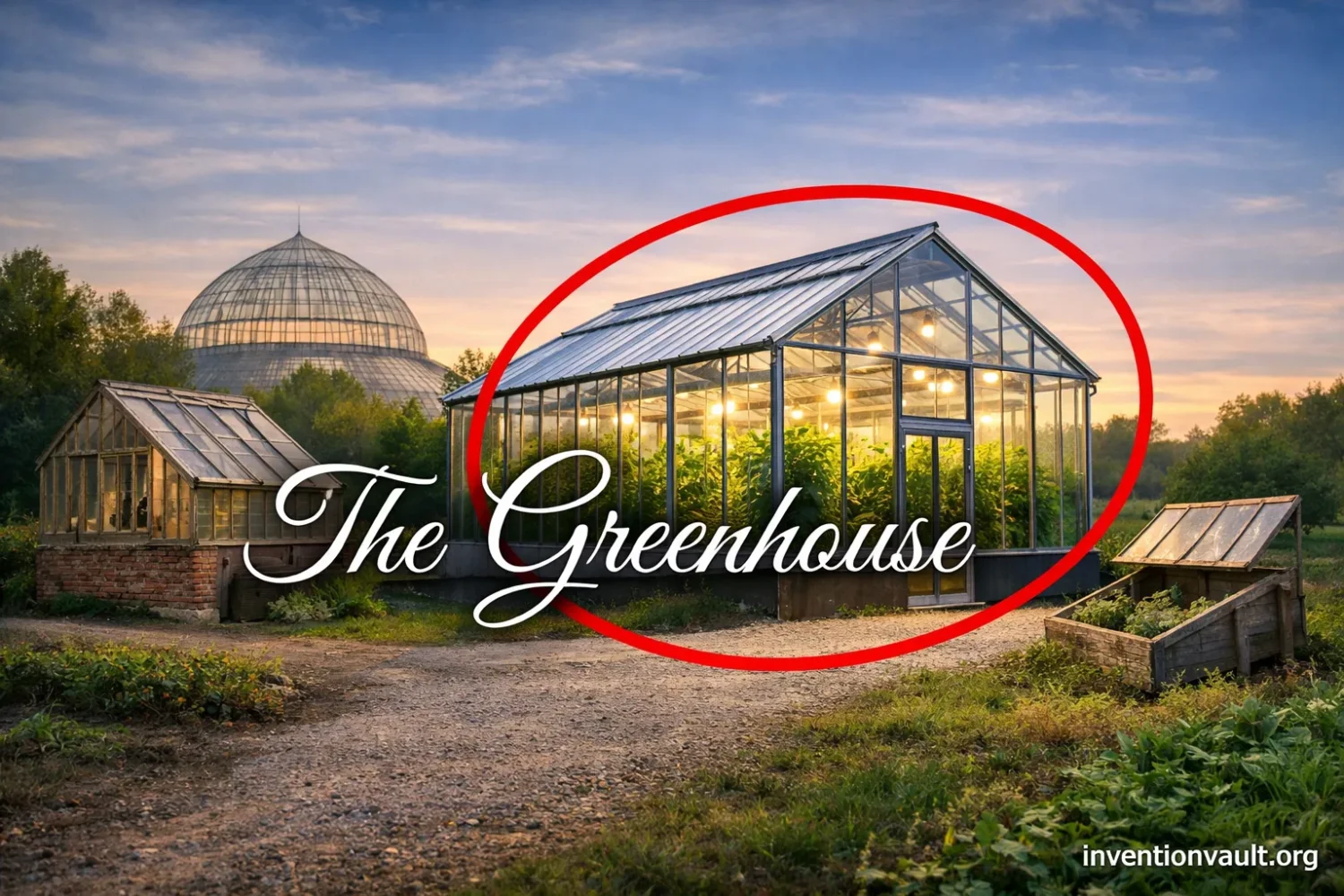
| Aspect | Details |
|---|---|
| Invention | The greenhouse, also known in related forms as a glasshouse, hothouse, conservatory, or orangery. |
| Single Inventor | No single inventor is known. The greenhouse emerged through many linked advances in horticulture, materials, heating, and building design. |
| Earliest Recorded Predecessor | Roman specularia described in the 1st century CE, used to protect tender crops for year-round cultivation. |
| Early Materials | Wooden frames, translucent coverings such as lapis specularis or other light-admitting covers, and later glazed windows. |
| Early Purpose | To keep warmth around valuable plants, extend the growing season, and make delicate fruit, vegetables, and medicinal plants easier to raise outside their normal climate. |
| Renaissance Development | Italian botanic gardens and plant shelters turned the idea into a more settled structure for study, preservation, and cultivation. |
| 17th-18th Century Shift | European orangeries and heated hothouses introduced large south-facing windows, glazed roofs, flues, and later hot-water heating. |
| 19th-Century Leap | Iron ribs, larger panes of glass, and better heating produced vast houses such as the Palm House at Kew and other Victorian glasshouses. |
| Related Invention | The Wardian case (1829) functioned as a portable miniature greenhouse for long-distance plant transport. |
| Scientific Role | Greenhouses supported botanical study, plant exchange, acclimatization, seedling propagation, and the keeping of living collections. |
| Modern Descendants | Commercial glasshouses, polyhouses, polytunnels, solar greenhouses, research houses, and sensor-managed controlled-environment systems. |
| Present-Day Relevance | In official U.S. data for 2024, horticulture operations reported $18.3 billion in sales, including $1.01 billion in food crops grown under protection. |
The greenhouse was not born in one workshop, and it did not arrive with one clean patent-like moment. It grew out of a practical question that gardeners, physicians, estate owners, and botanists kept asking for centuries: how can a plant be given warmth, light, and shelter when the season or the local climate refuses to cooperate? The answer changed shape over time. Roman crop shelters, Renaissance botanic gardens, masonry orangeries, heated hothouses, iron-and-glass houses, and modern commercial structures all belong to the same long chain of invention.
How the Greenhouse Began
Among the earliest recorded forerunners were the Roman specularia. Ancient writers describe protected growing spaces used for tender crops linked to Emperor Tiberius. Many popular articles reduce that story to “the Romans built a greenhouse for cucumbers,” but the ancient term cucumis is treated more carefully by modern historians. What matters most is the method, not the grocery label. The Romans had grasped the core principle: if you admit light and trap useful heat around a plant, you can stretch the calendar.
That point deserves emphasis because the greenhouse is often described as if somebody “invented it” in a later European court. The record does not support that simplified version. What we see instead is a layered invention. One culture develops protected beds. Another improves coverings. Another improves heating. Another makes larger panes of glass affordable. Another turns the structure into a scientific workplace. The greenhouse is a slow-built machine for climate control.
The greenhouse was a long experiment in holding light, heat, air, and moisture around a living plant with more precision than the open field allows.
Why Gardeners Needed It
Climate and Season
The first need was simple. Winter killed or stalled tender plants. A protected structure could keep frost off leaves, preserve fruit trees, and lengthen the season for crops that demanded more warmth than local weather would offer. Even a modest rise in temperature could decide whether a plant merely survived or actually grew.
Study, Collection, and Display
A second need came from medicine and botany. Renaissance scholars and garden keepers wanted living access to unfamiliar species. Plant shelters let them raise, observe, compare, and preserve specimens that would fail outdoors. That scientific use is often underplayed, yet it shaped the greenhouse just as much as luxury gardening did.
Once overseas plant collecting grew, the greenhouse became more than a winter refuge. It became a place where climate itself could be edited. Citrus, figs, grapes, pineapples, palms, orchids, and medicinal plants all pushed the structure forward. Each demanding plant forced a fresh technical answer.
How the Structure Changed
- Roman shelters established the idea of protected cultivation under transparent coverings.
- Italian botanical gardens gave plant protection a scholarly and institutional setting.
- European orangeries used thick walls and broad south-facing windows to overwinter citrus and other tender plants.
- Heated hothouses added flues, then steam and hot-water systems, allowing warmer interiors and longer growing periods.
- Victorian iron-and-glass houses expanded scale, light intake, and architectural ambition.
- Plastic-covered commercial houses lowered cost and widened access in the 20th century.
From Masonry Rooms to True Glasshouses
The orangery sits at the center of this story. It was not yet the fully glazed greenhouse most people imagine today. Early examples were more solidly built, often with masonry walls and large windows facing the sun. Plants were commonly kept in tubs and moved in and out with the season. This matters because many modern summaries blur the line between an orangery and a full glasshouse, even though the difference tells us how the invention matured.
By the 17th and 18th centuries, growers wanted stronger light and better temperature control. Roof glazing became more common. Heat moved from rough flues to more dependable systems. Pineapples and grapes were especially influential here. They were not decorative side stories. They pushed builders toward hotter, brighter, more carefully managed interiors.
Iron, Glass, and the Victorian Leap
During the 19th century, the greenhouse changed again. Better ironwork and larger sheets of glass allowed lighter frames and wider spans. The result was not just a better garden building. It was a new kind of architecture. Kew’s Palm House, begun in 1844, showed what became possible when horticulture, engineering, and industrial manufacturing met in one structure. The greenhouse stopped looking like a modified room and started looking like a purpose-built climate machine.
That shift also fed later public architecture. Long before glass office towers, greenhouse builders were solving problems of span, daylight, condensation, ventilation, and heat. In that sense, the greenhouse belongs to architectural history as much as it belongs to garden history.
The Wardian Case and the Portable Greenhouse
One of the most overlooked chapters in greenhouse history is the Wardian case, invented by Nathaniel Bagshaw Ward in 1829. It was, in effect, a portable greenhouse.
Ward noticed that plants could thrive inside a sealed glass space where moisture condensed and returned to the soil. That observation led to wood-and-glass cases that protected live plants during long sea voyages. Before this, many specimens died from salt spray, poor light, and irregular watering. The Wardian case solved that transport problem with elegant simplicity.
This small invention belongs in any serious history of the greenhouse because it carried greenhouse logic beyond the garden wall. It made long-distance botanical exchange far more reliable. Kew used Wardian cases regularly by the 1840s. Arboreta, botanic gardens, and growers used them as moving nurseries. A greenhouse no longer had to stay fixed to one site; it could travel.
That development also shows why the greenhouse should not be treated as a mere building type. It is a system of environmental control. Put that system in a palace garden, a research house, or a sealed transport box, and the underlying invention remains the same.
Forms That Grew Out of the Invention
| Form | Main Use | Typical Features |
|---|---|---|
| Orangery | Winter shelter for citrus and other tender plants | Solid walls, tall south-facing windows, movable tubs, restrained roof glazing |
| Hothouse | Warmer cultivation for demanding species | Added heating, closer climate control, stronger emphasis on temperature |
| Vinery or Pinery | Fruit production under shelter | High light demand, heated interiors, specialized management for grapes or pineapples |
| Palm House | Large tropical collections and public display | Iron and glass, tall spans, humid interiors, architectural drama |
| Lean-To Greenhouse | Heat-saving cultivation beside a wall or building | One glazed face, shared wall mass, efficient use of limited space |
| Commercial Glasshouse | Market production of vegetables, flowers, and seedlings | Regular bays, ventilation systems, benches or growing beds, scalable layouts |
| Polyhouse or Polytunnel | Lower-cost protected cultivation | Plastic film covering, simpler structure, fast deployment, broad farm use |
| Solar Greenhouse | Passive heat capture with lower energy demand | Orientation for winter sun, insulated surfaces, heat-storing mass |
| High-Tech Greenhouse | Precise year-round production | Sensors, climate control, screens, drip irrigation, supplemental lighting where needed |
What the Greenhouse Changed
Food and Horticulture
The greenhouse widened the menu and the market. It allowed seedlings to start earlier, fruit to ripen beyond local limits, and flowers to be produced with more control. Over time it moved from aristocratic estates into nurseries, botanic gardens, and commercial farming.
Science and Living Collections
It also changed how people studied plants. A dried herbarium sheet can preserve form. A greenhouse preserves life. That difference mattered to botany, plant breeding, propagation, and public education. Rare species could be kept alive, not merely recorded.
Architecture changed as well. Builders who designed large glasshouses had to think seriously about condensation, solar gain, air exchange, structural weight, and repair. Those lessons did not stay inside the garden. They moved outward into later public and urban building design.
Why the Invention Still Matters
Modern greenhouses may use glass, plastic film, or other light-admitting coverings, yet the old aim remains familiar: create a controlled growing environment without giving up the energy of sunlight. Sensors, vents, screens, irrigation lines, and data systems make today’s houses more exact, but they still depend on the same old grammar of light, heat, moisture, and airflow.
Official U.S. figures released in 2026 for the 2024 season show how far that invention has traveled. Horticulture operations reported $18.3 billion in sales, and food crops under protection accounted for $1.01 billion. Those numbers belong to a very modern industry, yet they rest on an idea that gardeners began testing many centuries ago: a plant does not have to accept the raw climate it is given.
So the invention of the greenhouse is best understood not as one event, but as a long sequence of refinements. Roman shelters supplied the first recorded model. Botanic gardens made plant protection a scholarly tool. Orangeries and hothouses improved winter survival. Iron-and-glass construction opened new scale. The Wardian case made the greenhouse portable. Commercial houses and poly-covered structures brought protected cultivation to a wider public. Each stage kept the old objective and improved the method.
References Used for This Article
- American Society for Horticultural Science — History of Controlled Environment Horticulture: Ancient Origins: Used for early recorded plant shelters and Roman protected cultivation.
- National Trust — Glasshouse, Orangery & Garden Shed History: Used for the shift from orangery to heated glasshouse in Britain.
- University of Vermont Extension — Speculating on the History of Greenhouses: Used for the Roman specularia tradition and later historical milestones.
- Uppsala University — The Orangery Linneanum: Used for the role and survival of the orangery form in university botanic culture.
- Royal Botanic Gardens, Kew — Palm House: Used for the 19th-century leap to large iron-and-glass structures.
- Arnold Arboretum of Harvard University — The Wardian Case: How a Simple Box Moved the Plant Kingdom: Used for the portable greenhouse idea and plant transport history.
- USDA National Agricultural Statistics Service — U.S. Horticulture Operations Report $18.3 Billion in Sales: Used for recent official figures on horticulture and crops grown under protection.