
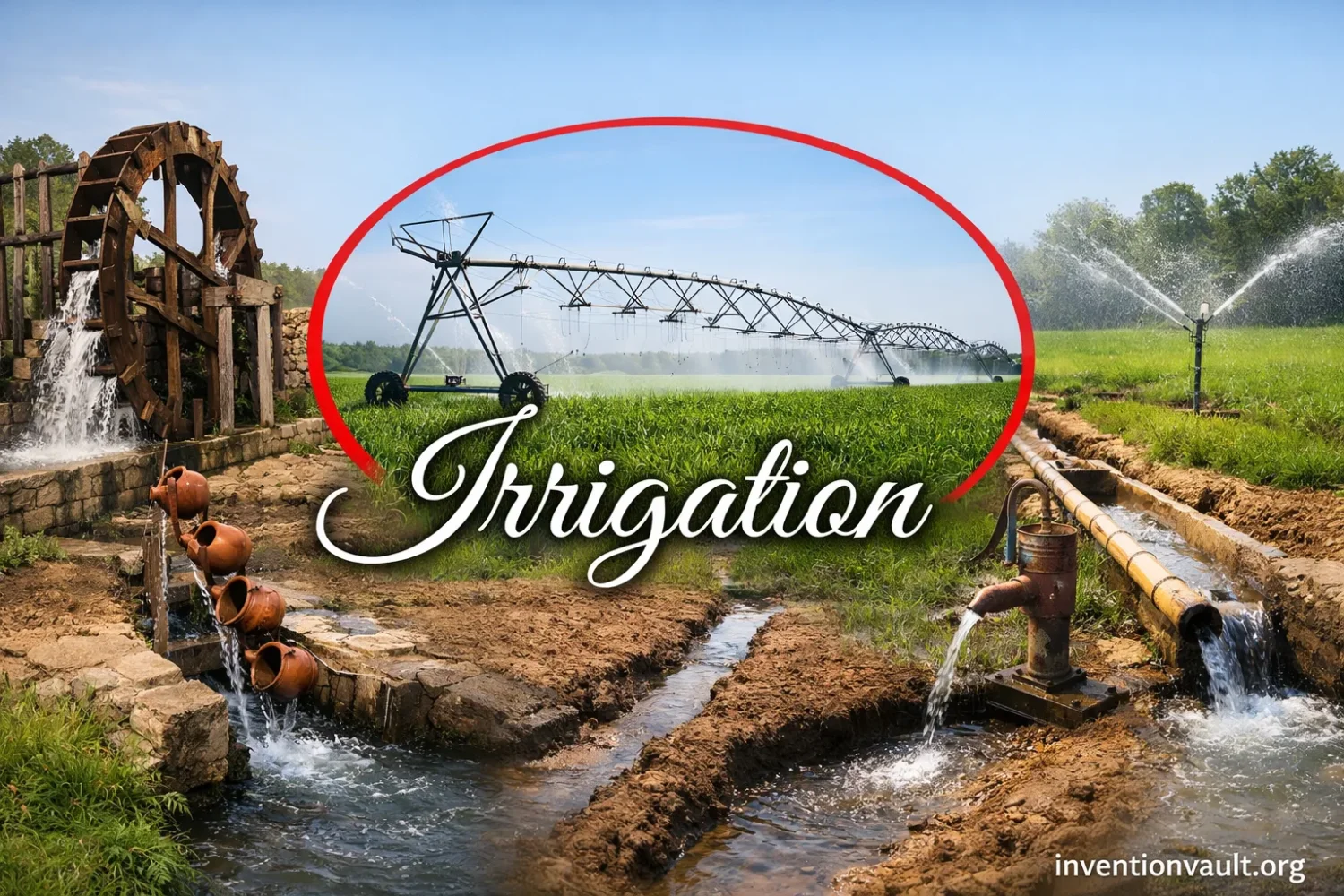
| Aspect | Details |
|---|---|
| What Irrigation Is | The deliberate control, movement, storage, or lifting of water so crops can grow beyond the limits of local rainfall. |
| Single Inventor | None known. Irrigation emerged in more than one region as farmers learned to guide river water, floodwater, springs, and groundwater. |
| Earliest Known Canal Evidence | Archaeological evidence points to canal irrigation in late 6th-millennium BCE Mesopotamia, especially at Choga Mami. |
| Early Civilizations Linked to Irrigation | Mesopotamia, Egypt, ancient Iran, the Indus region, early Chinese states, and later societies in the Andes and arid parts of the Americas. |
| Core Engineering Problem | Move water far enough to reach fields, slow it down so it can soak the soil, and remove excess water before it damages land. |
| Main Early Methods | Basin irrigation, diversion canals, levees, dikes, field channels, water-lifting devices, and underground gallery systems such as qanats. |
| Important Later Branches | Sprinkler systems, center-pivot irrigation, drip irrigation, and subsurface drip irrigation. |
| Crops Commonly Supported | Barley, wheat, flax, rice, vegetables, orchard crops, and later large-scale field crops in dry farming regions. |
| Why It Mattered | It stabilized harvests, supported larger settlements, widened the map of farming, and turned water management into a permanent civic task. |
| Persistent Design Risks | Salinity, waterlogging, silt build-up, broken canals, uneven water sharing, and high labor demands. |
| Why It Still Matters | Agriculture uses a large share of global freshwater withdrawals, and irrigated land still delivers a striking share of total crop output. |
Irrigation was not born as one machine, one patent, or one person’s idea. It grew out of a simple pressure that many farming societies faced at different times: rainfall did not arrive when crops needed it. Farmers answered that problem with channels, basins, lifting tools, tunnels, gates, and later with sprinklers and emitters. The invention of irrigation, then, is best understood as a long chain of water-control ideas rather than a single event.
Three Ideas That Clarify the Story
- No single inventor can be named with confidence.
- Irrigation never meant only canals; it also meant timing, lifting, drainage, and distribution.
- Systems lasted when communities matched design to slope, soil, flood rhythm, and groundwater.
Why the Invention Kept Changing
Every landscape asked a different question. River plains needed flood control. Dry uplands needed water lifting. Desert margins needed low-evaporation transport. Modern farms needed labor-saving distribution across large fields. Each answer added another branch to the same invention.
Earliest Origins and the Absence of a Single Inventor
The oldest story usually begins in Mesopotamia, and for good reason. Archaeology there preserves early canal evidence tied to settled farming in dry zones. Yet the broader record does not support a narrow “one birthplace, one inventor” version. Water control appeared where farmers had to stretch a flood, divert a stream, trap seasonal water, or tap groundwater without losing too much of it to heat and distance.
Mesopotamia and Early Canal Logic
In southern Mesopotamia, farming depended on learning how to divert river water over flat land without letting it drown fields or vanish into the wrong channels. That demanded more than digging a ditch. Farmers had to read gradient, place embankments, manage silt, and keep water moving at a workable pace. Early canal irrigation in this region helped make settled agriculture more dependable, and over time it supported larger villages and urban life.
That engineering habit matters. Mesopotamian irrigation was not just a means of wetting crops. It was a way of organizing labor, timing field work, and tying water access to collective maintenance. Repair was part of the invention from the start.
Egypt and the Art of Basin Irrigation
Egypt followed a different path. The Nile rose and fell with more regularity than the Tigris and Euphrates, so Egyptian irrigation leaned heavily on basin irrigation. Farmers shaped fields with earthen banks so floodwater could spread, settle, and soak the soil before planting. This method did not try to defeat the river. It worked with its seasonal rhythm.
That distinction is often missed. Canal diversion and basin impoundment solve related problems, but they are not the same design. Egypt also pushed irrigation forward through water-lifting devices such as the shaduf, which made it easier to move water from the river or a canal to a higher field edge.
Iran, the Qanat, and Underground Water Transport
In arid Iranian landscapes, open channels could waste too much water to evaporation or fail to reach the right places. The answer was the qanat: a gently sloping underground tunnel connected to vertical shafts, designed to bring groundwater to the surface by gravity. This was one of the most elegant turns in irrigation history. It did not simply carry water. It protected water while carrying it.
Qanats also tied irrigation to community rules. A tunnel of that kind demanded surveying, digging skill, long-term upkeep, and agreed sharing. In other words, the invention was social as much as technical.
Other Early Centers That Belong in the Story
- Indus settlements developed water storage and controlled distribution suited to urban and farming needs.
- Ancient China produced large hydraulic works, later including the still-famous Dujiangyan system, which guided water without a conventional dam wall across the river.
- Andean societies used canals and terraces to turn steep terrain into productive land.
- Dryland societies in the Americas built irrigation works adapted to desert or semi-dry landscapes long before modern state projects.
The history of irrigation makes more sense when it is read as many local inventions solving one recurring problem: how to put water in the right place, at the right time, in the right amount.
Main Irrigation Types and Why They Appeared
| Type | How It Worked | Where It Fit Best | What It Solved | Main Limitation |
|---|---|---|---|---|
| Basin Irrigation | Floodwater was trapped inside bounded plots. | River valleys with predictable seasonal rise. | Deep soil wetting with little lifting effort. | Depended on flood timing and careful land shaping. |
| Canal Irrigation | Water was diverted through main canals and field channels. | Flat alluvial plains. | Expanded farmland away from the main riverbank. | Silt, breaches, and unequal distribution. |
| Lift Irrigation | Water was raised with tools such as the shaduf or wheel. | Fields above river or canal level. | Reached higher ground. | High labor or animal-power demand. |
| Qanat and Similar Gallery Systems | Groundwater moved through underground tunnels by gravity. | Dry uplands and desert margins. | Reduced evaporation and extended farming into dry regions. | Surveying, digging, and upkeep were demanding. |
| Furrow and Surface Field Systems | Water flowed through shallow field channels. | Row crops and gently graded land. | Simple distribution across cultivated plots. | Runoff losses if slope was wrong. |
| Sprinkler Systems | Water was sprayed under pressure over the field. | Large modern farms with pumping capacity. | More even coverage than many surface methods. | Wind drift and evaporation. |
| Center-Pivot Irrigation | A rotating pipeline watered a circular field. | Large open farms, especially in dry plains. | Reduced labor and covered wide acreage. | Energy use and circular field geometry. |
| Drip Irrigation | Emitters delivered water near the root zone. | Water-scarce farming, orchards, vegetables, protected crops. | High water precision and reduced wetting of unused soil. | Clogging risk and higher system complexity. |
| Subsurface Drip | Drip lines were buried below the soil surface. | Permanent or repeated cropping systems. | Very low evaporation losses and targeted delivery. | Monitoring and maintenance are harder. |
Engineering Shifts That Reshaped Irrigation
Once irrigation began, it did not move in a straight line. It split into branches that answered fresh limits in land, labor, and water supply.
From Earthworks to Controlled Distribution
The first great step was not a machine. It was the shaped landscape itself: levees, basin walls, feeder channels, and outlet cuts. These features let farmers decide where floodwater should go and where it should stop. That turned seasonal uncertainty into something closer to a schedule.
Water-Lifting Devices
Lift devices changed what counted as irrigable land. A field no longer had to sit at the same level as the river or canal. The shaduf gave farmers a compact lever-based way to raise water. Wheels and related devices later improved volume and repeatability. This was a quiet but major shift: irrigation was no longer just about redirecting water; it was also about raising it.
Gravity Tunnels in Dry Country
Qanat systems solved a different problem: how to move water over distance without exposing it to punishing heat. That design choice linked irrigation to geology, not just topography. A good qanat depended on aquifer access, correct gradient, and long-term shaft maintenance. It rewarded patience and punished shortcuts.
Mechanized Sprinkling and the Center Pivot
Modern mechanized irrigation changed scale. In the mid-20th century, Frank Zybach developed the center-pivot system, first as a working prototype and then in patented form. The design let a long sprinkler line rotate around a fixed point, covering large fields with much less manual pipe moving. That design became especially influential in the Great Plains and other broad farming regions where labor, field size, and water access favored mechanization.
Drip Irrigation and the Turn Toward Precision
Modern drip irrigation, developed in practical form in the late 1950s and 1960s, pushed the invention in the opposite direction from broad spraying. Instead of covering everything, it fed water slowly near the root zone. That shift mattered in orchards, vegetables, greenhouse crops, and other systems where water cost, fertilizer control, and plant uniformity mattered. Drip did not replace earlier methods everywhere, but it redefined what efficient irrigation could look like.
One Design Rule Never Disappeared
The most durable systems did not chase maximum water movement. They aimed for controlled delivery. Ancient basin walls, qanat gradients, pivot alignment valves, and modern drip emitters all reflect the same lesson: too little water fails the crop, but too much water can damage soil, waste labor, and shorten the life of the system.
Why Irrigation Changed Settlement, Labor, and Food Production
Settlement
Irrigation let communities farm beyond the narrow strip where rain alone was dependable. Villages could stay longer in place, and some regions could support denser populations.
Labor
Canals, gates, tunnels, and wheels needed builders, cleaners, surveyors, and rules. Water control made farming more secure, but it also tied agriculture to shared work.
Crops
Irrigation widened the range of crops that could be grown and helped fields produce with more regularity. That mattered for cereals, gardens, orchard crops, and later high-value farming.
Output
Official global summaries often note that irrigated land occupies less than one-fifth of cropland yet delivers around two-fifths of food output. That ratio explains why irrigation has remained central to agricultural planning.
The Hidden Side of Irrigation: Drainage, Salt, and Water Sharing
Many histories stop at the moment water reaches the field. That leaves out one of the hardest parts of the invention. An irrigation system is only half-finished if it cannot remove excess water, manage dissolved salts, and distribute access fairly enough to keep the network functioning year after year.
- DRAINAGE: Water that stays too long can raise the water table and damage roots.
- SALINITY: In dry climates, repeated irrigation can leave salts behind as water evaporates.
- SILT: Canals need clearing or they lose capacity and break their intended flow paths.
- SHARING RULES: A technically sound system still fails if users cannot agree on turns, repairs, and upkeep.
This is why many old irrigation societies paired engineering with timekeeping, local management, and repeated maintenance. The invention was never only about abundance. It was also about restraint.
Modern Irrigation Still Carries Ancient Ideas
Today’s irrigation may use pumps, pressure regulators, remote sensors, and automated valves, yet its oldest questions remain familiar. Where should water enter the field? How fast should it move? How much should be lost to air, seepage, or runoff? What part of the soil really needs wetting? Modern systems differ in hardware, but they still revolve around control of timing, volume, elevation, and distribution.
Agriculture now accounts for about 70 percent of global freshwater withdrawals, so irrigation sits inside a larger water story than it did in early farming states. That makes old lessons newly relevant. Matching method to terrain, protecting soil health, reducing waste, and building maintenance into design are not modern add-ons. They have been part of irrigation since the beginning.
Seen that way, the invention of irrigation is not a relic from early agriculture. It is an ongoing sequence of designs, each trying to solve the same stubborn problem with a little more accuracy than the last.
References Used for This Article
- UNESCO World Heritage Centre — Mount Qingcheng and the Dujiangyan Irrigation System: Official heritage record for the long-lived Chinese irrigation system and its historical importance.
- Cambridge Core — Samarran Irrigation Agriculture at Choga Mami in Iraq: Scholarly source on early canal irrigation evidence in Mesopotamia.
- Water — Irrigation of World Agricultural Lands: Evolution through the Millennia: Review article used for chronology, Egyptian methods, and later technical branches.
- UNESCO World Heritage Centre — The Persian Qanat: Official source on qanat engineering, gravity flow, and communal water management.
- FAO — Water and One Health: Used for the global freshwater withdrawal share linked to agriculture.
- World Bank — Irrigation and Drainage Development: Source for widely cited irrigation output and cropland share figures.
- FAO — Chapter 1. Introduction: Used for drainage, waterlogging, and salinity issues tied to irrigation history.
- Google Patents — US2604359A Self-Propelled Sprinkling Irrigating Apparatus: Patent record for Frank Zybach’s center-pivot irrigation apparatus.
- National Inventors Hall of Fame — Frank Zybach: Biographical source on the center-pivot system and its later spread.
- Netafim — Israel’s ‘Invention of the Century’: Drip Irrigation Still Changing Farming Worldwide: Corporate historical note used for the modern drip irrigation branch and its 1960s development.