
| Invention Detail | Verified Information |
|---|---|
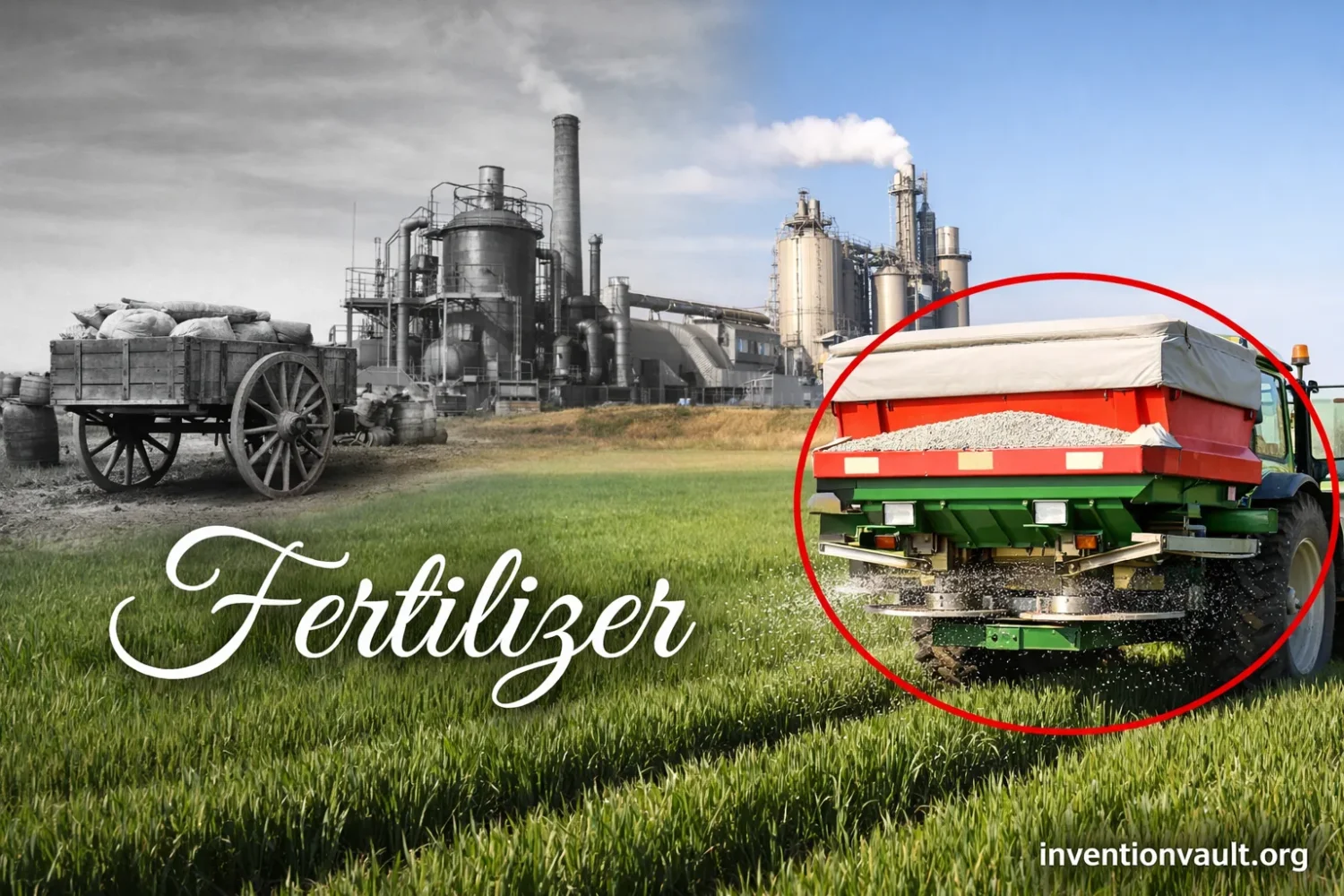
| Invention Name | Fertilizer, covering organic amendments, artificial and mineral fertilizers, and modern nutrient products. |
| Short Definition | A fertilizer is a material added to soil or growing media to supply plant nutrients. The development of artificial fertilizer turned nutrient supply into a chemical, measurable, and industrial process. |
| Was It Invented by One Person? | No. Fertilizer as a practice is older than recorded invention. Artificial fertilizer developed through agricultural chemistry, phosphate processing, mining, industrial nitrogen production, and later blending technologies. |
| Early Fertilizer Materials | Farmyard manure, composted plant matter, ash, bones, lime, seaweed, fish remains, guano, and natural mineral deposits. |
| Main 19th-Century Step | John Bennet Lawes patented a process in 1842 for making superphosphate fertilizer by treating phosphate materials chemically, helping launch the artificial fertilizer industry. |
| Scientific Shift | Plant nutrition became linked to measurable mineral nutrients, especially nitrogen, phosphorus, and potassium, rather than only to soil “richness.” |
| Synthetic Nitrogen Expansion | Industrial ammonia synthesis in the early 20th century gave fertilizer manufacturers a large new nitrogen feedstock. The invention and engineering of that process are covered in Ammonia Synthesis. |
| Major Fertilizer Families | Organic amendments, phosphate fertilizers, potash fertilizers, nitrogen fertilizers, compound NPK fertilizers, liquid fertilizers, and controlled-release products. |
| 2024 Global Production | FAO reported 216 million tonnes of inorganic fertilizer production, with nitrogen accounting for 57.7%, phosphorus 21.8%, and potassium 20.5%. |
| Current Direction | Modern work centers on nutrient-use efficiency, controlled-release products, recycled nutrient sources, and lower-emission production methods. |
Fertilizer was not invented in one clean moment. Farmers had used manure, ash, bones, compost, lime, and other soil-enriching materials for centuries before chemistry gave the practice a new form. The real invention was artificial fertilizer: the idea that plant nutrients could be identified, processed, measured, moved, and supplied on demand. That shift changed farming because it moved crop nutrition from local waste cycles into chemical agriculture.
Precise answer: if the question means natural soil-enriching materials, fertilizer has no single inventor. If it means the artificial fertilizer industry, John Bennet Lawes is central because of superphosphate in the 1840s. Synthetic nitrogen fertilizer arrived later as industrial nitrogen production expanded in the early 20th century.
Fertilizer Was Invented in Layers
The word “fertilizer” covers more than one invention. It includes old organic materials, mined minerals, chemically treated phosphates, synthetic ammonia, and blended products with printed nutrient ratios. A sack of modern NPK fertilizer looks simple, but behind it sits a long chain of soil observation, laboratory chemistry, mining, industrial processing, and agricultural testing.
The earliest form was not an invention in the patent sense. People noticed that crops grew better where animals had left manure, where ashes returned minerals to the soil, or where decayed plant matter restored texture and fertility. These practices were practical, local, and based on experience. They worked, but they did not explain why crops responded.
The change came when scientists began treating plant growth as a nutrient problem. Plants were not simply “fed” by rich soil. They required specific chemical elements. This idea opened the door to mineral fertilizer, where nitrogen, phosphorus, potassium, sulfur, calcium, magnesium, and micronutrients could be studied separately.
Before Artificial Fertilizer
Before manufactured fertilizers, soil fertility depended on what a farm, town, coast, or nearby mine could provide. The materials varied by region, but the logic was similar: return useful matter to the soil and keep harvests from draining it year after year.
- Animal manure supplied nitrogen, phosphorus, potassium, organic matter, and soil organisms.
- Wood ash supplied potassium and alkaline minerals.
- Bone meal became valued because bones contain phosphorus and calcium.
- Seaweed gave coastal farms potassium and trace minerals.
- Guano, rich bird or bat deposits, became a high-value nitrogen and phosphorus source in the 19th century.
- Natural nitrates and potash salts linked farming to mining and long-distance trade.
These materials were useful, but they had limits. They were bulky, uneven in nutrient content, tied to local supply, and hard to standardize. A farmer could apply manure, but the exact nutrient value changed with animal diet, bedding, storage, moisture, and age. Artificial fertilizer promised something new: known nutrients in known amounts.
The Chemistry That Changed Soil Fertility
The 19th century brought a sharper view of plant nutrition. Agricultural chemists studied how crops took up minerals from soil and how harvests removed those minerals. The most familiar result was the NPK idea: plants need nitrogen, phosphorus, and potassium in larger amounts than many other mineral nutrients.
This did not mean plants need only N, P, and K. They also need other elements, including calcium, magnesium, sulfur, iron, zinc, copper, boron, manganese, molybdenum, chlorine, and nickel. The invention of fertilizer is often told as a nitrogen story, but phosphorus and potassium had their own technical paths.
Nitrogen
Nitrogen supports protein formation and leafy growth. Air is about 78% nitrogen gas, but most plants cannot use that gas directly. Synthetic ammonia later gave fertilizer manufacturers a large industrial source of reactive nitrogen. Its production belongs to a separate branch of invention history from phosphate processing, potash mining, and NPK blending.
Phosphorus
Phosphorus supports energy transfer, roots, seeds, and genetic material. Early artificial fertilizer focused strongly on phosphate because bones and phosphate rock could be chemically treated into more plant-available forms.
Potassium
Potassium helps plants regulate water movement, enzyme activity, and stress response. Potash fertilizers developed through ash use, brines, and mined potassium salts rather than through one dramatic laboratory discovery.
John Bennet Lawes and Superphosphate
The first major industrial step in artificial fertilizer was superphosphate. John Bennet Lawes, an English landowner and agricultural experimenter, worked with phosphate materials and patented a process in 1842 that treated bones or mineral phosphates with sulfuric acid. The result was a phosphate fertilizer that plants could use more readily than raw mineral material.
This mattered because phosphorus can be present in soil or rock but still remain poorly available to crops. Superphosphate turned an agricultural observation into a manufactured product. Lawes also helped build a bridge between farm trials and science by establishing long-running experiments at Rothamsted with Joseph Henry Gilbert.
Lawes did not “invent fertility.” He did something more specific: he helped make fertility manufacturable. A farmer no longer had to rely only on local manure, ash, or bone supply. Phosphate could be processed, sold, transported, compared, and tested.
Why Superphosphate Deserves More Attention
Artificial fertilizer began before synthetic ammonia became industrial. The superphosphate industry had already shown that crop nutrients could be turned into standardized commercial inputs decades before large ammonia plants began operating.
Synthetic Nitrogen Joins Fertilizer Production
The nitrogen supply problem differed from the phosphate and potash paths. Manure, guano, legumes, and natural nitrate deposits supplied useful nitrogen, but their availability was limited by biology, geography, or trade.
In the early 20th century, Fritz Haber demonstrated ammonia synthesis and Carl Bosch led its industrial scale-up. For fertilizer history, the result was a new feedstock for nitrogen products. The high-pressure reaction, Robert Le Rossignol’s apparatus work, catalyst development, and Bosch’s plant engineering belong to the separate history of ammonia synthesis.
The Main Types of Fertilizer
Fertilizer is best understood by nutrient source and chemical form. The categories below are not instructions for use; they show how the invention developed into several product families.
| Type | Main Nutrient Role | Historical Path |
|---|---|---|
| Organic Amendments | Release nutrients slowly and add organic matter. | Manure, compost, plant residues, fish materials, and similar farm-based sources. |
| Phosphate Fertilizers | Supply phosphorus for roots, seeds, and energy transfer. | Developed through bones, phosphate rock, and superphosphate processing. |
| Potash Fertilizers | Supply potassium for water regulation and plant stress response. | Linked to ash, brines, and mined potassium salts. |
| Nitrogen Fertilizers | Supply nitrogen for proteins, chlorophyll, and vegetative growth. | Expanded in the 20th century as industrial nitrogen feedstocks became widely available. |
| Compound NPK Fertilizers | Combine nitrogen, phosphorus, and potassium in stated ratios. | Grew from the need to package multiple nutrients in measured products. |
| Controlled-Release Fertilizers | Release nutrients over a designed period. | Built on coating technology and nutrient management research. |
Why NPK Became the Language of Fertilizer
The three letters on fertilizer labels are not decoration. N stands for nitrogen, P for phosphorus, and K for potassium. This letter system became the practical language of fertilizer because it connects chemistry to crop nutrition.
NPK also corrected an old misunderstanding. Fertilizer is not generic “plant food.” Plants make sugars through photosynthesis. Fertilizer supplies mineral nutrients that plants need to build tissues, enzymes, proteins, roots, flowers, and seeds. That difference matters because too little or too much of a nutrient can affect plant growth and the surrounding environment.
The NPK idea helped farmers, scientists, and manufacturers talk about fertilizers in comparable terms. It also allowed fertilizer to become a measured product rather than a vague soil additive. This was one of the quiet inventions inside the larger invention.
Technical Data Behind the Invention
Fertilizer changed agriculture by joining nutrient chemistry with manufacturing and distribution. The most useful technical details are the nutrient forms and production figures that show how the industry developed.
| Technical Point | Data or Explanation |
|---|---|
| Main Synthetic Nitrogen Feedstock | Ammonia, written as NH3, is used to make major nitrogen fertilizers such as urea and ammonium salts. |
| Phosphate Path | Phosphate rock or bone-derived phosphate can be processed into more plant-available fertilizer forms. |
| Potash Path | Potassium fertilizers developed from ash, brines, and mined potassium salts rather than one single laboratory invention. |
| 2024 Inorganic Fertilizer Production | FAO reported 216 million tonnes worldwide. |
| 2024 Production Shares | Nitrogen: 57.7%; phosphorus: 21.8%; potassium: 20.5%. |
| 2024 Agricultural Use | FAO reported 197 million tonnes of inorganic fertilizer nutrients used in agriculture: 115 Mt nitrogen, 44 Mt phosphorus, and 38 Mt potassium. |
| Current Efficiency Focus | Soil testing, nutrient budgeting, precision placement, controlled release, and nutrient recovery aim to reduce losses while maintaining crop nutrition. |
What Fertilizer Made Possible
Artificial fertilizer helped agriculture move beyond the nutrient limits of local recycling. A farm still needed soil care, water, seed quality, knowledge, and weather. Yet fertilizer changed the nutrient side of farming by making nitrogen, phosphorus, and potassium more available at scale.
Nitrogen products expanded as industrial nitrogen feedstocks became more dependable. Phosphate and potash products followed different raw-material and processing paths, so modern fertilizer production came to combine several nutrient industries rather than one single invention.
This does not mean fertilizer alone explains crop yield growth. Plant breeding, irrigation, mechanization, crop protection, soil testing, storage, and transport all played roles. Fertilizer was one powerful part of a larger agricultural transformation.
The Invention Also Created New Responsibilities
Because fertilizers contain concentrated nutrients, they need careful handling, storage, labeling, transport, and field management. Nutrients that help crops can also move into water or air when poorly managed. Nitrogen can leach as nitrate or escape through gaseous pathways. Phosphorus can contribute to water-quality problems when it leaves fields in runoff or eroded soil.
This is why the modern fertilizer story includes soil testing, nutrient budgeting, precision placement, coating technologies, cleaner ammonia production, and better recycling of organic nutrients. The invention did not end in 1913. It continues in the effort to deliver the right nutrient with less waste.
Safety note: this article explains fertilizer history and chemistry at a general level. Fertilizer products differ by nutrient form, concentration, crop, soil, climate, and local rules, so safe use depends on product labels, soil testing, and qualified agricultural guidance.
Why the Inventor Question Is Hard
Asking “Who invented fertilizer?” gives a misleadingly simple question. Several answers can be true, depending on the meaning of the word.
- Natural fertilizer practice: no known single inventor.
- Artificial phosphate fertilizer: John Bennet Lawes is one of the central figures because of superphosphate and early industrial production.
- Scientific plant nutrition: 19th-century agricultural chemistry helped define the mineral nutrient idea.
- Synthetic nitrogen fertilizer: it became practical at large scale as industrial nitrogen production expanded in the early 20th century.
- Modern NPK products: these grew through fertilizer manufacturing, labeling, blending, and agronomic testing rather than one single patent.
The cleanest historical answer is this: fertilizer as a practice is ancient, artificial fertilizer emerged in the 19th century, and synthetic nitrogen fertilizer became industrial in the early 20th century.
Timeline of Fertilizer Invention
| Period | Development | Why It Mattered |
|---|---|---|
| Pre-Industrial Farming | Use of manure, compost, ash, lime, bones, seaweed, and other local materials. | Farmers restored soil fertility through observation and recycling. |
| Early 1800s | Agricultural chemistry began linking plant growth to mineral nutrients. | Soil fertility became a chemical subject, not only a farming tradition. |
| 1842 | John Bennet Lawes patented a superphosphate process. | Artificial phosphate fertilizer became an industrial product. |
| 1843 | Rothamsted Experimental Station began its long-running agricultural experiments. | Fertilizer effects could be tested over time under field conditions. |
| 1909–1913 | Synthetic ammonia moved from laboratory demonstration to industrial production. | A new large-scale feedstock became available for nitrogen fertilizer manufacture. |
| 20th Century | NPK blends, urea, ammonium fertilizers, phosphate fertilizers, and potash fertilizers spread widely. | Fertilizer became part of global crop production systems. |
| 21st Century | Nutrient efficiency, controlled-release products, recycling, and lower-emission production receive more attention. | The focus has moved toward supplying nutrients with lower losses. |
Fertilizer and Today’s Food System
Fertilizer remains tied to food supply, energy, mining, soil health, and environmental management. FAO’s July 2026 release reports that world inorganic fertilizer production reached 216 million tonnes in 2024, while agricultural use reached 197 million tonnes of nutrients. Nitrogen remained the largest nutrient category.
Nitrogen fertilizer also links agriculture to energy because ammonia production requires substantial energy and a hydrogen source. That production issue is separate from the broader fertilizer question of how nutrients are selected, blended, transported, applied, and recovered.
Fertilizer history therefore has several technical branches. Superphosphate changed phosphate supply, industrial ammonia expanded nitrogen supply, and NPK labeling gave farmers and manufacturers a common nutrient language. Current work centers on precision, cleaner production, soil testing, and better nutrient recovery.
Common Misunderstandings About the Invention
Fertilizer Was Not First Invented as a Bagged Product
Bagged fertilizer is a later commercial form. The deeper invention was the ability to identify nutrients, process them, standardize them, and deliver them beyond local organic sources.
Organic and Artificial Fertilizers Are Not Opposites in History
Organic amendments came first and still have agricultural value. Artificial fertilizers did not erase them; they gave farmers concentrated mineral nutrients that could be measured with far greater precision.
NPK Does Not Mean Plants Need Only Three Nutrients
Nitrogen, phosphorus, and potassium are major nutrients, but plants need a wider set of elements. NPK became famous because those three nutrients are often needed in larger amounts and are widely supplied through fertilizer products.
References Used for This Article
- Rothamsted Research — History of Rothamsted Research: Supports the Lawes and Gilbert agricultural experiment timeline.
- Encyclopaedia Britannica — Sir John Bennet Lawes: Summarizes Lawes’s superphosphate patent and fertilizer industry role.
- FAO — Inorganic Fertilizers 2015–2024: Provides 2024 global fertilizer production, agricultural use, and nutrient shares.
- IEA — Ammonia Technology Roadmap: Supports the energy link between industrial ammonia and nitrogen fertilizer production.
- Oregon State University Extension — A Guide to Understanding Fertilizers: Explains NPK, secondary nutrients, micronutrients, and fertilizer labeling.