| Detail | Information |
|---|---|
| Common Name | Crop duster |
| Modern Term | Aerial application aircraft or agricultural aircraft |
| First Working Demonstration | August 3, 1921, near Troy, Ohio, United States |
| First Test Aircraft | A modified Curtiss Jenny biplane, described in historical sources as a JN-4 or JN-6 variant |
| First Pilot | Lieutenant John A. Macready |
| Application Equipment Designer | Etienne Dormoy, an engineer at McCook Field |
| Early Agricultural Idea | Charles R. Nellie, an Ohio Department of Agriculture forester, proposed using an airplane for crop dusting; entomologist John S. Houser helped move the idea toward a test |
| First Target Crop or Tree | Catalpa trees affected by sphinx moth larvae |
| Original Material Used | Lead arsenate powder, a historical insecticide not representative of modern application standards |
| First Test Scale | About six acres and roughly 6,000 catalpa trees |
| Early Hopper Capacity | About 100 pounds of dry powder in the first experimental hopper |
| Later Commercial Step | Huff-Daland Dusters helped turn aerial crop application into an early commercial service in the 1920s |
| Main Purpose | To apply seed, fertilizer, or crop-protection materials from aircraft when speed, terrain, crop height, or wet soil makes ground equipment less practical |
| Main Invention Type | A practical aviation-and-agriculture system, not a single isolated machine |
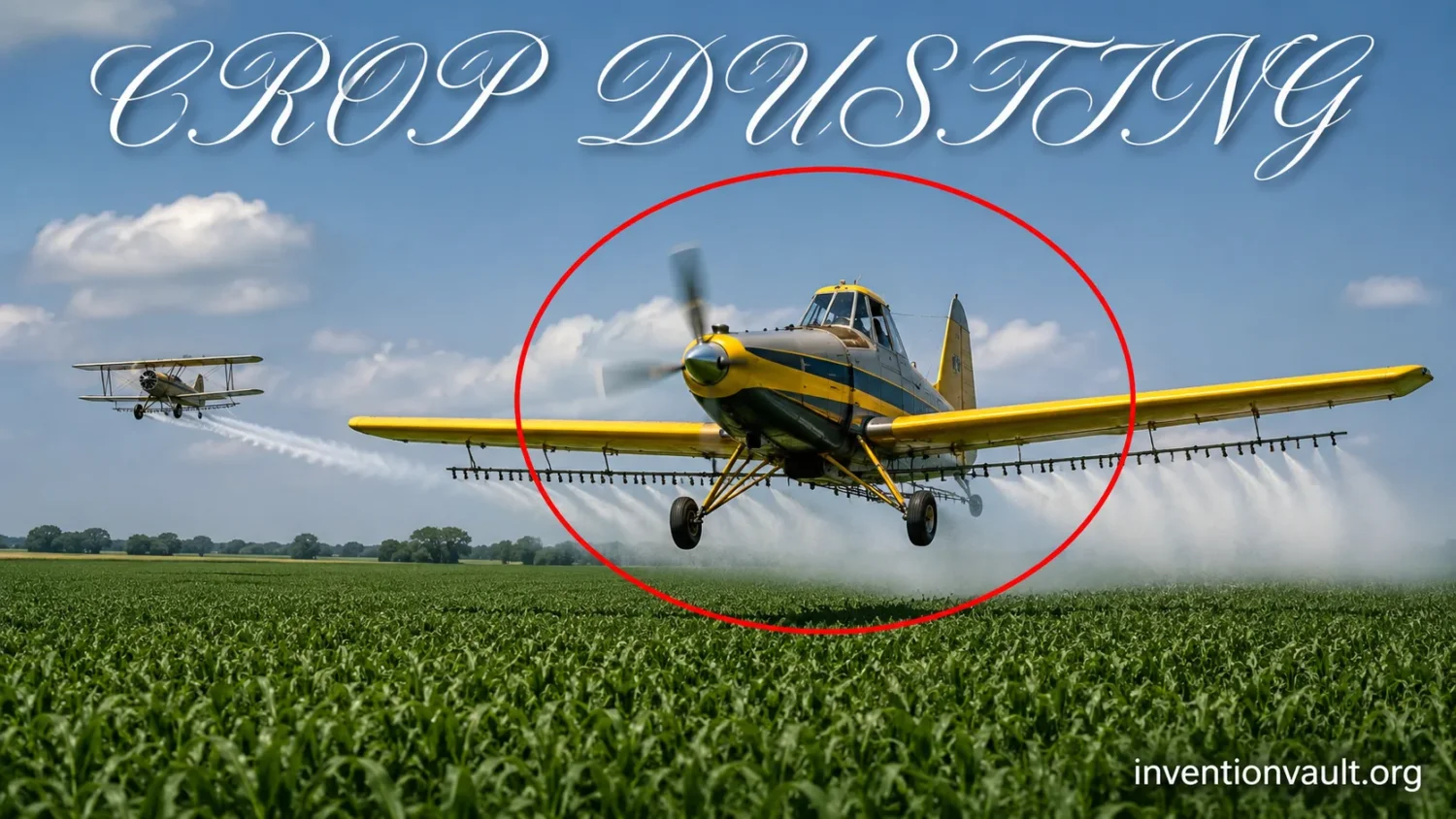
A crop duster did not begin as a sleek yellow airplane sweeping over cornfields. It began as a practical experiment: could an airplane carry a measured amount of agricultural material, release it over a living crop, and finish in minutes what ground crews might need days to do? That question turned a simple biplane into one of the most recognizable inventions in agricultural aviation. The better term today is aerial application, because modern aircraft usually spray liquids, spread seed, apply fertilizer, support forestry work, or help with public health operations. The old name survived because the first machines really did throw dust into the air.
What the Crop Duster Actually Invented
The invention was not only an airplane. It was a delivery system: aircraft, hopper, release control, airflow, pilot technique, crop timing, and field judgment working together. That is why the crop duster belongs as much to agricultural engineering as it does to aviation history.
The first test proved three things at once. An aircraft could fly low enough to place material over a selected area. A mechanical hopper could release powder during flight. Propeller wash and wind could help carry the material downward. Each part was imperfect, but the combined system worked.
The 1921 Ohio Test
The first widely recognized airplane crop-dusting test took place on August 3, 1921, near Troy, Ohio. Lieutenant John A. Macready flew a modified Curtiss Jenny over catalpa trees at low altitude while a release system spread lead arsenate powder from the aircraft. The target was not a field of grain. It was a grove of catalpa trees affected by sphinx moth larvae.
The test grew from several minds rather than one inventor working alone. Charles R. Nellie, an Ohio Department of Agriculture forester, suggested the airplane idea. Entomologist John S. Houser helped connect the problem with the people who could test it. Etienne Dormoy, an engineer at McCook Field, built the hopper and release mechanism. Macready supplied the flying skill. Together, they created a working method for airborne crop treatment.
The aircraft flew about 20 to 35 feet above the trees. The hopper held around 100 pounds of powder, and the plane landed several times to refill. By the standards of later agricultural aircraft, the equipment looked rough. By the standards of 1921, it was bold engineering: a temporary container, a release control, and a pilot using airflow as part of the applicator.
The crop duster was born when flight stopped being only transportation and became a farm tool.
Why the First Test Matters
The 1921 flight did more than treat one grove. It showed that aircraft could solve a timing problem in agriculture. Many crop threats move faster than ground equipment, especially when land is wet, large, uneven, or hard to reach. A plane could cover ground quickly without rolling over the crop or compacting the soil. That core advantage still explains the crop duster’s place in farming.
It also revealed an early limit. The first system depended heavily on wind and propeller wash. It could place material over a broad area, but it lacked the refined nozzles, booms, GPS guidance, and drift-control tools that later shaped precision aerial application.
Why It Was Called a Crop Duster
The phrase “crop duster” came from the material used in early aerial application. Early operators often worked with dry powders, especially insecticidal dusts. The airplane scattered dust, so the public name was direct and memorable.
Modern aerial applicators mostly use liquid systems. A present-day agricultural aircraft may carry a tank, pump, flow controller, spray boom, nozzles, GPS guidance, and mapping tools. The old term remains familiar, but it can mislead readers into picturing a cloud of powder. In practice, today’s crop duster is usually a specialized low-level application aircraft.
From Modified Biplanes to Purpose-Built Aircraft
The first crop duster was not designed from the start for agriculture. It was an adapted airplane. That mattered, because early aircraft had limited payload, limited safety features, and little room for proper application equipment. Farmers and pilots soon learned that agricultural flying needed its own machines.
In the 1920s, Huff-Daland Dusters helped move crop dusting from experiment to business. Its “Puffer” aircraft became one of the best-known early purpose-built crop-dusting designs. The aircraft placed a dust hopper inside the fuselage, a cleaner arrangement than tying a makeshift container to the side of a plane. That small design shift made the crop duster feel less like a field test and more like a real agricultural machine.
Later designs pushed the idea further. The AG-1, developed through work connected with the Civil Aeronautics Administration and Texas A&M, focused on safety and agricultural function. It had a single-seat low-wing layout and a 225-horsepower Continental engine. The AG-2 expanded liquid capacity and added equipment for solids, liquids, pumps, tanks, booms, and spreaders. These aircraft showed that a crop duster had to be designed around payload, low-speed handling, pilot protection, and application control.
Leland Snow’s S-1 and later Air Tractor designs helped define the modern agricultural airplane. Snow’s work treated the crop duster not as an altered trainer or surplus airplane, but as a machine built for the field from the first sketch. The Grumman G-164 Ag-Cat later became another landmark: a major aircraft manufacturer had taken agricultural aviation seriously enough to build a dedicated ag aircraft.
| Period | Development | Why It Changed the Invention |
|---|---|---|
| 1921 | Modified Curtiss Jenny used in the Ohio catalpa-tree test | Proved that aircraft could apply agricultural material from the air |
| 1920s | Huff-Daland Dusters and the “Puffer” aircraft | Moved the idea toward early commercial crop-dusting service |
| Late 1940s to 1950s | AG-1 and AG-2 agricultural aircraft work | Put safety, hopper placement, payload, and low-speed control near the center of design |
| 1950s | Leland Snow’s S-1 and related designs | Helped establish the purpose-built agricultural airplane as a mature aircraft type |
| 1957 and After | Grumman G-164 Ag-Cat | Brought major-manufacturer engineering to dedicated agricultural aviation |
| Late 20th Century to Today | Turbine aircraft, GPS, variable-rate controls, drones, and improved nozzles | Shifted crop dusting from broad application toward measured aerial placement |
How a Crop Duster Works
A crop duster works by carrying material in a hopper or tank and releasing it through an application system while the aircraft follows planned passes over a field. Early aircraft used dust hoppers. Modern machines may use liquid tanks, pumps, flow meters, spray booms, rotary atomizers, hydraulic nozzles, spreaders, or seed boxes depending on the job.
The pilot’s path matters as much as the equipment. The aircraft must fly the correct swath width, maintain suitable height, watch wind movement, avoid obstacles, and stop application at the right boundary. Modern GPS guidance helps pilots keep parallel passes and reduce missed strips or overlap. In advanced setups, variable-rate controls can adjust the amount applied in different parts of the field.
Nozzles turned into one of the crop duster’s most important technical details. Smaller droplets may drift more easily, while larger droplets tend to move less in the air but may not suit every crop or product. That is why spray equipment is chosen around label rules, crop type, aircraft speed, weather, and the intended result. The invention became more precise as engineers learned to control droplet size, nozzle angle, boom placement, and swath offset.
Main Parts
- Hopper or tank: holds dry material, liquid product, seed, or fertilizer.
- Pump and flow controller: regulate how much material leaves the aircraft.
- Spray boom or spreader: distributes the material across the swath.
- Nozzles or atomizers: shape droplet size and spray pattern.
- GPS and mapping tools: help align passes and document coverage.
Main Flight Demands
- Low-level control: the aircraft must remain steady close to the crop.
- Swath accuracy: each pass must match the planned pattern.
- Wind reading: smoke systems and instruments help judge air movement.
- Boundary control: application must stop before non-target areas.
- Obstacle awareness: wires, towers, trees, and terrain shape every pass.
Types of Crop Dusters
The crop duster is not one fixed aircraft shape. It is a family of machines built around aerial application. Some are fixed-wing airplanes. Some are helicopters. Some are drones. Each type solves a different field problem.
| Type | Typical Use | Main Strength | Main Limit |
|---|---|---|---|
| Early Dry-Dust Biplane | Historic insecticide dusting | Simple airborne spreading over trees or crops | Limited precision and low payload by modern standards |
| Piston Agricultural Airplane | Spraying, dusting, seeding, and fertilizer work | Lower purchase cost than many turbine aircraft | Less power and payload than larger turbine models |
| Turbine Agricultural Airplane | Large fields, fast coverage, heavy seasonal work | High speed and payload | Higher purchase and operating cost |
| Helicopter Applicator | Irregular fields, orchards, steep land, smaller areas | Hovering ability and tight maneuvering | Usually slower than fixed-wing aircraft over broad acreage |
| Uncrewed Spraying Drone | Small fields, specialty crops, wet ground, localized treatment | Can work in areas where crewed aircraft may be less practical | Lower payload and shorter flight duration than larger aircraft |
| Aerial Seeder or Topdresser | Seed, cover crops, fertilizer, or land-treatment material | Can reach wet or inaccessible ground without soil compaction | Depends strongly on weather, material type, and field planning |
Why Farmers Used Aircraft
The crop duster solved a time problem first. A pest outbreak, plant disease, or missed application window can move faster than tractors. Aircraft helped farmers treat large areas while the soil remained wet, the crop stood tall, or the terrain made ground equipment difficult.
Speed was the obvious gain. Early sources describe airplanes doing in minutes what ground crews might need days to finish. Later comparisons in agricultural aviation literature describe aircraft treating far more acres per day than ground rigs under certain row-crop conditions. The exact number changes by aircraft, swath width, field size, weather, and refill distance, but the pattern is clear: aircraft can place material quickly when timing matters.
The crop duster also avoided soil compaction. A ground sprayer must drive through the field. An aircraft passes over it. That difference can matter during wet periods or when plants are already tall enough to be damaged by tires and booms.
A Better Way to Read Crop Duster History
Many short histories reduce the crop duster to one date and one pilot. That is too thin. The invention had at least four layers: the agricultural problem, the aircraft modification, the application mechanism, and the later shift toward purpose-built machines. Reading it this way makes the invention easier to understand and harder to miscredit.
The Safety Shift in Design
Early crop dusting asked ordinary aircraft to do unusual work. Low-altitude flying, frequent turns, changing loads, and rough fields created design demands that basic training aircraft did not answer well. Engineers soon saw that agricultural aircraft needed better pilot protection, better low-speed handling, clear visibility, and a safer relationship between the pilot, engine, and chemical load.
The AG-1 reflected that shift. It was created as a dedicated agricultural prototype, not a quick conversion. Its safety ideas included a stronger pilot seat, shoulder harness, and low-speed control features. Later aircraft continued that logic: put the hopper near the aircraft’s balance point, give the pilot a clear view, make the airframe durable, and shape the machine for repeated low-level work.
This is one reason crop dusters often look different from ordinary small aircraft. The cockpit, landing gear, wings, tank placement, and tail surfaces serve field work. Beauty was never the point. Control at low altitude was.
Modern Crop Dusters and Precision Tools
Modern aerial application uses tools that the 1921 team could not have imagined: GPS guidance, electronic flow control, GIS prescription maps, turbine engines, improved nozzles, pattern testing, and digital job records. The machine still flies low over fields, but the work has become far more measured.
Industry data in the United States places annual aerial treatment at about 127 million acres of cropland, with additional acres in pasture, rangeland, forest land, and public health work. The same data describes a fleet dominated by fixed-wing aircraft, with helicopters serving roles where maneuvering matters more than raw acreage. Many modern agricultural aircraft use turbine power, and large models can carry hundreds of gallons.
The newer story also includes drones. The FAA treats dispensing or spraying from aircraft, including drones, under agricultural aircraft rules when the operation fits Part 137. Smaller uncrewed aircraft add a new branch to the crop duster family, especially for specialty crops, smaller plots, wet fields, and targeted work. They do not erase crewed aircraft. They expand the toolbox.
Aerial Application Beyond Row Crops
The public often pictures a crop duster over corn, wheat, cotton, rice, or soybeans. Those crops matter, but aerial application reaches wider. Aircraft can seed cover crops, apply fertilizer, support forestry, treat pasture or rangeland, and assist mosquito-control programs run by trained public agencies. In some regions, aircraft also help place seed when wet soil would block tractors.
This wider use explains why the invention lasted. A crop duster is not only a machine for one chemical or one crop. It is a way to move agricultural material across land without driving through it. The exact mission changes; the airborne delivery idea remains.
Technical Changes That Made It Better
The crop duster improved through many small engineering decisions rather than one grand redesign. Better tanks improved balance. Better pumps controlled flow. Better nozzles shaped droplets. Better pilot seats improved protection. Better engines carried heavier loads. Better navigation reduced overlap and missed strips.
| Improvement | What It Changed | Result |
|---|---|---|
| Internal Hopper Placement | Moved the load into a more controlled position | Better balance and cleaner aircraft layout |
| Purpose-Built Airframes | Designed aircraft around low-level agricultural work | Better handling, visibility, and durability |
| Spray Booms and Nozzles | Replaced broad dust release with controlled distribution | More even placement across the swath |
| Droplet Classification | Allowed nozzles to be compared by droplet spectrum | Better drift management and product matching |
| GPS Guidance | Helped pilots follow planned passes | Less overlap, fewer skipped strips, better records |
| Variable-Rate Control | Adjusted output across different field zones | More targeted application where field data supports it |
| Drone Systems | Added smaller uncrewed aircraft to the category | More options for localized or hard-to-reach work |
Why the Invention Is Often Misunderstood
The crop duster is easy to recognize and easy to oversimplify. Three misunderstandings appear often. First, the invention was not the airplane itself. The airplane already existed. The invention was the use of aircraft as an agricultural application system.
Second, one person should not receive all the credit. Macready flew the first test, but Dormoy designed the hopper, Nellie suggested the concept, Houser helped connect the agricultural science, and public agencies supported the experiment. The crop duster came from cooperation between agriculture, engineering, and flight.
Third, “crop dusting” no longer describes most modern work. The name is historical. Aerial applicators now use far more controlled equipment, and many applications involve liquids, seed, fertilizer, or other regulated materials handled by trained operators under aviation and agricultural rules.
The Legacy of the Crop Duster
The crop duster changed how aircraft could be understood. It showed that an airplane could be a working agricultural instrument, not only a vehicle for people or cargo. It also helped create a specialized aircraft class with its own pilots, rules, engineering culture, and safety habits.
Its legacy is visible in modern ag aircraft with turbine engines, reinforced airframes, large tanks, GPS lines on cockpit displays, and spray systems tested for pattern and droplet behavior. It is also visible in drones that carry smaller loads over vineyards, orchards, vegetables, and other specialty crops. The form keeps changing. The central idea remains practical: use the air above a field to reach the crop at the right time.
References Used for This Article
- Federal Aviation Administration — 100 Years of Aerial Crop Dusting: Used for the 1921 Ohio test, Macready’s flight, Dormoy’s hopper, early equipment details, and AG-1 development.
- Smithsonian Magazine — The Little “Puffer” That Could, and Did, Change an Industry: Used for the Huff-Daland Duster, early commercial development, and museum-backed historical details.
- National Agricultural Aviation Association — The Industry’s History: Used for the 1921 experiment, the “crop duster” name, early commercial operations, and modern terminology.
- National Agricultural Aviation Association — Industry Facts, Environmental Benefits and FAQs: Used for current acreage figures, fleet notes, GPS use, and aerial application roles.
- Electronic Code of Federal Regulations — 14 CFR Part 137 Agricultural Aircraft Operations: Used for the official U.S. regulatory category covering agricultural aircraft operations.
- Federal Aviation Administration — Dispensing Chemicals and Agricultural Products with UAS: Used for drone-related aerial application and Part 137 treatment of dispensing operations.
- USDA Agricultural Research Service — Spray Drift Reduction Evaluations: Used for nozzle, droplet-size, airspeed, and drift-reduction technical details.
- Air Tractor — Our Heritage: Used for Leland Snow, the S-1, and the later development of modern agricultural aircraft.
- University of Florida IFAS Extension — Regulatory Requirements to Operate Spraying Drones: Used for current drone spraying regulation and agricultural UAS operation details.