| Field | Detail |
|---|---|
| Invention Name | Grain elevator, also known in early port use as a grain transfer elevator |
| First Working Commercial Form | Dart’s Elevator, a steam-powered grain storage and transfer warehouse |
| Main Credited People | Joseph Dart, a Buffalo grain merchant, and Robert Dunbar, the engineer who designed the working machinery |
| Place of Origin | Buffalo, New York, near the meeting point of Great Lakes shipping and the Erie Canal route |
| Date Range | Built in 1842 and in practical operation in 1843 |
| Primary Purpose | To move loose grain from ships into storage bins, weigh it, hold it, and reload it for canal boats, railcars, barges, or later ships |
| Mechanical Principle | A bucket elevator on a moving belt or chain lifted grain vertically; gravity then helped distribute it through spouts |
| Technical Ancestor | Oliver Evans’s automated flour-milling system, which used elevators and conveyors before Dart adapted similar ideas for bulk port handling |
| Early Materials | Wood framing and timber bins, later followed by steel, tile, reinforced concrete, and modern metal bin systems |
| Common Grain Unit | The bushel; its weight changes by crop, such as 56 lb for corn and 60 lb for wheat in common U.S. trade use |
| Modern Legal Meaning in U.S. Regulation | A plant or installation where grain is unloaded, handled, cleaned, dried, stored, or loaded |
| Main Modern Types | Country elevators, terminal elevators, export elevators, storage elevators at processing plants, marine legs, and specialized transfer systems |
A grain elevator is not just a tall bin on the edge of a railroad line. It is a mechanized system for lifting, weighing, storing, and moving grain in bulk. Before this invention, grain often moved in sacks, barrels, or loose loads handled by human labor. After the grain elevator, wheat, corn, oats, barley, soybeans, and other crops could move through a port or rail town as a continuous stream.
The idea sounds simple now: raise grain upward, let it fall into the right bin, then release it when the next carrier is ready. In the 1840s, that changed the business of grain. It also changed the shape of agricultural towns. The tall elevator became a machine, a warehouse, a measuring station, and a local landmark at the same time.
Plain definition: a grain elevator is a facility that receives grain, lifts it with mechanical equipment, stores it in bins or silos, and loads it out for transport or processing.
What the Grain Elevator Changed
The grain elevator solved a narrow but costly problem: how to move large amounts of loose grain quickly without treating every load as a separate sack or barrel. That problem mattered most in places where grain arrived from farms and had to move onward by water, rail, or both.
Buffalo was the right place for this invention because it sat at a busy transfer point. Grain came by lake vessels from growing regions to the west and needed to move east through the Erie Canal system. The old method did not match the new traffic. A ship could wait while crews unloaded grain by hand. Delays cost money. Wet weather, slow storage, and poor handling could damage value.
- It reduced handling time. Grain moved through a machine instead of being carried load by load.
- It made bulk storage practical. Loose grain could be held in bins until buyers or carriers were ready.
- It joined transport modes. A ship, canal boat, railcar, barge, or truck could become part of one flow.
- It helped standardize trade. Weighing, sampling, cleaning, drying, and blending became tied to one facility.
The grain elevator did not invent grain storage. People had stored grain for centuries. Its fresh contribution was the industrial movement of grain: lifting, routing, measuring, and releasing a crop at a scale that matched railways, canals, and steamships.
Who Invented the Grain Elevator
Most short histories name Joseph Dart as the inventor of the grain elevator. That is fair, but it leaves out part of the story. Dart supplied the commercial insight and backed the project. Robert Dunbar supplied the engineering skill that turned the idea into a working machine.
Dart was a Buffalo merchant who understood the pressure on the grain trade. Dunbar, trained in mechanical work, designed the tall transfer system that made the elevator function. Together, they produced a new building type: not a mill, not a simple warehouse, and not a dock. It was all three, arranged around a vertical moving belt with buckets.
Oliver Evans also belongs in the story. Decades earlier, Evans had designed automated flour-milling systems that used conveyors and elevators to move grain and flour through a mill. Dart and Dunbar adapted that kind of mechanical thinking to a different setting: bulk grain transfer at a port.
Joseph Dart’s Role
- Recognized the commercial need in Buffalo
- Backed the construction of Dart’s Elevator
- Adapted elevator machinery to grain transfer
- Connected storage, weighing, and shipment
Robert Dunbar’s Role
- Designed the working mechanical system
- Built the marine-leg style lifting arrangement
- Helped define the early grain elevator form
- Influenced later elevator construction
The Problem Before Bulk Handling
Before the steam-powered elevator, the slowest part of the grain route was often not the farm and not the final mill. It was the transfer point. Grain had to leave one carrier and enter another. Every extra movement added time, labor, spillage, and risk of quality loss.
Loose grain is awkward because it behaves like a fluid only when the system is ready for it. It flows downhill, but it does not lift itself. It fills corners. It must be weighed, sampled, and kept dry. A good elevator handled those problems as a chain of tasks rather than separate chores.
The grain elevator mattered because it treated grain as a stream, not as a pile of separate packages.
That one shift explains the invention better than any single date. The elevator did not merely store grain. It reorganized the movement of grain.
How the Machine Moved Grain
The early machine used a vertical belt or chain fitted with small buckets. The lower end reached into the vessel or receiving area. As the belt moved, the buckets filled with grain, rose to the top, and emptied into a head section. From there, gravity and spouts sent the grain into storage bins or toward loading points.
This is why the word elevator became attached to the whole facility. The lifting device was the heart of the operation, but the surrounding building gave it purpose.
| Step | What Happens | Why It Matters |
|---|---|---|
| Receiving | Grain arrives by ship, barge, railcar, truck, or wagon in older systems. | The elevator becomes the transfer point between farm output and wider trade. |
| Lifting | A bucket elevator or leg carries grain upward. | Vertical movement lets gravity do much of the later routing. |
| Weighing and Sampling | Grain can be weighed, inspected, or sampled before storage or shipment. | Trade depends on quantity and quality, not only on volume. |
| Distribution | Turn heads, spouts, conveyors, or trippers direct grain to selected bins. | Different lots, grades, or crops can be separated. |
| Storage | Grain rests in bins, tanks, or silos. | Storage smooths the gap between harvest time and market demand. |
| Loadout | Grain leaves through gravity gates, conveyors, spouts, or loading stations. | The crop re-enters transport without being repacked by hand. |
Main Parts of a Grain Elevator
A grain elevator is easier to understand when its parts are read as one route. Grain enters low, rises high, then flows down or sideways into storage and loading systems.
| Part | Role | Notes |
|---|---|---|
| Receiving Hopper or Pit | Collects grain as it is unloaded. | Usually placed below the unloading area so grain can fall into it. |
| Elevator Leg | Lifts grain vertically. | The classic form uses buckets fixed to a belt or chain. |
| Marine Leg | Removes grain from a vessel hold. | This feature made early port elevators especially useful. |
| Headhouse | Houses upper machinery, scales, distributors, and control points. | The tall headhouse gave many elevators their familiar skyline shape. |
| Bins or Silos | Store grain by crop, grade, owner, or shipment lot. | Modern storage often uses steel or reinforced concrete. |
| Spouts and Turn Heads | Direct grain into selected bins or loadout paths. | They turn height into routing control. |
| Cleaner, Dryer, or Conditioner | Improves storage quality when the grain lot requires it. | Not every elevator performs every process. |
| Dust-Control Equipment | Helps collect airborne grain particles during handling. | Modern facilities manage dust for safety, air quality, and equipment care. |
Major Types and How They Differ
Not every grain elevator does the same job. Some sit close to farms. Some stand at river ports, rail terminals, or coastal export points. Others serve mills and processing plants. The name stays the same because the core action remains the same: receive, lift, store, and load grain.
| Type | Main Function | Typical Location |
|---|---|---|
| Country Elevator | Receives grain directly from nearby farms, holds it for a limited time, and loads it for movement to larger markets. | Small towns, rural rail lines, farm regions, and local buying points. |
| Terminal Elevator | Handles larger volumes, often cleaning, drying, blending, storing, and sending grain onward. | Major rail hubs, inland ports, river terminals, and urban grain centers. |
| Export Elevator | Loads grain mainly onto vessels for overseas shipment. | Seaports and large waterborne shipping terminals. |
| Storage Elevator at a Processing Plant | Holds grain for flour mills, corn mills, rice mills, soybean plants, and other processors. | Industrial food and feed processing sites. |
| Marine Elevator or Marine Leg | Transfers grain between vessels and storage. | Harbors, rivers, canals, and lake ports. |
| Floating Elevator | Uses vessel-mounted equipment to transfer grain on water. | Ports where mobile transfer is useful. |
| On-Farm Grain Handling System | Stores and moves grain within a farm operation, often using bins, augers, dryers, and small legs. | Farmyards and private storage sites. |
Materials That Changed the Shape
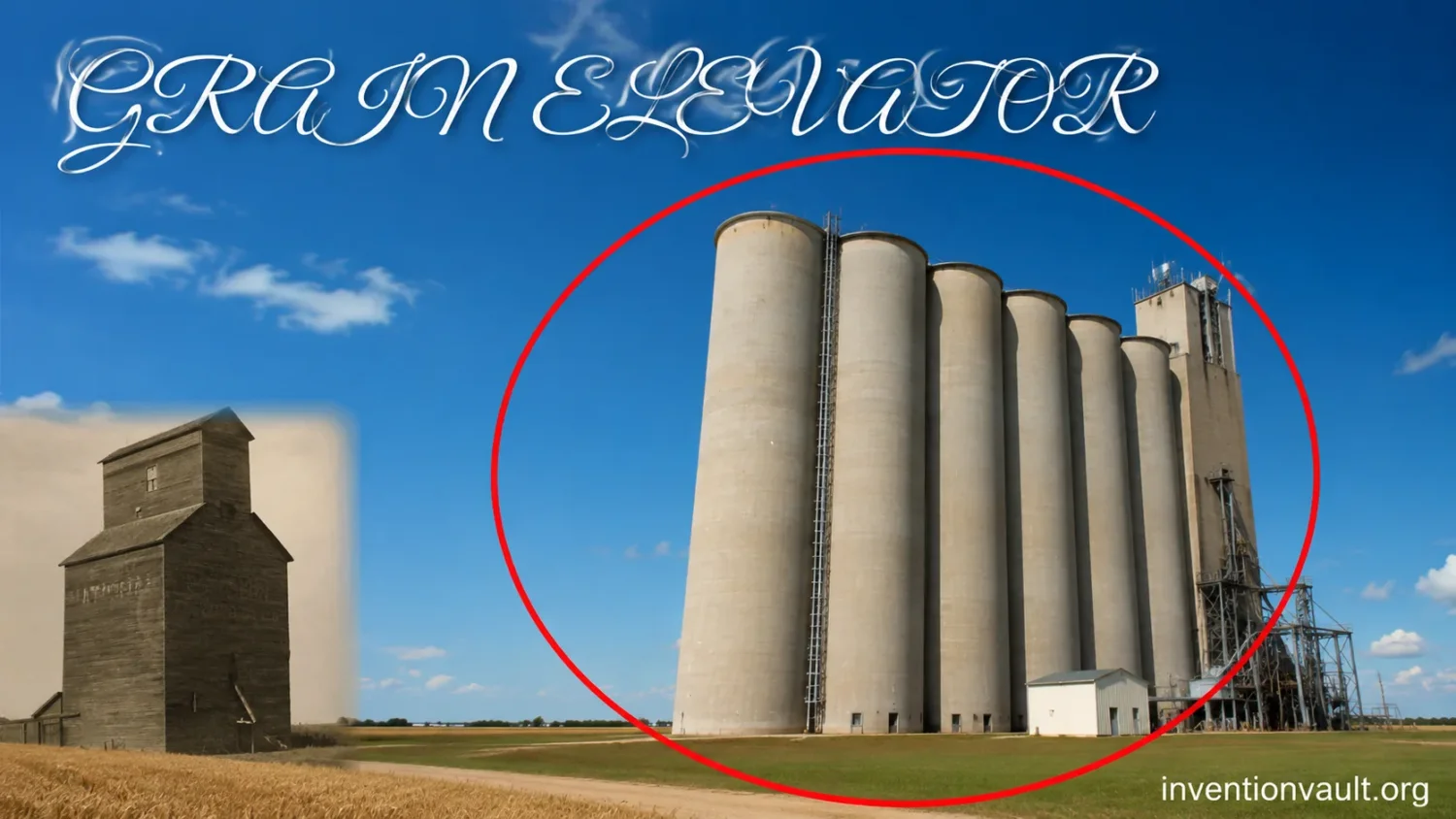
The earliest elevators in Buffalo used wood because timber was available, affordable, and fast to build with. Wood also had limits. It aged, absorbed stress, and demanded care. As grain volumes grew, builders experimented with stronger and more durable materials.
The next major leap came with reinforced concrete and steel. The Peavey-Haglin Concrete Grain Elevator in St. Louis Park, Minnesota, completed in 1900, showed that a circular concrete grain elevator could work. ASCE records describe it as 125 feet high, with a 20-foot inside diameter and a 30,000-bushel capacity.
That shift changed the look of grain country. Wooden elevator houses gave many towns a barn-like vertical marker. Concrete silos gave ports and rail centers a cleaner, cylindrical mass. Steel bins later made modular expansion easier for many operations.
| Material | Use in Elevator History | Design Effect |
|---|---|---|
| Wood | Common in early elevators and country-style storage. | Fast to build but less durable than later materials. |
| Steel | Used for bins, tanks, conveyors, structural frames, and later storage systems. | Allowed stronger, more standardized equipment layouts. |
| Tile and Brick | Used in some late 19th- and early 20th-century experiments. | Helped builders move away from all-wood storage. |
| Reinforced Concrete | Became a defining material for large terminal elevators and silo groups. | Produced tall, durable, cylindrical storage forms. |
Technical Measures That Matter
Grain elevators are measured in more than height. Their real scale appears in bushels, throughput, storage capacity, and handling rate. A tall elevator with slow equipment is not the same as a high-throughput terminal. A modest country elevator may be small by port standards yet vital to its surrounding farms.
The bushel can confuse readers because it is a volume measure tied in trade to crop-specific weights. In common U.S. agricultural use, a bushel of corn is often treated as 56 pounds, while wheat and soybeans are commonly treated as 60 pounds. So the same number of bushels can mean different weights depending on the crop.
| Crop | Common U.S. Bushel Weight | Why It Matters in Elevators |
|---|---|---|
| Corn | 56 lb per bushel | A 100,000-bushel corn lot represents about 5.6 million pounds. |
| Wheat | 60 lb per bushel | Wheat weight changes how storage and shipment totals are read. |
| Soybeans | 60 lb per bushel | Soybean facilities often use bushel totals for accounting and movement. |
| Barley | 48 lb per bushel | Lower bushel weight affects tonnage comparisons. |
| Oats | 32 lb per bushel in common U.S. domestic/export use | Large bushel totals do not always mean high total weight. |
Scale example: 30,000 bushels of wheat at 60 lb per bushel equals 1,800,000 lb, or 900 U.S. short tons. That helps explain why grain elevator engineering is about load, flow, moisture, and timing—not only storage space.
Development Path of the Invention
The grain elevator did not appear from nowhere. It grew from milling automation, port pressure, steam power, and later structural engineering. The dates below show the invention as a sequence, not a single isolated moment.
| Period | Development | Effect on Grain Handling |
|---|---|---|
| 1780s | Oliver Evans developed automated flour-milling ideas using elevators and conveyors. | Showed that grain-related materials could move through machines with less manual handling. |
| 1842 | Joseph Dart and Robert Dunbar built the first steam-powered commercial grain elevator in Buffalo. | Applied vertical lifting machinery to port-scale grain transfer. |
| 1843 | Dart’s Elevator entered working use. | Proved that grain could be unloaded and stored in bulk far faster than by older hand methods. |
| Late 19th Century | Elevators spread to ports, rail towns, and grain regions. | The elevator became a common link between farms and long-distance markets. |
| 1899–1900 | Peavey and Haglin tested a circular concrete grain elevator in Minnesota. | Opened the path for reinforced concrete silo forms. |
| 20th Century | Steel, concrete, electric drives, conveyors, dryers, cleaners, and control systems expanded elevator capacity. | Large terminal elevators became central to rail, river, and export grain movement. |
| Current Use | Modern elevators use automation, monitoring, dust-control equipment, aeration, and digital inventory tools. | The old idea of lifting and routing grain still supports today’s food and feed supply chains. |
Why the Design Spread
The grain elevator spread because it matched the needs of agricultural expansion, rail growth, port shipping, and processing industries. It also gave grain merchants better control over time. Grain could be collected during harvest, stored, blended, dried if needed, and shipped when transport or prices made sense.
The invention also suited the physical nature of grain. Grain can flow through chutes. It can be lifted by buckets. It can be held in vertical bins. It can leave a bin by gravity. A well-designed elevator made those natural properties work in sequence.
- Height created control. Once grain reached the top, gravity helped move it through the facility.
- Bins created separation. Different crops, grades, owners, or lots could be stored apart.
- Scales created trust. Payment and shipment depended on measured quantities.
- Rail and water links created reach. Elevators connected local harvests to distant markets.
What People Often Misread
Grain elevator history is often shortened so much that useful detail disappears. Three points deserve special care.
The Invention Was Not Only a Tall Bin
A bin stores grain. A grain elevator does more. It receives, lifts, weighs, routes, stores, and loads. The invention was the system, not only the container.
Dart Was Not the Only Figure
Joseph Dart deserves credit for recognizing the business need and building the first commercial system. Robert Dunbar deserves attention because the working machine required engineering. Oliver Evans also belongs in the background because automated milling machinery helped make the idea thinkable.
The Date Needs Care
Many accounts use 1842 because construction and development began then. Others emphasize 1843 because Dart’s Elevator entered practical use then. The safest wording is that the first steam-powered commercial grain elevator was built in Buffalo in 1842 and operating in 1843.
The Grain Elevator as an Invention of Flow
The grain elevator’s real achievement was flow. Grain moved from a vessel or wagon into a pit, up a leg, across a distributor, into a bin, and out again. Each step reduced friction in the trade. Less waiting. Less repeated lifting. Better accounting. More predictable storage.
This made the invention valuable far beyond Buffalo. Any place that gathered crops and had to send them onward could use the same logic. Country towns used elevators to collect grain from farms. Terminal cities used them to sort and ship huge lots. Export ports used them to load vessels. Processing plants used them to feed mills and factories.
Even today, the old pattern remains visible. A modern elevator may use electric motors, enclosed conveyors, sensors, software, aeration fans, and controlled loadout equipment. Yet the basic act remains familiar: lift grain high, control where it falls, and keep it ready for the next movement.
Terms That Make the Invention Easier to Read
| Term | Meaning |
|---|---|
| Bushel | A grain trade measure; the weight represented by one bushel depends on the crop. |
| Bucket Elevator | A belt or chain fitted with buckets that lift grain vertically. |
| Elevator Leg | The vertical lifting section of a grain elevator. |
| Marine Leg | A vessel-unloading elevator leg used at ports, rivers, canals, or lake terminals. |
| Headhouse | The upper working area that houses machinery for lifting, weighing, and distributing grain. |
| Spout | A chute that lets grain flow by gravity from one point to another. |
| Garners or Surge Bins | Temporary holding bins used during weighing, routing, or loadout. |
| Aeration | Controlled airflow through stored grain to help manage temperature and moisture conditions. |
| Throughput | The amount of grain a facility can move through its system over a period of time. |
Why the Grain Elevator Still Matters
The grain elevator remains one of the most practical inventions in agricultural infrastructure because it sits between harvest and use. A farmer may grow the crop, and a mill or shipper may need it, but the elevator manages the middle: volume, timing, quality, storage, and movement.
Its shape has changed. Its motors have changed. Its controls have changed. The core idea has not changed much. Grain still needs to be lifted, directed, protected, measured, and loaded. That is why the grain elevator is more than a rural landmark. It is a durable answer to a physical problem: how to move millions of small kernels as one controlled commodity.
References Used for This Article
- Library of Congress — Buffalo Grain Elevators, Buffalo, Erie County, NY: Documents Buffalo’s grain elevators through the Historic American Engineering Record.
- National Park Service — Oliver Evans: Supports the background on Evans’s automated flour-milling ideas.
- eCFR — 40 CFR 60.301 Definitions: Provides current U.S. regulatory definitions for grain elevators and terminal capacity.
- U.S. Environmental Protection Agency — AP-42 Grain Elevators and Processes: Explains elevator process flow, facility types, and handling operations.
- Purdue Extension — Managing Dry Grain in Storage: Supports details on grain storage care, aeration, observation, and safety awareness.
- USDA Economic Research Service — Feed Grains Database Documentation: Provides official conversion factors for several common grain units.
- USDA Economic Research Service — Weights, Measures, and Conversion Factors for Agricultural Commodities: Supports bushel weight examples for grain comparisons.
- American Society of Civil Engineers — Peavey-Haglin Concrete Grain Elevator: Gives technical data on the early circular concrete grain elevator prototype.
- New York Heritage — Grain Elevators & the Central Wharf: Supports the Buffalo origin story and Joseph Dart’s role in the invention.