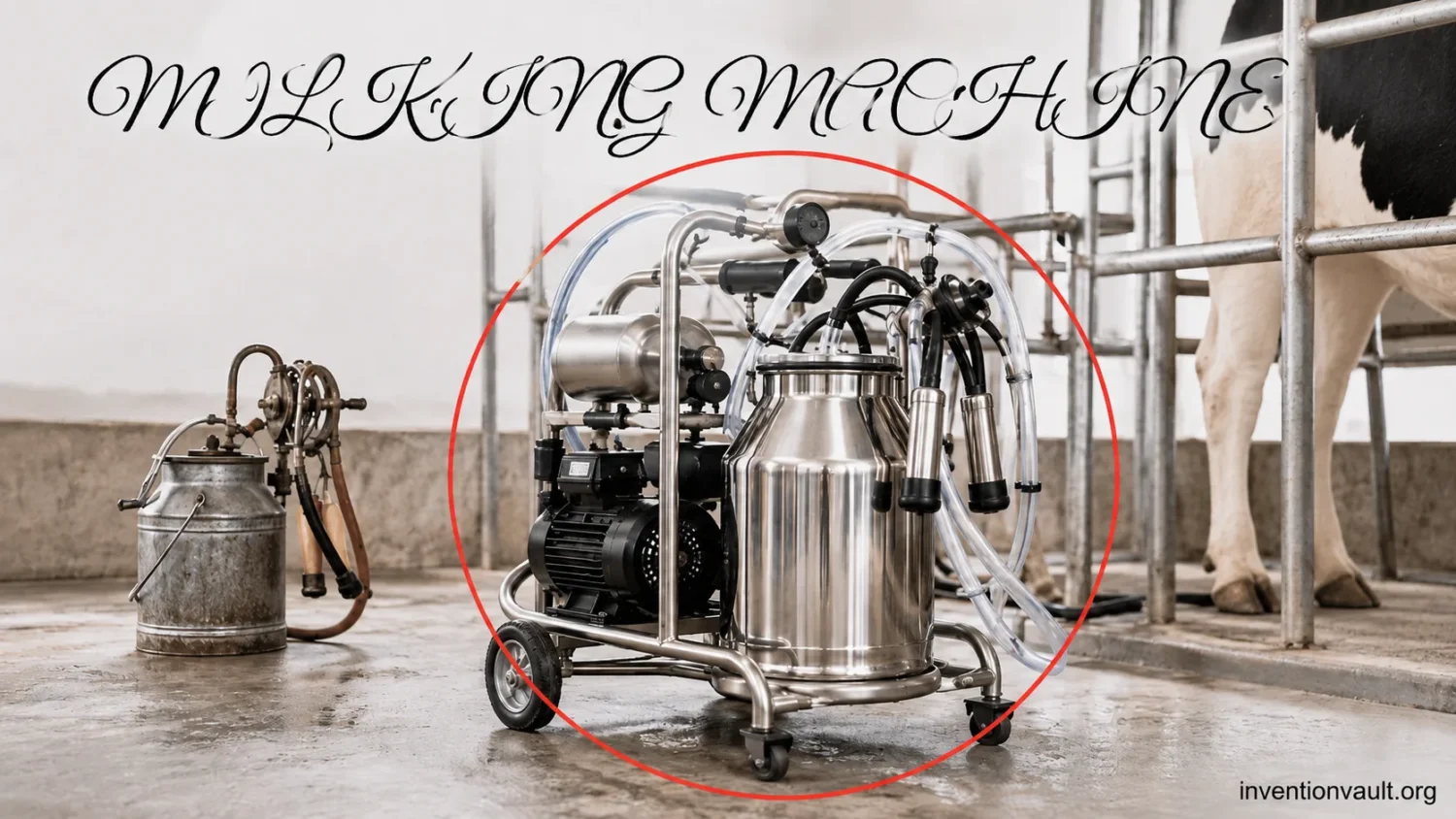
| Invention | Milking Machine, also called a mechanical milker, vacuum milker, or machine milking system. |
|---|---|
| Main Purpose | To draw milk from dairy animals through controlled vacuum, teat cups, pulsation, and a closed milk path. |
| Main Field | Agricultural engineering, dairy technology, animal husbandry, and food production equipment. |
| Early Mechanical Lineage | Mid-19th-century suction devices, including the American Cow Milker era and other early vacuum-based attempts. |
| Well-Documented 1879 Patent | Anna Corey Baldwin patented the Hygienic Glove-Milker, a rubber udder-covering suction device connected to a pump. |
| Commercial Development Stage | William Mehring and the Mehring Company developed hand- and foot-powered milkers in the 1890s; more than 3,000 were sold. |
| Modern Vacuum-Milker Turning Point | Norman John Daysh worked with DeLaval on a vacuum-pump milking machine launched in 1917, helping shape later commercial machine milking. |
| Core Parts | Vacuum pump, vacuum regulator, pulsator, teat cups, liners, claw, milk tubes, receiver or bucket, and cleaning system. |
| Core Technical Principle | The machine creates a pressure difference to move milk, while pulsation lets the liner squeeze and release the teat. |
| Common Later Forms | Bucket milker, pipeline milker, herringbone parlor, rotary parlor, and automatic milking system. |
The milking machine did not appear as one perfect device from one workshop. It grew through a long series of farm problems: tired hands, slow work, open buckets, variable milk cleanliness, and the need to milk more animals without turning the dairy shed into a harsher place. The best way to understand the invention is to follow the movement of milk itself: from the teat, through a liner and tube, into a container or pipeline, under a carefully controlled vacuum.
That simple path hides a demanding engineering problem. A cow is not a tap. Early inventors learned that suction alone could pull milk, but continuous suction could also cause discomfort and poor results. The lasting invention was not just a pump. It was a timed system that could draw, pause, massage, and carry milk away with less air exposure.
What The Milking Machine Actually Does
A milking machine uses vacuum to create a pressure difference. The vacuum does not “pull” milk in a rough or random way. In a well-designed system, atmospheric pressure and milk pressure help move milk through the teat cup, short milk tube, claw, long milk tube, and then into a bucket, receiver, or milk line.
The teat cup has two main zones: a rigid shell and a flexible liner. The liner touches the teat. A pulsator changes the air pressure around the liner, making it open and close in a repeating cycle. During the open phase, milk flows. During the closed phase, the liner gives the teat a short rest. This is why pulsation became one of the great dividing lines between early experiments and practical machine milking.
Plain definition: A milking machine is a controlled vacuum system that removes milk through teat cups while a pulsator alternates between milk-flow and rest phases.
Why Hand Milking Needed A Mechanical Rival
Hand milking served households and small farms for generations. It worked well when herds were small and milk stayed close to the farm kitchen. Larger dairy trade changed the pressure on farmers. More cows meant more hands, more time, more open pails, and more variation from one milker to another.
The machine answered a practical question: could a farm milk more animals while keeping the work steady and the milk path cleaner? The answer took decades because the task required both mechanical force and biological restraint. A pump could be built quickly. A gentle, repeatable milking action took far more thought.
What It Solved
- Reduced the strain of repeated hand milking.
- Made milking routines more consistent across larger herds.
- Moved milk through hoses or pipelines instead of open handling alone.
- Helped shape dedicated milking sheds and dairy parlors.
What Took Longer
- Finding the right balance between vacuum and teat comfort.
- Cleaning tubes, liners, buckets, and valves well enough for daily use.
- Keeping vacuum steady while milk and air moved together.
- Designing systems that fit real barns, not only patent drawings.
The Invention Was A Chain, Not A Single Moment
Many short histories say “the milking machine was invented in 1879.” That statement points to Anna Corey Baldwin’s famous patent, yet it leaves out earlier vacuum machines, later commercial improvements, and the technical shift that made machine milking reliable. A better answer is more precise: the milking machine evolved through several invention stages.
The lasting milking machine was not merely the first device that used suction. It was the device family that learned how to use suction with rhythm, cleanliness, and repeatable control.
In the mid-19th century, inventors experimented with vacuum and teat cups. The American Cow Milker, represented by surviving museum examples from around 1865, used hand-operated suction in rubber tubes. Its success was limited, yet it shows that farm engineers had already recognized the central idea: milk could move by vacuum through a mechanical path.
Anna Corey Baldwin’s 1879 Hygienic Glove-Milker gave the history a memorable patent. Her design used an elastic rubber case placed over the udder, four teat tubes, and a suction pump. The patent language compared the device to a glove, with tubes and bands acting like fingers. It was inventive and direct, but it still belonged to the early suction era.
The 1890s brought a more practical farm phase. The Mehring Company developed mechanized milkers that used hand power and then foot power. Smithsonian records note that these machines could milk two cows at once with less exertion, and the company sold more than 3,000 units. That number matters because an invention only changes farm life when it can leave the workshop, be bought, be repaired, and be used repeatedly.
By the early 20th century, the modern vacuum-pump milker took clearer form. Norman John Daysh, a New Zealand dairy farmer, worked with DeLaval on a vacuum-pump machine that was launched in 1917. That stage connected farm experience with industrial manufacture. It also reinforced the idea that a milking machine had to work with the animal’s body rather than against it.
Milking Machine Timeline
| Period | Development | Why It Matters |
|---|---|---|
| Mid-19th Century | Early vacuum and teat-cup machines appeared, including the American Cow Milker era. | They proved that vacuum milking was mechanically possible, even when adoption stayed limited. |
| 1879 | Anna Corey Baldwin patented the Hygienic Glove-Milker. | It gave the invention a clear U.S. patent record tied to suction, rubber parts, and a pump. |
| 1890s | The Mehring Company sold hand- and foot-powered mechanized milkers. | It showed a move from experimental devices toward farm sale, use, and service. |
| 1917 | Norman John Daysh and DeLaval launched a vacuum-pump milking machine. | It helped define the modern commercial line of vacuum-operated machine milking. |
| 1950s-1960s | Herringbone and rotary milking layouts spread in mechanized dairying. | The invention moved from a single device to a full dairy shed system. |
| 1992 Onward | Commercial automatic milking systems appeared in the Netherlands. | Robotic arms, electronic identification, sensors, and data turned milking into a 24-hour automated process. |
The Technical Breakthrough: Vacuum Plus Pulsation
The earliest devices often tried to imitate hand milking with suction. That was only half the answer. A teat cannot stay under constant vacuum without strain. Modern machine milking uses pulsation because the liner must alternately open and close. The open phase permits flow. The closed phase massages the teat and helps maintain circulation.
FAO material on milking equipment describes the basic principle as vacuum extraction combined with a periodic external squeeze. That second part is easy to overlook, but it explains why the practical machine took so long to mature. The machine needed both negative pressure and a controlled rest phase.
Useful technical ranges vary by system design. FAO notes that milk flow after cup attachment often reaches a maximum within about one minute, commonly around 2-5 kg per minute, with the total milk-flow period ranging from about 2 to 8 minutes. DairyNZ lists general vacuum levels from roughly 40 to 48 kPa depending on milk-line height. These figures are not decorative trivia; they show that the invention works inside a narrow engineering band.
| Part | Role In The Machine | Common Problem If Poorly Designed Or Maintained |
|---|---|---|
| Vacuum Pump | Removes air from the system so vacuum can operate the milker. | Weak or unstable vacuum can slow milking and disturb the process. |
| Vacuum Regulator | Helps hold the chosen vacuum level while air demand changes. | Fluctuation may affect milk flow and teat-cup stability. |
| Pulsator | Alternates pressure around the liner so it opens and closes. | Faulty pulsation can remove the rest phase that protects the teat. |
| Teat Cup Shell | Holds the liner and gives the cup its shape. | Poor fit can make attachment unstable. |
| Flexible Liner | Touches the teat and performs the open-close movement. | Worn liners may reduce comfort, flow, and cleanliness. |
| Claw | Collects milk from the four short milk tubes before it moves onward. | Air leaks or poor flow can disturb vacuum under the teat. |
| Milk Tube Or Pipeline | Carries milk from the cluster to a bucket, receiver, or cooling path. | Long or poorly cleaned lines can create flow and hygiene problems. |
Main Types Of Milking Machines
The milking machine became a family of systems. The same core principle can appear in a small bucket unit, a pipeline barn, a fast rotary platform, or a robot stall. Each type reflects a different farm size, labor pattern, and level of automation.
Bucket Milkers
A bucket milker sends milk from the teat cups into a portable bucket or can. It keeps the core vacuum-and-pulsation idea but does not require a full permanent milk pipeline. This made it useful for smaller farms and for settings where a fixed parlor system did not make sense.
Pipeline Milkers
A pipeline milker carries milk through fixed lines to a receiver or storage system. This design reduces the need to carry individual containers. It also connects the milking process more closely to washing, cooling, and milk handling routines. The machine becomes part of the building.
Herringbone Parlors
In a herringbone parlor, cows stand at an angle on both sides of a central pit. The layout gives workers access to the udder area while using space efficiently. This was not a new way to create vacuum; it was a new way to arrange animals, people, and machines in a repeatable milking line.
Rotary Parlors
A rotary parlor places cows on a slowly moving circular platform. Workers or automated systems attach units as cows move through the cycle. Rotary systems made high-throughput milking easier because the parlor itself controlled flow. The invention had now expanded from a pump-and-cup device into a moving production space.
Automatic Milking Systems
Automatic milking systems, often called robotic milking systems, complete the process without direct milking labor at each visit. A cow enters a stall, an identification system checks whether she is due for milking, and a robotic arm attaches teat cups. Sensors can record milk flow and other data. The machine still depends on vacuum, liners, and pulsation, but now software controls much of the routine.
Important distinction: A robotic milker is not a separate invention from the milking machine. It is an automated form of machine milking built on the same vacuum, teat-cup, liner, and milk-flow principles.
How The Machine Changed The Dairy Shed
The milking machine changed more than the act of milking. It changed the shed. Once milk moved through tubes and pipelines, farm buildings had to make room for vacuum lines, washing systems, milk receivers, cooling tanks, animal movement lanes, worker pits, and later electronic controls.
This is one reason many online histories feel too thin. They stop at the patent and miss the shed-level effect. A milking machine is not like a hand tool stored on a shelf. It joins architecture, animal movement, plumbing, power, and cleaning routines. The invention became useful because farms could organize around it.
DigitalNZ records connect machine milking in New Zealand with changes in farm-shed design and with later herringbone and rotary layouts. This pattern fits dairy history in many regions: when machine milking spreads, the farm’s daily rhythm changes with it.
Why Clean Milk Handling Became Part Of The Invention
Early mechanical milkers had to win trust. Speed alone was not enough. Farmers also needed equipment that could be cleaned, inspected, and used without letting milk pass through dirty or hard-to-reach areas. Rubber, metal, valves, hoses, and buckets all had to survive repeated washing.
The shift from open pails to hoses and pipelines helped reduce exposure to dust, hair, and stable debris. Smithsonian’s Mehring record notes that the company advertised sanitation as well as labor savings. That was a smart claim for its time: machine milking had to be judged not only by how fast it removed milk, but by the path milk traveled after leaving the animal.
Modern systems still reflect that lesson. Milk handling is tied to washing cycles, liner condition, air leaks, cooling, and system checks. The invention is mechanical, but its success depends on routine care. A neglected milking machine is not the same invention in practice.
The Role Of Animal Comfort
The milking machine could not become a lasting farm technology unless animals tolerated it well. This is where early suction devices struggled. Continuous vacuum could draw milk, yet it did not provide the natural pause that a teat needs. The move to pulsation made the machine more refined.
A good milking unit must stay attached, keep vacuum stable, let milk flow, and avoid harsh action. Liner design matters. So do vacuum level, pulsation rate, teat-cup fit, and the timing of unit removal. This is why the invention belongs as much to biological engineering as to mechanical engineering.
Automatic systems extend this idea by letting cows enter the stall voluntarily in many farm setups. The cow is identified, the machine decides whether milking permission is due, and teat cups are attached one at a time. That does not remove the farmer’s role. It changes it toward management, observation, maintenance, and data reading.
What People Often Confuse With The Milking Machine
Dairy history includes many inventions, and several sit near the milking machine in the same shed or processing chain. They should not be treated as the same device.
| Technology | What It Does | How It Differs From A Milking Machine |
|---|---|---|
| Cream Separator | Separates cream from milk using centrifugal action. | It processes milk after collection; it does not remove milk from the animal. |
| Pasteurizer | Heats milk under controlled conditions for food-safety processing. | It treats milk after milking; it is not part of extraction. |
| Bulk Milk Tank | Cools and stores milk on the farm. | It receives milk after the milking unit or pipeline has moved it. |
| Automatic Milking Robot | Identifies cows, attaches cups, milks, records data, and releases the animal. | It is an automated version of machine milking, not a replacement for vacuum milking principles. |
Why The Invention Still Matters
The milking machine still matters because milk production remains large, daily, and time-sensitive. FAO reports that world milk production rose by more than 77% over three decades, from 524 million tonnes in 1992 to 930 million tonnes in 2022. The OECD-FAO Agricultural Outlook 2025-2034 projects world milk production growth of about 1.8% per year over the next decade, with cow milk making up about 81% of world milk production.
Those numbers do not mean every farm uses the same equipment. Small farms, grazing farms, housed systems, family dairies, and large commercial operations may choose different forms. Yet the core invention remains visible wherever a machine uses vacuum, pulsation, and teat cups to remove milk in a repeatable way.
The milking machine also stands out because it did not erase skill from dairy farming. It moved skill into other places: choosing liners, watching flow, maintaining pumps, checking vacuum, keeping equipment clean, reading sensor data, and designing sheds that suit the animals and the people who work there.
The Most Accurate Way To Remember The Milking Machine
The most accurate memory of the milking machine is not “one inventor, one date.” It is a layered story. Early inventors showed that vacuum could move milk. Anna Corey Baldwin gave the story a clear patented suction design in 1879. Mehring helped bring mechanized milkers into sale and daily farm use in the 1890s. Daysh and DeLaval helped shape the vacuum-pump machine that became a model for later commercial systems. Robotic milking then added identification, sensors, software, and automated cup attachment.
Seen this way, the milking machine becomes one of agriculture’s most instructive inventions: a device that succeeded only after engineers learned that speed, cleanliness, rhythm, and comfort had to work together.
References Used for This Article
- Smithsonian National Museum of American History — Foot-Powered Milking Machine: Supports details about Mehring milkers, sales volume, sanitation claims, and foot-powered operation.
- Google Patents — US212423A Improvement in Cow-Milkers: Provides the 1879 Anna Corey Baldwin patent record and device description.
- The Henry Ford — Milking Machine, circa 1865: Supports information about the American Cow Milker and early suction-based design.
- FAO — Milking Machines and Equipment: Explains vacuum extraction, pulsation, milk flow, and standard machine components.
- DairyNZ — Pulsation and Vacuum: Supports technical details about vacuum pumps, regulators, and operating vacuum levels.
- DairyNZ — Automatic Milking Systems: Supports the description of robotic milking, cow identification, and automated cup attachment.
- DigitalNZ — From Milkmaids to Machine Milking of Cows: Supports the discussion of machine milking, herringbone shed design, and rotary milking development.
- DeLaval — 100 Years Since the Launch of the Modern Milking Machine: Supports details about Norman John Daysh, DeLaval, and the 1917 launch.
- FAO — Milk Production: Supports global milk production data from 1992 to 2022.
- OECD-FAO Agricultural Outlook 2025-2034 — Dairy and Dairy Products: Supports current projections for global milk production and animal-source shares.