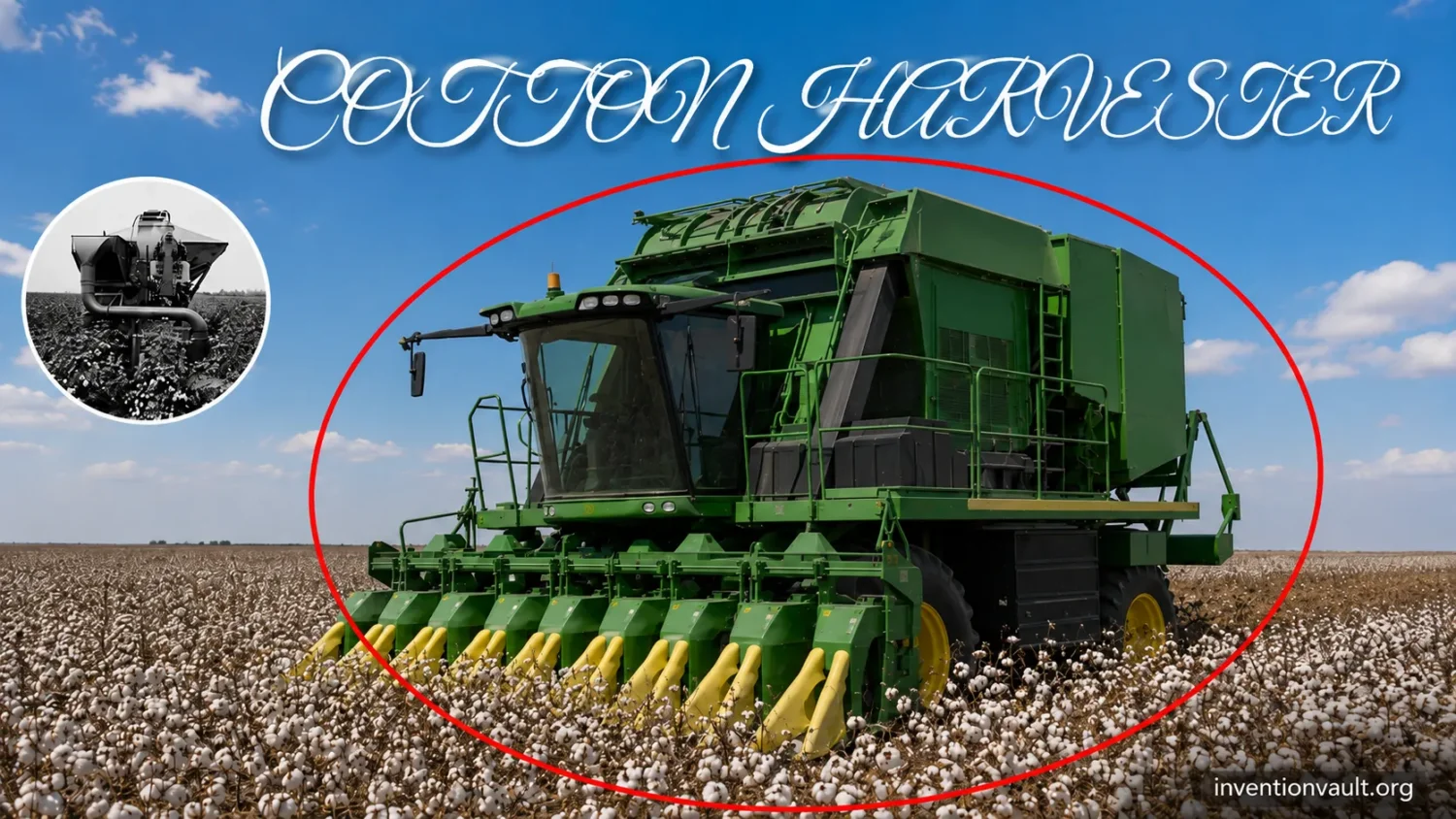
| Invention Name | Cotton harvester, also called a mechanical cotton picker when it selectively removes cotton from open bolls. |
|---|---|
| Main Purpose | To remove seed cotton from cotton plants in the field before ginning. |
| Earlier Patent Milestone | Samuel S. Rembert and Jedediah Prescott received U.S. Patent No. 7,631 for a field cotton-picking machine on September 10, 1850. |
| Practical Spindle Picker | John D. Rust, working later with his brother Mack D. Rust, developed a practical spindle-type cotton picker during the late 1920s and 1930s. |
| Public Demonstration | The Rust picker was demonstrated at the Delta Experiment Station in Stoneville, Mississippi, on August 31, 1936. |
| Early Commercial Machine | International Harvester’s “Old Red”, built in 1943, became one of the first commercial spindle cotton picking machines. |
| Main Machine Families | Spindle pickers and cotton strippers, with later self-propelled and onboard module-building designs. |
| Core Technical Problem | Picking fluffy cotton from open bolls without clogging the machine, damaging fiber, or collecting too much plant material. |
| Modern Example Data | A current six-row spindle picker may use 414 kW / 555 hp rated power and form round modules weighing roughly 2,222–2,676 kg. |
| Not the Same as | The cotton gin. A harvester gathers cotton from plants; a gin separates lint from seed after harvest. |
The cotton harvester solved a problem that looked simple only from far away. Cotton hangs in open bolls like soft white fiber, yet each boll sits on a branching plant, often surrounded by leaves, stems, dust, moisture, and uneven ripening. A useful machine had to enter the row, touch the cotton, pull the fiber away, release it inside the machine, and keep moving without turning the harvest into dirty waste. That is why the cotton harvester was not a single sudden idea. It was a long mechanical chase.
The Simple Definition
A cotton harvester is a field machine that gathers seed cotton from cotton plants. In its best-known form, the spindle picker, rotating spindles pull cotton from open bolls while the plant remains standing. In another form, the stripper, the machine removes more of the boll material and plant matter, then relies on cleaning systems to prepare the harvested cotton for ginning.
What the Cotton Harvester Does
The cotton harvester works before the gin and after the crop has matured in the field. Its job is not to make finished cotton fiber. It gathers seed cotton, meaning cotton lint still attached to the seed. That harvested material later goes to a gin, where seed, lint, and unwanted plant material are separated more fully.
This distinction matters because many readers confuse the cotton harvester with the cotton gin. The gin belongs to processing. The harvester belongs to field collection. One handles cotton after it leaves the plant. The other must meet the plant in the row, at field speed, under real weather and crop conditions.
Early inventors knew the goal. The difficult part was touch. Cotton fiber clings. Leaves tear. Stalks bend. Bolls open at different rates. A heavy-handed machine could knock cotton to the ground or drag too much trash into the basket. A timid machine could pass through the row and leave good cotton behind.
Why Cotton Was So Hard to Pick by Machine
Mechanical grain harvesting matured faster because grain heads can be cut, gathered, and threshed in a more uniform pass. Cotton asked for something more delicate. A good cotton harvester had to select open cotton from a living plant structure rather than simply cut the plant down.
Uneven Opening
Cotton bolls do not always open at the same time. A harvester must work when enough bolls are open, yet it must avoid taking too much unopened material.
Fiber Clogging
Spindles and picking fingers can grab cotton, but early designs often held it too well. The machine had to pick cotton and then let it go.
Plant Trash
Leaves, stems, burrs, and soil can enter the harvest stream. Cleaner cotton usually brings easier ginning and better fiber handling.
Row Shape
Cotton plants branch and vary in height. The machine must fit row spacing, enter the plant canopy, and keep its picking parts aligned.
Who Invented the Cotton Harvester
The fairest answer uses three milestones rather than one name. Samuel S. Rembert and Jedediah Prescott received an early U.S. patent in 1850 for a machine meant to pick cotton from standing plants. Their patent shows that the idea existed long before the working cotton picker became a dependable farm machine.
The practical spindle picker is most often linked to John D. Rust, with major help from his brother Mack D. Rust. John Rust worked on the idea through the late 1920s and 1930s. His central insight was that a spindle could pick cotton more cleanly if it used the right surface and moisture action, then released the fiber before clogging the mechanism.
The early commercial turning point came through International Harvester. Its machine known as Old Red, built in 1943, proved that spindle picking could move from experiment to real production. Later self-propelled machines pushed the invention toward the form people now recognize: a large, row-guided harvester that picks cotton, stores it, and in some models forms it into modules.
The cotton harvester should be credited as a chain of invention: early patents, practical spindle design, commercial engineering, and later field-scale refinement.
Timeline of the Cotton Harvester
| Date or Period | Milestone | Why It Matters |
|---|---|---|
| 1850 | Rembert and Prescott patent | The patent described a machine for picking cotton from bolls while plants still stood in the field. |
| Late 1800s | Inventor experiments | Designers tested picking fingers, revolving parts, curved prongs, and early spindle concepts, but dependable field success remained difficult. |
| 1897 | Peter Paul Haring patent work | Haring’s cotton-picking machine patent shows the long trial period before the practical spindle picker. |
| Late 1920s–1930s | Rust brothers develop spindle picker | John and Mack Rust improved the idea of using spindle action to pull cotton from open bolls. |
| 1936 | Stoneville demonstration | The Rust picker demonstrated that a machine could pick cotton in a public field test, even if the design still needed refinement. |
| 1943 | Old Red built by International Harvester | Old Red became one of the first commercial spindle cotton picking machines. |
| 1950 | Self-propelled cotton picker era | Self-propelled designs reduced dependence on tractor-mounted arrangements and helped scale field work. |
| 2007–2009 | Commercial onboard module systems | Harvesters that picked cotton and formed modules onboard changed harvesting logistics. |
| Today | High-capacity digital harvesters | Modern machines combine spindle or stripper units with guidance, onboard diagnostics, high horsepower, and module handling. |
How a Spindle Cotton Picker Works
The spindle picker is the classic cotton harvester because it performs a selective action. It does not simply strip the plant. It reaches into the open boll and removes cotton lint with seed still attached. The result is usually cleaner harvested material than a stripping action, especially where the crop, field, and climate suit spindle picking.
- Row units guide the cotton plants into the picking zone.
- Rotating spindles enter the plant canopy and twist cotton from open bolls.
- Moistener pads help the spindle surface grip cotton and manage release.
- Doffers wipe cotton from the spindles so the spindles can pick again.
- Airflow and conveyors move cotton into a basket or onboard module system.
The genius of the design is not just the spindle. It is the cycle: pick, remove, clean, repeat. A spindle that grabs cotton but never releases it is not useful. A doffer that removes cotton poorly slows the whole row unit. A moistener system that fails can reduce picking action. Each part depends on the next one.
Main Types of Cotton Harvesters
Cotton harvesters are often discussed as if every machine does the same job in the same way. They do not. The two main families are pickers and strippers, and the difference affects field conditions, cleaning needs, machine design, and fiber handling.
| Machine Family | Harvesting Action | Typical Result | Where It Fits Best |
|---|---|---|---|
| Spindle Picker | Rotating spindles pull cotton from open bolls. | Usually less plant material enters the machine. | Fields where open-boll cotton can be selectively picked. |
| Finger Stripper | Fixed or moving fingers strip bolls and cotton from the plant. | More burrs and plant material may enter the harvested stream. | Shorter plants, narrow rows, or conditions suited to stripping. |
| Brush-Roll Stripper | Brush rolls remove cotton and boll material from plants. | Harvested material often needs more cleaning before ginning. | Regions where stripper harvesting matches crop form and climate. |
| Self-Propelled Picker | Integrated engine, cab, row units, and cotton-handling system. | Higher field capacity and less reliance on separate tractor mounting. | Large-scale cotton production with aligned row systems. |
| Onboard Module Harvester | Picks or strips cotton and forms modules on the machine. | Reduces support equipment used during harvest. | Operations that need faster cotton handling after field collection. |
Spindle Pickers
A spindle picker aims for selectivity. It uses rotating spindles to take cotton from open bolls, then doffers remove that cotton from the spindle. The best-known practical breakthrough came when inventors learned that spindle surface, moisture, angle, timing, and cleaning mattered as much as raw pulling force.
Cotton Strippers
A stripper removes more material from the plant. That can be useful in certain regions and crop systems, especially when plant form and field conditions support this method. The trade-off is simple: a stripper may gather more cotton in one pass, but it may also bring more plant matter into the harvested material.
Onboard Module Harvesters
Later cotton harvesters did more than pick. Some machines compact cotton into modules on the harvester itself. This changed the harvest chain because cotton no longer had to move immediately from picker to boll buggy to separate module builder in the same way. Modern round-module systems wrap cotton into large cylindrical packages that can wait for transport to the gin.
The Rust Brothers and the Practical Spindle Picker
John D. Rust is often called the inventor of the practical mechanical cotton picker. That wording is careful for a reason. Earlier inventors had tried to mechanize cotton picking, yet their machines did not become widely dependable farm tools. Rust’s contribution was practical: he focused on how cotton sticks, how it releases, and how the machine could repeat that action across a row.
His brother Mack D. Rust brought engineering skill to the work. The Rust patents and prototypes moved cotton harvesting away from vague ambition and toward a machine with row units, spindles, housing, and a repeatable picking cycle. Their work did not instantly produce a mass-market machine, but it gave later engineering teams a clearer path.
The 1936 public demonstration in Mississippi showed both the promise and the remaining faults. The machine did pick cotton. It also needed better durability, cleaner picking, and stronger manufacturing support. That mixed result is part of the invention’s real history. Good inventions often arrive rough.
Old Red and the Move into Commercial Harvesting
International Harvester’s Old Red became a museum-worthy machine because it marked a move from hopeful prototypes to commercial spindle picking. Built in 1943, it was one of the first commercial spindle cotton picking machines. The National Museum of American History records it as the 25th of 30 machines manufactured that year.
Old Red usually operated at about 2 mph and picked 8,000 bales before retirement in 1959. Those numbers give the invention a physical scale. It was not just a clever mechanism. It became a working agricultural machine that could spend years in the field.
Why Old Red Matters
Old Red matters because it separates a patent story from a field story. A patent can show an idea. A prototype can prove a mechanism. A commercial machine has to survive use, service, repairs, transport, dust, plant matter, and repeated harvest seasons.
Technical Parts That Made the Invention Work
The cotton harvester became useful only when several mechanical systems worked together. A single spinning part could not solve the whole harvest. The machine needed a controlled path from plant to storage.
| Part or System | Function | Why It Matters |
|---|---|---|
| Row Divider | Separates and guides plants into the picking unit. | Good entry reduces missed cotton and plant disturbance. |
| Spindle | Rotates into open bolls and pulls seed cotton free. | This is the main picking action in a spindle picker. |
| Moistener Pad | Controls moisture on the spindle surface. | Proper moisture helps cotton grip and release in the right sequence. |
| Doffer | Removes cotton from the spindle. | Without doffing, spindles clog and picking quality drops. |
| Air System | Moves harvested cotton away from the row unit. | Fast movement keeps the row unit clear during field operation. |
| Basket or Module Builder | Stores or compacts harvested seed cotton. | Storage capacity affects field rhythm and support equipment needs. |
| Cleaning System | Removes some plant material before or during handling. | Cleaner seed cotton is easier to gin and manage. |
Modern Cotton Harvester Scale
Modern cotton harvesters show how far the invention moved from early wheeled frames and experimental pickers. A current spindle picker such as the John Deere CP770 lists 414 kW / 555 hp rated engine power, six-row configurations, in-line spindle picking units, and round modules up to 244 cm in diameter and 239 cm wide.
The machine’s module weight range of about 2,222–2,676 kg shows a major shift in cotton handling. The harvester no longer acts only as a picker. It can also become a mobile packaging point, shaping cotton into field-ready modules before transport.
That change matters because harvest is also a logistics problem. Picking cotton is one task. Moving it, protecting it, storing it, and sending it to the gin are separate tasks. Onboard module building pulled several steps closer to the machine itself.
Cotton Harvester vs Cotton Gin
The cotton gin and the cotton harvester are linked, but they are not the same invention. The gin separates cotton lint from seed after harvest. The harvester gathers seed cotton from the field. A farm can have excellent ginning equipment and still need an efficient way to collect cotton from plants.
This is one reason the cotton harvester took so long to perfect. Ginning happens at a fixed site with powered machinery and controlled feeding. Harvesting happens outdoors, across uneven fields, with crop conditions changing by row, day, moisture level, and plant variety.
Why the Invention Still Matters
Cotton remains a major natural fiber crop, and the harvester still shapes how cotton moves from field to textile supply chains. The OECD-FAO outlook for 2025–2034 projects global cotton production reaching 29.5 million tonnes by 2034, with yield gains playing a large role. That forecast makes the harvester more than a historic machine. It is part of a living production system.
Modern research also shows that cotton harvesting is not finished as an engineering subject. USDA work continues to study picker and stripper systems, harvesting efficiency, crop handling, and new harvest concepts. The invention keeps changing because cotton itself remains difficult to gather cleanly at scale.
Common Misunderstandings
“One Person Invented It Completely”
The cotton harvester has many inventors in its background. Rembert and Prescott patented an early field machine. Haring and other designers worked on later concepts. John and Mack Rust advanced the practical spindle picker. International Harvester helped bring commercial production into view.
“A Picker and a Stripper Are the Same Machine”
They are both cotton harvesters, but their actions differ. A picker uses spindles to remove cotton from open bolls. A stripper removes more boll and plant material, then depends more heavily on cleaning.
“The Harvester Replaced the Gin”
It did not. The cotton harvester collects seed cotton. The gin processes it afterward. The two machines sit at different points in the cotton chain.
Related Inventions Around Cotton Harvesting
The cotton harvester sits inside a wider machine family. Its story connects to other inventions that changed cotton farming and processing without doing the same job.
- Cotton gin: separates lint from seed after seed cotton leaves the field.
- Mechanical planter: helps place cotton seed in rows suited to later cultivation and harvest.
- Tractor power systems: made mounted and self-propelled harvesting equipment practical.
- Cotton module builder: compacted harvested cotton into larger units for storage and transport.
- Onboard round-module system: combined picking and module forming inside one harvester.
- Digital guidance and diagnostics: help modern machines maintain row alignment, monitor machine condition, and manage field operation.
A More Accurate Way to Remember It
The cotton harvester was not born as one finished machine. It moved through sketches, patents, failed mechanisms, field trials, spindle refinements, commercial machines, self-propelled designs, and module-building systems. Its lasting value comes from a careful mechanical act: removing cotton from the plant while leaving as much unwanted material behind as possible.
That small act required nearly a century of invention before farmers could use it at scale. The best cotton harvesters still depend on the same principle: touch the cotton correctly, release it cleanly, move it safely, and keep the machine working row after row.
References Used for This Article
- National Museum of American History — International Harvester Mechanical Cotton Picking Machine: Supports the 1943 Old Red details and museum record.
- Google Patents — US7631A Improvement in Picking Cotton from the Bolls in the Field: Provides the 1850 patent text and publication date.
- Google Patents — US2023491A Cotton Picking Machine: Shows John D. Rust and Mack D. Rust’s 1935 cotton picking machine patent.
- The Henry Ford — Self-Propelled Cotton Picker, 1950: Describes the 1950 self-propelled picker and its recorded labor-reduction claim.
- ASABE — Old Red Cotton Picker, 1978: Records Old Red’s engineering landmark wording and 8,000-bale service history.
- Encyclopedia of Arkansas — John Daniel Rust: Gives biographical details on John Daniel Rust, Mack Rust, and the 1936 demonstration.
- John Deere — CP770 Cotton Picker: Provides modern machine specifications, row units, module size, and spindle details.
- Cotton Incorporated — A Brief History of Cotton Modules: Explains the shift from conventional modules to onboard module-forming harvesters.
- USDA Agricultural Research Service — Cotton Production and Processing Research: Notes continuing research on pickers, strippers, and new harvest concepts.
- OECD-FAO — Cotton Agricultural Outlook 2025–2034: Gives current cotton production outlook data and the role of yield gains.