
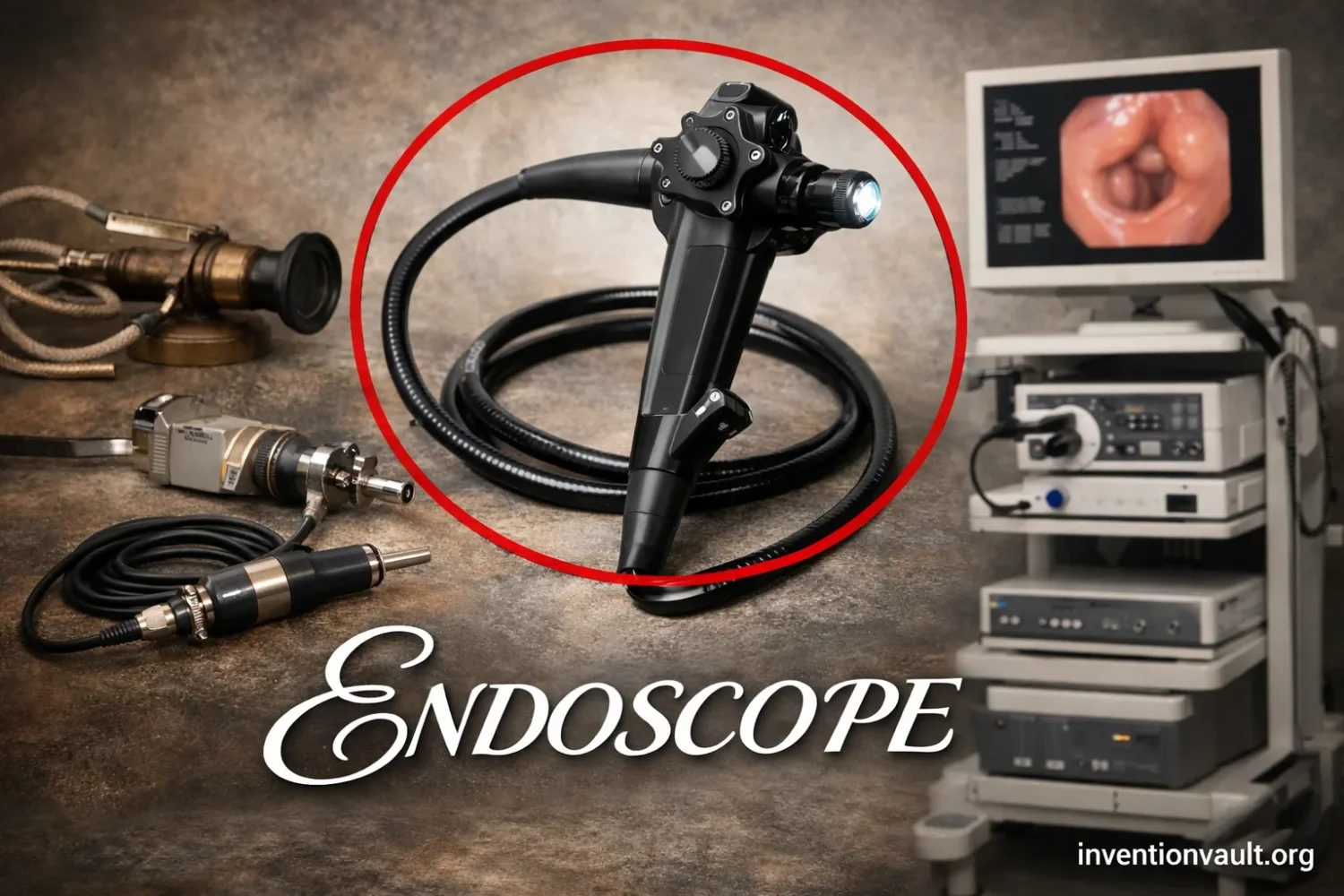
| Aspect | Detail |
|---|---|
| Commonly Credited Starting Point | Philipp Bozzini, whose Lichtleiter is usually placed at the start of endoscope history. |
| Earliest Date Widely Cited | 1806, the year Bozzini described the instrument that carried reflected light into body cavities. |
| Original Device Name | Lichtleiter, usually translated as “light conductor”. |
| Early Clinical Aim | Direct inspection of internal canals and cavities rather than relying only on symptoms or touch. |
| First Illumination Method | A candle with reflected light guided through a tube and mirror system. |
| Body Areas Targeted Early On | The bladder, rectum, and pharynx appear often in early historical accounts of Bozzini’s design. |
| Name “Endoscope” Popularized By | Antonin Jean Desormeaux, who improved the instrument in the mid-19th century and helped fix the term in medical use. |
| Rigid Endoscopy Leap | Maximilian Nitze and instrument makers such as Joseph Leiter moved the device toward direct vision and better internal lighting in the late 1870s. |
| Flexible Endoscopy Leap | Rudolf Schindler in the early 1930s and Basil Hirschowitz with colleagues in the 1950s pushed the instrument toward true flexibility. |
| Optical Breakthroughs | Harold Hopkins improved image quality with rod-lens optics, and Karl Storz advanced fiberoptic light transmission. |
| What the Invention Became | A family of rigid, semi-flexible, flexible, video, and capsule instruments adapted to different organs, access routes, diagnostic needs, and treatments. |
| Most Accurate Short Answer | The endoscope was not a one-step invention; it matured through linked advances in light, optics, flexibility, and imaging. |
Doctors wanted a direct view inside the body long before modern imaging existed. The endoscope answered that need in a literal way: it brought light into a cavity, returned a visible image, and turned hidden anatomy into something a physician could inspect with the eye rather than imagine from symptoms alone. The device most often placed at the start of that story is Philipp Bozzini’s 1806 Lichtleiter, yet the instrument known today did not appear in finished form all at once. It took shape over decades.
Who Invented the Endoscope?
The cleanest answer is also the least misleading: Bozzini is usually credited with the first endoscope, though the modern instrument came from a chain of inventors, physicians, and optical specialists. His early design established the central idea. A physician could guide light into an internal space and inspect a body cavity directly.
That early step did not settle the story. In the mid-19th century, Antonin Jean Desormeaux improved illumination and helped attach the word endoscope to the instrument. A little later, Adolf Kussmaul showed that upper digestive inspection was possible, even if the method was still rigid and uncomfortable; his early gastroscopy is closely linked with the famous use of a professional sword swallower. In the late 1870s, Maximilian Nitze pushed the instrument much closer to what many historians call modern rigid endoscopy by combining better optics with internal light.
A fuller answer must also include the people who changed the instrument after its first appearance. Rudolf Schindler moved gastroscopy toward flexibility in the early 1930s. Basil Hirschowitz and his collaborators then changed the field in the 1950s by producing a practical flexible fiberoptic scope. Seen this way, the invention of the endoscope is best understood as a layered invention, not a single isolated moment.
The endoscope began as a viewing tube with reflected light. It became a modern instrument only after optics, illumination, flexibility, and image capture improved enough to work together.
How the First Endoscope Worked
Bozzini’s first design looks simple by present standards, though the idea behind it was remarkably clear. It used a protected candle flame as the light source, mirrors to direct that light, and a tube fitted with attachments for different body openings. The physician looked directly through the instrument. No camera was involved. No monitor existed. The image depended on line of sight, available light, and the narrow geometry of the tube.
- The instrument needed a source of illumination strong enough to reach inside the body.
- It needed a viewing path that let the operator see what the light revealed.
- It needed cavity-specific fittings so the same idea could be adapted to different openings.
- It needed to remain narrow enough to enter the body without making the attempt impossible.
Those basic needs still define endoscopes. What changed was the quality of each part. Early models gave a dim image, produced heat, offered only a narrow field, and reached limited depths. They proved the concept before they solved the practical problems.
What Early Designers Needed
- More light inside deep cavities
- A clearer image path
- Less heat near tissue
- More control over insertion
- Less discomfort for the patient
What Held Early Models Back
- Weak and uneven lighting
- Rigid shafts with limited reach
- No image recording
- Small viewing field
- High reliance on operator skill
Milestones That Turned a Concept Into a Medical Instrument
| Period | Person or Team | Change | Why It Mattered |
|---|---|---|---|
| 1806 | Philipp Bozzini | Described the Lichtleiter. | Established the core idea of direct internal viewing with guided light. |
| 1853 | Antonin Jean Desormeaux | Improved illumination and promoted the term endoscope. | Moved the instrument toward regular medical use and clearer naming. |
| 1868 | Adolf Kussmaul | Performed early gastroscopy with a rigid instrument. | Showed that inspection of the upper digestive tract could be attempted in practice. |
| Late 1870s | Maximilian Nitze and Joseph Leiter | Developed a true working cystoscope with better optics and internal light. | Brought endoscopy closer to modern direct-vision practice. |
| Early 1930s | Rudolf Schindler | Advanced the semi-flexible gastroscope. | Improved reach and made upper gastrointestinal inspection more practical. |
| 1950s | Basil Hirschowitz and colleagues | Produced the flexible fiberoptic endoscope. | Changed endoscopy from a rigid, limited procedure into a far more adaptable one. |
| 1959 | Harold Hopkins | Introduced rod-lens optics for clearer rigid endoscopic images. | Raised image quality sharply in rigid scopes used for surgery and diagnosis. |
| 1960 | Karl Storz | Advanced fiberoptic light transmission and cold-light practice. | Improved illumination while reducing heat at the operating end. |
| Late 20th century | Multiple medical and engineering teams | Shifted many systems to video imaging and monitor viewing. | Made teaching, recording, teamwork, and image-guided procedures easier. |
How the Endoscope Split Into New Forms
Once the basic idea worked, the endoscope did not remain a single instrument. It branched into a family of tools shaped by anatomy, specialty, and purpose. That branching matters because the history of the endoscope is also the history of its subtypes, while several of those subtypes later developed invention histories of their own.
Rigid Instruments
Rigid scopes remained useful where a straight path and sharp optics were possible. The cystoscope, many laparoscopes, arthroscopes, and several ENT instruments belong to this line. They share rigid-endoscope ancestry, but each later developed around a different anatomical access problem.
Flexible Instruments
The gastroscope, bronchoscope, and colonoscope needed far more flexibility because the body does not offer a straight corridor. Fiber optics, steering controls, and later chip-on-tip imaging turned these scopes into the dominant form for many internal examinations.
Video and Capsule Systems
Later devices replaced direct eyepiece viewing with electronic imaging. Video endoscopes let a whole team see the same image at once. Capsule endoscopes took the idea further by turning the camera into a swallowable device for selected parts of the digestive tract.
That spread into new forms explains why no single description captures the whole invention. A colonoscope, bronchoscope, laparoscope, and cystoscope share ancestry, yet each reflects a different anatomical problem. The endoscope became a platform that could be reshaped for many organs rather than a fixed object with one final form. The abdominal access, insufflation, and surgical history of the laparoscope belongs to that instrument’s own development rather than to the general endoscope timeline.
Why the Invention Changed Medical Practice
- It replaced blind internal inspection with direct visualization.
- It made tissue sampling, foreign-body retrieval, and several internal procedures more precise because the operator could see the target.
- It reduced the need for blind or indirect assessment in many settings as rigid and later flexible scopes improved.
- It allowed recording, teaching, and shared viewing after video systems became normal.
- It turned one instrument idea into many organ-specific tools used across gastroenterology, urology, pulmonology, surgery, and other fields.
The practical effect was plain. Physicians could inspect mucosa, bleeding points, obstructions, ulcers, tumors, stones, and foreign bodies with far more confidence than earlier methods allowed. Over time, the endoscope also stopped being only a diagnostic device. It became a treatment platform.
What Makes a Modern Endoscope Different
| Feature | Early Endoscope | Modern Rigid Scope | Modern Flexible Scope |
|---|---|---|---|
| Light Source | Candle or external flame-based illumination | Powerful external light with efficient transmission | External light or distal electronic imaging systems with strong illumination |
| Image Path | Direct viewing through mirrors and a straight tube | High-quality rod-lens optics | Fiber bundles or digital chip-on-tip imaging |
| Movement | Very limited | Stable but mostly straight | Steerable tip and curved navigation |
| Patient Comfort | Low by modern standards | Depends on access route and indication | Far better for winding internal passages |
| Image Recording | None | Possible through attached systems | Routine with digital video capture |
| Working Channel | Minimal or absent | Often present in procedural models | Common for biopsy, suction, irrigation, and tools |
A modern endoscope is more than a tube with a light. It combines illumination, image transmission, steering or rigid optical control, air or fluid handling where needed, and often a channel for tools. Different specialties adapt those functions to different anatomical routes.
By the time flexible fiberoptic and later video systems became normal, the endoscope was no longer just a viewing device. It had become a means to inspect, document, biopsy, retrieve, cauterize, and perform selected treatments through endoscopic access routes. That long transition is the most accurate way to understand the invention of the endoscope: a first concept in 1806, followed by decades of refinement that turned visibility inside the body into a practical medical reality.
References Used for This Article
- National Center for Biotechnology Information — Endoscopy Lifetime Systems Architecture: Scoping Out the Past to Diagnose the Future Technology: Explains the historical stages of endoscope design and the technical changes in light, optics, and imaging.
- PubMed — Philipp Bozzini (1773-1809): The Earliest Description of an Endoscope: Supports the early Bozzini narrative and the place of the Lichtleiter in endoscope history.
- NCBI Bookshelf — Cystoscopy: Summarizes the working cystoscope developed by Nitze and Leiter and its role in later practice.
- PubMed — Visceral Vistas: Basil Hirschowitz and the Birth of Fiberoptic Endoscopy: Describes how the flexible fiberoptic scope changed gastrointestinal endoscopy.
- National Museum of American History — Gastroscope, Schindler: Documents Rudolf Schindler’s early flexible gastroscope and its place in the museum record.
- Olympus Global — History of Olympus Products: Endoscopes: Provides a manufacturer history page that traces later industrial development in endoscopy.
- PubMed — Endoscopic Surgery: the History, the Pioneers: Helps place endoscopy within the rise of procedural and surgical endoscopy.
- PubMed — Revolutionary Inventions in the 20th Century. The History of Endoscopy: Supports the discussion of Hopkins optics and Storz illumination advances.