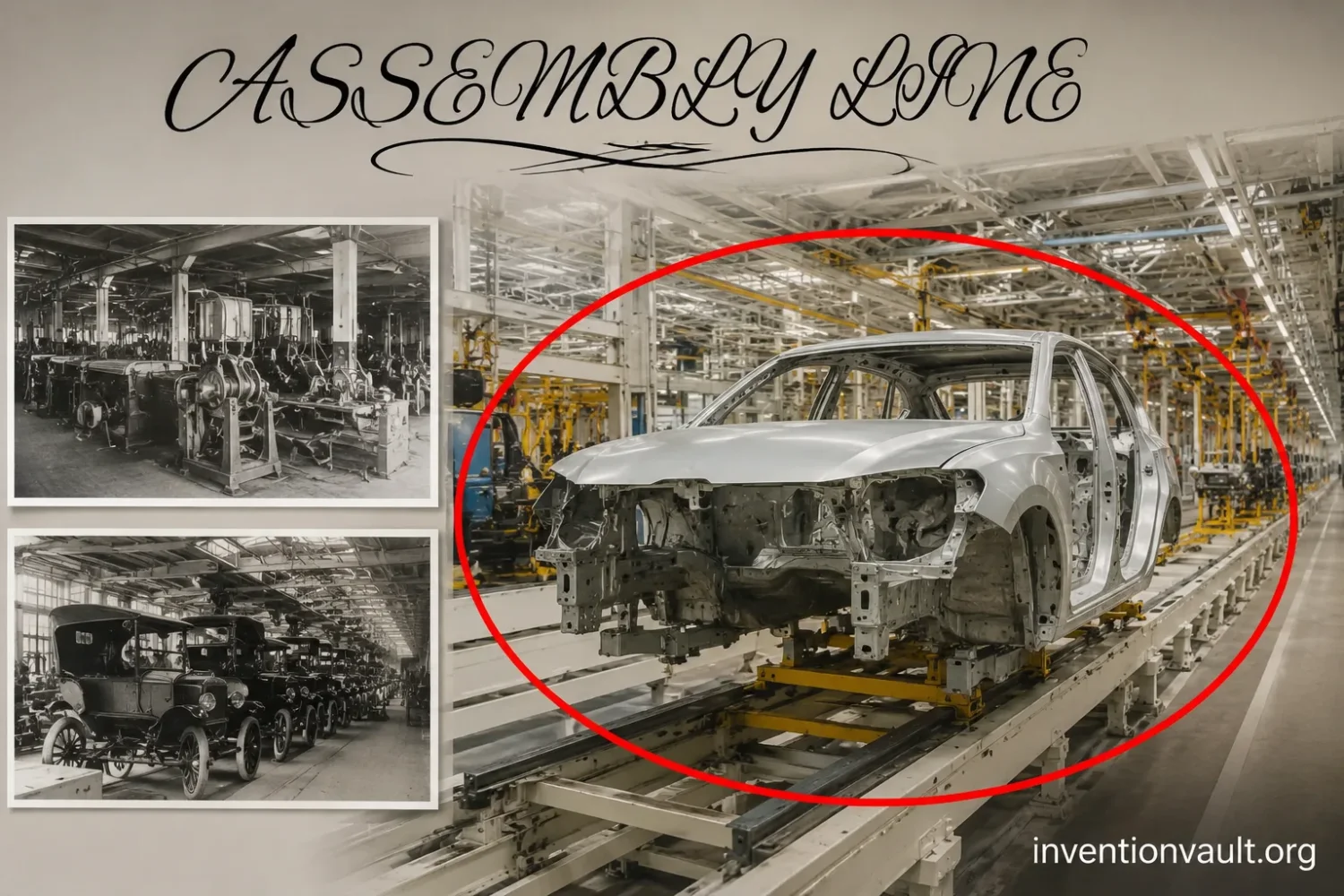
Production System Timeline
How the Moving Line Took Shape
Trace the earlier methods, Ford experiments, factory redesign, output gains, and labor consequences behind moving automobile assembly.
Industrial precedents
Flow Production Before Ford
Current stage
Existing principle
Interchangeable parts, divided labor, conveyors, and sequential processing already appeared in armories, mills, food production, and other industries before automobile assembly.
Useful observation
Factories gained speed when material followed a planned route and workers repeated a smaller set of operations instead of carrying a product through every task.
Unsolved problem
An automobile contained many interdependent parts. Applying flow production required accurate components, timed deliveries, ordered stations, and a way to prevent one slow task from stopping the line.
Ford inherited several production ideas; the difficult step was joining them into one synchronized automobile system.
Automotive precedent
Ransom Olds and Progressive Assembly
Current stage
Documented first
Olds Motor Works produced the Curved Dash Oldsmobile with an early automotive assembly arrangement beginning in 1901, years before Ford introduced continuous movement.
Production pattern
Work was divided and vehicles advanced through assembly, but the system lacked the fully synchronized, chain-driven motion later associated with Ford’s Highland Park plant.
Credit boundary
Olds is central to the history of automotive assembly. Ford’s claim rests on developing and scaling the continuously moving line rather than inventing assembly itself.
The Olds precedent separates the first automotive assembly line from Ford’s later moving production system.
Production constraint
Model T Demand Exposed Delay
Current stage
Market pressure
The Model T reached customers in 1908. Rising orders made stationary team assembly too slow for Ford’s low-price, high-volume sales plan.
Lost time
Workers walked around vehicles, fetched parts and tools, waited for other tasks, and performed long sequences that differed in duration from one crew to another.
Design target
Ford managers sought a production rhythm in which parts arrived at the point of use and each station completed a narrowly timed operation.
The production bottleneck was movement and waiting as much as the mechanical act of fastening parts.
1913 experiment
The Magneto Line Proved the Method
Current stage
Starting point
Around April 1, 1913, Ford placed Model T flywheel magnetos on a simple moving line and divided assembly among workers standing beside a platform.
Measured change
A magneto that had taken one worker about 20 minutes emerged every 13 minutes under the first arrangement, then every five minutes after further adjustments.
Next application
The successful small-part test encouraged Ford managers to apply the same logic to engines, transmissions, and eventually complete chassis.
The magneto test turned a general flow idea into a measured production method that could be extended.
System integration
The Chassis Became the Moving Spine
Current stage
August expansion
Ford extended moving assembly to complete chassis in August 1913. Early chassis were pushed or pulled before chain-driven systems regulated their motion.
Feeder lines
Engines, transmissions, wheels and other subassemblies arrived from smaller lines timed to meet the main chassis route at the required station.
Controlled pace
Continuous motion reduced handling and established a common tempo. The slowest station became a measurable production constraint that managers could rebalance.
The moving chassis linked separate departments into a factory-wide flow rather than a single conveyor demonstration.
Production result
Mass Output Changed the Cost Structure
Current stage
Assembly time
By mid-1914, Ford’s refined system had reduced the often-cited Model T assembly time from about 12.5 hours to 93 minutes.
Parallel work
Many vehicles occupied the line at once. The 93-minute journey through assembly did not mean that only one car could be completed every 93 minutes.
Economic loop
Lower labor time per car supported price cuts, higher demand and larger output, which gave Ford more reason to refine machines, routing and task timing.
Mass production came from synchronized parallel work, not from one worker building an entire car faster.
Workplace consequence
The Line Took Control of Work Pace
Current stage
Task change
Broad craft work was divided into short, repeated motions. Training could be faster, but workers lost variety and much of their control over pace.
Turnover
Ford experienced labor turnover reported at 370 percent as workers quit, arrived late or missed shifts rather than endure repetitive line work.
Five-Dollar Day
Ford announced a five-dollar day and an eight-hour shift in January 1914. The plan helped retain labor but initially included conditions enforced through company inspection of workers’ home lives.
The production system lowered car costs while transferring control of time from skilled crews to factory management.
Henry Ford did not invent assembly work, interchangeable parts, or the first automotive assembly line. Ford Motor Company’s lasting contribution was the continuously moving automobile assembly system developed at Highland Park during 1913 and refined into 1914. It brought standardized parts, divided labor, feeder lines, planned routing, and controlled motion into one production method. Ransom E. Olds had already used a stationary or progressive assembly arrangement for the Curved Dash Oldsmobile in 1901. Ford’s team made the vehicle move past fixed stations at a regulated pace and built the surrounding factory around that flow.
| Assembly line fact | Historically grounded description |
|---|---|
| Best description of Ford’s innovation | Integrated, continuously moving automotive assembly |
| Earlier automotive precedent | Ransom E. Olds and progressive or stationary assembly, beginning in 1901 |
| Main development site | Ford Motor Company’s Highland Park plant in Michigan |
| Experimental period | 1913 through early 1914 |
| Early moving-line test | Model T flywheel magneto assembly around April 1, 1913 |
| Complete chassis application | Introduced during 1913, with August tied to early chassis experiments |
| Often-cited time reduction | About 12.5 hours to 93 minutes by mid-1914 |
| Production principles combined | Interchangeable parts, task division, sequenced flow, timed delivery and line balancing |
| Main labor effect | Shorter training and narrower tasks, paired with repetition and line-controlled pace |
Who Invented the Assembly Line?
The question depends on what the term assembly line is being used to mean. Sequential production existed long before the automobile. Workshops and factories had divided jobs among specialized workers, arranged machines by process, and moved materials between operations. Nineteenth-century arms production also pushed the use of gauges and interchangeable components, although true interchangeability was achieved unevenly and required careful machine work.
Automobile history adds another distinction. Ransom E. Olds used an assembly arrangement to produce the Curved Dash Oldsmobile in volume from 1901. The vehicle advanced through production while tasks were divided among workers. The Smithsonian describes the Olds factory as the first to build cars on an assembly line, while also specifying that it was not a moving line in the Ford sense.
Assembly vs. Moving Assembly
An assembly line organizes work into a sequence. A continuously moving assembly line adds regulated product motion, timed stations, coordinated part delivery, and a shared production pace.
Olds Progressive Assembly
Olds divided automobile production into stages and moved vehicles through them. The arrangement enabled higher output than craft-style car building but was not yet a factory-wide, continuously powered system.
Ford Moving Assembly
Ford synchronized a moving chassis with fixed jobs, incoming subassemblies, standardized parts and controlled timing. The line became the center of the plant’s production organization.
Henry Ford therefore deserves credit for directing and financing the production strategy that made moving automotive assembly practical at a vast scale. Credit also belongs to the managers, engineers, tool designers and production workers who tested and altered the system. Calling Ford the sole inventor hides both the Olds precedent and the collaborative nature of the work at Highland Park.
Production Flow Before Ford
Ford’s factory methods did not appear from an empty industrial landscape. The useful ideas were scattered across several trades. Flour mills used gravity and conveyors to move material through ordered stages. Breweries and food plants placed processes in a fixed sequence. Meatpacking plants carried carcasses past workers who repeatedly removed one part. Manufacturing shops divided complex work into smaller jobs and used fixtures or gauges to control dimensions.
The meatpacking comparison is often told as a single moment in which Ford copied a slaughterhouse “disassembly line.” That version is too neat. Later accounts connect Ford employee William “Pa” Klann with observations of Chicago meatpacking, and the resemblance is clear: a main object moves while stationary workers perform one repeated task. Records also point to bakeries, mills, breweries, foundries and other conveyor-based operations as part of the wider industrial background.
The transfer was not literal. A carcass can be separated by removing parts in sequence. An automobile must receive hundreds of parts in the right order, with tolerances close enough for them to fit, while engines, transmissions, wheels, controls and bodies arrive from other departments. The automobile line required a coordination problem to be solved across the entire plant.
Why Model T Production Needed a Different System
Ford introduced the Model T in 1908 as a durable, relatively simple automobile aimed at a broad market. Demand rose beyond what stationary team assembly could handle efficiently. Under the older method, a vehicle remained in place while mechanics and helpers moved around it. A team might complete a broad range of tasks, fetch parts from storage, locate tools, adjust pieces that did not fit cleanly, and wait for another operation to finish.
That arrangement wasted time in ways that were hard to see when attention stayed on the mechanic’s hands. Walking, reaching, carrying, searching, repositioning and waiting all lengthened assembly. Crews also worked at different speeds. A fast group could not create a stable factory rhythm if the next operation took longer or a part failed to arrive.
Ford’s production managers attacked those delays by reversing the movement pattern. The worker would remain near the required tools and parts. The product would arrive. Each job would be shortened until its duration could fit the pace of the line. The factory’s layout, supply routes and machine positions then had to support that sequence.
The 1913 Experiments at Highland Park
The moving assembly line developed through a chain of experiments rather than a single unveiling. The earliest well-documented Ford test involved the Model T flywheel magneto. Around April 1, 1913, workers stood along a waist-high platform. Instead of one person assembling a magneto from start to finish, each person added a limited set of parts and slid the work to the next station.
Ford records summarized by The Henry Ford give a clear measure of the change. One worker had needed about 20 minutes to assemble a magneto. The first divided arrangement produced one in about 13 minutes. After the jobs and layout were revised, the time fell to about five minutes. The lesson was broader than the component itself: repeated tasks, orderly movement and close part placement could produce a measurable gain.
The method spread to engines and transmissions. By August 1913 it was being applied to complete chassis. Early photographs show that the chassis line was not immediately a polished, motor-driven conveyor. Workers first pushed or pulled assemblies. Chain-driven systems followed, reducing handling and setting a more regular speed.
| Date or period | What the date describes | Why it matters |
|---|---|---|
| 1901 | Olds Motor Works uses progressive or stationary assembly for the Curved Dash Oldsmobile | Establishes an automotive assembly-line precedent before Ford |
| 1908 | The Model T enters the market | Growing demand creates pressure for a higher-output method |
| Around April 1, 1913 | Ford tests moving assembly on flywheel magnetos | Provides a measured proof on a manageable subassembly |
| Mid-1913 | The method spreads to engines and transmissions | Shows that the approach can handle larger assemblies |
| August 1913 | Moving work is applied to complete chassis | Connects major vehicle systems on a main route |
| October 1913 | Library of Congress history marks the moving automobile line at Highland Park | Commonly used date for the public-facing automobile milestone |
| Early to mid-1914 | Continuous lines are refined and the 93-minute figure is reached | Represents a mature operating system rather than the first experiment |
Why Several 1913 Dates Appear
April refers to the magneto test, August to complete chassis experiments, and October to the moving automobile line at Highland Park. Early 1914 marks further integration and powered-line refinement.
How Ford’s Moving Assembly System Worked
A conveyor alone could not deliver Ford’s output. The moving line depended on several production rules working together. Parts had to be consistent enough to fit without extensive hand adjustment. Tasks had to be ordered so that one operation did not block the next. Supplies had to arrive beside the correct worker. Subassemblies had to meet the main chassis line at the right time. Managers also had to measure each station and respond when work accumulated.
- Standardize the partsGauges, machine tools and repeatable dimensions reduced filing, fitting and individual adjustment during final assembly.
- Divide the workA long craft job became many short operations, allowing each station to use fixed tools and a repeatable motion.
- Feed the stationsParts and subassemblies were routed to the point of use so workers spent less time walking or searching.
- Move the chassisThe main product advanced past fixed stations, first by simple pushing or pulling and later through chain-driven movement.
- Balance the lineManagers adjusted staffing, task boundaries, tool positions and line speed when one station could not match the required cycle.
The Chassis as the Main Route
The chassis acted as the spine of final assembly. Frames received axles and other running gear. Engines and transmissions arrived from their own production routes. Controls, wheels, radiators, fuel systems, bodies and fittings joined in an order chosen to limit obstruction and handling. The precise sequence changed as Ford altered plant layout and Model T production methods, so no single diagram describes every Highland Park line for the entire production run.
Feeder Lines and Factory Timing
Smaller lines converged on final assembly. An engine line could not simply produce as fast as possible and send a pile of engines to the chassis area. Its output had to reach the installation point in step with the main route. The same applied to transmissions and other assemblies. This coordination turned the plant into a linked production network.
The Slowest Station Set the Limit
A moving line exposes delay. When one task takes longer than the available cycle, work piles up before that station or incomplete products move onward. Ford managers could split the task, add another worker, alter the tool, change the platform height, reposition parts or adjust line speed. The method encouraged constant revision. Highland Park’s line was never a frozen invention.
From 12.5 Hours to 93 Minutes
The best-known figure in the Ford story is the reduction of Model T assembly time from roughly 12.5 hours to 93 minutes by mid-1914. It describes the time a vehicle spent moving through the refined assembly process. It does not cover mining ore, casting every component, machining all parts, making tires, transporting supplies, drying every coating, or delivering the finished car.
The number also does not describe the interval between finished cars. Many chassis occupied the route at the same time. Once a line was filled, completed vehicles could emerge much more frequently than one every 93 minutes. The Henry Ford’s research service reports that three parallel chassis lines were operating by April 1914 and could assemble more than 1,200 chassis during an eight-hour shift. That output is possible because the work was performed simultaneously across many stations and vehicles.
Total Time Is Not Cycle Time
Ninety-three minutes describes a car’s journey through assembly. Line output depends on how often a finished unit leaves after the stations are filled and synchronized.
This distinction prevents a common arithmetic error. Dividing an eight-hour shift by 93 minutes treats the plant as though it built one complete car and then started the next. A production line overlaps the work. One chassis can receive an engine while another receives wheels and a third enters inspection.
How Mass Production Lowered the Model T’s Price
The moving assembly line reduced labor time attached to each car and made output more predictable. It also supported investment in specialized machinery because large production runs spread the cost of that equipment across many vehicles. Ford could order materials in larger quantities, simplify parts, refine tooling and learn from repeated work.
Model T prices varied by year and body style, but the broad direction is clear. The car cost more than $800 in its early years, while Ford offered versions for $260 by 1925. More than 15 million Model Ts were produced before the model ended in 1927. The line contributed to that price decline, though it was not the only cause.
Several linked changes mattered:
- Standardized design: fewer variations simplified tools, inventories and station instructions.
- High output: machine, building and engineering costs were spread across more cars.
- Shorter handling: workers and components traveled less distance during final assembly.
- Special-purpose machinery: repeated operations justified equipment built for a narrow task.
- Supplier and material coordination: larger, steadier orders supported planned purchasing and delivery.
- Continuous revision: seconds saved at many stations accumulated into lower labor time per vehicle.
Price cuts then increased demand. Higher demand supported even larger output, which created fresh reasons to simplify the car and refine the plant. The economic effect came from this repeated loop rather than one sudden drop caused by a conveyor.
Standardization Made the Line Possible
A moving line works poorly when every product requires a different tool, fitting method or sequence. Ford’s production system depended on parts that could be installed with little individual correction. It also favored a car whose design changed slowly enough for dedicated machines, fixtures and worker routines to remain useful.
Standardization brought lower cost and steadier assembly, but it narrowed variation. A customer request that changed a component could interrupt supply, alter station time or require a separate route. The famous association between the Model T and limited choice reflects a production truth: variety creates scheduling, inventory and tooling work.
| Standardization enabled | Standardization restricted |
|---|---|
| Repeatable station work | Individual customization |
| Interchangeable service parts | Frequent design variation |
| Special-purpose tools | Rapid changes to the product |
| Predictable part supply | Large option combinations |
| Lower unit cost at high volume | Economical production at very low volume |
The factory influenced the design of the car, and the car’s design influenced the factory. Ford engineers did not merely find a faster way to assemble an unchanged object. They developed a product-production relationship in which simplicity, fit, routing and volume reinforced one another.
The People Behind Ford’s Assembly System
Henry Ford set the business direction: build a durable car for a broad market, reduce its cost, and expand output. He approved the investment and created an organization that rewarded production experiments. The detailed line emerged from collective work inside Ford Motor Company.
The Henry Ford’s personnel records identify production leader Peter E. Martin, Clarence Avery, Charles Sorensen, C. Harold Wills and Henry Ford among those involved in starting the moving final assembly line. Their responsibilities overlapped across engineering, plant management, methods, tooling and vehicle production. Later recollections do not always agree on who proposed each individual step.
Workers also shaped the operating system. A manager could draw a route, but only use on the factory floor revealed whether a worker had to bend too far, whether a fastener arrived in the wrong orientation, whether a tool blocked the next movement, or whether a task could fit the chosen pace. Many gains came from small physical changes rather than a new machine: raising a platform, moving a drill, changing a parts rack or dividing one job between two stations.
What Different Records Can Establish
- Factory photographsShow line layout, worker positions and whether chassis were manually moved or mechanically driven at a given moment.
- Production studiesRecord task times, machine placement and output, but may describe only one stage of a system that kept changing.
- Company recollectionsIdentify participants and remembered origins, yet later accounts can compete for individual credit.
- Public milestone datesMark when the automobile line became visible or operational; they do not erase earlier component experiments.
The Human Cost of Line-Controlled Work
The same division of labor that shortened training also narrowed the job. A mechanic who had once completed several operations could be assigned one repeated movement. The worker stayed near a fixed position while the chassis arrived at a pace set by management. Falling behind affected the next station, so the line created direct pressure to match its speed.
Ford faced severe dissatisfaction. The Henry Ford reports a labor turnover rate of 370 percent during the early assembly-line period. Workers quit, arrived late or missed shifts, forcing the company to hire and train replacements. A line designed around exact staffing could not run reliably when positions were empty.
The Five-Dollar Day Was a Labor Policy
On January 5, 1914, Ford Motor Company announced a five-dollar day and an eight-hour shift for qualifying workers. The payment was often described as a simple wage doubling, but the first plan combined base pay with profit sharing. Eligibility rules reached beyond factory performance.
Ford’s Sociological Department inspected workers’ living conditions and personal habits. Employees could be questioned about alcohol, savings, family conduct, boarders and household cleanliness. The higher income attracted large numbers of job applicants and helped stabilize the workforce, while the home inspections gave the company an intrusive role in private life. The department’s influence later receded and it was largely dissolved by 1921.
The wage policy and the assembly line belonged to the same operating problem. Ford needed enough people to staff repetitive jobs every day. Higher pay made the work more tolerable for many employees and reduced the cost of constant replacement. It also generated public attention and expanded the purchasing power of industrial workers.
Why There Is No Single Assembly Line Invention Date
Several dates can be correct because they identify different thresholds. The first divided component test is not the first complete chassis line. The first chassis movement is not the same as a chain-driven continuous system. A working line is not identical to a mature factory with parallel routes and timed feeders.
For a balanced historical answer, the milestones can be stated this way:
- 1901: Ransom E. Olds provides the earlier automotive assembly precedent.
- April 1913: Ford tests moving assembly on flywheel magnetos.
- August 1913: Ford applies moving work to complete chassis.
- October 1913: the moving automobile assembly line at Highland Park is commonly dated by the Library of Congress and Ford history pages.
- Early to mid-1914: powered, integrated lines reach the production performance associated with the 93-minute figure.
This sequence also explains why the label “invented in 1913” is useful but incomplete. The year marks the decisive Ford development period. It does not identify one moment when every part of the final system appeared at once.
What Fordism Added Beyond the Conveyor
Later writers used the term Fordism for a wider production and economic pattern associated with Ford’s methods. It joined standardized goods, large plants, specialized machines, tightly divided labor, high output and lower unit prices. Wages high enough to retain workers and support mass consumption became part of the discussion as well.
The pattern contained a tension. Consumers received cheaper, more consistent products. Factory employees performed work that could be monotonous, closely timed and controlled by machinery. The gain in affordability and the loss of craft autonomy came from the same division and measurement of work.
Fordism should not be treated as a recipe that every factory copied without change. Products differ. Aircraft, appliances, food, electronics and farm machinery each require their own materials, inspection, joining methods and production volumes. Ford’s wider legacy is the idea that product design, task timing, factory layout, tools, supply and labor can be engineered as one connected system.
How Modern Assembly Lines Differ from Highland Park
Modern vehicle plants still use ordered stations, feeder systems, takt or cycle targets, quality gates and line balancing. They add programmable robots, machine vision, digital work instructions, automated transport, sensor data and computer models of production. NIST describes digital twins as virtual representations that can test production changes, monitor performance and support predictive maintenance before or during changes on the factory floor.
Current factories also seek more product flexibility than the Model T system allowed. In 2026, Mercedes-Benz reported producing battery-electric, hybrid and combustion-engine versions on the same line at its Bremen plant. That kind of mixed production requires software-controlled routing, adaptable tools, variant tracking and supply systems able to deliver different components to consecutive vehicles.
Human work remains part of final assembly. Robots handle many welding, painting, lifting and repeated precision tasks. People continue to install variable interior parts, resolve faults, inspect fit and finish, and respond when real production departs from the plan. Modern automation changes the distribution of tasks; it does not turn the factory into a single unattended conveyor.
Highland Park pursued maximum repetition with a narrow product range. A modern plant often pursues steady flow while allowing multiple models, options and powertrains. The shared idea is coordinated movement. The control layer has shifted from chains, foremen and mechanical timing toward software, sensors and programmable equipment.
Questions People Ask About the Assembly Line
Did Henry Ford steal the assembly line from Ransom Olds?
Olds established an earlier automotive assembly method, and Ford’s achievement came later. “Steal” does not describe the historical relationship well. Ford combined known production principles and developed a more integrated, continuously moving system suited to Model T output.
Was the assembly line copied from slaughterhouses?
Meatpacking offered a strong model for moving work past fixed stations, and later Ford recollections linked that industry to the idea. Ford’s system also drew on conveyors and flow methods used in mills, breweries, bakeries, foundries and other plants. Automobile assembly required extra coordination because parts were being added from many production routes.
What was the first part built on Ford’s moving line?
The best-documented early test involved Model T flywheel magnetos around April 1, 1913. Ford then expanded the method to engines, transmissions and complete chassis.
Did a Model T take exactly 93 minutes to manufacture?
The 93-minute figure refers to the refined assembly process by mid-1914. It does not represent the full time needed to make every material and component. It also differs from the interval at which completed cars left a filled line.
Why did Ford pay workers five dollars a day?
Worker retention was a major reason. Repetitive line work produced extreme turnover, and missing workers disrupted output. The plan also improved Ford’s public image and drew applicants, though qualifying workers initially faced company scrutiny of their private lives.
Are assembly lines still used?
Yes. Modern lines retain sequenced work and coordinated supply while adding robots, sensors, software, automated vehicles, digital simulation and flexible routing for multiple product variants.
The Lasting Invention Was the Production System
Ford’s achievement cannot be reduced to a belt carrying cars. The Highland Park method linked interchangeable parts, specialized work, component feeders, a moving chassis, station timing, factory layout and continuous measurement. Each element depended on the others.
That is why the most accurate historical description gives credit in layers. Olds belongs to the early automotive assembly story. Earlier industries supplied flow and division-of-labor precedents. Ford Motor Company’s team created and scaled the continuously moving automotive line during 1913 and 1914. Henry Ford supplied the production goal, authority and capital, while managers, engineers and workers turned that goal into an operating factory.
The durable idea was organizational: move the product through a planned sequence, deliver each part where it is needed, measure the delay between operations, and redesign the system whenever flow breaks. Modern factories use different machines and control technologies, yet they still work on that problem.
References Used for This Article
- Library of Congress, “Ford Implements the Moving Assembly Line” — used for the October 1913 Highland Park milestone and the industrial processes that preceded Ford’s line.
- The Henry Ford, “Ford Methods and the Ford Shops” — used for magneto timing, the August chassis application, chain-driven development, the 12.5-hour to 93-minute reduction and continuous factory revision.
- The Henry Ford Research Service, “Assembly Line” — used for the staged rollout and the output of parallel chassis lines in 1914.
- Smithsonian National Museum of American History, “Oldsmobile Curved-Dash Runabout, 1903” — used for the Olds assembly-line precedent and the distinction from Ford’s moving line.
- Detroit Historical Society, “Olds, Ransom E.” — used for Olds Motor Works, the Curved Dash and stationary mass-production context.
- The Henry Ford Research Service, “Ford Motor Company Personalities” — used to identify documented participants in the moving final assembly effort.
- The Henry Ford, “Ford’s Five-Dollar Day” — used for labor turnover, the 1914 pay plan, eligibility conditions and the Sociological Department.
- Ford Motor Company, “The Moving Assembly Line and the Five-Dollar Workday” — used for Ford’s corporate production history and Model T price trend.
- National Institute of Standards and Technology, “The Rise of Artificial Intelligence in U.S. Manufacturing” — used for current digital-twin applications in manufacturing.
- Mercedes-Benz Group, “Successful Production Ramp-Up in the Bremen Plant” — used for the 2026 example of electric, hybrid and combustion vehicles sharing a flexible production line.