
| Field | Details |
|---|---|
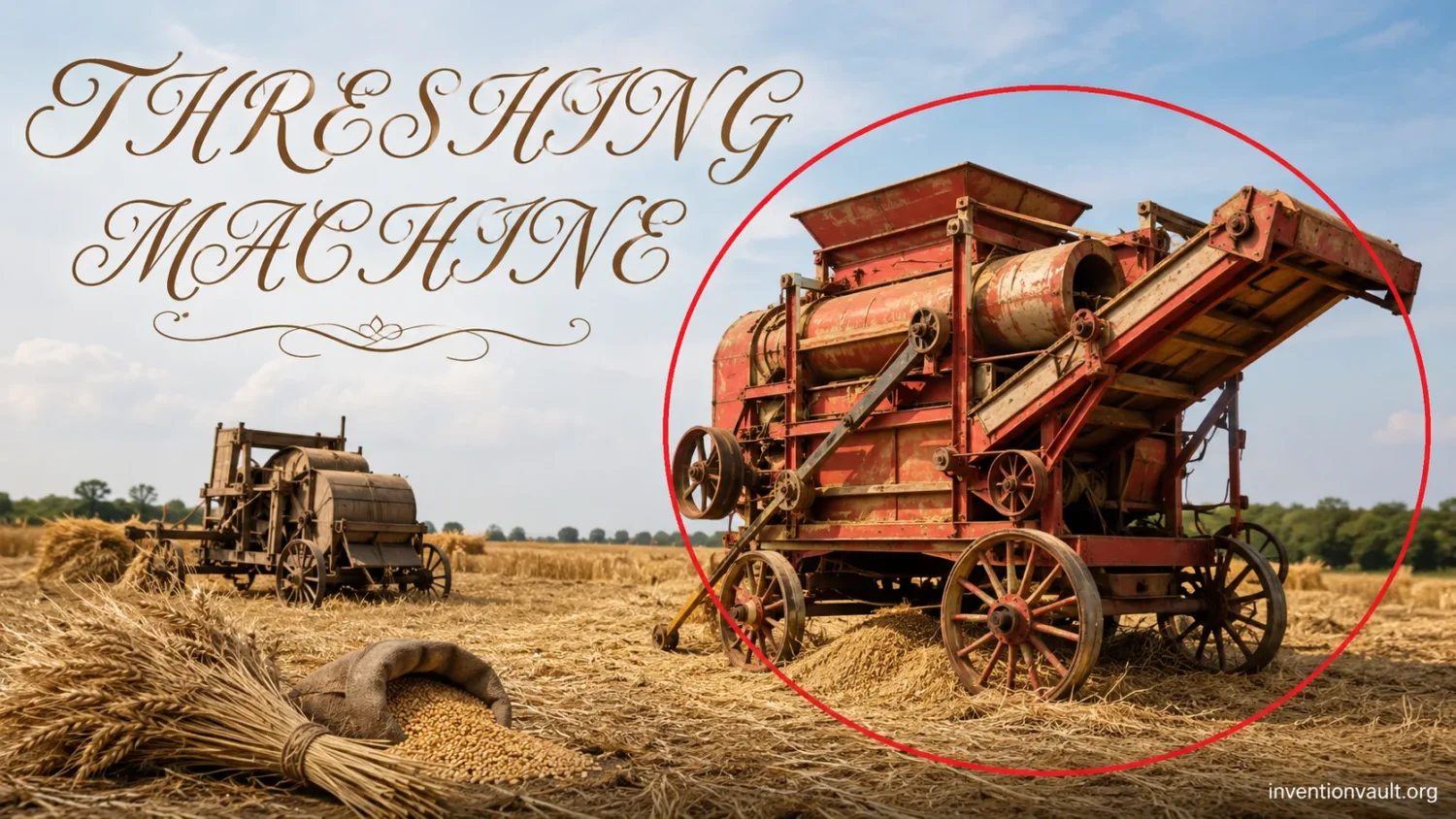
| Invention Name | Threshing machine, also called a mechanical thresher or drum thresher. |
| Main Purpose | To separate edible grain or seed from stalks, straw, husks, ears, pods, or panicles after harvest. |
| Best-Known Inventor | Andrew Meikle, a Scottish millwright from East Lothian, is widely credited with the first successful drum threshing machine. |
| Date of Successful Design | Usually given as c. 1786, with Meikle’s patent following in 1788. |
| Earlier Related Work | Earlier attempts included a 1734 device linked to Michael Menzies and later regional designs that did not become the standard working solution. |
| Core Mechanism | A rotating drum or cylinder beat crop material against a curved casing called the concave, allowing grain to fall away from straw. |
| Power Sources | Early machines used water, wind, horses, or other animal power; later designs used steam engines, traction engines, tractors, electric motors, or small engines. |
| Main Crops | Wheat, barley, oats, rye, rice, sorghum, millet, beans, soybeans, and maize-related shelling systems. |
| Later Evolution | The combine harvester joined cutting, threshing, separating, cleaning, and collecting into one mobile machine. |
| Why It Matters | It moved threshing from slow hand labor into controlled mechanical processing, changing post-harvest grain work. |
The threshing machine solved one of farming’s most tiring jobs: removing grain from the plant that carried it. Before mechanical threshers, workers used flails, sticks, trampling, or rubbing to release kernels from wheat, barley, oats, rice, millet, beans, and other crops. The work was slow, repetitive, and highly dependent on weather, crop dryness, timing, and human endurance. A good threshing machine did not simply “hit grain harder.” It controlled impact, feed rate, separation, and cleaning so the farmer could keep more usable grain with less breakage.
Plain definition: a threshing machine separates grain or seed from the rest of the harvested plant. It is not a mill, because it does not grind grain into flour. It is not only a harvester, because many threshers worked after crops had already been cut. Its job sits in the middle of post-harvest processing: release the grain, keep it usable, and prepare it for cleaning or storage.
What the Threshing Machine Was
A threshing machine was a mechanical answer to an old agricultural problem. Grain crops grow with the useful seed attached to parts of the plant that people do not normally eat: straw, ears, heads, pods, husks, or panicles. After cutting and drying, those parts still hold the grain. Threshing breaks that attachment.
The earliest successful threshers used a rotating drum fitted with beaters or bars. Crop bundles entered the machine at one side. The drum pulled them through and pressed them against a curved surface. The grain dropped through openings, while straw moved onward. Later machines added shakers, sieves, fans, elevators, and bagging outlets, turning a single separating action into a cleaner, more organized process.
What It Did
- Separated kernels or seeds from stalks and husks.
- Reduced dependence on hand flails and trampling.
- Handled larger volumes of harvested crop.
- Made grain cleaning easier when fans and sieves were added.
What It Did Not Do
- It did not grind grain into flour.
- It did not always cut the crop in the field.
- It did not remove every impurity without later cleaning.
- It did not work well unless the crop was mature and dry enough.
The Name Behind the Invention
Andrew Meikle did not invent threshing itself. Farmers had threshed crops for thousands of years by hand, by animals, or by simple tools. His achievement was different: he made a practical drum machine that could do the job with regularity and enough reliability to spread beyond experiment.
Meikle worked as a millwright, a trade that demanded knowledge of shafts, gears, mills, power transfer, timber, iron, and moving parts. That background mattered. A threshing machine had to accept uneven crop bundles, grip them without clogging, beat them with enough force, let grain escape, and carry straw away. A poor design could break grain, tangle straw, shake itself apart, or waste power.
Historical accounts usually place Meikle’s successful machine around 1786. He patented a machine for separating corn from straw in 1788. The word “corn” in that British usage meant grain crops such as wheat, barley, or oats, not only maize. That detail matters because many modern readers otherwise misunderstand the crop involved.
Meikle’s real advance was not a single metal part. It was the arrangement: controlled feeding, a fast drum, a concave surface, and a path that separated grain from straw without turning the whole crop into a useless heap.
Earlier Attempts Were Part of the Story
The threshing machine is often presented as a one-person invention, but the better story is more careful. Earlier mechanical attempts existed before Meikle, including a device associated with Michael Menzies in 1734. Meikle also worked after earlier regional machines had shown promise but failed to become dependable farm equipment. His design drew on practical millwright thinking and on the wider mechanical culture of the 18th century.
That does not weaken Meikle’s place. It clarifies it. Invention often happens when an older idea becomes workable. The threshing machine became historically important when it could stand up to real farm use: dust, straw, uneven feeding, vibration, long working days, and crop differences.
How the Machine Worked
The mechanical heart of the classic threshing machine was the drum and concave. The drum rotated at speed. The concave curved around part of it. Crop material passed between them. Beaters, bars, or teeth struck and rubbed the heads of grain, releasing kernels. The machine then needed to move straw away and let grain fall through.
Later threshers did more than thresh. They shook the straw so trapped grain could fall out. They used fans to blow away chaff. They used sieves to sort heavier grain from lighter debris. This is why old farm descriptions sometimes speak of threshing, shaking, and winnowing as linked actions inside one machine.
| Part | Role in the Machine | Why It Mattered |
|---|---|---|
| Feed rollers or feed opening | Moved the crop into the threshing area at a controlled rate. | Even feeding reduced clogging and uneven separation. |
| Threshing drum or cylinder | Rotated with beaters, teeth, or bars to strike or rub the crop heads. | This was the main grain-release action. |
| Concave | Curved surface near the drum, often with openings below. | Helped separate grain while letting kernels fall through. |
| Straw walkers or shakers | Agitated straw after it left the drum. | Recovered grain that remained trapped in straw. |
| Fan or fanners | Blew lighter chaff away from heavier grain. | Improved cleanliness before storage or milling. |
| Sieves | Sorted grain by size and weight. | Reduced weed seed, broken material, and loose debris. |
| Belt, shaft, or gear drive | Transferred power from water, wind, horses, steam, tractor, or engine. | Let the machine work at a steady speed. |
Why the Drum Design Was So Effective
Hand threshing depends on repeated blows. The drum thresher turned that repeated action into a continuous mechanical process. Instead of a person lifting and swinging a flail again and again, the drum delivered many impacts in a steady rhythm. The concave kept the crop close enough to the drum for grain to release, while openings allowed the kernels to escape.
This made the machine more than a labor saver. It also made threshing more predictable. Farmers could plan around a machine, a power source, and a crew. When later machines became portable, contractors could bring threshers from farm to farm. The invention moved threshing from a household-scale task toward a service-based farm operation.
Important technical idea: better threshing is not only about higher speed. A machine must balance grain release, grain damage, feed rate, crop moisture, straw flow, and cleaning. Too little force leaves grain attached. Too much force cracks kernels.
The Main Historical Stages
The threshing machine did not appear in one finished form. It moved through stages, each shaped by available power and farm size. Barn-based machines made sense where water, wind, or animal power already existed. Portable steam threshers suited farms that needed powerful seasonal service. Tractor-driven and engine-driven machines later made threshing more flexible.
| Period | Development | Main Change |
|---|---|---|
| Before Mechanical Threshers | Flails, sticks, trampling, rubbing, and simple hand tools. | Threshing depended mostly on human or animal effort. |
| 1730s | Earlier patented attempts appeared, including work linked to Michael Menzies. | The idea existed, but dependable farm use remained difficult. |
| c. 1786 | Andrew Meikle developed a successful drum threshing machine in Scotland. | Rotating drum and concave design made mechanical threshing practical. |
| 1788 | Meikle patented his machine for separating corn from straw. | The invention gained a defined legal and technical identity. |
| Early 1800s | Water, wind, horse, and steam-powered threshers spread across larger farms. | Threshing became a planned machine operation. |
| 1837 | John A. Pitts and Hiram A. Pitts received U.S. Patent No. 542 for a machine for threshing and cleaning grain. | American improvements linked threshing and cleaning in one system. |
| Mid-19th Century | Portable and double-blast threshers became common in many regions. | Threshing moved more easily between farms. |
| 20th Century | Combines joined cutting, threshing, separating, cleaning, and collecting. | The separate threshing machine became part of a larger harvesting machine. |
| 21st Century | Small, axial-flow, and multi-crop threshers remain useful in many farming systems. | The same principle now appears in machines sized for different crops and budgets. |
Types of Threshing Machines
Threshing machines changed shape because crops differ. Wheat straw does not behave like rice panicles. Beans do not thresh like barley. A machine that works well for dry wheat may damage rice if the drum speed, teeth, clearance, or feeding method do not match the crop. That is why threshers developed into several families rather than one permanent design.
Barn-Based Threshers
Early barn-based threshers were often fixed in place. They could be powered by waterwheels, windmills, horses, or other local power systems. The advantage was stability. The disadvantage was movement: cut crops had to be brought to the machine.
Portable Threshers
Portable threshers changed the work pattern. A machine could travel to the farmyard or field edge, often powered by a portable steam engine, a traction engine, or later a tractor. Many machines used wide drive belts, so the thresher and engine had to be aligned carefully.
Double-Blast Threshers
A double-blast thresher used two fans in the cleaning stage. The idea was simple but valuable: air could remove lighter chaff while sieves and gravity helped separate heavier grain. These machines show how threshing gradually merged with cleaning rather than staying as a single beating action.
Pedal and Hand-Driven Threshers
Smaller machines can use a hand crank or pedal system. In rice threshing, a pedal-driven drum lets the operator press panicles against rotating teeth or wire loops. FAO material describes hand or pedal drum threshers working around 300 revolutions per minute when used properly. That speed helps release grain while keeping the machine small and affordable.
Axial-Flow Threshers
Axial-flow threshers move crop material along the axis of the cylinder rather than across it in a short path. The crop stays inside the threshing area longer, which can improve separation for rice and other crops when the machine is tuned well. Many modern combines use axial or hybrid threshing principles.
Multi-Crop Threshers
Multi-crop threshers are designed to handle more than one crop by changing screens, clearances, drums, or settings. Recent service models use locally made machines for crops such as sorghum, millet, wheat, cowpea, beans, soybean, and maize. A 2024 CIMMYT report described a multi-crop thresher in Zimbabwe powered by an 8 HP diesel engine and able to process up to 0.5 tons per hour for small grains under efficient operation.
Threshing Machine vs Combine Harvester
Readers often confuse a threshing machine with a combine harvester. The connection is real, but they are not the same object. A threshing machine focuses on separation after harvest or after cutting. A combine harvester performs several jobs in one moving machine: cutting the crop, feeding it inward, threshing it, separating grain from straw, cleaning it, and collecting it.
| Feature | Threshing Machine | Combine Harvester |
|---|---|---|
| Main job | Separates grain from harvested plant material. | Cuts, feeds, threshes, separates, cleans, and stores grain. |
| Crop cutting | Usually done before the crop reaches the machine. | Done by the machine itself. |
| Mobility | Can be fixed, portable, tractor-driven, or engine-driven. | Usually self-propelled or tractor-pulled. |
| Historical role | Major step in mechanized post-harvest processing. | Later integration of several harvest operations. |
| Modern use | Still useful where separate, small, or crop-specific threshing is practical. | Dominant in many large-scale cereal systems. |
Technical Details That Affect Performance
A threshing machine can look simple from outside, yet its results depend on several interacting settings. Good threshing releases grain without excessive cracks, losses, dust, or impurities. That balance changes with crop variety, maturity, moisture, straw length, and machine design.
- Drum speed: higher speed can improve grain release, but it can also increase grain damage if the crop is fragile.
- Concave clearance: a narrow gap increases rubbing and impact; a wider gap may leave grain attached.
- Feed rate: overfeeding can clog the machine or leave grain in straw; underfeeding wastes capacity.
- Crop moisture: wetter crops often thresh less cleanly, while very dry crops can shatter or break.
- Threshing element: spike teeth, rasp bars, wire loops, and beaters act differently on crop heads.
- Cleaning system: fans and sieves decide how much chaff, dust, and broken material remains with the grain.
Modern research still studies these variables. A 2025 study of a rice threshing unit compared drum and conical structures under different speeds and feed rates. In that research, the drum thresher reached 2,448 kg/h throughput and 99.07% threshing efficiency at 1,500 rpm and a 1.4 kg/s feeding rate. The same study reported a low damage rate of 0.24% under gentler settings. These figures show why the old threshing principle remains an active engineering subject.
Crops and Adapted Thresher Forms
The word “thresher” can hide a wide range of machines. Some release cereal grain from straw. Others shell maize. Some are built for rice panicles. Others work as multi-crop machines for small farms and service providers. The shared idea is separation, but the mechanical details shift with the crop.
| Crop Group | Common Threshing or Shelling Need | Typical Machine Approach |
|---|---|---|
| Wheat, barley, oats, rye | Release kernels from ears while moving straw away. | Drum or cylinder with concave, straw walkers, fans, and sieves. |
| Rice | Separate paddy from panicles with limited grain breakage. | Pedal threshers, axial-flow threshers, or combine threshing units. |
| Sorghum and millet | Release small grains from heads and reduce dirt contamination. | Small-engine or multi-crop threshers with suited screens. |
| Beans and soybeans | Open pods without cracking too many seeds. | Lower-impact multi-crop threshers with careful clearance settings. |
| Maize | Remove kernels from cobs; often called shelling rather than threshing. | Maize shellers, picker-shellers, or multi-crop machines with maize fittings. |
Why the Invention Changed Grain Work
The threshing machine changed agriculture by attacking the slow middle stage between harvest and food. Cutting a crop was only part of the job. A farmer still needed loose grain, clean enough to store, sell, mill, malt, or seed. When threshing remained slow, the whole harvest rhythm slowed down with it.
Mechanical threshing allowed larger volumes of grain to move through the farmyard. It also made timing more manageable. Grain could be processed when dry enough, with fewer workers doing the heaviest repetitive motion. In many regions, the thresher became a shared machine, a contractor’s machine, or part of a seasonal crew system.
The invention also influenced machine design beyond threshing. Feed mechanisms, rotating cylinders, sieves, fans, belts, shafts, adjustable clearances, and crop-specific settings all became part of agricultural engineering. The combine harvester did not erase the threshing machine. It carried the thresher inside a larger machine.
What Many Short Histories Miss
Short histories often say, “Andrew Meikle invented the threshing machine,” then move on. That statement is useful, but it leaves out the part that makes the invention interesting. The real advance was a system, not only a drum. Feeding, beating, separation, cleaning, and power transfer all had to work together.
Another missed point is the difference between threshing and cleaning. Early machines could release grain but still leave it mixed with chaff and straw fragments. Later machines improved the process by adding shakers, fans, and sieves. The best machines did not only speed up work; they improved the condition of grain leaving the machine.
A third missed point is crop diversity. A wheat thresher, rice thresher, maize sheller, and multi-crop thresher share a family resemblance, yet their settings and parts differ. Modern designs still adjust speed, clearance, tooth shape, feeding rate, and screen size because crops resist separation in different ways.
The Threshing Machine in Modern Farming
Large grain farms often use combines, so the separate threshing machine can appear old-fashioned. That view misses its continuing role. Many farms still benefit from smaller or separate machines where field size, crop type, repair access, cost, or post-harvest handling makes a combine less practical.
Modern small-scale threshers also support service models. A group, workshop, cooperative, or local business can own a machine and thresh for many farmers. This keeps the machine active during harvest periods and can reduce the need for every household to buy its own equipment. University and agricultural research programs have used this approach for multi-crop threshers in several countries.
The old invention still has a modern technical problem at its center: how to separate the useful seed from the plant cleanly, quickly, and gently. That is why research on drum shape, axial flow, concave clearance, crop moisture, and seed damage continues long after Meikle’s first successful machine.
A Simple Way to Understand Its Lasting Value
The threshing machine turned a repeated hand motion into a controlled mechanical flow. Crop entered. Grain released. Straw moved away. Lighter waste separated. That sequence sounds ordinary now, but it became one of the core patterns of modern grain handling.
Common Misunderstandings About the Threshing Machine
- It was not the same as a mill. A mill grinds grain; a thresher releases grain from the plant.
- It was not always self-moving. Many threshers were fixed or pulled to farms and powered by a separate engine.
- It did not begin as a combine. The combine arrived later by joining several harvest jobs in one machine.
- It was not one unchanging design. Drum, axial-flow, double-blast, pedal, steam-powered, tractor-driven, and multi-crop versions show a long design family.
- It did not remove the need for judgment. Operators still had to consider crop dryness, feed rate, drum speed, and cleaning quality.
Why It Belongs Among Important Inventions
The threshing machine belongs among important inventions because it changed a hidden but essential part of food production. It did not make grain grow. It did not bake bread. It did something between those visible stages: it helped turn harvested plants into usable grain at a scale and speed that hand methods could not match.
Its influence also lasted because the idea adapted. The drum and concave became part of larger threshers. The threshing unit moved into combines. Smaller versions served rice, millet, sorghum, beans, and soybean. New studies still measure throughput, damage rate, energy use, and separation efficiency. Few machines from the late 18th century have such a clear line into today’s agricultural equipment.
Andrew Meikle’s machine stands out because it made mechanical threshing practical. Later engineers refined it. Farmers adapted it. Modern machines absorbed it. The invention’s value sits in that continuity: a farmyard machine from the age of mills became a core mechanism inside the machines that still harvest much of the world’s grain.
References Used for This Article
- Science Museum Group — Threshing Machine built by R.G. Garvie and Son: Used for the c.1786 date, Meikle credit, machine purpose, and later replacement by combine harvesters.
- Encyclopaedia Britannica — Andrew Meikle: Used for Meikle’s biography, earlier failed designs, and the 1788 patent detail.
- Scottish Engineering Hall of Fame — Andrew Meikle: Used for drum, fluted rollers, concave, patent, and early manufacturing details.
- Google Patents — US542A Machine for Thrashing and Separating Grain: Used for the 1837 Pitts patent and U.S. threshing-cleaning improvement details.
- FAO — Agricultural Engineering in Development: Threshing and Shelling: Used for threshing definitions, traditional methods, hand-output ranges, and pedal drum speed information.
- CIMMYT — No Stones, No Grit! A Game-Changing Technology to Process Small Grain Introduced in Zimbabwe: Used for recent multi-crop thresher examples, 8 HP engine detail, crop range, and hourly output.
- University of Illinois ADM Institute — Scaling Multi-Crop Thresher Fabrication Training: Used for modern locally fabricated multi-crop thresher service and training examples.
- Scientific Reports — The Impact of Threshing Unit Structure and Parameters on Enhancing Rice Threshing Performance: Used for modern rice thresher performance data, throughput, efficiency, speed, feed rate, and damage-rate figures.