
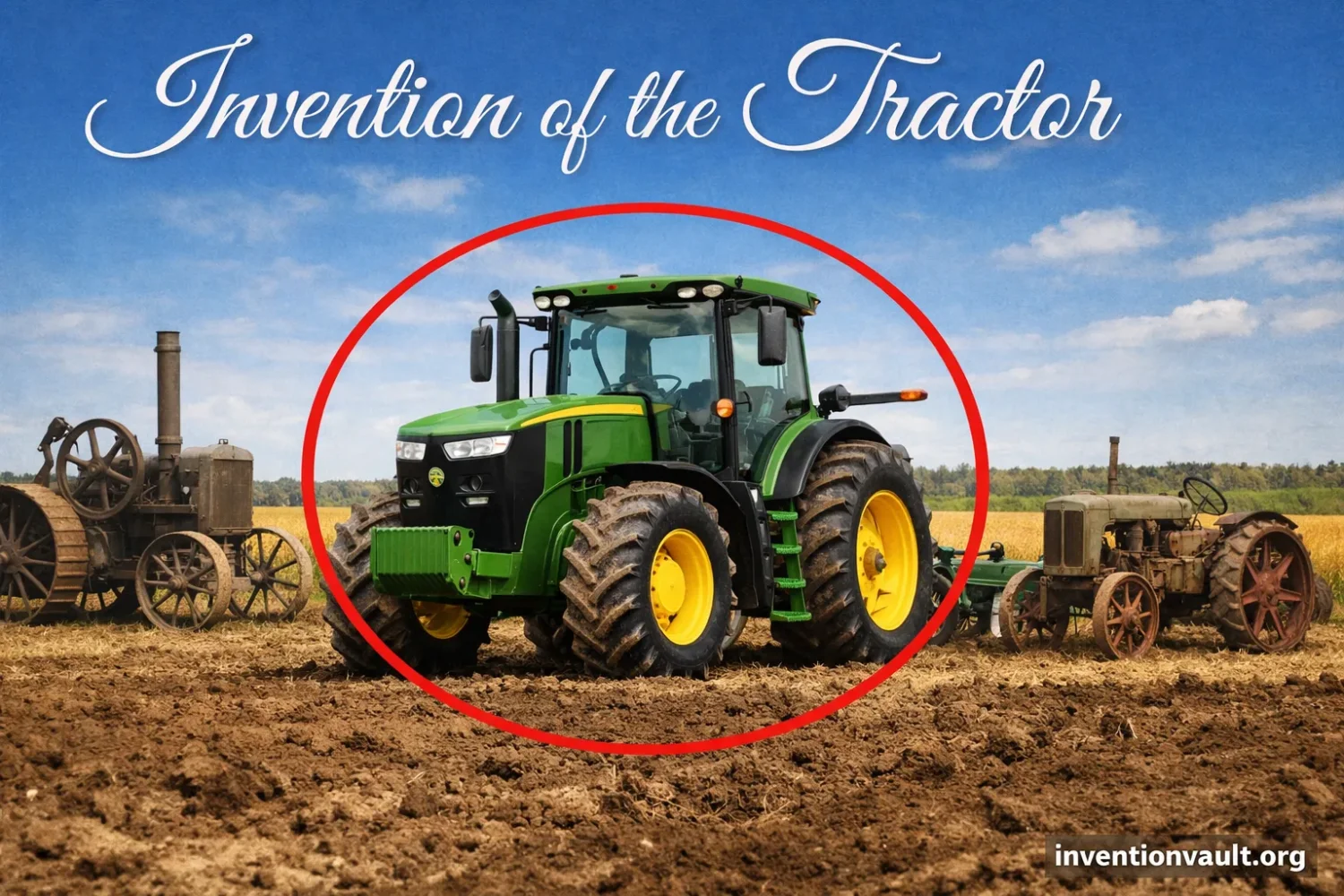
| Aspect | Details |
|---|---|
| Name of the Invention | The tractor, first as a self-propelled field power unit and later as a machine built to pull, lift, and power farm implements. |
| Earliest Roots | Mid-19th-century portable steam engines and traction engines used for threshing and heavy field work. |
| Early Breakthrough | The first successful gasoline farm tractor is widely linked to John Froelich in 1892. |
| Naming Milestone | The word tractor was coined by the Hart-Parr company in 1903. |
| Mass Adoption Phase | Adoption accelerated in the 1910s, then widened when lighter, lower-cost machines reached ordinary farms around 1915. |
| System Breakthrough | Harry Ferguson’s 1925 coupling patent and the later Ferguson System made the tractor and implement work as one unit. |
| Major Early Figures | John Froelich, Charles Hart, Charles Parr, Benjamin Holt, Henry Ford, and Harry Ferguson. |
| Original Farm Problem Solved | Replacing slow, costly, labor-heavy animal and steam power with a machine that could move under its own power and drive other equipment. |
| Foundational Technologies | Internal-combustion engines, gearing and transmission, traction wheels or tracks, belt pulleys, power take-off systems, hydraulic lift, and implement hitch control. |
| Early Fuel Story | Steam came first; then gasoline, kerosene, hot-bulb and crude-oil engines, and later diesel became dominant. |
| Technical Snapshot | The surviving 1903 Hart-Parr #3 weighed about 14,000 pounds and produced roughly 30 horsepower. |
| Market Turning Point | Low-cost, mass-produced tractors changed the market. By 1932, more than a million lightweight tractors had been sold in the United States. |
| Why the Invention Matters | The tractor did not just replace horses. It remade timing, labor, field scale, implement design, and later opened the door to guided and data-based farming. |
A tractor looks simple when seen from a distance: engine, wheels, driver, field. Its history is nothing like that. The tractor was not born in one clean moment, and it was not the work of one inventor alone. It emerged in layers. Steam traction engines proved that field power could move. John Froelich’s 1892 gasoline machine showed that a farm tractor could be self-propelled and usable. Hart-Parr gave the machine its lasting name. Mass production pushed it onto ordinary farms. Then Harry Ferguson’s hitch and hydraulic ideas turned it from a pulling engine into a fully integrated working platform. That slower, step-by-step story is the real invention of the tractor.
Origins of the Tractor
The tractor grew out of a problem that shaped farming for centuries: how to get more pulling power into the field without feeding and resting teams of animals. Before tractors, farmers relied on horses, mules, oxen, and, later, portable steam engines. Those early engines helped with threshing and stationary work, yet many were not self-propelled. They had to be hauled into place, set up, fueled, and watched closely. They saved labor in one sense and created fresh labor in another.
The move from portable steam engine to traction engine mattered because it introduced mobility. Once the machine could move itself, even awkwardly, the next question became obvious: could field power be smaller, lighter, cheaper, and easier to start? That question drove the next wave of invention.
One detail is often missed: a traction engine and a tractor are related, but they are not identical ideas. The tractor becomes a distinct invention when self-propelled power is shaped for regular farm movement, implement work, and repeated daily use in the field.
Why the Tractor Has More Than One Inventor
Many articles try to pin the tractor to one name. That makes the story neat, but it makes the history thin. A better answer is that different people invented different parts of what readers now mean by tractor. One builder made the first successful gasoline farm tractor. Another firm gave the machine its public name. Others made it cheaper, more stable, safer, or better matched to cultivation.
John Froelich and the First Successful Gasoline Farm Tractor
John Froelich is usually placed at the front of the story because his 1892 machine is widely treated as the first successful gasoline-powered farm tractor. That “successful” part matters. Earlier attempts at self-propelled field power existed, yet Froelich’s machine showed that internal combustion could do real farm work without the bulk and handling burdens of steam. It pointed toward a machine that could be started faster, moved more flexibly, and used by more farms.
Even here, the wording needs care. Froelich did not finish the tractor’s history in 1892. He opened a door. Others would widen it.
Hart-Parr and the New Word “Tractor”
Charles Hart and Charles Parr helped fix the invention in the public mind. In 1903 their company built self-propelled traction engines and, in a marketing move that outlived the firm itself, used the word tractor. The name stayed because it was short, clear, and exact enough to separate the new machine from earlier steam power. That naming step sounds minor. It was not. A machine becomes easier to sell, compare, and improve once people agree on what to call it.
The surviving Hart-Parr #3 also shows how early these machines still were. It weighed about 14,000 pounds and produced only around 30 horsepower. Farmers could admire it and still decide it was too large, too costly, or too specialized for ordinary work. The tractor existed, but it had not yet become the farmer’s everyday companion.
Fordson and the Shift to Mass Adoption
The tractor changed farms only when it escaped the large-estate and specialty market. That happened when lighter, cheaper machines began to reach ordinary fields in the 1910s. Ford’s Fordson became the clearest marker of that turn. Cheap production, rising output, and price pressure pushed tractors toward farms that had once relied on animal teams by default. In 1921 Ford sold 36,000 tractors, and by 1923 Fordsons accounted for three-quarters of tractors bought in the United States. That is not a footnote in the tractor’s history. That is the moment the invention became a mass tool.
Before Mass Adoption
- Steam engines proved field power could be mechanized.
- Gasoline engines reduced weight, setup time, and fuel-handling strain.
- Early tractors still served big farms better than mixed, smaller holdings.
- Belt work mattered almost as much as drawbar pulling.
After Mass Adoption
- Factories pushed prices down and output up.
- General-purpose layouts made one tractor useful across many tasks.
- Cultivation work became practical, not just plowing and belt work.
- Farm planning started to follow machine timing rather than animal limits.
The Systems That Turned an Engine Into a Working Tractor
Another weak point in many tractor histories is the habit of treating the machine as nothing more than an engine on wheels. The real leap came when builders solved a chain of linked problems. A tractor had to move itself, transfer power well, hold traction, connect to implements, maintain working depth, and stay controllable in rough soil. Without that full system, it remained a noisy engine with limited use.
- Traction let power reach the ground instead of disappearing in wheel slip.
- Transmission and gearing matched engine output to slow, heavy field work.
- Belt pulleys and later PTO systems let the tractor run outside machinery.
- Lift and hitch design turned implements into part of the machine rather than a loose load behind it.
- Task-specific geometry made cultivation, row work, and orchard work easier.
That is why the tractor’s history is really the history of integration. The machine became truly useful when engineers stopped treating drawbar pull as the whole story.
Harry Ferguson and the Tractor-Implement Unit
Harry Ferguson changed the tractor’s design logic. His 1925 patent for apparatus for coupling implements to tractors and automatically regulating depth addressed a long-standing weakness: a tractor and its plow often behaved like separate machines tied together by force. Ferguson’s answer was to make the implement act as part of the tractor itself. The later Ferguson Black, launched in 1933, fully embodied that thinking.
That shift had plain, practical results. The tractor became easier to control. Implements attached faster. Working depth could return to a preset level. Safety improved. Field efficiency improved as well. Once that system spread, the modern tractor stopped being just a pulling machine and became a controlled power platform.
The honest history of the tractor is cumulative: engine, traction, transmission, hitch, hydraulics, and control all had to mature before the machine reached its familiar form.
Major Tractor Forms and Why They Appeared
The tractor did not evolve in one straight line. It branched. Different soils, crops, and farm layouts pulled the design in different directions. This is another point many articles leave underexplained. The machine changed shape because farming problems were not identical from one field to another.
| Type | What Defined It | Why It Appeared |
|---|---|---|
| Standard or General-Purpose Tractor | Built for plowing, belt work, and broad farm use. | Farmers wanted one machine that could handle more than one job without owning a large fleet. |
| Row-Crop Tractor | Narrow front arrangements, higher crop clearance, and layouts suited to cultivation between rows. | Row farming demanded visibility, maneuverability, and less crop damage during field passes. |
| Crawler or Track-Type Tractor | Tracks in place of ordinary wheels. | Soft ground, hard pulling jobs, and the need for better grip pushed engineers toward track systems. |
| Orchard and Utility Tractor | Lower, narrower, and shaped for work in tighter spaces. | Trees, confined lanes, and mixed-use farms called for compact forms rather than broad-field machines. |
| Compact Tractor | Smaller power units with attachment flexibility. | Small farms, grounds work, and multi-task use rewarded machines with lighter scale and easier handling. |
Track-type development deserves special notice. In 1904 the Holt company produced the first gasoline-powered caterpillar tractor, showing that wheels were not the only answer to traction. That idea later shaped not just farm equipment but earthmoving and track-driven machines far beyond agriculture.
Row-crop design also marks a big break. By the 1920s, tractors were no longer judged only by how well they pulled a plow. Farmers wanted machines that could cultivate standing crops, turn sharply, and move through rows with less waste. That demand pushed the tractor into more specialized forms.
How the Tractor Recast Farm Work
The tractor changed labor, timing, and farm scale at once. It reduced dependence on animal feed, stable labor, and rest cycles. It also made field work less tied to the physical limit of draft animals. That did not mean farmers suddenly worked less. It meant they could plan larger tasks inside tighter weather windows and use machines for pulling, threshing, planting, and hauling with one power source.
By 1932, more than one million lightweight tractors had been sold in the United States. The change continued after that. In 1940 only 4 percent of U.S. farms reported tractors and no horses or mules. By 1954 that share had risen to 38 percent, and tractor farms of all kinds made up 58 percent of farms. Later, the contrast became starker still: where early-20th-century agriculture relied on 22 million work animals, modern U.S. agriculture came to use about 5 million tractors in their place.
What the Tractor Replaced
- Daily care and feed demands for large work-animal teams
- Long setup times tied to portable steam equipment
- Field schedules shaped by animal fatigue
- Separate power arrangements for hauling, pulling, and stationary machinery
From Drawbar Power to Guided Farming
The tractor kept changing after its early farm breakthrough. Manufacturers added better transmissions, improved tires, safer operator positions, more reliable diesel engines, hydraulic systems, and power take-off arrangements that made one machine useful across a far wider set of tasks. Experiments even reached fuel cells, turbines, and hydrostatic systems. Not every experiment lasted. That is normal in the history of invention. The lasting pattern is that the tractor absorbs useful ideas and sheds the rest.
That same pattern continues now. Modern tractors often use GPS or GNSS guidance, steering aids, and data screens that help reduce overlap, missed strips, operator fatigue, and input waste. The hardware is newer, yet the design question is familiar: how can one moving power unit place effort in the right spot, at the right depth, on the right pass? The invention still answers the same farm problem. It simply answers it with finer control.
Seen this way, the invention of the tractor is not a closed chapter from the 1890s or the 1910s. It is a long engineering line that began with self-propelled field power and still runs through today’s guided, sensor-rich machines. The shape has changed. The purpose has not.
References Used for This Article
- USDA Agricultural Research Service — History of Research at the U.S. Department of Agriculture: Records the 1892 Froelich milestone and the early Holt crawler milestone.
- Smithsonian National Museum of American History — These Tractors Show 150 Years of Farming History: Explains naming, market growth, and several design shifts in tractor history.
- USDA National Agricultural Statistics Service — Mechanization: Describes when gasoline tractors spread and why lighter models widened adoption.
- USDA National Agricultural Statistics Service — 1954 Agriculture Graphic Summary: Farm Machinery and Facilities: Provides historical figures on tractors replacing horses and mules on U.S. farms.
- USDA Economic Research Service — The 20th Century Transformation of U.S. Agriculture and Farm Policy: Supplies long-range data on work animals, mechanization, and tractor use.
- Google Patents — GB253566A: Apparatus for Coupling Agricultural Implements to Tractors and Automatically Regulating the Depth of Work: Preserves Ferguson’s patent record for implement coupling and depth control.
- Ulster Transport Museum — The Ferguson Black: Homecoming: Describes the Ferguson Black and the spread of the Ferguson System.
- USDA Agricultural Research Service — Benefits and Evolution of Precision Agriculture: Shows how tractor guidance and precision systems extend the tractor’s working logic into the present.