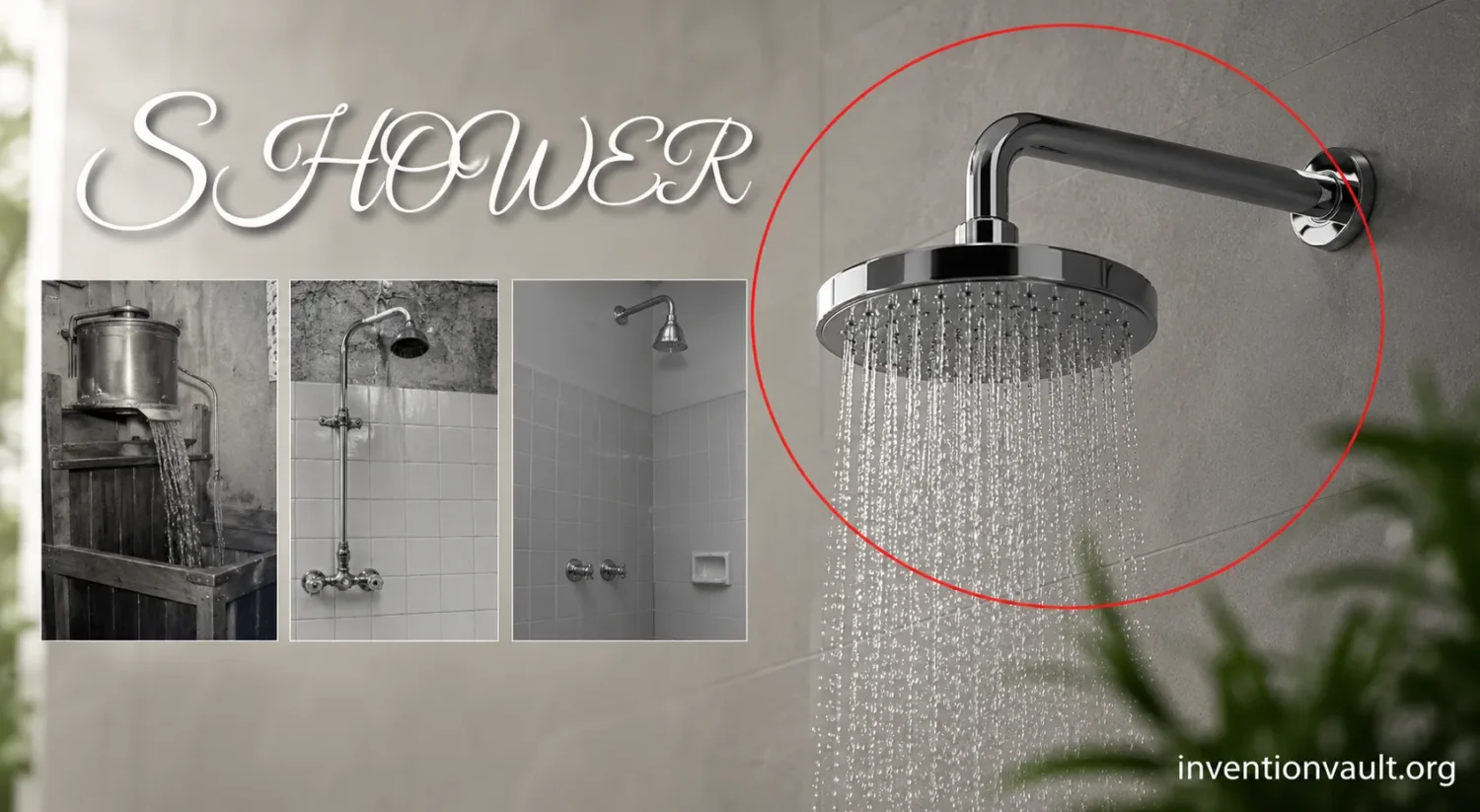
Hygiene System Evolution
How the Shower Became Ordinary
Follow the shift from poured water to a heated, drained, controllable household system.
Early bathing evidence
Washing Beneath Poured Water
Current stage
Documented practice
Ancient art and bathing spaces show people washing while water was poured from vessels or directed through built outlets.
Missing machinery
The water usually had to be carried, lifted, heated separately, or released by another person rather than supplied on demand.
Historical boundary
These practices establish overhead washing, but they do not establish the pressurized, self-controlled household shower.
The physical act existed long before the plumbing system that made it repeatable and private.
Medical water treatment
The Shower Bath as Therapy
Current stage
Primary purpose
Early modern shower baths were often described as controlled applications of cold water rather than routine washing equipment.
Operating method
A raised container, pull cord, valve, or attendant could release a short fall of water over a patient.
Design consequence
Control over dose, force, and body coverage entered shower design before comfort and domestic convenience became the main goals.
Medical use supplied a language of control that later mechanical designs carried into bathing.
Documented patent
William Feetham’s 1822 Apparatus
Current stage
Patent record
British patent No. 4680, dated 13 December 1822, described improvements to baths and shower equipment.
Flow adjustment
An adjustable stop limited valve movement, while divided sections in the perforated outlet changed the area receiving water.
Practical limit
The apparatus depended on manual pumping and a small body of water that cooled and became dirty during use.
Feetham documented a controllable machine, not the complete fresh-water shower found in later homes.
Institutional redesign
Delabost’s Prison Rain Bath
Current stage
Setting
Prison physician François Merry Delabost developed the system for Bonne-Nouvelle Prison in Rouen, where many people had to be washed cheaply and quickly.
Dating
The project was tested in 1872, installed in 1873, and described in a medical hygiene paper published in 1875.
System change
Heated fresh water served several washing positions, while used water left through drains instead of returning to the bather.
The shower became a repeatable hygiene process for groups, though one shaped by supervision and limited privacy.
Urban support system
Water, Heat, and Waste Networks
Current stage
Clean-water supply
Municipal mains and building pipes removed the need to carry and refill a small shower reservoir by hand.
Usable temperature
Water heaters and mixing controls allowed a flowing supply to remain warm without preparing each container separately.
Waste removal
Traps, sloped floors, waterproof surfaces, drains, and sewers made overhead washing compatible with an indoor room.
Once water could enter, heat, mix, and leave safely, the shower stopped behaving like a standalone contraption.
Household adoption
The Shower Enters the Home
Current stage
Early market
Private showers first appeared mainly in well-equipped homes, hotels, institutions, and new buildings with indoor plumbing.
Space-saving format
A spray fitted over a bathtub allowed builders to add showering without constructing a separate wet enclosure.
Uneven spread
Adoption differed by city, country, income, housing stock, water service, fuel access, and local bathing habits.
Mass housing and standardized plumbing made the shower ordinary, but there was no single worldwide adoption date.
Modern performance
Flow Becomes an Engineering Target
Current stage
Measured output
Modern showerheads are evaluated by flow rate as well as the force, coverage, and stability of the spray.
WaterSense limit
In the United States, labeled models must use no more than 2.0 gallons per minute while meeting performance tests.
Current direction
Thermostatic controls, pressure compensation, hand sprays, and recirculating designs manage comfort, access, water, and energy together.
The modern design problem is no longer water delivery alone, but useful spray with less water and heat.
No single person invented every part of the modern shower. People washed beneath poured or directed water long before machines existed; William Feetham patented a controllable mechanical shower apparatus in 1822; François Merry Delabost developed an economical fresh-water rain-bath system for a Rouen prison in the 1870s; and the familiar household shower emerged only when piped water, heating, valves, waterproof construction, drainage, and sewerage worked together. The invention of the shower is therefore the history of a system assembled in stages, not a finished object produced on one date.
Device or System?
A showerhead can release water from above, but an everyday shower also needs a dependable supply, usable temperature, flow control, a water-resistant enclosure, and a safe route for wastewater.
| Historical attribute | Best-supported description |
|---|---|
| Invention type | Multi-stage bathing, plumbing, heating, and drainage system |
| Early principle | Washing while water is poured or directed over the body |
| Documented mechanical patent | William Feetham, British patent No. 4680, 13 December 1822 |
| Institutional turning point | François Merry Delabost’s 1872 trial and 1873 installation at Bonne-Nouvelle Prison in Rouen |
| Enabling systems | Piped water, water heating, mixing controls, waterproof surfaces, traps, drains, and sewers |
| Household adoption | Gradual, regionally uneven, and tied to modern housing and utility networks |
| Balanced credit | No single inventor created the entire modern household shower |
A Modern Shower Does More Than Drop Water
The word shower can describe both an action and a machine. Water falling over a person is the oldest part of the story. The modern fixture adds controlled delivery: fresh water arrives under pressure, passes through a heater or hot-water store, mixes to a chosen temperature, exits through a spray plate, and runs across a sealed surface toward a trapped drain.
Each part solves a different problem. Pressure moves water to an outlet above the user. Heating avoids the discomfort and health risks associated with uncontrolled cold exposure. A valve manages flow, while a mixer combines hot and cold streams. The showerhead distributes the stream over a wider area. The enclosure keeps water away from walls and floors that cannot tolerate repeated wetting. The drain and sewer remove used water before it can collect in the room.
- SupplyFresh water enters from a municipal main, storage tank, well, or building pump.
- HeatingA storage or instantaneous heater raises part or all of the incoming water to a usable temperature.
- MixingManual, pressure-balancing, or thermostatic controls regulate temperature and flow.
- DistributionThe showerhead divides the stream into jets or droplets with a selected spray pattern.
- ContainmentA tub, tray, membrane, tiled enclosure, curtain, or door keeps the wet zone controlled.
- DrainageSlope carries wastewater to a trapped drain connected to a disposal or sewer system.
This chain explains why a patented spray apparatus did not instantly create modern showering. A useful domestic shower depended on inventions outside the shower itself.
Before the Shower Was a Machine
Poured Water Is Not the Same as Pressurized Plumbing
Ancient evidence shows that people understood the value of washing beneath water delivered from above. A Greek terracotta pyxis dated to about 420–400 BCE depicts a bride bathing while Eros empties an amphora over her. The scene records a familiar action: water carried in a vessel could be directed over the body while the bather stood or crouched below.
Built bathing rooms added floors, basins, outlets, and drains. Greek and Roman bath cultures also developed heated rooms, immersion pools, water channels, and public facilities on a scale far beyond a private jug bath. Yet most of these installations centered on immersion, steam, oiling, scraping, or communal bathing. Calling every ancient spout a modern shower erases the mechanical and social differences.
An overhead stream may be produced by gravity alone. A domestic shower needs water available at the right height, rate, temperature, and moment, with the used water removed from the same room. Ancient bathing supplied parts of that idea, not the full arrangement now hidden behind a bathroom wall.
Roman Baths Were a Different Kind of Hygiene Space
Roman bath complexes are often treated as oversized ancestors of the bathroom. Their actual purpose was broader. They combined exercise, social contact, heated rooms, cold and warm pools, steam, body oil, scraping, and leisure. Aqueducts and distribution pipes supported the complexes, while furnaces and hypocausts heated selected spaces.
Directed water could be present, but a Roman bath was not simply a room full of individual showers. The dominant experience was shared and architectural. The modern shower moved in another direction: a compact washing station designed around a single user, a short duration, controlled flow, and eventually greater privacy.
What Different Evidence Can Establish
- Artistic sceneShows that pouring water over a bather was recognizable, but does not prove a permanent pressurized installation.
- Bathing room or drainShows planned water use and removal, but not necessarily a self-operated overhead spray.
- Patent recordDocuments a claimed mechanism and date, but does not prove broad use or commercial success.
- Institutional reportCan document an installed system, operating routine, cost, and number of users in a real setting.
- Housing and utility recordsHelp explain when a technology moved from special facilities into ordinary homes.
When the Shower Bath Was a Medical Treatment
Before showering became a routine form of personal cleaning, the shower bath often belonged to hydrotherapy. Physicians and bath operators used brief falls of cold water to produce a bodily shock that they believed could stimulate circulation, alter nervous activity, or treat illness. The recipient was commonly described as a patient rather than a bather.
These early devices could be simple: a raised vessel released water when a cord was pulled. More elaborate versions let an attendant change the amount, height, direction, or temperature. The medical setting pushed designers to think about dose and coverage. A sudden torrent and a softer shower were not treated as the same intervention.
This history also explains language found in Feetham’s patent. His apparatus gave the “patient” control over the discharge and over how much of the perforated outlet supplied water. The goal was not yet a fast morning wash supported by hidden household utilities. It was a controllable water treatment that could also be used for bathing.
William Feetham and the 1767 Patent Myth
Many short histories state that London stove maker William Feetham patented the first mechanical shower in 1767. The surviving patent index does not support that date. Feetham’s recorded shower-bath patent is No. 4680, dated 13 December 1822. The commonly repeated 1767 claim appears to be a later error that spread through secondary summaries.
Dating the Patent
1767 should not be presented as Feetham’s verified shower-patent year. The documented record places patent No. 4680 in 1822. A patent date also marks a legal claim, not the first human use of falling water or the arrival of the modern bathroom.
Correcting the date changes more than a line in a timeline. A 1767 patent would place the apparatus before several decades of published medical discussion and portable shower-bath development. The 1822 record fits a period when shower baths were already recognized as therapeutic devices and inventors were refining control rather than discovering the basic act of water falling over a body.
What Feetham Actually Patented
Feetham’s design used a frame to hold a cistern above the user. A pump in the base lifted water to that upper container. When released, the water passed through a perforated box or strainer and fell onto the person below. The machine brought lifting, storage, release, and collection into one piece of equipment.
Its more interesting feature was adjustability. A stop limited how far the water cock could turn, reducing or raising discharge. Concentric divisions inside the perforated outlet could confine water to selected areas rather than wetting the entire plate. The user could therefore alter both quantity and coverage.
That was a real mechanical contribution. It did not solve the problems that later defined household showering. Water still had to be pumped by hand. The limited supply cooled quickly. Used water remained within the apparatus and could pass over the body again. Fresh water was not continuously delivered from a main, and wastewater did not leave through a building drain.
Why the Apparatus Did Not Replace the Bath
A bath and Feetham’s shower shared one drawback: the user remained dependent on a fixed quantity of water. The shower used less, but that also meant dirt was concentrated in a smaller volume. Repeated pumping added labor, and cold water limited comfort. A servant could reduce the effort for a wealthy owner, but that did not turn the machine into a self-sufficient household utility.
Feetham had brought together an adjustable valve, an overhead tank, a pump, and a perforated outlet. Homes had not yet acquired the network around those parts. The machine arrived before the conditions needed for it to become ordinary.
Delabost Turned Showering into an Institutional Process
The next major change did not begin in a luxury bathroom. François Merry Delabost, chief physician at Bonne-Nouvelle Prison in Rouen, faced a problem of scale. A crowded institution needed a way to wash many prisoners with limited water, fuel, space, labor, and time. Individual filled baths were slow and costly to operate.
Delabost tested his rain-bath arrangement in 1872. The installation at Bonne-Nouvelle was completed in 1873, and he described the system in an 1875 paper on ablutions for prisons and other large establishments. These dates refer to separate events, which is why historical summaries may appear to disagree.
How the Rain-Bath System Worked
Water was heated centrally and distributed to several overhead outlets. Prisoners stood beneath the sprays in designated positions while staff controlled the routine. The flow could be delivered for a limited period, allowing a group to be washed in succession. Used water left through the floor drainage rather than returning to the supply.
The system’s strength came from its operating logic. It did not ask each user to pump a private cistern. It shared heating and supply equipment across several washing stations. It replaced filled tubs with timed flowing water. Cleaning became easier to schedule, measure, supervise, and repeat.
| Feature | Feetham apparatus, 1822 | Delabost rain bath, 1870s | Modern household shower |
|---|---|---|---|
| Main setting | Portable or private apparatus | Prison and later other institutions | Private bathroom |
| Water movement | Manual pump to raised cistern | Central supply to several outlets | Pressurized building pipework |
| Fresh water | Limited body of water, commonly recirculated | Fresh flow delivered during use | Continuous fresh supply while open |
| Heating | No dependable continuous heating | Central hot-water preparation | Storage or instantaneous heater |
| Control | User adjusts release and coverage | Institution controls timing and sequence | User controls flow and temperature |
| Wastewater | Collected within the apparatus | Removed through installed drainage | Removed through trap, drain, and sewer or disposal system |
| Main design goal | Adjustable shower bath | Fast, economical group washing | Private, repeatable personal washing |
Hygiene, Economy, and Supervision
The prison shower solved a hygiene problem, but its history cannot be separated from institutional control. Bodies were moved through a schedule. The duration and quantity of water could be limited. Staff could observe the process, and privacy was secondary to order and cost.
That combination made the design attractive to other large facilities. Barracks, schools, factories, workhouses, hospitals, public bathhouses, swimming facilities, and prisons all faced the same practical question: how could many people wash without filling and emptying a separate tub for each person?
The institutional shower answered with shared infrastructure and individual washing positions. The pattern later moved into homes, where control shifted toward the user and enclosures created greater privacy.
How Showers Spread Beyond the Prison
Barracks and Military Hygiene
Military sites had dense populations, scheduled routines, and a need to wash people after training or labor. Group shower rooms reduced the space and water required by rows of tubs. They also allowed cleaning to be built into institutional timetables.
Public Baths for Homes Without Bathrooms
Urban plumbing did not reach every dwelling at the same time. Municipal bathhouses offered tubs and showers to residents whose homes lacked running water, hot-water equipment, or a dedicated bathroom. A shower stall could serve more visitors in a day because it required less filling time and less floor area than a private tub room.
Public showers therefore formed a bridge between institutional machinery and household ownership. People could use a modern flowing-water system before they could afford or install one at home.
Schools, Factories, Pools, and Sports
Showers became linked with exercise, industrial dirt, uniforms, and shared facilities. Washing after sport now seems automatic in many places, yet that relationship had to be built through architecture and routine. Locker rooms, pool decks, changing areas, and workplace washrooms turned the shower into a standard response to sweat and grime.
These settings also kept the institutional tension between hygiene and privacy. Open shower rooms favored supervision, rapid turnover, and simple cleaning. Enclosed stalls favored personal space but cost more to build and maintain.
The Infrastructure Hidden Behind the Household Shower
Piped Water Removed the Pump
A household shower becomes convenient when opening a valve is enough to bring water to the outlet. That depends on a municipal distribution main, elevated tank, private well pump, or another pressure source. Building pipes must then carry the supply to an upper wall or ceiling point without leaking.
Pressure also changes spray behavior. Too little pressure produces weak streams and uneven coverage. Too much can waste water or make the spray uncomfortable. Later fittings, restrictors, and pressure-compensating parts helped control the relationship between supply conditions and the water felt by the user.
Water Heating Made Flowing Water Comfortable
Heating a bath could be done before the water entered the tub. A shower requires warm water while the stream is moving. Nineteenth-century gas heaters attempted to heat water as it passed through an appliance, but early designs could have poor combustion control and unsafe exhaust arrangements.
Edwin Ruud’s U.S. water-heater patent No. 443,797, granted in 1890, described automatic regulation of gas flow according to water temperature. This was not a shower patent. It solved an adjacent problem: maintaining usable heated water for domestic purposes without manually changing the burner throughout use.
Storage heaters, instantaneous heaters, electric showers, boilers, and district hot-water systems later supplied different buildings and regions. Their shared contribution was the same: warm water became available at the moment of washing rather than prepared as a separate batch.
Mixing Controls Made Temperature Usable
Hot water alone is not enough. A bather needs a way to combine it with cold water and keep the result within a comfortable range. Separate taps can feed a common outlet, while single-lever mixers adjust proportion and flow together. Pressure-balancing valves respond when pressure changes on one side. Thermostatic valves react to temperature changes and regulate the blend.
These controls matter because a toilet flush, opened tap, or heater cycle can alter pressure and temperature elsewhere in a building. The valve turned the shower from a raw hot-and-cold connection into a more stable personal control system.
Drainage Made Repeated Indoor Use Possible
A shower applies water across a standing person and a surrounding surface. Without containment, repeated use damages timber, plaster, floors, and rooms below. The modern wet area therefore relies on a tray, tub, membrane, tiled surface, sealed joints, curb or level-entry floor, and a designed slope toward the outlet.
The drain also needs a trap. Water held in the trap blocks sewer gases from entering the room. Beyond it, branch pipes and stacks carry wastewater to a sewer, septic tank, or another treatment system. Clean water entering the home is only half of the shower’s infrastructure; dependable removal is the other half.
Standard Parts Made Installation Repeatable
Threaded fittings, pipe sizes, valves, traps, outlets, waterproofing methods, and building rules allowed showers to be installed by many builders rather than constructed as one-off machines. Standardization reduced guesswork and made replacement parts easier to obtain.
This step is easy to miss because standards are less visible than an inventor or patent drawing. Yet a fixture becomes ordinary when it can be designed into a plan, approved, installed, repaired, and connected to local utilities with predictable parts.
How the Shower Entered Private Homes
First as an Addition to Wealthy Bathrooms
Late nineteenth-century private bathrooms could include elaborate shower cabinets, needle sprays, overhead roses, body jets, and therapeutic fittings. These installations were expensive and depended on reliable plumbing and heating. They belonged first to affluent homes, hotels, clubs, and medical establishments rather than the average dwelling.
The language of health did not disappear immediately. Catalogues could present sprays as invigorating or therapeutic while also selling them as modern comfort. The same fixture sat between medicine, luxury, and personal washing.
The Shower over the Bath Saved Space
Placing a spray above an existing bathtub solved a construction problem. The tub already provided a water-resistant basin and a drain. A curtain or screen could contain the spray. Builders did not need to allocate a second footprint for a separate stall.
This arrangement helped showering enter older homes during renovation. It also preserved the bath for soaking, children, laundry, or household tasks. The shower did not always replace the tub; the two were combined within one wet area.
Purpose-Built Stalls Fit Smaller Homes
As apartment construction and compact bathrooms expanded, a shower tray or enclosed stall could use less floor area than a full bathtub. Standardized enclosures, ceramic tiles, sheet materials, and prefabricated bases made the format easier to reproduce.
Level-entry showers later addressed another design need: access for people who could not safely step over a tub wall or raised curb. The handheld shower also widened use for seated bathing, caregiving, children, cleaning, and washing particular parts of the body.
There Is No Single Household Adoption Year
Household adoption varied by region and social class. A city apartment connected to water and gas could gain a shower before a rural home without a pressurized supply. New public housing could include standardized bathrooms while nearby older buildings relied on shared facilities. War, reconstruction, building codes, utility expansion, fuel prices, and local bathing customs all affected the pace.
For this reason, statements such as “the shower became common in the 1920s” or “every home had one by the 1950s” need a named place and housing group. The fixture spread through many markets over decades.
How Showering Changed the Meaning of Cleanliness
Washing Became Easier to Repeat
Filling a bath takes time and a large stored volume. A shower can begin as soon as heated water reaches the outlet and can stop the moment the valve closes. That makes washing easier to fit before work, after exercise, or between other tasks.
The difference encouraged a shift from occasional full-body bathing toward shorter, more frequent washing in places where water, energy, and private bathrooms were readily available. The shift was not caused by the fixture alone. Work schedules, advertising, deodorants, soaps, shampoos, laundry practices, and changing social expectations all shaped how often people felt they should wash.
Cleanliness Became Timed and Measurable
Institutional showers could set a duration for each group. Domestic water meters, fuel bills, heater capacity, and later environmental targets turned duration and flow into household concerns as well. A bath is often discussed as a volume; a shower is discussed as a rate multiplied by time.
This made the user part of the operating system. A shorter shower, lower-flow head, or pause control changes total consumption without rebuilding the bathroom. The same flexibility that made showering convenient also created a new question: how much water and heat should one wash require?
Privacy Replaced the Open Shower Room
The earliest large shower installations favored open rows or closely supervised positions. The private home reversed that arrangement. Curtains, doors, partitions, locks, opaque glazing, and individual controls made showering a personal activity.
Privacy was not a minor decoration. It changed who could use the system comfortably, how bodies were separated, and whether the experience felt institutional or domestic. Modern design still negotiates that boundary in schools, gyms, hospitals, care homes, barracks, and prisons.
From a Perforated Plate to Controlled Spray
Fixed Overhead Rose
The classic overhead rose spreads water through many small holes. Hole size, count, plate diameter, and supply pressure affect droplet size, coverage, and force. Mineral deposits can narrow openings over time, changing the pattern.
Handheld Shower
A flexible hose separates the spray direction from the wall outlet. This assists targeted washing, hair rinsing, seated use, caregiving, cleaning the enclosure, and bathing children or pets. A cradle can still hold the handset in a fixed position.
Pressure-Balancing and Thermostatic Systems
Pressure-balancing valves limit sudden changes in the hot-to-cold pressure ratio. Thermostatic valves sense temperature and adjust the mix. The two approaches address related but different disturbances, and some systems combine them.
Electric Showers
An electric shower heats cold water near the point of use rather than relying on a central hot-water store. This can provide independent showering where stored hot water is limited, though performance depends on electrical capacity, inlet temperature, and flow.
Low-Flow and Pressure-Compensating Heads
Reducing flow without considering spray quality can produce a narrow or weak experience. Modern efficiency testing therefore looks beyond gallons or liters per minute. Coverage, spray force, and performance across a range of pressures matter because users may compensate for poor spray by staying longer or replacing the product.
Digital and Recirculating Designs
Electronic controls can set temperature, route water between outlets, pause flow, and reduce the cold-water wait before entry. Recirculating shower systems collect used water, filter and treat it, then return it during the same session. Unlike Feetham’s untreated small reservoir, modern recirculation attempts to manage water quality as part of the loop.
These systems return the history to an old engineering question: can less water provide a satisfactory wash? The difference lies in sensors, treatment, pumps, standards, and building integration that early mechanical apparatus lacked.
Modern Shower Efficiency Is About Spray, Not Flow Alone
In the United States, a standard showerhead is commonly rated at up to 2.5 gallons per minute. A model carrying the EPA WaterSense label must use no more than 2.0 gallons per minute and must also meet tests for spray force and coverage. Pressure compensation is used to maintain acceptable delivery across changing household pressures.
The move from a simple flow cap to combined performance testing reflects a practical lesson. A lower number on a label does not automatically create a useful shower. Water has to reach enough of the body with enough force to rinse effectively. Modern design treats comfort and conservation as linked engineering targets.
| Design variable | What it changes | Why it matters |
|---|---|---|
| Flow rate | Water delivered per minute | Directly affects water use and the energy needed for heating |
| Spray coverage | Area reached by the jets | A stream can meet a flow limit yet feel too narrow |
| Spray force | Momentum felt at the body | Weak force can reduce rinsing performance |
| Pressure compensation | Response to changing supply pressure | Helps keep output usable in different buildings |
| Temperature control | Stability of the hot-and-cold mix | Affects comfort, safety, and time spent adjusting |
| Warm-up delay | Water discharged before the chosen temperature arrives | Creates water and energy loss before washing begins |
Who Should Receive Credit for Inventing the Shower?
The answer depends on what inventing the shower is meant to describe.
- For the basic act of overhead washing: there is no known single inventor. Poured and directed water appears in ancient visual and architectural evidence.
- For a documented adjustable mechanical shower bath: William Feetham’s 1822 patent is an important record.
- For an economical fresh-water group shower: François Merry Delabost’s Rouen prison system of 1872–1873 marks a clear operational change.
- For the household shower: credit is distributed among water-supply engineers, heater designers, valve makers, sanitary engineers, builders, standards bodies, and public utilities.
- For mass adoption: housing construction, municipal services, public bath programs, and changing hygiene routines mattered as much as the fixture.
Feetham and Delabost deserve places in the history, but neither created every layer of the shower now installed in a home. The former documented a controllable apparatus. The latter made flowing showers practical for repeated group washing. The private modern system emerged when control, comfort, drainage, infrastructure, and construction converged.
The Everyday Shower Is Still Not Universal
In homes with reliable utilities, a shower can appear to be a simple fixture. Globally, access to the conditions behind it remains uneven. The WHO and UNICEF Joint Monitoring Programme reported that 2.1 billion people lacked safely managed drinking-water services in 2024, while 3.4 billion lacked safely managed sanitation. It also reported that 1.7 billion people lacked a basic hygiene service at home.
Those hygiene figures measure the availability of a handwashing facility with soap and water; they should not be relabeled as a count of people without showers. They do, however, show why the hardware alone is a poor measure of bathing access. A usable shower depends on water quantity, reliability, privacy, drainage, sanitation, affordability, and often energy for heating.
Climate, culture, housing, disability, local water stress, and household income also shape how people wash. Daily showering is a routine produced by particular infrastructure and social expectations, not a universal endpoint of hygiene.
The Shower Was Standardized, Not Simply Invented
The shower became ordinary through a chain of solved problems. Ancient bathing supplied evidence of washing beneath poured water. Medical shower baths introduced controlled dose and coverage. Feetham patented an adjustable machine in 1822. Delabost reorganized showering as a heated, drained, fresh-water process for many users in the 1870s. Water mains, heaters, mixers, traps, sewers, waterproof rooms, and standard fittings then moved the system into private housing.
The most accurate history does not replace one celebrated inventor with another. It shows how a familiar action became dependable infrastructure. The modern shower exists because clean water can arrive under pressure, be heated and controlled, spread over the body, and leave the building again.
Questions People Ask About the Invention of the Shower
Did William Feetham invent the shower in 1767?
No verified shower patent for Feetham has been found from 1767. The documented British patent is No. 4680, dated 13 December 1822. He patented an adjustable mechanical shower-bath apparatus, not the complete modern household system.
Was the modern shower invented in a prison?
The idea of washing beneath falling water is much older. What Delabost developed at Bonne-Nouvelle Prison was a practical heated fresh-water arrangement for washing many people quickly and economically. That institutional model influenced later group and public showers.
Did ancient Greeks have showers?
Greek evidence includes people being washed with water poured from vessels, as well as developed public bathing architecture. Some directed-water arrangements resemble showering in action, but they should not be treated as the same system as a self-controlled pressurized household shower.
Why did showers become common later than the idea of showering?
The act is simple; the indoor system is not. A reliable shower needs water pressure, heating, mixing, waterproof surfaces, drainage, wastewater disposal, affordable fittings, and a building designed to accept them.
When did showers become standard in homes?
There is no single global date. Adoption began earlier in wealthy and well-served urban buildings, then expanded through new housing, renovations, public utilities, and standardized bathrooms during the late nineteenth and twentieth centuries.
What is the difference between a rain bath and a rain shower?
In nineteenth-century sources, rain bath often described water falling through many small openings over the body, including institutional equipment. Today, rain shower usually refers to a wide overhead showerhead designed to produce broad, softer coverage.
References Used for This Article
- Histories — “A History of Showers”: patent-index discussion, Feetham apparatus details, therapeutic shower-bath context, and water-heater background.
- Feetham Patents — “Feetham’s Shower Bath”: summary of British patent No. 4680 and its 13 December 1822 date.
- Criminocorpus — “La douche, une invention d’un médecin des prisons, le docteur Merry Delabost”: Delabost, Bonne-Nouvelle Prison, and the institutional history of the rain bath.
- History of Psychiatry — “Showers: From a Violent Treatment to an Agent of Cleansing”: medical shower treatment and the later shift toward cleansing.
- The Metropolitan Museum of Art — Terracotta Pyxis, ca. 420–400 BCE: visual evidence of a Greek bathing scene in which water is poured from an amphora.
- Science Museum — “Flushed Away: Sewers Through History”: development of drainage and sewer systems needed for repeated indoor water use.
- Google Patents — Edwin Ruud Water-Heater Patent US443797A: 1890 automatic gas-flow regulation according to water temperature.
- U.S. Environmental Protection Agency — WaterSense Showerheads: current U.S. flow, spray-force, spray-coverage, and pressure-compensation criteria.
- WHO/UNICEF Joint Monitoring Programme — Household Water, Sanitation and Hygiene 2000–2024: 2024 global water, sanitation, and basic hygiene service estimates.