Sanitation System Timeline
How the Flush Toilet Became a System
Trace the mechanical fixes, public adoption, and underground networks that turned an early water closet into modern sanitation.
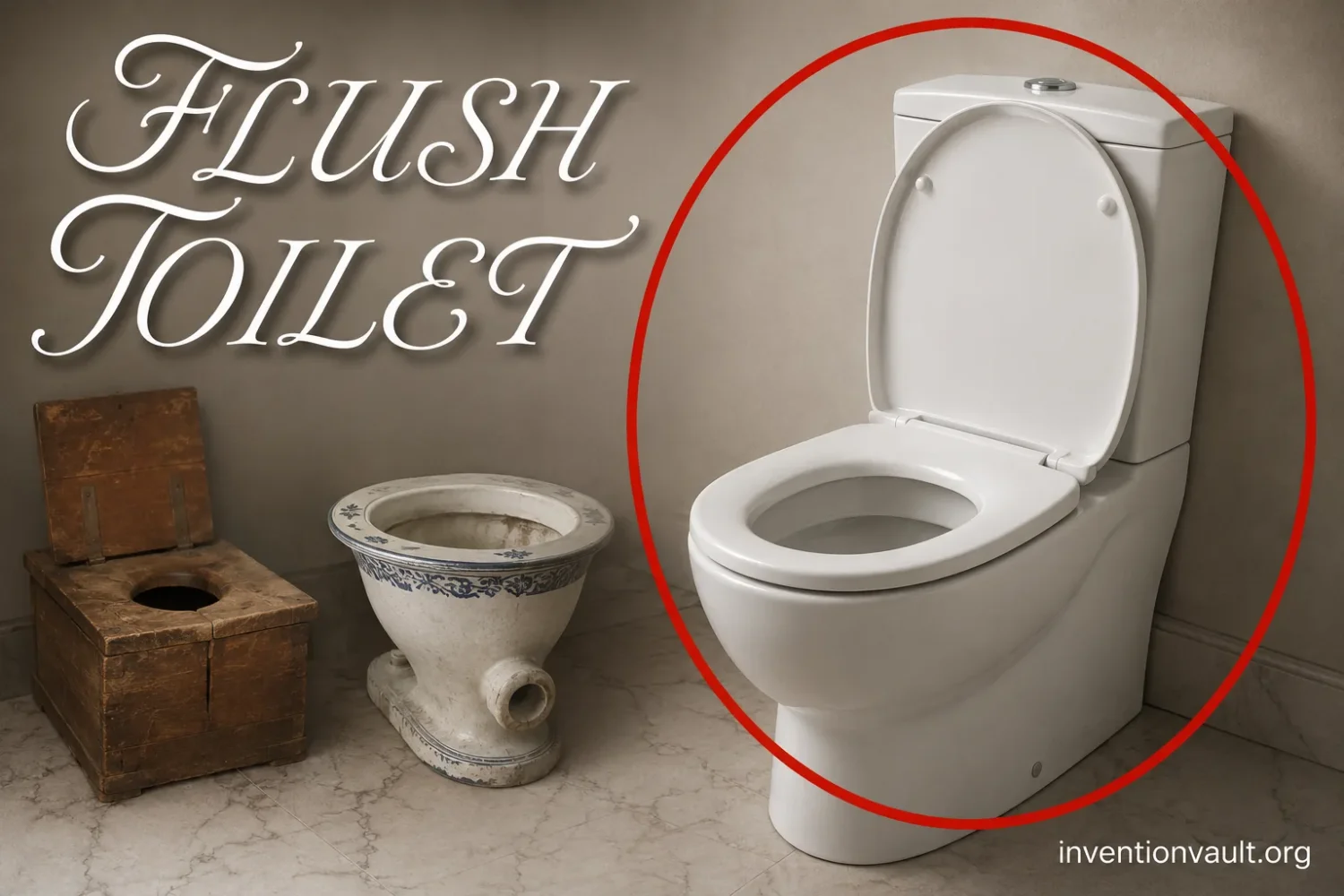
Waste before the water closet
Latrines, Pots, Cesspits, and Open Drains
Current stage
Household methods
Chamber pots, privies, and cesspits stored waste near where people lived. Removal depended on manual collection, local drains, or periodic emptying rather than a sealed indoor pipe system.
Ancient water use
Some ancient settlements and Roman facilities used flowing water beneath communal latrines. These systems moved waste, yet they lacked the private bowl, controlled flush, permanent trap, and household sewer connection of later water closets.
Unsolved problems
A practical indoor toilet had to remove waste, stop foul air from returning, provide reliable water, and connect to a destination that did not contaminate homes or drinking supplies.
Moving waste away from the seat was only the first task; safe storage, transport, and treatment remained unresolved.
Documented working design
John Harington’s 1596 Water Closet
Current stage
Published description
Harington described his device in A New Discourse upon a Stale Subject: The Metamorphosis of Ajax, published in 1596. The design paired a water-fed wash-down action with an outlet valve.
Working installations
He installed a version at his home and another for Queen Elizabeth I. These examples show that the idea moved beyond a sketch, even though it did not become a standard household product.
Why it stalled
The closet demanded a large charge of water and appeared before piped domestic supply and sewer networks were widely available. A working fixture could not create the missing urban infrastructure around it.
Harington proved that controlled water could clear a bowl, but the design arrived before cities could support routine use.
Patented odour control
Alexander Cumming’s Water Seal
Current stage
Patent record
On 11 November 1775, Scottish watchmaker Alexander Cumming received the first British patent for a flushing water closet. The patent marks a documented mechanical claim, not the first use of water to move human waste.
S-shaped trap
The bent outlet retained water after each discharge. That standing water interrupted the open air path between the room and the waste line, reducing the return of odours through the fixture.
Lasting principle
Modern toilets use different trapway forms, yet the same basic idea remains: enough water stays in the bend to form a renewable seal after the flush has ended.
The water seal solved the problem that flushing alone could not: keeping the waste pipe from breathing back into the room.
Mechanical refinement
Joseph Bramah’s More Reliable Valve
Current stage
1778 patent
Locksmith and inventor Joseph Bramah patented an improved water closet in 1778 after working with Cumming-type installations. His arrangement used a hinged valve at the bottom of the bowl.
Service problem
Early sliding parts could leak, jam, or collect dirt. A household sanitary fixture needed to hold water between uses, open cleanly, and close again many times without constant adjustment.
Long production life
Bramah’s design became a leading form for decades. Its value came from repeated operation and repairability, qualities that separated a persuasive demonstration from a usable manufactured fixture.
Reliable valves moved the water closet closer to a product that builders, owners, and plumbers could maintain.
Urban adoption
Fixtures Built for Public Use
Current stage
New setting
Public toilets had to withstand repeated use in railway stations, exhibition halls, and other shared spaces. Durability, cleaning access, drainage capacity, and supervision mattered more than they did in a lightly used private room.
George Jennings
In 1852, sanitary engineer Josiah George Jennings designed a water closet for public locations. His work belongs to the adoption story: adapting the fixture for crowds and routine institutional maintenance.
Manufacturing shift
Victorian makers offered more models, improved sanitary ceramics, and displayed plumbing goods to buyers. The water closet became a specified building product rather than an unusual custom installation.
Public installations tested toilets as shared infrastructure and exposed the need for stronger drains, cleaning systems, and dependable water supply.
Metropolitan waste network
The Sewer System Beneath the Flush
Current stage
Displaced pollution
More flushing sent more liquid waste into cesspits, old drains, and the Thames. The fixture made the room cleaner while overloading systems that had never been designed for large, continuous wastewater flows.
1858 pressure
During the hot summer of 1858, the smell of the polluted Thames reached an intolerable level in central London. The episode called the Great Stink pushed sewer construction up the political agenda.
Bazalgette’s network
Joseph Bazalgette and his team built intercepting sewers, embankment conduits, and pumping stations that carried sewage eastward away from central London. The network supported water closets on a metropolitan scale.
A flush became useful at city scale only when streets, sewers, pumps, and outfalls could receive what left the bowl.
Modern sanitation chain
Containment, Transport, and Treatment
Current stage
Beyond the fixture
A toilet is one interface in a longer chain. Waste must be contained, removed or conveyed, treated, and finally discharged or reused without exposing people or contaminating water sources.
Water efficiency
Modern bowl geometry, directed jets, pressure assistance, dual-flush controls, and vacuum transport can reduce the water needed per use. Performance depends on the whole fixture and drain arrangement, not tank volume alone.
Unfinished access
WHO and UNICEF estimates for 2024 show that 3.4 billion people still lacked safely managed sanitation. The historical invention remains incomplete wherever waste is not safely contained and treated.
The modern measure is not whether a bowl flushes, but whether the entire sanitation chain protects people and water.
The flush toilet was not invented in one finished form by one person. Sir John Harington described and installed an early working water closet in 1596; Alexander Cumming patented a water-sealed outlet in 1775; Joseph Bramah improved the valve mechanism in 1778; later manufacturers and sanitary engineers adapted toilets for routine household and public use. The fixture became part of modern sanitation only after piped water, trapped drains, sewers, pumping stations, and wastewater treatment were joined into a working chain.
Fixture vs. Sanitation System
A flushing bowl can remove waste from a room while still sending it to an overflowing cesspit, an open drain, or untreated water. Safe sanitation depends on what happens after the waste passes through the outlet.
| Milestone | Date or period | Person or system | What it actually added |
|---|---|---|---|
| Early working water closet | 1596 | Sir John Harington | A documented wash-down arrangement with stored water and a controllable outlet valve |
| First British flushing-toilet patent | 1775 | Alexander Cumming | An S-shaped outlet that retained water and separated the room from drain air |
| More dependable valve | 1778 | Joseph Bramah | A hinged-valve design suited to repeated operation and long manufacture |
| Public-use water closet | 1852 | Josiah George Jennings | A fixture developed for railway stations, exhibition halls, and other high-use settings |
| Metropolitan sewer expansion | After 1858 | Joseph Bazalgette and the Metropolitan Board of Works | Intercepting sewers, pumping stations, and outfalls that carried sewage away from central London |
| Safely managed sanitation | Modern standard | Water, plumbing, sewerage, treatment, and service operators | Containment and treatment of waste, not merely its removal from the toilet bowl |
Who Invented the Flush Toilet?
The most accurate answer depends on what counts as the invention. Harington has the strongest claim to an early documented and installed flushing water closet in Britain. Cumming holds the first British patent for a flushing toilet and supplied the enduring water-seal principle. Bramah made the mechanism more dependable. Jennings helped adapt water closets to public environments. Thomas Crapper later manufactured, displayed, and sold sanitary fittings, but he did not originate the flush toilet.
None of those labels identifies the entire modern system. A household fixture can be dated to a design or patent; a sanitation network cannot. It develops through building practice, pipe production, municipal finance, public-health law, water supply, sewer construction, treatment plants, maintenance, and standards.
What Each Kind of Evidence Can Establish
- Published descriptionShows that a mechanism was recorded in words or drawings, but does not by itself prove reliable daily operation.
- Surviving or reported installationSupports the existence of a working example, though one custom fixture may never have entered regular manufacture.
- Patent recordFixes a legal claim and date for defined features. It does not automatically identify the earliest experiment or the first practical product.
- Manufactured modelShows that a design could be produced, sold, installed, repaired, and repeated beyond a single demonstration.
- Municipal adoptionShows that water, drains, sewers, and public administration had developed enough to support use across many buildings.
Dating the First
Ancient water-fed latrines, Harington’s working closet, Cumming’s patent, Bramah’s commercial mechanism, and Victorian sewer systems answer different historical questions. Treating them as competing versions of one event hides the development path.
Sanitation Before the Water Closet
People managed human waste long before the modern toilet. The common methods included chamber pots, simple privies, shared latrines, cesspits, dung heaps, and drains leading toward streets or waterways. In many towns, workers collected “night soil” from pits and containers. Some of it entered agricultural use; some remained near housing or reached rivers.
Ancient settlements also used water to carry waste. Roman communal latrines could have channels beneath the seats, sometimes supplied by water from bath complexes. These arrangements are part of the history of hydraulic sanitation, but they were not modern flush toilets. They did not combine a private ceramic bowl, a user-controlled charge of water, a permanent trap seal, a ventilated household drain, and a managed sewer destination.
The Three Problems an Indoor Toilet Had to Solve
- Clear the receptacle: Water or a mechanical action had to move urine, feces, and paper away from the user area.
- Close the air path: The outlet needed a barrier that stopped drain odours, insects, and gases from returning into the room.
- Manage the destination: Waste leaving the building needed safe containment, transport, and treatment rather than simple displacement.
Early inventors mainly worked on the first two problems. The third required decisions and investments at street, district, and city scale.
John Harington’s 1596 Flushing Water Closet
Sir John Harington described his water closet in a satirical work published in 1596, commonly shortened to The Metamorphosis of Ajax. The design used a cistern or stored body of water above the receptacle. Opening the mechanism released a large wash that swept the contents through an outlet controlled by a valve.
The arrangement contained two features recognizable in later toilets: a deliberate wash-down flow and a valve that held or released the contents. Harington installed a version at his home and is reported to have installed another for Queen Elizabeth I at Richmond Palace. That makes his contribution more than an unbuilt proposal.
Why Harington’s Toilet Did Not Spread
The problem was not simply reluctance to accept a new idea. His closet required a large amount of water in a period before dependable indoor supply was common. Most buildings lacked standardized soil pipes, trapped connections, venting, and sewers capable of receiving repeated flushes. The device could clean its own receptacle while leaving the owner with an unresolved waste-disposal problem.
A water closet also had to compete with cheaper arrangements that matched the available infrastructure. A chamber pot could be carried away. A privy could sit above a pit. Harington’s design tied the room to a fixed water source and drain, increasing installation and maintenance demands.
Alexander Cumming and the Water Seal
Alexander Cumming, a Scottish watchmaker and instrument maker, obtained the first British patent for a flushing water closet on 11 November 1775. His best-known contribution was the S-shaped pipe beneath the outlet. After a discharge passed through, water remained in the lower bend.
That retained water formed a seal between the room and the waste line. Gas could no longer travel through an unobstructed pipe into the toilet compartment. The bend did not purify sewage or remove disease organisms, yet it made an indoor connection to a drain more tolerable and controllable.
- Water is releasedA tank, valve, or pressure source sends water into the bowl, raising flow through the outlet.
- Waste enters the trapwayThe moving water carries waste through the curved internal passage toward the building drain.
- The main flow endsAir enters and the discharge loses momentum or siphonic pull, depending on the bowl design.
- Water remains in the bendThe geometry holds a measured depth of water between the bowl and drain side.
- The bowl refillsThe fill system restores the operating water level so the seal is ready for the next use.
Why the Trap Matters More Than Its Letter Shape
Historical accounts often call Cumming’s feature an S-trap. Modern plumbing may use integral trapways, P-traps, or other approved forms. The enduring idea is not the visual resemblance to a letter; it is the retained body of water that blocks the direct air route.
A trap seal can still fail if water evaporates from an unused fixture, is pulled out by poor venting, leaks away, or is disturbed by pressure changes. Modern drainage therefore pairs the trap with venting, tested fixture geometry, proper pipe sizing, and refill control.
Joseph Bramah Turns a Clever Device into Dependable Equipment
Cumming’s water seal addressed odour return, but early water closets still depended on valves and moving parts that could leak or foul. Joseph Bramah, trained as a locksmith and experienced with Cumming-type installations, patented his own improved water closet in 1778.
Bramah’s design used a hinged valve at the bottom of the bowl. The arrangement held water when closed and opened to discharge the contents when operated. It remained in production in various forms for many decades. The long service life matters because sanitary equipment must repeat the same cycle without frequent failure: hold water, release it, pass waste, close, and refill.
Working Prototype
Demonstrates that stored water and an outlet can clear a receptacle under selected conditions. It may rely on custom construction, abundant water, or frequent attention.
Dependable Fixture
Repeats the cycle with controlled leakage, accessible repairs, predictable connections, cleanable surfaces, and parts that builders and plumbers can install more than once.
Public Toilets Changed the Design Brief
During the nineteenth century, water closets moved from custom rooms in wealthy buildings toward manufactured sanitary equipment. Public display, railway travel, exhibition halls, hotels, institutions, and dense urban buildings created a different set of demands. A shared toilet might be operated many times each day by people unfamiliar with its mechanism.
Josiah George Jennings designed a water closet in 1852 for railway stations, exhibition halls, and other public places. This did not make him the sole inventor. His role shows how adoption changes an object: controls must be obvious, components must tolerate repeated use, surfaces must be cleaned, drains must carry concentrated loads, and maintenance cannot depend on the original maker being present.
Sanitary Ceramics and Standard Installation
Victorian manufacturers produced a growing range of closets, cisterns, valves, basins, traps, and pipes. Glazed ceramic surfaces offered a smooth, low-absorption finish that could be washed more easily than porous or jointed enclosures. Decorative cabinets did not disappear at once, but the ceramic fixture gradually became more visible and easier to inspect.
Standardized connections also mattered. A toilet could spread only when its inlet, outlet, trap, floor joint, shutoff, and tank parts could fit the rest of a building’s plumbing. Manufacture and installation practice advanced together.
Thomas Crapper Did Not Invent the Flush Toilet
Thomas Crapper was born after the patents of Cumming and Bramah and centuries after Harington’s water closet. He became a successful London sanitary engineer and manufacturer. His company sold toilets, cisterns, fittings, and other plumbing goods, and his showrooms made sanitary equipment more visible to buyers.
The lasting myth comes from several sources: his memorable surname, the company name cast or printed on fittings, later stories linking him to royal installations, and the public visibility of his business. These details made him easy to remember. They do not move the origin of the flush toilet into his lifetime.
What the Record Supports
Thomas Crapper contributed to the manufacture, sale, display, and improvement of sanitary fittings. Earlier documented flushing designs and patents rule out the claim that he invented the flush toilet itself.
Flushing Made the City’s Waste Problem Larger
A flush creates the impression that waste has vanished. In physical terms, it has been mixed with water and moved somewhere else. That change can improve cleanliness around the user while increasing the volume and mobility of sewage beyond the room.
In early nineteenth-century London, many homes relied on cesspits below or near buildings. Extra flush water filled them faster and encouraged leakage or overflow. Connections to old drains sent sewage toward tributaries and the Thames, which also supplied water to parts of the city. The water closet amplified the need for a coordinated wastewater network.
Miasma, Cholera, and Contaminated Water
Many officials and residents associated disease with foul-smelling air. The miasma explanation was wrong about cholera transmission, although the smell accurately revealed that sewage was present. Cholera spreads through contaminated food or water, so separating human waste from drinking supplies addressed the actual exposure route.
The water seal inside a toilet could reduce odour in a room. It could not protect a river used for both sewage disposal and water supply. Household plumbing and city sanitation solved different portions of the same exposure chain.
The Great Stink of 1858
During the hot summer of 1858, sewage and industrial waste in the Thames produced an intense stench across central London. Conditions affected the Palace of Westminster and helped force action on a long-recognized drainage problem. Parliament approved a large sewer scheme, and Joseph Bazalgette, chief engineer of the Metropolitan Board of Works, led its execution.
Bazalgette’s system intercepted flows that had entered central sections of the river, carried them eastward, and used pumping stations where gravity alone could not maintain the route. River embankments concealed major conduits and also altered streets, waterfront access, and flood protection. Crossness Pumping Station opened in 1865 as part of this network.
The scheme did not initially provide the full biological treatment expected of a modern plant; sewage was moved farther downstream for discharge. Even so, it reduced the overlap between central waste disposal and heavily used water sources. Later sanitation added treatment as another required stage.
How a Modern Gravity Toilet Works
Most domestic tank toilets store a measured amount of water above the bowl. Operating a lever or button lifts or opens the flush valve. Water enters the bowl rapidly through rim passages, directed openings, or a combination of channels. Bowl and trapway geometry then convert that short water release into waste removal.
- The flush valve opensStored tank water gains an open path into the bowl and begins moving under gravity.
- The bowl receives a fast flowWater washes the surface and pushes the bowl contents toward the trapway entrance.
- Waste passes the trapwayWash-down bowls rely mainly on directed flow; siphonic bowls also develop a temporary pull as the trapway fills.
- The discharge breaksAir reaches the passage, the main flow ends, and a controlled amount of water remains to form the seal.
- The tank and bowl refillA fill valve responds to the lower water level, replenishes the tank, and restores water in the bowl.
Wash-Down and Siphonic Bowls
A wash-down toilet directs water against the bowl contents and toward a comparatively direct trapway. A siphonic toilet is shaped so the moving water fills part of the trapway and creates a temporary pressure difference that helps draw the bowl contents through. Both are gravity-operated fixtures, but the internal hydraulic sequence differs.
Neither label tells the whole performance story. Trapway diameter, bends, bowl surface, jet placement, tank discharge rate, drain connection, and refill level all influence clearing ability. A lower-volume fixture succeeds through coordinated geometry, not by reducing water while leaving every other feature unchanged.
What the Overflow Tube and Fill Valve Do
After a flush, the fill valve admits fresh water until the tank reaches its set level. A smaller refill stream may feed the overflow tube so the bowl’s trap seal returns to the intended depth. If the fill valve fails to shut, the overflow route directs excess tank water into the bowl instead of over the tank rim.
From High Cisterns to Concealed Tanks
Early and Victorian water closets often placed the cistern high on the wall. The long drop increased water speed before it reached the bowl, helping a large gravity charge produce a forceful wash. A chain provided a simple remote control.
Later close-coupled toilets placed the tank directly behind the bowl. Better bowl passages and flush valves allowed a shorter path, while factory-matched components reduced exposed pipework. One-piece toilets joined tank and bowl into a continuous ceramic body. Wall-hung toilets moved the carrier and cistern into a service cavity, leaving the bowl clear of the floor.
| Design family | How waste is moved | Where it fits | Main trade-off |
|---|---|---|---|
| High-level gravity cistern | A large water charge falls through a long flush pipe | Historic and restored installations | Strong gravity flow with exposed pipework and more wall height |
| Close-coupled gravity toilet | Tank water enters a bowl designed for wash-down or siphonic action | Common household bathrooms | Simple service parts, with performance tied closely to bowl geometry |
| Pressure-assisted toilet | Stored pressure adds energy to the discharge | Some homes and high-use settings | Forceful clearing with more noise and specialized internal parts |
| Flushometer-valve toilet | A timed valve releases water directly from a pressurized supply | Commercial and institutional washrooms | No storage tank, but it requires suitable supply pressure and pipe sizing |
| Dual-flush toilet | The user selects a reduced or full-volume cycle | Water-conscious residential and commercial use | Savings depend on correct use, adjustment, and reliable clearing |
| Vacuum toilet | A pressure difference pulls waste into a sealed transport line | Aircraft, ships, trains, and selected buildings | Very low flush water use with specialized pumps and sealed piping |
The Toilet Is One Link in the Sanitation Chain
Modern public-health measurement follows waste beyond the fixture. A service is described as safely managed when an improved facility is not shared with other households and the excreta are safely disposed of in place or removed and treated off site. The definition prevents a clean-looking toilet from masking an unsafe pit, leaking tank, open discharge, or failed treatment route.
- ContainmentThe toilet connects to a sewer, septic tank, lined pit, holding tank, or another system intended to isolate excreta.
- Emptying or collectionOn-site systems require safe removal when solids accumulate; sewered systems collect wastewater through connected drains.
- TransportPipes, pumps, tankers, or container services carry waste without uncontrolled leakage or direct human contact.
- TreatmentPhysical, biological, and sometimes chemical processes reduce solids, organic loading, and disease-causing organisms.
- Discharge or reuseTreated water and residual solids follow controlled routes suited to local health and environmental requirements.
This chain can be centralized or decentralized. A dense city may rely on sewers and large treatment works. A rural property may use a well-designed septic system. Water-scarce communities may use dry, urine-diverting, container-based, or vacuum arrangements. The safe outcome matters more than copying one nineteenth-century urban model everywhere.
Water Use Became a New Design Problem
Harington’s device depended on a large release of water. Later high-level cisterns also used volume and drop height to compensate for less refined bowl hydraulics. Modern toilets seek the same clearing result with less water by coordinating tank discharge, valve opening, jet direction, surface finish, trapway shape, and drain performance.
In the United States, the current federal standard for many new residential toilets is 1.6 gallons per flush. EPA WaterSense-labeled tank toilets use 1.28 gallons per flush or less while meeting performance requirements. The comparison shows how design testing replaced the assumption that a dependable flush always needed a large volume.
Volume Is Only One Measure
A low flush number does not guarantee good results. Bowl hydraulics, trapway design, drain conditions, correct installation, refill level, and leakage determine whether water savings persist in everyday use.
Leaks Can Outweigh Design Savings
A worn flapper, seal, fill valve, or improperly set overflow can allow tank water to pass into the bowl between uses. Because the flow may be quiet and continuous, a nominally efficient toilet can waste more water than an older fixture that closes correctly. Water efficiency therefore includes maintenance and repair access.
Modern Sanitation Remains Unfinished
The latest global household estimates published by the WHO/UNICEF Joint Monitoring Programme cover data through 2024. They report that safely managed sanitation coverage rose from 48 percent in 2015 to 58 percent in 2024. About 1.2 billion people gained access during that period.
The remaining gap is large. In 2024, 3.4 billion people lacked safely managed sanitation services. That total included people with basic facilities whose waste was not safely managed, people sharing facilities, people using unimproved facilities, and 354 million people practising open defecation.
| Global sanitation measure | 2015 | 2024 | What the change means |
|---|---|---|---|
| Safely managed sanitation coverage | 48% | 58% | About 1.2 billion additional people gained a service in which excreta are safely disposed of or treated |
| People lacking safely managed sanitation | Not used here as a direct comparison | 3.4 billion | Having a toilet does not always mean that the waste is safely managed |
| People practising open defecation | Higher by 429 million | 354 million | The practice declined, yet it remained a daily reality for hundreds of millions of people |
These categories explain why the history cannot end with the ceramic bowl. The technical interface is mature in many markets, while safe emptying, sewer coverage, treatment capacity, reliable water, affordability, and access remain unresolved elsewhere. In some places the needed advance is a better toilet; in others it is a service chain that keeps an existing toilet from discharging into the environment.
When Was the Modern Flush Toilet Really Invented?
The mechanical lineage can be dated in stages. Harington demonstrated the wash-down idea in 1596. Cumming’s 1775 patent added the water seal that allowed a drain connection without a permanently open air path. Bramah’s 1778 design improved repeated operation. Nineteenth-century manufacturers, public installations, sanitary ceramics, piped supply, and standardized plumbing turned water closets into building equipment.
The sanitation system took longer. London’s sewer works after the Great Stink showed that mass flushing needed metropolitan collection and pumping. Later wastewater treatment addressed the pollution that transport alone had moved downstream. Modern definitions add safe containment, treatment, and equitable access.
There is therefore no single honest birthday for the complete modern flush toilet. The answer changes with the boundary of the question:
- 1596 for Harington’s documented working wash-down water closet.
- 1775 for Cumming’s first British flushing-toilet patent and water-seal arrangement.
- 1778 for Bramah’s dependable valve-based improvement.
- The mid-nineteenth century for broader manufacture, public use, and municipal sewer support.
- The twentieth and twenty-first centuries for wastewater treatment, lower-water designs, service monitoring, and the unfinished work of universal safe sanitation.
Questions People Ask About the Flush Toilet
Did Sir John Harington invent the first flush toilet?
He is commonly credited with an early documented working flushing water closet in Britain, described in 1596 and installed in at least limited settings. Ancient water-fed latrines predated him, while later inventors supplied the trap, reliable valves, manufactured forms, and supporting infrastructure associated with modern toilets.
What exactly did Alexander Cumming invent?
Cumming received the first British patent for a flushing water closet in 1775. His defining feature was an S-shaped outlet that retained water after use. The trapped water reduced the return of drain odours and established a principle still used in toilet trapways.
Why is Joseph Bramah part of the invention story?
Bramah improved the operating mechanism and patented his water closet in 1778. His hinged-valve arrangement was better suited to repeated use than less dependable early parts and remained influential for many decades.
Why do many people think Thomas Crapper invented it?
Crapper’s company name appeared on sanitary fittings, his business promoted bathroom equipment, and later stories attached his memorable surname to the object. He was a successful sanitary engineer and manufacturer, but flushing toilets and their main early patents existed before his birth.
Did the flush toilet stop cholera outbreaks?
The fixture alone did not. A toilet could send sewage into a cesspit or polluted river. Cholera control depended on separating fecal waste from drinking water through safer water supply, drainage, sewerage, treatment, hygiene, and public-health action.
Why does a toilet need water in the bowl?
The visible water connects to the trapway seal. Enough water remains in the curved passage to block the direct air route from the drainage system. The next flush replaces that water as waste passes through.
Are all modern flush toilets siphonic?
No. Wash-down toilets use directed water flow to push waste through the outlet. Siphonic toilets develop a temporary pull as water fills the trapway. Pressure-assisted, flushometer, dual-flush, and vacuum systems use other combinations of stored water, supply pressure, air, and geometry.
References Used for This Article
- The National Archives — “Innovations in Toilet Design”: patent dates and the documented roles of Alexander Cumming, Joseph Bramah, and Josiah George Jennings.
- Science Museum Blog — “A Flushing Story”: John Harington’s 1596 design, the water demand of the early closet, Cumming’s trap, and Bramah’s valve.
- Science Museum — “Flushed Away: Sewers Through History”: ancient precedents, cesspits, the effect of added flush water, Victorian manufacture, and the path toward sewer networks.
- Historic England — “The Great Stink”: Thames pollution, cholera context, Bazalgette’s intercepting sewers, embankments, and pumping stations.
- Smithsonian Magazine — “Three True Things About Sanitary Engineer Thomas Crapper”: the distinction between Crapper’s sanitary business and the false claim that he invented the flush toilet.
- UNICEF Data — 2025 JMP Household WASH Report: global sanitation coverage and service-level estimates through 2024.
- World Health Organization — WHO/UNICEF WASH Update: the 2024 totals for people lacking safely managed sanitation and practising open defecation.
- World Health Organization — Safely Managed Sanitation Indicator Definition: the service definition based on an improved, unshared facility and safe disposal in place or treatment off site.
- U.S. Environmental Protection Agency — WaterSense Residential Toilets: current U.S. flush-volume benchmarks and performance-based water-efficiency information.