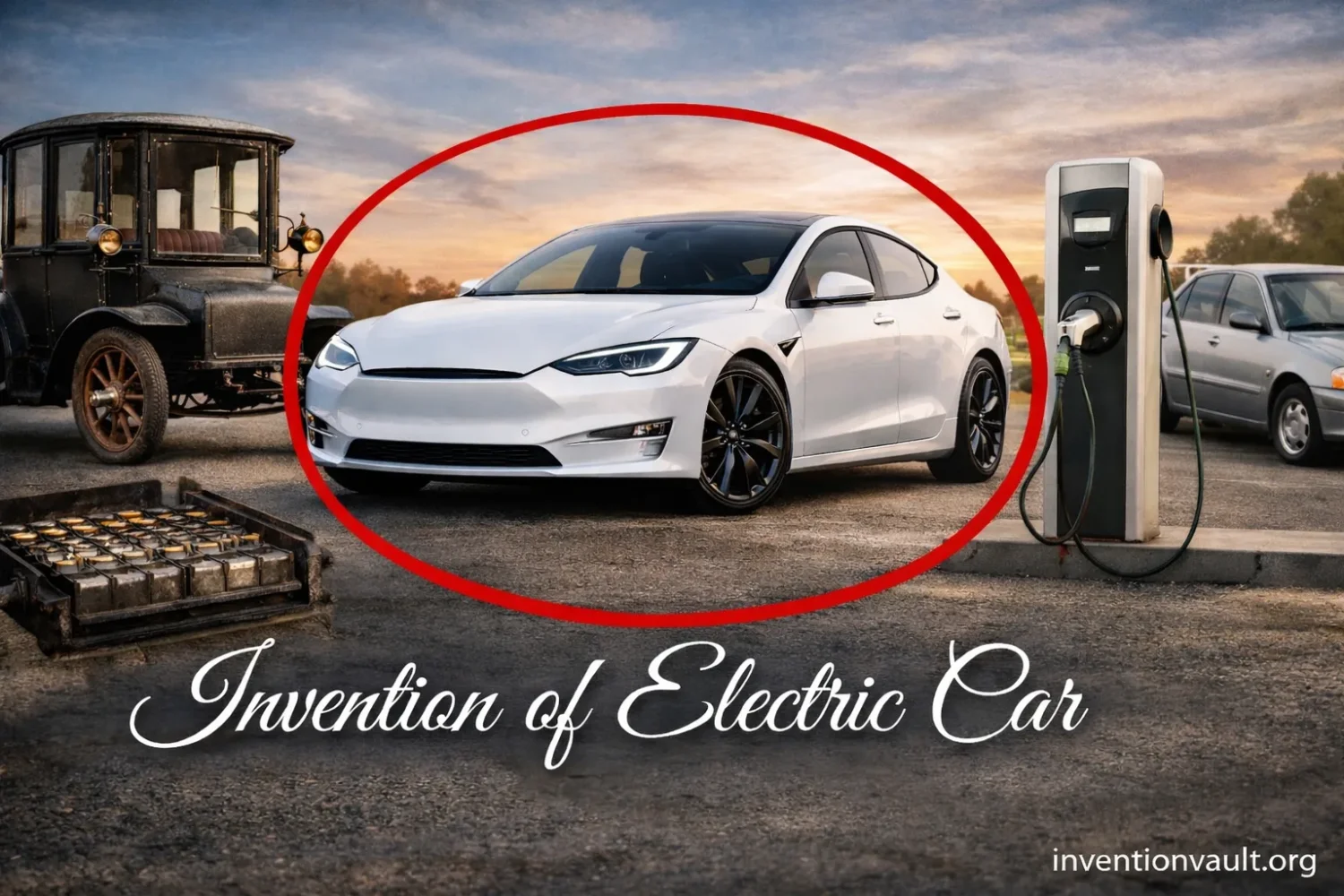
| Field | Verified Details |
|---|---|
| Invention | Electric car — a road vehicle propelled by an electric motor drawing power from onboard electrical energy storage. |
| Single Inventor | No single inventor; the electric car emerged from 19th-century advances in batteries, motors, and control systems. |
| Earliest Road Experiments | Small-scale electric vehicle experiments appeared around 1828–1835 in parts of Europe and the United States. |
| Battery Breakthrough | The first widely recognized rechargeable storage battery (lead-acid) was developed in 1859, making repeatable road trials far more realistic. |
| When “Practical” Arrived | Roadworthy electric cars began to appear in the second half of the 19th century, especially in France, England, and the United States. |
| Early U.S. Milestone | U.S. histories often highlight an electric car built around 1890 by William Morrison in Des Moines, helping spark wider interest. |
| Urban Adoption | Electric cars gained traction in cities thanks to smooth driving and quiet operation; by about 1900, electric cars were a major presence in the mix of steam, gasoline, and electric vehicles. |
| Fleet Use | Electric taxis and commercial vehicles became early proofs of value; London’s Bersey electric cabs entered service in 1897. |
| Iconic Performance Moment | La Jamais Contente became the first automobile to exceed 100 km/h in 1899. |
| Core Engineering Idea | An electric drivetrain converts stored electricity into controllable torque at the wheels. |
| Modern Design Families | BEV (battery-electric), HEV (hybrid), PHEV (plug-in hybrid), and FCEV (fuel-cell electric) are later branches of the same propulsion concept. |
| Why This Invention Matters | The electric car shaped early urban mobility and continues to drive advances in energy storage, motors, and power electronics. |
The electric car was not “born” in a single workshop on a single day. It took shape as a chain of real, testable breakthroughs—especially in rechargeable energy storage and reliable electric motors—until a battery-powered road vehicle could move people through a city without drama. If you want the invention story that actually matches how technology evolves, focus on what became possible at each step, not on finding one name to credit.
Think of the invention of the electric car as a working system: stored electricity, a motor that turns it into motion, and a control method that makes the vehicle safe and predictable on real roads.
- Battery: stores energy on the vehicle.
- Motor: turns electrical power into rotation and torque.
- Control: regulates speed, starting, and braking in a repeatable way.
Why The Electric Car Has No Single Inventor
When people search for the “inventor of the electric car,” they usually mean one of three different things. Mixing these up is the fastest route to confusion.
First Demonstrations
In the early 1800s, inventors in multiple countries built small electric vehicles and carriages. Many were limited by early batteries and were better as proof-of-concept than daily transport.
First Practical Road Cars
By the late 19th century, improved batteries and motors enabled electric cars that could operate on public streets with usable speed and reliability.
First Scaled Use
Fleet operations—especially electric taxis and delivery vehicles—proved that electric mobility could work as a service, not only as a prototype.
What Counts As An Electric Car
At its simplest, an electric car is a road vehicle where propulsion comes from an electric motor. That sounds obvious, yet the invention story becomes clearer when you break the machine into parts.
- Energy storage: early electric cars relied on storage batteries; the concept of an onboard “tank,” just electrical.
- Traction motor: delivers instant torque and smooth rotation, ideal for stop-and-go city travel.
- Power control: early vehicles used step controllers and resistors; modern EVs use electronic inverters, yet the purpose is unchanged—precise control.
- Drivetrain layout: direct drive, reduction gearing, or hub motors all appeared early in electric-vehicle experimentation.
Rechargeable Batteries Made Electric Cars Practical
Electric propulsion was imaginable before rechargeable batteries were truly usable, but it was hard to turn imagination into a repeatable road machine. The breakthrough arrived with the lead-acid storage battery, recognized as the first practical rechargeable battery design (mid-19th century). That step changed the electric car from a short-lived experiment into a vehicle that could be driven, recharged, and driven again.
| Period | Milestone | Why It Mattered |
|---|---|---|
| 1828–1835 | Early small-scale electric vehicle experiments | Proved that electric motion on wheels was feasible, even with limited early batteries. |
| 1859 | Rechargeable lead-acid storage battery becomes possible | Enabled repeated use rather than single-use power, a requirement for practical road vehicles. |
| Late 1800s | Practical electric cars appear in Europe and the U.S. | Battery and motor improvements make street use realistic for urban travel. |
| c. 1890 | Successful U.S. electric car associated with William Morrison | Helped drive public attention and experimentation by multiple builders. |
| 1897 | London Bersey electric cabs enter service | Demonstrated fleet logistics, including rapid battery exchange at a depot. |
| 1899 | La Jamais Contente exceeds 100 km/h | Showed that electric cars were not limited to low-speed utility roles. |
| c. 1900 | Electric cars reach a peak of popularity in cities | Urban charging access and easy operation made EVs a compelling choice for many buyers. |
A Timeline Of Early Electric Cars
The electric car’s invention story reads like a sequence of “now it works” moments. Below is a careful timeline that prioritizes what can be stated without guesswork.
- Early 1800s: experimental electric vehicles appear in multiple regions, typically small and limited by energy storage.
- Mid-19th century: rechargeable batteries transform what “portable electricity” can do.
- Late 1800s: practical electric cars show up on roads, especially for city travel.
- 1890s: electric cars expand into taxis and commercial work, where reliability can be measured in daily service.
- c. 1900: electric cars become a major part of the urban vehicle landscape.
Electric Taxis and Fleet Operations
Many histories focus on private owners, yet early electric mobility also grew as a service model. Fleets forced engineers to solve practical questions: where does energy come from, how fast can a vehicle return to duty, and what happens when batteries age?
London, 1897
London’s Bersey electric cabs entered service in 1897 and became known for their distinctive sound and appearance. A key operational idea was battery exchange: instead of waiting for a long recharge, batteries could be swapped at a depot using lifting equipment in just a few minutes.
- Designed for short, frequent trips
- Built around depot logistics
- Helped define what “urban range” meant in practice
New York City, Around 1900
By around 1900, New York City had a fleet of more than 60 electric taxis according to major historical summaries. That matters because it proves electric cars were not only curiosities—they were deployed where uptime and reliability were visible to the public.
- Fleet use makes performance measurable
- Charging access becomes a planning factor
- Maintenance routines shape vehicle design
Why Fleet History Changes The Invention Story
A fleet reveals the hidden half of the invention: infrastructure. Early electric cars were at their best when they could return to a known place for energy service—charging, inspection, and battery care—much like today’s emphasis on dependable charging networks.
Electric Cars Set Early Performance Milestones
Electric cars were not confined to gentle city cruising. In 1899, La Jamais Contente—designed and driven by Camille Jenatzy—became the first automobile to cross the 100 km/h threshold at Achères near Paris. Museums and archival sources treat this moment as a landmark in both automotive and electrical history.
| Date | Vehicle | Milestone | Location |
|---|---|---|---|
| 1899 | La Jamais Contente | First automobile over 100 km/h | Achères (near Paris) |
Engineering Ideas That Still Matter
The most durable inventions are the ones that keep their shape even as components improve. Early electric cars introduced patterns that modern EVs still follow—just with better materials and far more refined electronics.
Control: From Steps To Smooth Torque
Early electric cars had to manage current safely and predictably. Period descriptions of electric vehicles linked to Ferdinand Porsche note multi-step control and braking settings—an ancestor of today’s seamless pedal mapping and traction control.
Packaging: Hub Motors and Layout Freedom
By 1900, wheel-hub motor concepts were already being demonstrated in high-profile exhibitions. This approach rearranges the car: fewer drivetrain parts, more flexible cabin and chassis packaging, and a direct link between motor torque and the wheel.
Operations: Energy Service As A Design Feature
Battery exchange depots for taxis show a lasting truth: an electric car is easiest to live with when energy service is predictable. That principle reappears today as home charging, workplace charging, and reliable public charging corridors.
Electric mobility has always been a balance of machine and system. When the system is strong—charging access, maintenance routines, and energy storage that can be reused—electric cars thrive.
Major Electric Car Types
The invention story begins with battery power, yet the electric car family later branched into several subtypes. Each still relies on an electric motor for propulsion, while energy sources and operating patterns differ.
| Type | Primary Energy Source | How It Gets More Energy | What It’s Known For |
|---|---|---|---|
| BEV | Battery (all-electric) | Charging from external electricity | Pure electric driving with a simple drivetrain |
| HEV | Battery + fuel-powered engine (hybrid) | Battery is charged by the engine and energy recovery during driving | Efficient operation without plugging in |
| PHEV | Battery + fuel-powered engine (plug-in hybrid) | External charging plus onboard engine support | Electric driving for many trips with longer total range potential |
| FCEV | Fuel cell + small buffer battery | Refueling with hydrogen, generating electricity onboard | Electric propulsion with fast refueling patterns |
Why Early Electric Cars Disappeared From Showrooms
Electric cars were strong in city life around 1900, yet market conditions shifted. Major historical overviews point to affordability, improved road networks, and changes in how people expected to travel. As gasoline cars became cheaper and easier to operate, the electric car’s early advantages were no longer enough to keep it dominant, and by the mid-1930s electric passenger cars had largely faded from mainstream sales.
How The Electric Car Returned
The electric car’s return was not a single comeback moment; it was a series of improvements that stacked up over decades. Better batteries, modern power electronics, and broader charging access gradually brought electric propulsion back into everyday automotive life—first in limited programs and later as mass-market options across many vehicle sizes.
The Invention’s Throughline
- Energy storage improves, expanding what “usable range” means.
- Control becomes precise, making electric driving feel natural and confident.
- Infrastructure grows, turning charging from a barrier into a routine.
References Used for This Article
- U.S. Department of Energy — The History of the Electric Car: A government overview that anchors key dates, early adoption, and major turning points.
- Smithsonian National Museum of American History — Riker Electric Automobile, ca. 1900: A museum object record illustrating early electric car design and ownership.
- Science Museum — The Surprisingly Old Story Of London’s First Ever Electric Taxi: An institutional write-up describing the 1897 Bersey cab and rapid battery exchange operations.
- Château de Compiègne — Automobile électrique « La Jamais Contente »: A museum collection page documenting the 1899 100 km/h milestone.
- FranceArchives — Camille Jenatzy atteint, à bord d’une automobile électrique la vitesse de 105,88 km/h: A national archive entry describing the record-setting run and its measured speed.
- Bibliothèque nationale de France — Sciences pour tous (1850–1900) page on La Jamais Contente: A national library exhibition page summarizing the 1899 speed landmark.
- Encyclopaedia Britannica — Development of batteries: A reference overview that includes the mid-19th-century emergence of practical rechargeable batteries.
- Porsche Museum — Egger-Lohner C2 Phaeton: A museum press kit describing early electric vehicle control features and historical vehicle context.