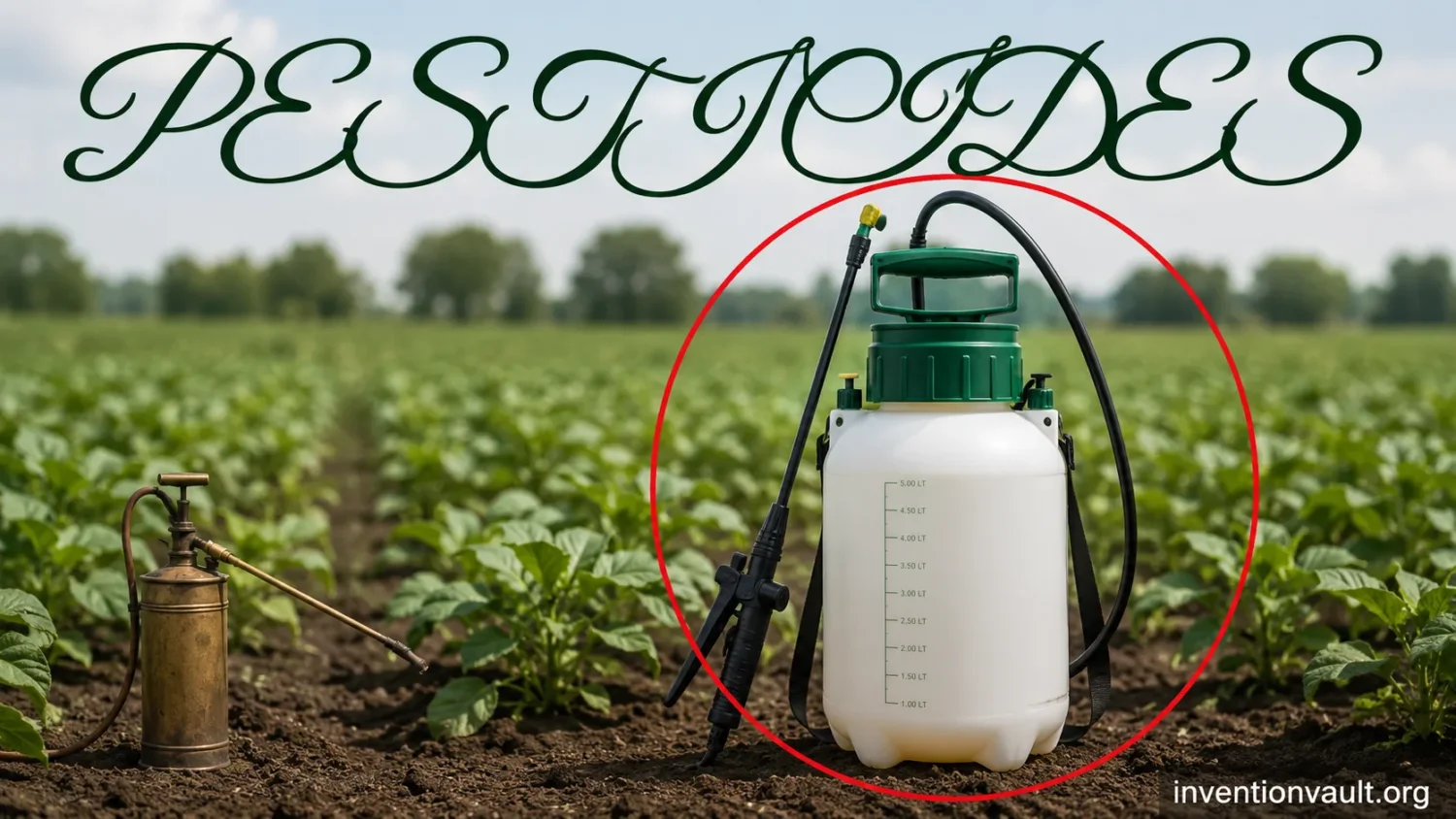
| Invention Name | Pesticide, meaning a substance or mixture intended to prevent, destroy, repel, or reduce a pest, or to act as a plant regulator, defoliant, desiccant, or nitrogen stabilizer. |
|---|---|
| Type of Invention | A family of crop-protection and pest-management technologies, not one single product. |
| Earliest Recorded Use | About 4,500 years ago, when Sumerians used sulfur compounds to control insects and mites. |
| Early Natural and Mineral Forms | Sulfur, plant extracts, pyrethrum, mineral compounds, smoke treatments, and copper-based mixtures. |
| First Major Commercial Fungicide | Bordeaux mixture, developed in the late 19th century by Pierre-Marie-Alexis Millardet for grape downy mildew. |
| Modern Synthetic Turning Point | DDT became the best-known early modern synthetic insecticide in the 1940s, although the compound had first been synthesized in 1874. |
| Important Named Figures | Pierre-Marie-Alexis Millardet, Paul Hermann Müller, Othmar Zeidler, and John E. Franz are among the names tied to major pesticide milestones. |
| Main Subtypes | Insecticides, herbicides, fungicides, bactericides, rodenticides, miticides, algicides, fumigants, antimicrobials, repellents, defoliants, and plant growth regulators. |
| Product Structure | Most pesticide products contain an active ingredient plus other ingredients that affect stability, handling, coverage, or performance. |
| Current Global Scale | Agricultural pesticide use reached about 3.73 million tonnes of active ingredients in 2023, with an average of 2.40 kg per hectare of cropland. |
Pesticide is one of the most misunderstood inventions in agricultural history. It is often described as if it were only an insect-killing chemical, yet the term covers a wider set of tools: weed control, fungal disease control, rodent control, microbial control, mite control, plant regulation, and more. The invention did not appear in one laboratory on one clear date. It grew slowly from mineral powders, plant extracts, copper mixtures, and later synthetic chemistry into a regulated technology used in farming, stored-food protection, public health, forestry, gardens, and water systems.
Core idea: a pesticide is best understood as a controlled pest-management invention, not as one chemical, one brand, or one farming method. Its history is a record of people trying to protect food, plants, stored goods, buildings, and public spaces from organisms that could damage them.
What a Pesticide Is
A pesticide is any substance or mixture made to manage a pest. A “pest” may be an insect, weed, fungus, rodent, mite, algae, bacterium, or another organism in the wrong place at the wrong time. This broad meaning matters because pesticide is the umbrella term, while insecticide, herbicide, and fungicide are only subtypes.
The word also covers some products that do not fit the public’s narrow image of crop chemicals. For example, disinfectants, swimming pool treatments, plant defoliants, desiccants, attractants, and plant growth regulators can fall under pesticide regulation when they meet the legal definition. That is why a pesticide article must not treat the invention as a single spray bottle or one crop chemical. The category is wider and more technical.
Active ingredient means the part that produces the intended pest-control effect.
Other ingredients may help with mixing, stability, spread, shelf life, or safe handling. The word “inert” does not automatically mean harmless.
Why It Was Invented
The need was simple: crops and stored foods could be damaged by insects, fungi, weeds, mites, and rodents. Before modern plant science, people used what they could find nearby. Sulfur, smoke, bitter plant extracts, ash, sea water, tar, copper salts, and flower powders all appear in the long record of pest control.
Early pesticide invention was practical, not theoretical. Farmers noticed that certain substances repelled insects, reduced fungal growth, or made plants less attractive to pests. The first forms were often rough and inconsistent, yet they introduced the central idea: chemical or biological intervention could protect a crop before total loss.
The Invention Is a Family, Not One Product
Many inventions have a named inventor. The telephone, the light bulb, and the printing press can be tied to a small set of famous names. Pesticides do not work that way. The word describes a family of inventions shaped by farmers, botanists, chemists, public health workers, regulators, toxicologists, and environmental scientists.
The most accurate answer to “Who invented pesticide?” is this: no single person invented pesticides. Sumerian sulfur use, Persian pyrethrum, Bordeaux mixture, DDT, glyphosate, microbial pesticides, and plant-incorporated protectants all belong to the same long invention line, but each came from a different time, problem, and scientific method.
Main Types of Pesticides
| Type | Main Target | How It Fits the Invention |
|---|---|---|
| Insecticide | Insects and arthropods | One of the oldest and best-known branches; includes natural products, inorganic compounds, synthetic chemicals, and some microbial tools. |
| Herbicide | Weeds and unwanted plants | Developed to reduce crop competition and labor-heavy hand weeding; modern examples often act on plant-specific biochemical pathways. |
| Fungicide | Fungi, molds, mildews, rusts, and blights | Includes sulfur, copper mixtures, Bordeaux mixture, and later systemic products for crop disease control. |
| Bactericide | Bacterial plant diseases or microbes | Used in specialized settings where bacteria can damage plants or surfaces. |
| Rodenticide | Rodents | Part of pest control in stored food, buildings, and some agricultural systems. |
| Miticide or Acaricide | Mites and ticks | Created for pests that are not insects but can harm crops, animals, or managed environments. |
| Algicide | Algae | Used in water-related settings such as ponds, canals, water tanks, and pools. |
| Fumigant | Pests in enclosed spaces, soil, or stored goods | Works as a gas or vapor and belongs to a highly controlled branch of pesticide technology. |
| Repellent and Attractant | Pest movement or behavior | Does not always kill the pest; it may keep pests away or draw them into traps. |
| Plant Growth Regulator | Plant growth processes | Classed as a pesticide in some legal systems because it changes plant growth rather than directly attacking a pest. |
Early History of Pesticides
The earliest known pesticide history begins with mineral chemistry. About 4,500 years ago, Sumerians used sulfur compounds against insects and mites. Around 3,200 years ago, Chinese records point to mercury and arsenical compounds used for body lice. These were not modern pesticides, but they show that people had already linked substance, pest, and effect.
Pyrethrum adds another important chapter. Made from dried chrysanthemum flowers, it has been used for more than two thousand years. It became famous because it acted on insects while coming from a plant source. The later development of synthetic pyrethroids would borrow from that natural model, showing how an old botanical idea could guide modern chemistry.
Fungicides followed a related path. Sulfur had a long history against fungal problems. Copper mixtures then became central in plant disease control. The late-19th-century Bordeaux mixture, associated with Pierre-Marie-Alexis Millardet, showed that crop disease could be managed at commercial scale with a prepared mineral mixture. For vineyards and later other crops, that was a landmark in applied plant protection.
Development Timeline
| Period | Development | Why It Matters |
|---|---|---|
| About 4,500 Years Ago | Sumerians used sulfur compounds against insects and mites. | Shows the first recorded link between mineral substances and pest control. |
| About 3,200 Years Ago | Chinese sources refer to mercury and arsenical compounds for lice control. | Shows early mineral-based pest management beyond crop fields. |
| More Than 2,000 Years Ago | Pyrethrum from chrysanthemum flowers was used as an insect-control material. | A plant-derived pesticide idea later influenced synthetic pyrethroid chemistry. |
| Late 19th Century | Bordeaux mixture appeared as a copper-lime fungicide linked with Millardet. | It became one of the first fungicides used widely at commercial scale. |
| 1874 and 1939 | DDT was synthesized in 1874; its insecticidal effect was identified in 1939. | This separates chemical synthesis from pesticidal discovery, a detail often missed. |
| 1940s | The modern synthetic pesticide era expanded with DDT and other compounds. | Crop protection became tied to industrial organic chemistry and formal testing. |
| 1950s and Later | Resistance management and integrated pest ideas began to gain attention. | The invention shifted from “use a chemical” to “manage pest pressure wisely.” |
| 1970s | Glyphosate was developed as a broad-spectrum herbicide. | It became one of the best-known herbicide inventions in modern agriculture. |
| 1990s and After | Newer families, biopesticides, and more selective products grew in use. | The field moved toward lower use rates, narrower targets, and formal risk review. |
| 2023 | Global agricultural use reached about 3.73 million tonnes of active ingredients. | Pesticides remain a large agricultural input, measured and monitored at global scale. |
DDT and the Modern Synthetic Era
DDT is one of the clearest examples of why invention history needs precision. The compound was first synthesized in 1874, but its insecticidal properties were discovered decades later. Paul Hermann Müller received the 1948 Nobel Prize in Physiology or Medicine for discovering the high efficiency of DDT as a contact poison against several arthropods.
DDT’s early use changed public health and agriculture, especially during the 1940s. It also created a hard lesson for later pesticide science. Its persistence, movement through the environment, and accumulation in living tissue made it a reference point for modern regulation, residue monitoring, and environmental review. The important historical lesson is not that one chemical defines pesticides; it is that one famous chemical forced the field to become more careful.
Important distinction: DDT was not “invented” as a working pesticide in 1874. It was synthesized then. Its value as an insecticide was recognized later. That difference between making a molecule and discovering its function appears many times in pesticide history.
Herbicides and the Weed-Control Branch
Herbicides are pesticides aimed at unwanted plants. Their story is different from insecticides because the target is not an animal pest but plant competition. A weed can reduce crop access to light, water, nutrients, and space. Early weed control relied heavily on hand labor, tillage, salt, and other rough methods. Later herbicides made weed control more chemical, more selective, and more closely tied to plant physiology.
Glyphosate is the best-known modern herbicide example. John E. Franz developed glyphosate’s herbicidal use in 1970 while working at Monsanto. The molecule became famous because it acted broadly on plants and moved through plant tissue. Its spread also shows how one pesticide invention can reshape farming systems, research priorities, resistance management, and residue testing.
Fungicides and the Fight Against Plant Disease
Fungicides target fungi and fungal-like crop diseases: mildews, rusts, molds, blights, and rots. A fungal disease can damage leaves, fruit, stems, roots, or stored crops. For that reason, fungicides became one of the most durable pesticide branches.
Bordeaux mixture deserves special attention because it turned observation into a practical invention. Vineyard plants treated with copper-lime mixtures showed less disease pressure, and Millardet’s work helped convert that field observation into a usable fungicide. It also created an early model for plant protection: identify the disease, test a material, compare results, and apply the method within limits.
Biopesticides and Newer Directions
Biopesticides are pesticides derived from natural materials such as plants, bacteria, animals, and certain minerals. They are not all the same. Some act as biochemical signals, some use microorganisms, and some are plant-incorporated protectants. This branch shows that pesticide invention did not stop with synthetic chemistry.
| Biopesticide Class | Basic Meaning | Example of the Idea |
|---|---|---|
| Biochemical Pesticides | Naturally occurring substances that control pests through non-toxic or behavior-based mechanisms. | Sex pheromones used to disturb mating or attract pests into traps. |
| Microbial Pesticides | Microorganisms such as bacteria, fungi, viruses, or protozoa used as the active ingredient. | Bacillus thuringiensis, often called Bt, with strains aimed at certain insect larvae. |
| Plant-Incorporated Protectants | Pesticidal substances produced by plants from added genetic material. | A plant producing a pest-control protein; the substance and genetic material are regulated, not the plant itself. |
How Pesticides Work
Pesticides work in different ways. Some affect an insect’s nervous system. Some interfere with fungal growth. Some block a plant pathway that animals do not have. Others repel, attract, dry, regulate, or disrupt pest development. This is why the phrase mode of action matters. It describes the biological route by which a pesticide produces its effect.
Mode of action also explains resistance. If the same pest population faces the same action again and again, individuals that survive can become a larger share of the next generation. Over time, a product that once worked well may lose strength. The invention then becomes less about one substance and more about rotation, monitoring, thresholds, and integrated management.
Resistance Changed the Meaning of the Invention
Early pesticide stories often present the invention as a simple victory over pests. The deeper history is more careful. Pests adapt. Insects, weeds, fungi, and mites can develop resistance when selection pressure stays high. DDT resistance appeared soon after broad use, and later pesticide families faced their own resistance problems.
This changed pesticide science. Researchers and regulators began to treat pest control as a system, not as a single chemical event. Integrated Pest Management, often shortened to IPM, combines biological, chemical, physical, and crop-specific measures to keep pest populations below damaging levels while reducing risk to people and the environment.
Regulation Became Part of the Technology
A modern pesticide is not just a molecule. It is a tested and regulated product with a label, allowed uses, residue rules where food is involved, environmental review, and safety limits. This is one of the largest changes between early pesticide history and current pesticide science.
Regulatory systems examine active ingredients, product composition, where the product may be used, possible residues, exposure routes, effects on non-target organisms, environmental fate, and label language. In plain English: the invention moved from “this substance affects a pest” to “this product may be used only under defined conditions.”
Safety note: pesticide history should be read as science and technology history, not as a set of use instructions. Pesticides can affect people, animals, water, soil, and non-target organisms if handled or used improperly. Real-world use must follow local law, product labels, trained guidance, and official safety rules.
Food Residues and Public Health
Pesticides can leave residues on or in food, which is why maximum residue limits and monitoring systems exist. These limits are not casual numbers. They come from toxicology review, exposure assessment, and legal standards. Residue science is one reason modern pesticides are part of both agriculture and public health administration.
Workers who handle pesticides directly face different exposure concerns from consumers who may encounter small residues through food. This distinction matters. A good history of pesticides should not blur all exposure into one story. The invention has many settings: crop fields, storage areas, homes, gardens, food systems, and public health programs.
Global Scale of the Invention Today
Pesticides remain a large global agricultural input. In 2023, agricultural pesticide use reached about 3.73 million tonnes of active ingredients. The average use per cropland area was about 2.40 kg per hectare. These figures show that pesticides are not a minor tool at the edge of farming; they sit inside the economics, science, and sustainability debates of food production.
Trade data adds another layer. In 2023, total pesticide exports were about 6.7 million tonnes of formulated products, valued at about USD 42.8 billion. The difference between active ingredients and formulated products is important. An active ingredient is the substance that does the pesticidal work; a formulated product includes other materials that affect handling, delivery, storage, and performance.
What People Often Get Wrong
- Pesticide does not mean insecticide only. Herbicides, fungicides, rodenticides, antimicrobials, and plant regulators can also belong to the category.
- Natural does not automatically mean risk-free. Toxicity depends on the substance, dose, exposure route, target, and setting.
- Synthetic does not always mean more dangerous. Each product needs evidence, not assumptions based only on origin.
- Inert ingredient does not mean harmless. It means the ingredient is not the active pesticidal agent under the legal wording.
- Discovery and invention can be separate. DDT shows this clearly: the compound existed before its insecticidal use was recognized.
- Resistance is part of the history. Pesticides can lose effectiveness when pests adapt under repeated pressure.
- Modern pesticide science includes regulation. A product’s label, allowed uses, residue limits, and risk review are part of how the technology functions.
The Technical Shape of a Pesticide Product
A pesticide product is rarely only one pure chemical sitting alone in a container. It may include solvents, carriers, stabilizers, surfactants, anti-foaming agents, preservatives, or materials that help the active ingredient spread, stick, dissolve, or remain stable. This product design is part of the invention.
The same active ingredient can appear in different product forms for different settings. A liquid, granule, bait, coating, dust, or gas-forming product may behave differently even when the pest target sounds similar. This is another reason pesticide history belongs to chemistry, biology, engineering, labeling, and regulation at the same time.
Environmental Lessons from Pesticide History
The environmental lesson is not that all pesticides are the same. They are not. Some degrade quickly; some persist. Some act broadly; others are narrow. Some affect non-target organisms more than others. Older persistent chemicals such as DDT became part of international control efforts because they could remain in the environment and move through food chains.
Modern pesticide invention tries to deal with that history through lower application rates, more selective action, better testing, residue limits, worker protection rules, and IPM. The direction is clear: pest control is judged not only by whether a pest dies, but by what happens to soil, water, wildlife, crops, workers, consumers, and future effectiveness.
How Pesticides Changed Agriculture
Pesticides changed agriculture by giving farmers more ways to manage insects, weeds, fungi, and other crop threats. They helped protect yields, reduce some forms of manual labor, improve storage protection, and support larger food systems. They also required new responsibilities: training, monitoring, resistance planning, residue testing, and environmental review.
That double nature makes pesticide history worth studying. The invention helped solve real agricultural problems, yet it also forced science to ask harder questions about exposure, persistence, non-target effects, and long-term pest adaptation. A pesticide is not simply a “chemical.” It is a managed tool inside a larger living system.
Why the Invention Still Matters
Pesticides still matter because agriculture still faces insects, fungi, weeds, mites, rodents, and plant diseases. The difference is that today’s best pesticide history is more honest about complexity. It separates insecticides from herbicides. It separates old mineral compounds from modern synthetic products. It separates active ingredients from full formulations. It separates discovery from safe, regulated use.
The invention of pesticides is therefore not a single heroic moment. It is a long technical record of observation, chemistry, biology, crop loss, public health, regulation, and adaptation. Its most useful lesson is carefulness: every pest-control tool must be understood by what it targets, how it works, how long it lasts, what it touches, and how it fits into a wider pest-management plan.
References Used for This Article
- U.S. Environmental Protection Agency — Basic Information about Pesticide Ingredients: Defines pesticides and explains active and inert ingredients.
- IUPAC — History of Pesticide Use: Supports the early timeline from sulfur compounds to synthetic pesticide chemistry.
- U.S. Environmental Protection Agency — Types of Pesticide Ingredients: Lists major and less familiar pesticide categories.
- U.S. Environmental Protection Agency — DDT, A Brief History and Status: Provides historical and regulatory details on DDT.
- Nobel Prize — Paul Müller Facts: Verifies Müller’s Nobel Prize and DDT-related discovery.
- FAO — Pesticides Use and Trade, 1990–2023: Supplies recent global pesticide use, intensity, export, and value figures.
- World Health Organization — Pesticide Residues in Food: Explains residue limits, exposure concerns, and public health monitoring.
- FAO — Integrated Pest Management: Defines IPM and its role in reducing pesticide risks.
- Stockholm Convention — DDT Overview: Confirms DDT’s synthesis, insecticidal discovery, and restricted status.
- Lemelson-MIT Program — John Franz: Supports the 1970 glyphosate development milestone.