
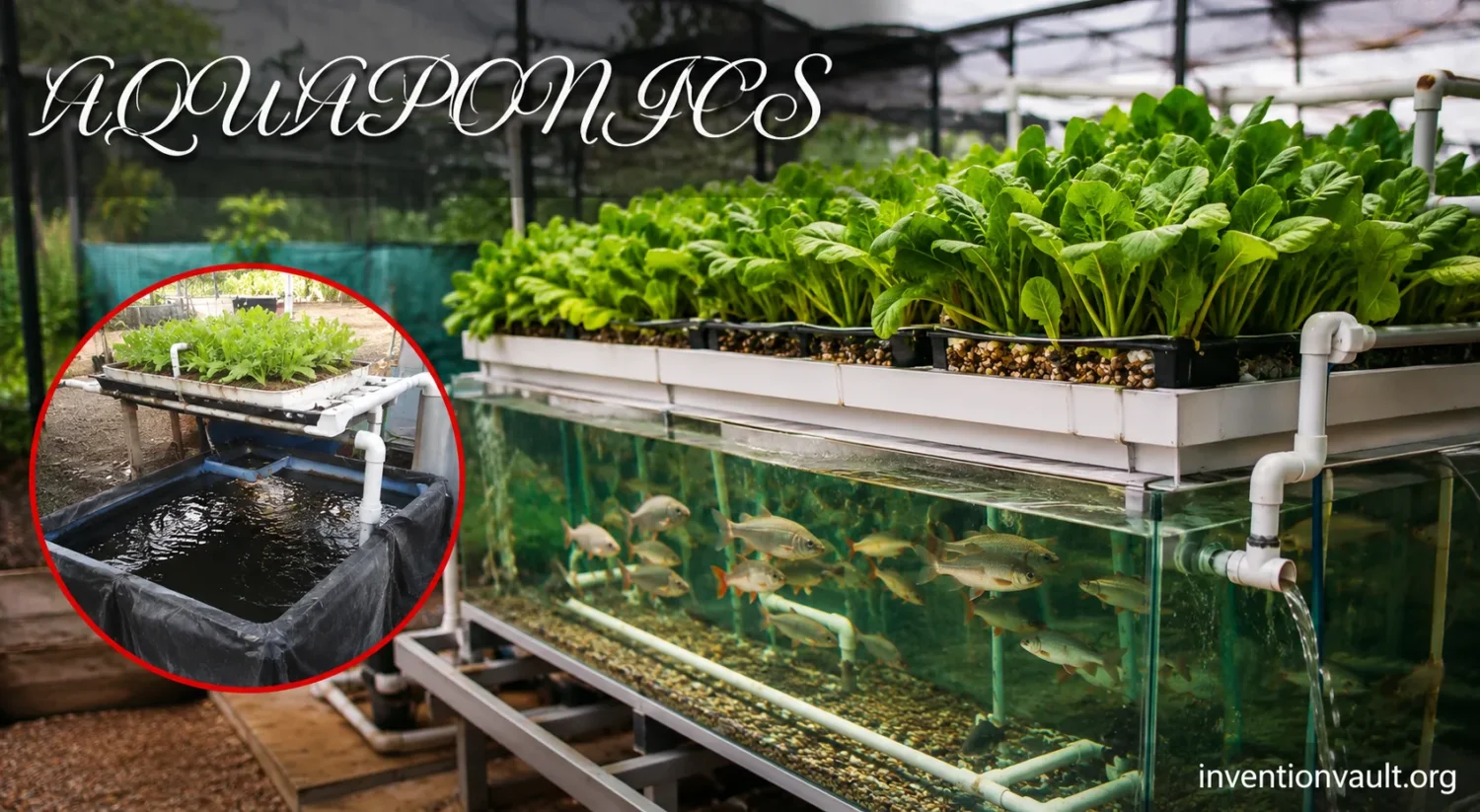
| Invention Name | Aquaponics |
|---|---|
| Basic Meaning | A food-production method that links aquaculture, hydroponics, and microbial biofiltration in one water-based system. |
| Single Inventor | No single person can be named as the inventor. Aquaponics developed through earlier wetland farming practices, fish-and-plant cultivation methods, and modern university research. |
| Early Predecessors | Historical examples often include chinampa-style agriculture, rice-fish farming, and other wetland systems where aquatic life, water, and plant production worked together. |
| Modern Development Period | The modern form took shape mainly in the 1970s and 1980s, when researchers began combining recirculating aquaculture with soilless plant production. |
| Known Research Centers | New Alchemy Institute, North Carolina State University, University of the Virgin Islands, and later extension and agricultural research programs in many regions. |
| Core Biological Process | Ammonia from aquatic animals is converted by bacteria into nitrite and then nitrate, a form plants can absorb. |
| Main Living Parts | Fish or other aquatic animals, plants, nitrifying bacteria, and the wider microbial community living in water, filters, media, and root zones. |
| Common System Forms | Media bed, raft or deep-water culture, nutrient film technique, drip-based layouts, vertical adaptations, coupled systems, and decoupled systems. |
| Common Crops | Leafy greens, herbs, basil, lettuce, pak choi, kale, Swiss chard, tomatoes, cucumbers, peppers, strawberries, and other crops when system design allows. |
| Common Aquatic Species | Tilapia, catfish, carp, ornamental fish, and other species selected according to water temperature, market use, regulation, and system design. |
| Technical Strength | It can recycle water and nutrients with high efficiency. FAO notes that some integrated aquaponic farms can cut water use by up to 90% compared with traditional agriculture. |
| Modern Category | Controlled environment agriculture, especially when used in greenhouses, indoor farms, educational labs, and urban production sites. |
Aquaponics is one of those inventions that looks simple only from a distance. A fish tank feeds a plant bed. The plants clean the water. The water returns to the fish. That description is useful, but it leaves out the part that made aquaponics a real technical invention: the managed partnership between animals, plants, water, and bacteria.
The invention did not arrive as a single machine with a single patent date. It grew from observation, agriculture, biology, and engineering. Earlier farmers saw that water rich in organic matter could support crops. Later researchers learned how to control that relationship inside tanks, pipes, filters, rafts, pumps, and greenhouses.
Plain answer: aquaponics was not invented by one person. It is a modern name for an integrated production method that matured when recirculating aquaculture met hydroponic plant growing and microbial water treatment.
What Aquaponics Is
Aquaponics combines two older production methods. Aquaculture raises aquatic animals in water. Hydroponics grows plants without soil, usually by delivering nutrients through water. Aquaponics joins them so that the waste from aquatic animals becomes part of the plant nutrition path.
The missing third partner is the microbial layer. Fish do not feed lettuce directly. Their waste first has to pass through biological conversion. Bacteria turn ammonia into nitrite, then into nitrate. Plants use nitrate more readily, and the cleaned water can move back toward the fish side of the system.
Aquaculture Side
Fish or other aquatic animals produce waste while eating and growing. The system must protect their water quality, oxygen supply, temperature range, and welfare.
Plant Side
Plants grow in water, media, rafts, channels, or containers. Their roots absorb dissolved nutrients and help remove compounds that would otherwise build up.
Bacterial Side
Nitrifying bacteria live on wet surfaces such as filters, grow media, tank walls, and roots. They run the conversion that makes the system stable.
Why the Word Aquaponics Matters
The word blends aqua, from aquaculture, with ponics, from hydroponics. It describes more than a farming style. It names an engineered relationship. In ordinary hydroponics, growers add mineral nutrients to water. In aquaculture, growers usually remove waste from animal tanks. In aquaponics, that waste becomes a managed nutrient stream.
This is why aquaponics belongs in the history of invention. It did not invent fish. It did not invent plant roots. It invented a controlled way to keep both alive inside one water cycle, with biology doing work that would otherwise require separate waste treatment and nutrient mixing.
Who Invented Aquaponics
No honest history can give aquaponics one inventor. The better answer is a chain of invention. Early wetland agriculture showed that water, fish, silt, and plants could support one another. Modern aquaponics began when researchers made that relationship measurable, repeatable, and suitable for tanks and greenhouses.
Many popular explanations point to Aztec chinampas or Asian rice-fish systems as “the first aquaponics.” That is only partly fair. Those systems were not the same as a modern recirculating aquaponic unit with pumps, filters, oxygen management, and nutrient testing. They are better described as predecessors: older practices that revealed the same natural logic.
The modern research story becomes clearer in the 1970s and 1980s. The New Alchemy Institute experimented with living systems that joined shelter, food, fish, and plants. North Carolina State University researchers developed closed-loop aquaponic research designs. The University of the Virgin Islands, especially through work associated with James Rakocy and colleagues, became widely known for commercial-scale research on tilapia and vegetable production.
Development Timeline
| Period | Development | Why It Matters |
|---|---|---|
| Before Modern Tanks | Wetland agriculture, chinampa-style cultivation, and rice-fish farming connected water, nutrients, aquatic life, and crops. | These practices showed that aquatic ecosystems could support plant production, even if they were not modern aquaponic systems. |
| Mid-20th Century | Recirculating aquaculture and hydroponics became more technical fields, with stronger control over water, nutrients, pumps, and filters. | Modern aquaponics needed these two separate technologies before they could be joined in a reliable way. |
| 1970s | The term aquaponics came into use, and research groups began testing integrated fish-and-plant systems more directly. | The idea moved from natural imitation toward named, studied production design. |
| 1980s | Closed-loop research systems, sand-based designs, raft culture, and greenhouse models gained attention. | Aquaponics became a repeatable technical method rather than a broad ecological idea. |
| 1990s to 2000s | University and extension publications described system design, economics, plant crops, fish species, and water-quality limits. | The invention entered classrooms, small farms, research stations, and commercial trials. |
| 2010s to 2020s | Aquaponics became part of controlled environment agriculture, urban farming, water-saving food production, and agricultural research programs. | The method now sits beside hydroponics, greenhouse cropping, vertical farming, and recirculating aquaculture. |
How Aquaponics Works
The basic cycle starts with feed. Fish eat. The fish release ammonia through waste and gill activity. In high enough amounts, ammonia can harm fish, so the system cannot simply let waste collect.
Bacteria then do the quiet work. Ammonia changes into nitrite, and nitrite changes into nitrate. This is called nitrification. Plants absorb nitrate and other dissolved nutrients. As water passes through roots, filters, and media, it becomes more suitable for returning to the animal side.
Aquaponics therefore depends on balance. Too few fish, and the plants may not receive enough nutrients. Too many fish, and waste can rise faster than bacteria and plants can process it. Too little oxygen, and fish, roots, and nitrifying bacteria all suffer. The invention is not the tank itself; it is the controlled circulation of life processes.
| Part | Main Role | What Can Go Wrong |
|---|---|---|
| Fish Tank | Holds aquatic animals and starts the nutrient flow through feed and waste. | Poor oxygen, wrong temperature, crowding, or rising ammonia can stress aquatic animals. |
| Pump | Moves water through the fish, filter, and plant sections. | If water flow stops, oxygen and nutrient movement can drop fast. |
| Solids Filter | Removes larger waste particles before they collect near roots or clog channels. | Too many solids can reduce oxygen, block flow, and disturb plant roots. |
| Biofilter | Gives bacteria surface area for nitrification. | Too little surface area or unstable water conditions can weaken ammonia conversion. |
| Grow Bed or Channel | Holds plant roots and exposes them to nutrient-rich water. | Poor flow, root crowding, or unbalanced nutrients can limit plant growth. |
| Sump or Return Line | Collects water and sends it back through the system. | Bad layout can create pump problems, water-level swings, or uneven circulation. |
The Nitrogen Cycle Inside Aquaponics
Nitrogen is the heart of aquaponics chemistry. It begins in feed, passes through fish, moves into water, and reaches plants after microbial conversion. This gives aquaponics its main identity: it transforms a waste-control problem into a plant-nutrition path.
Ammonia is the first concern. Then nitrite appears. Nitrate comes later and is generally the form plants can use more safely. A new system usually needs time for bacterial colonies to establish themselves. Extension publications often describe this as cycling, a period when ammonia, nitrite, nitrate, pH, oxygen, and temperature need close observation.
Technical note: aquaponics is often described as a fish-and-plant invention, but it is really a fish-plant-microbe invention. Without nitrifying bacteria, the cycle breaks.
Main Types of Aquaponic Systems
Aquaponics has several forms because plants and fish do not all need the same conditions. A lettuce raft system, a basil greenhouse, a small media bed, and a decoupled commercial design can all be called aquaponics, but they do not behave the same way.
| System Type | How It Works | Common Fit | Main Limitation |
|---|---|---|---|
| Media Bed | Plants grow in gravel, expanded clay, shale, or another inert medium that also gives bacteria surface area. | Small systems, schools, hobby units, and mixed-crop setups. | Media can trap solids and needs careful water movement. |
| Raft or Deep-Water Culture | Plants sit in floating rafts while roots hang into aerated, nutrient-rich water. | Leafy greens, basil, and larger greenhouse layouts. | Requires good solids removal before water reaches the root zone. |
| Nutrient Film Technique | A thin stream of water runs through channels where plant roots touch the nutrient flow. | Light crops and compact layouts. | Channels can clog, and roots have less buffer if flow stops. |
| Drip-Based Aquaponics | Water is delivered near plant roots in containers, troughs, or Dutch-bucket-style layouts. | Fruiting crops such as tomatoes, peppers, cucumbers, and strawberries when managed well. | Needs stronger solids control and more detailed nutrient management. |
| Vertical Aquaponics | Plants grow in stacked towers or vertical modules while water circulates through levels. | Space-limited areas, classrooms, display systems, and some urban sites. | Light distribution, pumping height, and root-zone clogging can become harder to manage. |
| Decoupled Aquaponics | The fish and plant loops are partly separated, allowing each side to run under different water conditions. | Research and commercial designs where plants and fish need different pH or nutrient targets. | More equipment, monitoring, and design skill are required. |
What Aquaponics Changed
Aquaponics changed the way people think about waste in food production. In a normal fish-only tank system, dissolved waste must be managed mainly to protect aquatic animals. In a hydroponic system, nutrients must be supplied to plants from outside the system. Aquaponics asks a different question: can one stream serve both needs?
The answer is yes, but only with control. Aquaponics did not remove the need for skill. It shifted the skill toward water chemistry, oxygen, microbial surfaces, feed rate, plant choice, and system layout.
- It linked two production outputs: aquatic animals and plants can come from one managed water cycle.
- It reduced waste discharge: nutrients from fish production can move into plant biomass instead of being discarded.
- It saved water in some designs: recirculation can sharply reduce water demand compared with open-field growing.
- It gave cities a compact model: aquaponics can fit greenhouses, rooftops, unused industrial spaces, schools, and research sites.
- It made microbes visible: bacteria moved from being an invisible background process to a designed part of the invention.
The Water-Saving Claim
Water efficiency is one reason aquaponics receives attention. FAO has reported that some integrated agri-aquaculture farms using aquaponic technology can reduce water consumption by up to 90% compared with traditional agricultural farms. That number should be read carefully. It refers to some integrated systems, not every small tank or backyard setup.
The saving comes from recirculation. Water does not flow through the system once and leave. It keeps moving between fish tanks, filters, plant roots, and return lines. Losses still happen through evaporation, plant transpiration, cleaning, harvest, and maintenance, but the loop can use water far more carefully than many open systems.
Why Aquaponics Is Not Just “Natural Fertilizer”
A common weak explanation says fish “fertilize” plants. That is true in a broad sense, but it hides the engineering. Fish feed is the original nutrient input. The fish process it. Bacteria transform part of it. Plants take up what they can. Solids may need removal or mineralization. Some nutrients may still run low, depending on crop type and system design.
That matters because aquaponics is not magic. It can save water, recycle nutrients, and produce two kinds of food, yet it also needs power, pumps, testing, filtration, planning, and daily care. The invention works best when people respect both sides: the biology and the machinery.
Plants Used in Aquaponics
Leafy greens and herbs often suit aquaponics because they grow fast and use nutrients efficiently. Lettuce, basil, pak choi, kale, and Swiss chard appear often in aquaponic research and greenhouse production. Fruiting crops can also grow in aquaponic systems, but they usually ask for tighter control over nutrients, support structures, lighting, pruning, pollination, and harvest timing.
| Plant Group | Examples | Why They Are Used | Extra Demand |
|---|---|---|---|
| Leafy Greens | Lettuce, pak choi, kale, Swiss chard | Fast growth, shorter cycles, good fit for raft and media systems. | Consistent water flow and clean roots. |
| Herbs | Basil, mint, parsley, cilantro | High value per growing area in many local markets. | Careful harvest timing and strong light. |
| Fruiting Crops | Tomato, cucumber, pepper, strawberry | Good crop value when system design and nutrients match the plant. | More support, stronger nutrient balance, and longer crop cycles. |
| Ornamental Plants | Some flowers and display plants | Useful in education, display systems, and specialty production. | Market demand and crop-specific management. |
Fish and Aquatic Animals in Aquaponics
Tilapia became one of the best-known aquaponic fish because it tolerates a range of conditions and has been widely studied in warm-water systems. Catfish, carp, trout, ornamental fish, and other aquatic species can also appear, depending on local rules, climate, water temperature, market goals, and system design.
The aquatic animal side is not only about production. It sets the pace of the system. Feed rate affects nutrient output. Species choice affects temperature. Growth rate affects harvest planning. Animal health affects the whole water loop. A well-designed aquaponic unit treats fish as living partners, not nutrient machines.
The UVI Research Line
The University of the Virgin Islands helped make modern aquaponics easier to study and discuss because its research program developed commercial-scale models using tilapia and vegetable crops in a recirculating aquaculture system. UVI describes its commercial aquaponic system as a way to intensify production in a small land area, conserve water, reduce waste discharge, and recover fish-production nutrients into vegetable crops.
This research line matters because it moved aquaponics from a charming idea into measured production. Tanks, clarifiers, filters, plant beds, flow rates, harvest cycles, crop value, and animal production became part of the same design conversation.
Aquaponics and Controlled Environment Agriculture
Today, aquaponics often appears beside hydroponics, greenhouses, LED-lit farms, and indoor food-production systems. Virginia Cooperative Extension describes it as a related form of soilless agriculture within controlled environment agriculture. USDA Agricultural Research Service also treats aquaponics as a resource-efficient controlled environment agriculture approach that joins intensive aquaculture with greenhouse vegetable production.
This present-day role gives aquaponics new relevance. It can support local production, education, research, and water-aware growing. It also raises practical questions about energy use, food safety, cost, skilled labor, and which crops or fish make sense in a given place.
Careful reading: aquaponics is not automatically low-cost, easy, or suitable for every crop. Reliable systems need water testing, oxygen control, filtration, backup planning, safe handling, and knowledge of both fish culture and plant production.
Technical Details That Define the Invention
The most useful way to understand aquaponics is to look at the technical relationships it manages. These details separate real aquaponics from a decorative aquarium with plants nearby.
| Technical Element | Role in Aquaponics | Why It Matters |
|---|---|---|
| Feed Rate | Controls how many nutrients enter the system through fish food. | It shapes both fish growth and plant nutrient supply. |
| Ammonia Conversion | Moves animal waste toward plant-available nitrate through bacterial action. | It protects fish and feeds plants. |
| Dissolved Oxygen | Supports fish, roots, and nitrifying bacteria. | Low oxygen can weaken all three living parts at once. |
| pH Balance | Affects fish comfort, bacterial performance, and nutrient availability. | Different organisms prefer different ranges, so compromise is part of system design. |
| Solids Management | Removes or processes larger waste particles. | It reduces clogging, root stress, and oxygen loss. |
| Plant-Fish Ratio | Matches animal nutrient output with plant uptake. | Bad ratios can leave plants hungry or water overloaded. |
| System Coupling | Determines whether fish and plant water loops are fully connected or partly separated. | Coupled systems save water neatly; decoupled systems offer more control. |
Common Misunderstandings About Aquaponics
Many short articles make aquaponics sound effortless. That creates confusion. The invention is elegant, but it is not hands-off. A useful description should include both the promise and the limits.
- Misunderstanding: aquaponics is just hydroponics with fish.
Better view: it is hydroponics, aquaculture, filtration, and microbial water chemistry in one design. - Misunderstanding: fish waste feeds plants directly.
Better view: bacteria must convert ammonia and nitrite before plants can use much of the nitrogen safely. - Misunderstanding: the system needs no inputs.
Better view: feed, electricity, water replacement, testing, and maintenance still matter. - Misunderstanding: every plant grows well in aquaponics.
Better view: crop choice depends on nutrients, root space, light, temperature, and economic value. - Misunderstanding: aquaponics is automatically profitable.
Better view: high startup costs, energy use, labor, and market price can decide whether a commercial system works.
How Aquaponics Compares With Related Inventions
Aquaponics sits between several food-production methods. Comparing them makes its invention clearer.
| Method | Main Output | Nutrient Source | What Makes It Different |
|---|---|---|---|
| Soil Farming | Plants | Soil nutrients, compost, fertilizers, and biological soil life. | Roots grow in soil, and water usually does not recirculate through a fish tank. |
| Hydroponics | Plants | Mineral nutrient solution prepared for plant needs. | No aquatic animal production is required. |
| Aquaculture | Fish or other aquatic animals | Feed supports animal growth. | Plant production is not part of the water-treatment loop. |
| Recirculating Aquaculture | Fish or other aquatic animals | Feed supports animal growth while filters protect water quality. | Water recirculates, but plant beds may not be used as nutrient recovery units. |
| Aquaponics | Plants and aquatic animals | Fish feed enters the animal side, then microbes and plants recover part of the nutrient stream. | It joins animal production, plant production, and biofiltration in one planned cycle. |
Why Aquaponics Still Matters
Aquaponics matters because it treats water as a working medium rather than a disposable carrier. That idea fits many modern needs: greenhouse growing, urban sites, educational labs, local food production, water-aware agriculture, and research into circular nutrient use.
It also gives students and visitors a visible model of ecology. In one room, they can see fish, roots, filters, pipes, bacteria-driven chemistry, and plant growth. Few inventions make biological cycles so easy to observe.
The strongest future for aquaponics is likely not one universal design. It is a family of designs. Some systems will focus on leafy greens. Some will support fish research. Some will be teaching tools. Some will test decoupled loops, better sensors, improved feed strategies, and greenhouse crop models. The invention keeps evolving because it is built from living parts.
Reference Notes on Accuracy
Dates and origin claims around aquaponics need careful wording. Early wetland and rice-fish systems are best described as predecessors, not identical modern aquaponic systems. Modern aquaponics depends on recirculation, filtration, microbial conversion, and managed plant production. For that reason, the most accurate history is not “one ancient inventor” or “one modern inventor,” but a long technical development line.
References Used for This Article
- Food and Agriculture Organization of the United Nations — Every Drop Counts: Supports the water-saving explanation and the definition of aquaponics as fish farming combined with soilless plant cultivation.
- Oklahoma State University Extension — Principles of Small-Scale Aquaponics: Supports the definition, origin uncertainty, term history, and small-scale system principles.
- Oklahoma State University Extension — Aquaponics: Supports the discussion of aquaculture, hydroponics, advantages, limits, and common system designs.
- Oklahoma State University Extension — Nitrification and Maintenance in Media Bed Aquaponics: Supports the nitrogen-cycle explanation, bacteria role, and water-quality details.
- University of the Virgin Islands — Aquaculture: Supports the modern research discussion, UVI aquaponic system history, and tilapia-vegetable production details.
- Virginia Cooperative Extension — What Is Controlled Environment Agriculture?: Supports the placement of aquaponics within soilless and controlled-environment agriculture.
- EU Aquaculture Assistance Mechanism — What Is “Aquaponics” and What Are Its Advantages?: Supports the discussion of recirculation, urban placement, year-round production, costs, and technical limits.
- USDA Agricultural Research Service — Aquaculture National Program 106 Action Plan 2025–2029: Supports the present-day research link between aquaponics, controlled environment agriculture, water use, nutrient retention, and food safety.
- Encyclopaedia Britannica — Aquaponics Description, History, System, Benefits, Examples, and Facts: Supports the general history of aquaponics, early predecessors, and modern development in the 1970s and 1980s.