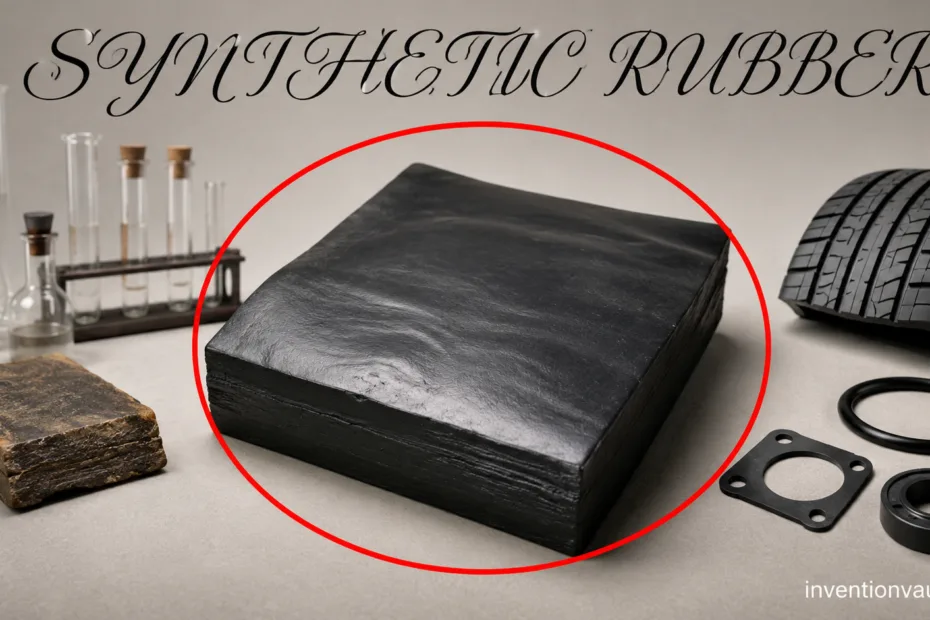
Synthetic rubber did not arrive as one single invention with one neat date. It grew from a hard industrial question: could chemists make an elastic material that behaved like natural rubber, but came from controlled chemistry rather than tree latex? The answer took shape through polymer science, laboratory trial, factory scale-up, and the rise of engineered elastomers such as neoprene, Buna rubbers, styrene-butadiene rubber, nitrile rubber, butyl rubber, and silicone rubber.
- Why Synthetic Rubber Had to Be Invented
- The First Laboratory Steps
- Neoprene and the First Commercial Success
- Buna Rubbers and the Rise of SBR
- How Synthetic Rubber Works
- Main Types of Synthetic Rubber
- Timeline of Engineered Elasticity
- What Made Synthetic Rubber Different from Natural Rubber
- Natural Rubber Strengths
- Synthetic Rubber Strengths
- The Role of Polymer Science
- From Invention to Mass Production
- Technical Data That Defines Synthetic Rubber
- The Main Content Gap in Many Rubber Histories
- Synthetic Rubber in Tires
- Beyond Tires: Everyday Uses
- Environmental and Safety Notes
- Why the Invention Still Matters
- References Used for This Article
| Topic | Details |
|---|---|
| Invention Name | Synthetic rubber, also called engineered rubber or synthetic elastomer |
| Main Idea | Making rubber-like elastic polymers from chemical monomers instead of harvesting natural latex from rubber trees |
| Early Breakthrough | In 1909, Fritz Hofmann and his team at Bayer polymerized methyl isoprene, an early synthetic rubber |
| Commercial Breakthrough | In 1930, DuPont researchers developed polychloroprene, later sold as neoprene, the first commercially successful synthetic rubber |
| Major Researchers | Fritz Hofmann, Sergei Lebedev, Wallace H. Carothers, Arnold Collins, Julius Nieuwland, Elmer K. Bolton, Hermann Staudinger, and teams at Bayer, DuPont, I.G. Farben, and public research programs |
| Core Chemistry | Polymerization of small molecules such as isoprene, butadiene, styrene, chloroprene, isobutylene, and acrylonitrile into long elastic chains |
| Important Materials | SBR, BR, neoprene/CR, NBR, IIR, EPDM, silicone rubber, fluoroelastomers, and thermoplastic elastomers |
| Technical Identity | A synthetic rubber is an elastomer: it can stretch under force and recover much of its original shape |
| Common Uses | Tires, seals, hoses, belts, shoe soles, cable insulation, adhesives, medical components, gloves, vibration mounts, and industrial parts |
| Modern Market Note | By the 2020s, synthetic rubber represented roughly half of world rubber consumption, with SBR remaining a major general-purpose grade |
Short definition: Synthetic rubber is a man-made elastic polymer designed to copy, improve, or specialize the behavior of natural rubber. Its value comes from control. Chemists can tune heat resistance, oil resistance, gas barrier strength, abrasion behavior, weathering, softness, rebound, and aging performance by changing the monomers and the polymer structure.
Why Synthetic Rubber Had to Be Invented
Natural rubber already had a long record before chemists made a practical substitute. It stretched, sealed, bounced, and absorbed shock better than most materials known to industry. After vulcanization made rubber more stable in the nineteenth century, demand rose sharply through bicycle tires, electrical insulation, industrial belts, hoses, and later automobile tires.
The difficulty was supply. Natural rubber came from plants, mainly Hevea brasiliensis, and it depended on land, climate, harvest cycles, shipping routes, and processing quality. Industrial users wanted a material with the same useful elasticity but with a more predictable source. That desire created the invention path for engineered elasticity.
The early search did not begin with a full understanding of polymers. Chemists knew that natural rubber was linked to isoprene, but they did not yet have the complete language of long-chain molecules. The invention of synthetic rubber helped push polymer chemistry from guessing into measurement, structure, and repeatable production.
The First Laboratory Steps
The first credible laboratory route came in the early twentieth century. In 1909, Fritz Hofmann, working at Bayer in Germany, succeeded in polymerizing methyl isoprene. This was an early synthetic rubber, sometimes described in later histories as “methyl rubber.” It proved that a rubber-like material could be made from controlled chemical reactions rather than tapped latex.
That material did not instantly replace natural rubber. Early synthetic rubbers were expensive, difficult to process, and often less satisfying in service. Some had poor aging behavior. Some lacked the right balance of tack, strength, rebound, and durability. Still, Hofmann’s work changed the question. Industry no longer asked whether artificial rubber was possible. It asked how to make it useful.
Sergei Lebedev also belongs in this story. His work on butadiene polymerization helped establish butadiene as one of the most important raw materials in synthetic rubber. Later rubber families, including SBR and polybutadiene rubber, depended on that direction.
Neoprene and the First Commercial Success
The first synthetic rubber that truly entered commercial life was neoprene, also known chemically as polychloroprene. In 1930, DuPont researchers working around Wallace H. Carothers, Arnold Collins, Julius Nieuwland’s acetylene chemistry, and Elmer K. Bolton developed a rubber-like polymer from chloroprene chemistry.
Neoprene mattered because it was not merely an imitation. It offered properties natural rubber did not handle as well, especially resistance to oils, heat, weather, and some chemicals. That gave synthetic rubber a new identity. It was not only a backup material. It could be a special-purpose elastomer selected because it performed better in a particular job.
Synthetic rubber became important when chemistry stopped trying to copy natural rubber exactly and began designing elastic materials for specific conditions.
Buna Rubbers and the Rise of SBR
Another branch of synthetic rubber developed around butadiene. German researchers produced Buna rubbers, a name linked to butadiene and sodium-based polymerization in early work. Buna-S, made from butadiene and styrene, became the foundation for styrene-butadiene rubber, better known as SBR.
SBR became one of the great general-purpose synthetic rubbers because it could be processed on familiar rubber equipment and worked well in tire treads. It resisted abrasion and could be blended with natural rubber. Those practical factory traits mattered as much as the chemistry. A material that performs in a test tube but fails on mill rolls or in tire curing has little industrial life.
By the 1940s, large-scale synthetic rubber production had moved from experimental chemistry to organized industrial manufacture. The United States Synthetic Rubber Program adopted government rubber-styrene, often written as GR-S, a styrene-butadiene rubber made at scale. Production plants, university laboratories, tire companies, chemical firms, and public agencies worked around shared formulas, standards, and plant designs.
How Synthetic Rubber Works
Rubber elasticity comes from long polymer chains. In a relaxed state, those chains sit in curled, tangled forms. When stretched, the chains align. When released, they tend to recoil. Crosslinks, fillers, additives, and curing systems help control that movement so the material does not simply flow or tear apart.
Natural rubber is mainly cis-1,4-polyisoprene. Synthetic rubber uses a wider chemical palette. Chemists choose monomers and reaction methods to adjust performance. Styrene adds toughness to SBR. Butadiene gives resilience and low-temperature flexibility. Acrylonitrile improves oil resistance in nitrile rubber. Chloroprene gives neoprene its useful balance of weather and oil resistance.
The word “synthetic” can make the material sound simple, but the opposite is true. Small changes in chain structure can alter grip, rebound, heat build-up, wear rate, swelling, gas permeability, or aging. Two rubbers may look alike to the eye and behave very differently in a fuel hose, a tire tread, or a window seal.
Main Types of Synthetic Rubber
| Synthetic Rubber Type | Common Name | Main Strength | Typical Uses |
|---|---|---|---|
| Styrene-Butadiene Rubber | SBR, Buna-S, GR-S | Good abrasion resistance and tire tread performance | Tires, shoe soles, belts, molded parts |
| Polybutadiene Rubber | BR | High resilience and low heat build-up | Tire blends, golf ball cores, mechanical goods |
| Polychloroprene | Neoprene, CR | Balanced oil, weather, and heat resistance | Hoses, gaskets, cable jackets, wetsuit foam, adhesives |
| Nitrile Butadiene Rubber | NBR | Strong resistance to oils and fuels | Seals, gloves, fuel hoses, O-rings |
| Butyl Rubber | IIR | Low gas permeability | Inner tubes, tire inner liners, stoppers, sealants |
| EPDM Rubber | EPDM | Weather, ozone, and outdoor aging resistance | Roofing membranes, automotive weatherstrips, seals |
| Silicone Rubber | VMQ and related grades | Wide temperature range and clean flexibility | Medical parts, cookware seals, electronics, gaskets |
| Fluoroelastomers | FKM and related grades | High chemical and heat resistance | Aerospace seals, chemical processing seals, fuel systems |
Timeline of Engineered Elasticity
| Period | What Happened | Why It Mattered |
|---|---|---|
| Late 1800s | Chemists studied isoprene and the chemical nature of natural rubber. | They began linking rubber behavior to molecular structure. |
| 1909 | Fritz Hofmann’s Bayer team polymerized methyl isoprene. | It showed that a rubber-like material could be synthesized in the laboratory. |
| 1910s | Butadiene research advanced, including work associated with Sergei Lebedev. | Butadiene became a central monomer for later synthetic rubber families. |
| 1920s | Polymer science became more exact as long-chain molecular theory gained ground. | Rubber chemistry moved closer to designed materials rather than trial-only mixtures. |
| 1930 | DuPont researchers developed polychloroprene. | Neoprene became the first commercially successful synthetic rubber. |
| 1930s | Buna rubbers and SBR-type materials developed further. | Synthetic rubber became more practical for tires and industrial parts. |
| 1940s | GR-S production expanded through large public-private manufacturing programs. | Synthetic rubber became a mass industrial material. |
| Post-1945 | Specialty rubbers such as nitrile, butyl, EPDM, silicone, and fluoroelastomers expanded. | Rubber selection became application-specific rather than one-material-for-all. |
| 2000s–2020s | Research focused on fuel efficiency, low rolling resistance, bio-based monomers, recycling, and specialty performance. | Synthetic rubber remained central to transport, energy, electronics, healthcare, and industrial design. |
What Made Synthetic Rubber Different from Natural Rubber
The early aim was substitution, but synthetic rubber eventually became its own material category. Natural rubber still has excellent tensile strength, resilience, and fatigue performance. That is why it remains valuable in tires and many demanding mechanical uses. Synthetic rubber brought a different advantage: design control.
A tire tread can use SBR and polybutadiene for wear, grip, and rolling behavior. A fuel hose can use nitrile rubber because oil resistance matters more than maximum bounce. A roof membrane can use EPDM because outdoor aging and ozone resistance matter more than tire-like abrasion. A pharmaceutical stopper can use butyl rubber because gas barrier performance matters.
This is the real invention: not one rubber, but a family of elastic materials whose properties could be selected. Synthetic rubber turned elasticity into an engineering choice.
Natural Rubber Strengths
- Excellent resilience and tensile strength
- Strong performance in many dynamic applications
- Renewable plant origin when responsibly sourced
- Useful in heavy-duty tires, mounts, and vibration parts
Synthetic Rubber Strengths
- Controlled chemistry and repeatable grades
- Better resistance to oils, heat, ozone, or gases in selected types
- Large-scale supply from industrial monomers
- Wide range of application-specific elastomers
The Role of Polymer Science
Synthetic rubber could not mature without polymer theory. Hermann Staudinger argued that materials such as rubber were made of very large molecules, not loose clusters of small molecules. That idea helped explain why rubber behaved as it did. It also gave researchers a way to think about chain length, repeating units, branching, and crosslinking.
Wallace H. Carothers and other researchers pushed this thinking into laboratory practice. They did not merely mix chemicals and hope for elasticity. They studied how smaller molecules joined into long chains. This shift gave synthetic rubber its deeper value: it connected chemical structure to physical behavior.
Once chemists understood that chain architecture mattered, they could begin to tune rubber. A higher styrene content changes hardness and grip. Different butadiene structures affect resilience and temperature behavior. Acrylonitrile content changes oil resistance in NBR. That is why synthetic rubber history belongs not only to invention history, but also to the birth of modern materials science.
From Invention to Mass Production
The invention of synthetic rubber was not complete when the first elastic polymer appeared. A usable rubber had to be made in tonnage, not grams. It had to be milled, compounded, cured, tested, and shaped. It had to work with carbon black, sulfur systems, accelerators, oils, fillers, and factory equipment.
The 1940s showed how complex this step was. Large-scale SBR production required steady supplies of butadiene and styrene, standard recipes, quality testing, and trained operators. Rubber factories also had to learn how synthetic stocks behaved under mixing and curing. In some applications, SBR worked best when blended with natural rubber rather than used alone.
This is a common hidden part of invention history. A material can be “invented” in the laboratory, yet become truly important only when production, standards, equipment, and users mature around it.
Technical Data That Defines Synthetic Rubber
Synthetic rubber is measured through properties that describe both chemistry and service behavior. Engineers do not choose “rubber” as one general material. They choose a grade after testing hardness, tensile strength, elongation, compression set, rebound, abrasion, heat aging, oil swelling, ozone cracking, tear strength, and low-temperature flexibility.
| Property | What It Measures | Why It Matters |
|---|---|---|
| Hardness | Resistance to indentation, often measured on the Shore A scale | Helps define softness, sealing pressure, and feel |
| Tensile Strength | Force needed to break the rubber under tension | Important for belts, seals, hoses, and stressed parts |
| Elongation at Break | How far rubber stretches before breaking | Shows flexibility and deformation tolerance |
| Compression Set | How much shape is lost after long compression | Important for gaskets, O-rings, and seals |
| Abrasion Resistance | Wear behavior under rubbing or road contact | Central for tire treads, soles, rollers, and conveyor belts |
| Oil Swell | How much rubber expands in oil or fuel | Critical for fuel hoses, seals, and engine parts |
| Gas Permeability | How easily gases pass through the rubber | Essential for tire inner liners, stoppers, and inflatable products |
| Ozone Resistance | Resistance to cracking in ozone-rich air | Important for outdoor seals and automotive weatherstrips |
The Main Content Gap in Many Rubber Histories
Many short histories treat synthetic rubber as a simple wartime substitute. That misses three useful points. First, the earliest work began decades before mass production. Second, neoprene proved that synthetic rubber could outperform natural rubber in selected jobs. Third, modern rubber is rarely a single pure polymer. It is usually a carefully compounded material containing elastomer, filler, curing agents, plasticizers, antioxidants, and processing aids.
That last point matters. A tire, gasket, hose, or seal is not just “synthetic rubber.” It is a compound. The polymer gives the main identity, but the full recipe determines the final product. Carbon black can improve strength and wear. Silica can help with tire rolling resistance. Antioxidants slow aging. Cure chemistry controls network strength.
Seen this way, synthetic rubber is not only an invention of chemistry. It is an invention of formulation.
Synthetic Rubber in Tires
Tires became the largest and most visible use for synthetic rubber. A tire must flex millions of times, grip road surfaces, resist wear, hold air, manage heat, and remain stable through weather and load changes. No single rubber does all of that perfectly.
That is why tire makers blend materials. SBR often appears in tread compounds because it offers abrasion resistance and can be tuned for grip. Polybutadiene helps with resilience and heat build-up. Natural rubber still serves demanding tire components because of its strength and fatigue resistance. Butyl rubber became important for inner liners because it slows air loss.
Modern tire development also links synthetic rubber to energy efficiency. Lower rolling resistance can reduce fuel use in conventional vehicles and help electric vehicles extend driving range. That keeps synthetic rubber tied to current materials research, not only industrial history.
Beyond Tires: Everyday Uses
Synthetic rubber hides in plain sight. It appears in the seals that keep windows and doors tight, the soles of shoes, the belts inside machines, the hoses under vehicle hoods, the insulation around cables, and the gaskets inside appliances. Specialty grades reach into medical devices, electronics, food-contact seals, laboratory equipment, and aerospace components.
- NBR supports oil-resistant seals, hoses, and disposable gloves.
- EPDM works well in outdoor weatherstrips, roofing membranes, and coolant hoses.
- Neoprene remains useful in gaskets, adhesives, protective foams, and cable jackets.
- Butyl rubber helps tire inner liners, pharmaceutical closures, and air-retaining products.
- Silicone rubber serves high-temperature seals, medical parts, and flexible electronics uses.
Environmental and Safety Notes
Synthetic rubber brought reliable performance, but it also created modern questions about raw materials, tire wear particles, recycling, and end-of-life handling. Most major synthetic rubbers use monomers derived from petroleum or natural gas streams. That makes feedstock choice, plant efficiency, and circular recovery more important than they were in the early twentieth century.
Rubber recycling is harder than metal recycling because cured rubber contains crosslinked polymer networks. Grinding, devulcanization, pyrolysis, chemical recovery, and material reuse all have roles, but each has limits. Researchers now study bio-based butadiene, renewable isoprene, improved tire recovery, and materials that keep performance while lowering waste.
Safe use also depends on the application. A rubber suitable for a shoe sole may not suit a medical seal. A fuel-resistant hose material may not suit high-heat electrical insulation. In modern manufacturing, synthetic rubber selection depends on standards, testing, and the service environment rather than material name alone.
Why the Invention Still Matters
Synthetic rubber changed how people think about materials. It showed that elasticity could be designed, not merely found in nature. The invention began with the wish to replace a scarce raw material, then grew into a broad family of engineered elastomers with properties natural rubber alone could not provide.
Its history also shows how invention works in real life. Hofmann’s early methyl rubber proved possibility. Lebedev and others widened the monomer path. Carothers, Collins, Nieuwland, Bolton, and DuPont’s research culture produced neoprene. Buna and SBR turned synthetic rubber into mass industry. Later specialty elastomers gave engineers a menu of elastic materials for heat, oil, ozone, gases, weather, and precision sealing.
The result is one of the most practical achievements in materials history: rubber that can be planned before it is made.
References Used for This Article
- Library of Congress — Synthetic Rubber Project: Technical Reports and Standards: A public archive guide for technical records from the synthetic rubber program.
- American Chemical Society — U.S. Synthetic Rubber Program: A historical chemical landmark page on GR-S and large-scale synthetic rubber production.
- Science History Institute — Wallace Hume Carothers: A biography covering Carothers, neoprene, nylon, and early polymer science.
- MIT Lemelson — Wallace Carothers: A university source describing Carothers’s research and synthetic rubber work.
- International Rubber Study Group — Synthetic Rubber: A specialist industry source on SBR, monomers, and synthetic rubber capacity.
- International Institute of Synthetic Rubber Producers — Rubber History and Types: A trade institute overview of SBR history and synthetic rubber development.
- Encyclopaedia Britannica — Synthetic Rubber: A reference overview of synthetic rubber chemistry, origins, and industrial use.
- Rubber Board — Rubber Statistical News: A public statistical source for recent natural and synthetic rubber consumption ratios.