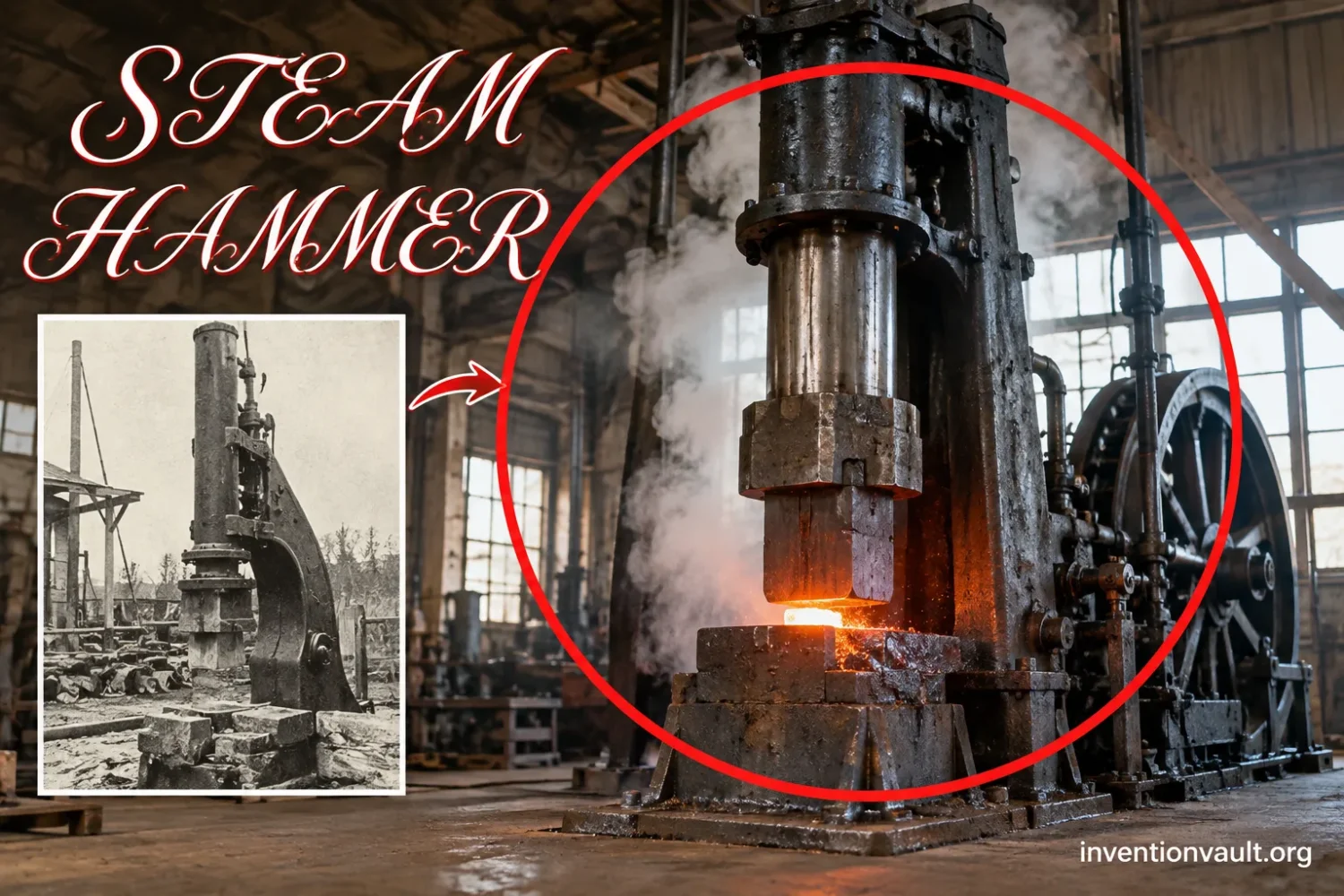
Claims and Milestones
Who Invented the Steam Hammer?
Trace the documented precursors, competing 1839–1842 claims, control improvements, and scale-up that turned steam power into a practical forging hammer.
Early documented concept
James Watt’s 1784 Patent
Current stage
Patent evidence
James Watt’s 1784 steam-engine patent included arrangements for using steam power to operate heavy hammers or stampers for working metals.
What it establishes
The record shows that applying steam power to forging hammers had been proposed decades before the machines associated with Nasmyth and Bourdon.
What it does not establish
Watt’s proposal was not the industrial steam hammer that entered heavy forging during the 1840s, and it did not create the later manufacturing system.
The steam hammer had documented conceptual ancestors long before the famous British and French machines appeared.
Direct-action precursor
William Deverell’s 1806 Patent
Current stage
Mechanical proposal
William Deverell patented a steam-powered hammer arrangement in which the hammer or stamper was associated directly with the piston mechanism rather than requiring a conventional rotating drive.
Closer to the later form
The direct vertical relationship between piston motion and hammer motion brought the concept closer to the direct-acting steam hammers built several decades later.
Industrial gap
The patent is evidence of an earlier mechanical idea, not evidence that Deverell established a successful heavy-forging machine in normal industrial service.
Deverell narrows the gap between an early steam-powered hammer idea and the direct-action arrangement of the 1840s.
British development
Nasmyth’s 1839 Scheme
Current stage
Manufacturing problem
James Nasmyth faced demand for forgings larger than existing forge equipment could comfortably handle, including a huge paddle shaft planned for Brunel’s steamship Great Britain.
Direct action
His scheme placed a steam cylinder above a vertically guided hammer mass, linking the piston and hammer so that steam could raise the moving assembly directly.
The original job disappeared
Great Britain was changed from paddle propulsion to screw propulsion, removing the intended paddle-shaft job before Nasmyth’s hammer was needed for it.
A shipbuilding problem helped define Nasmyth’s design even though the ship itself no longer required the planned forging.
Working machine
Bourdon at Le Creusot
Current stage
French engineering need
François Bourdon, working at Schneider’s Le Creusot works, also needed a way to forge very large components for expanding steamship and heavy-engineering production.
First practical machine
Le Creusot’s historical account credits Bourdon with assembling the first working steam hammer in 1840, before Nasmyth had a full-size hammer operating in Britain.
Why the distinction matters
Being first with a surviving design claim and being first to put a full-scale machine into operation are different historical tests. Bourdon’s place is strongest under the latter.
Bourdon shifts the story from drawings and patents toward the first documented full-size industrial operation.
Patent record
The 1841–1842 Patent Sequence
Current stage
French record
Accounts of Bourdon’s development describe French patent activity beginning in 1841, while a Schneider patent associated with the hammer is dated 19 April 1842.
British record
Nasmyth secured British Patent No. 9382 on 9 June 1842, after seeing the operating hammer at Le Creusot during a visit that year.
Patent is not invention date
Both design work and Bourdon’s operating machine predate these 1842 patent dates, so the patent sequence cannot by itself settle who conceived the machine first.
The legal record fixes useful dates, but it does not collapse conception, construction, patenting, and commercial development into one event.
Control development
Wilson and Automatic Regulation
Current stage
Early operation
Nasmyth’s early hammer used hand-operated valve gear. The operator controlled steam admission and therefore the lift and delivery of the hammer.
Robert Wilson’s contribution
Robert Wilson developed automatic regulating gear in the 1840s. An Institution of Mechanical Engineers drawing records his self-acting motion applied to a 30 cwt Nasmyth hammer.
Variable blows
The regulating mechanism allowed the number and strength of blows to be controlled without simply delivering the same full-force impact on every stroke.
Double action
Later arrangements also admitted steam above the piston during the downward stroke, adding steam pressure to the falling mass rather than relying only on gravity.
Useful forging depended on controllable stroke energy and repetition, not merely on making the moving hammer heavier.
Industrial scale-up
The 100-Ton Le Creusot Hammer
Current stage
Scale reached
By 1876 Schneider had built Le Creusot’s famous 100-ton drop hammer, a machine far larger than the early hammer that Bourdon had put into service in 1840.
Physical size
The preserved industrial landmark is described as about 21 metres high, illustrating how far steam-hammer construction expanded within a few decades.
Later competition
Hydraulic forging presses eventually took over much heavy forging because they shaped metal through slower, sustained pressure rather than a succession of high-velocity blows.
Steam-hammer development moved rapidly from a contested 1840 invention to some of the largest forging machines of the nineteenth century.
The steam hammer cannot be assigned cleanly to one inventor and one date. James Nasmyth devised his direct-action steam hammer in Britain in 1839, while François Bourdon developed a closely related machine at Le Creusot in France and put a full-size hammer into operation in 1840. Earlier patents by James Watt and William Deverell show that steam-powered hammer concepts already existed. Nasmyth obtained British Patent No. 9382 on 9 June 1842 and completed an operating hammer at Patricroft in 1843. The invention story is therefore best understood by separating the first recorded concepts, the 1839 designs, the first working machine, the patents, and the later control improvements that made steam hammers practical industrial tools.
| Steam Hammer Milestone | Person or Place | Date |
|---|---|---|
| Early steam-powered hammer concept | James Watt | 1784 |
| Later direct-action precursor patent | William Deverell | 1806 |
| Nasmyth’s direct-action scheme | James Nasmyth, Britain | 1839 |
| First working full-size steam hammer | François Bourdon, Le Creusot | 1840 |
| French patent activity | Bourdon / Schneider | 1841–1842 |
| Nasmyth’s British patent | Patent No. 9382 | 9 June 1842 |
| Nasmyth hammer operating at Patricroft | Nasmyth, Gaskell & Co. | 1843 |
| Self-acting regulating development | Robert Wilson | 1840s |
Dating the First
A statement such as “the steam hammer was invented in 1839” usually refers to Nasmyth’s design. It does not mean there were no earlier steam-hammer concepts, nor does it mean a full-size Nasmyth hammer was already working in 1839.
Why Heavy Forging Needed a Different Kind of Hammer
Large iron forgings were becoming harder to make with the equipment inherited from earlier ironworking. A traditional tilt hammer or helve hammer used a pivoting beam and a mechanical drive, often connected to a water wheel. A cam or similar mechanism repeatedly lifted one end of the beam and allowed the hammer end to strike the work.
That arrangement could perform useful forge work, but scaling it upward meant enlarging not just the striking mass but also the beams, pivots, drive components and supporting structure that moved it. Nineteenth-century marine engines, locomotives and stationary steam engines were demanding shafts, cranks and other wrought-iron pieces at sizes that pushed those arrangements toward their practical limits.
The steam hammer changed the geometry of the machine. Instead of transmitting power through a long oscillating beam, the characteristic nineteenth-century design placed the hammer mass in a vertical line beneath a steam cylinder. The piston rod and moving hammer assembly could rise between guides and descend onto an anvil carrying the hot workpiece.
This direct arrangement provided a path toward much heavier hammers without reproducing the entire mechanism of a giant tilt hammer. It also opened another possibility that mattered just as much: the stroke could be controlled through the steam valve.
The Steam Hammer Had Precursors Before 1839
Starting the history with Nasmyth hides two earlier patent records. Neither produced the steam-hammer industry of the 1840s, but both matter when deciding what the word invented should mean.
James Watt and the 1784 Patent
James Watt’s patent of 28 April 1784 covered several improvements and applications involving steam engines. Among them were arrangements for operating heavy hammers or stampers for metalworking. The proposal establishes that engineers were considering steam as a direct source of hammer motion more than half a century before Nasmyth and Bourdon.
Watt’s presence in the chronology should not be stretched beyond what the record supports. The industrial machine that became familiar in nineteenth-century forge shops was not simply a Watt hammer entering production decades late. The working steam hammer of the 1840s emerged from new manufacturing demands and a different stage of machine-tool engineering.
William Deverell’s 1806 Direct-Action Proposal
William Deverell received a British patent in 1806 for moving hammers, stampers and related tools without depending on conventional rotary transmission. Historical descriptions of the patent show a hammer associated directly with the piston mechanism of a steam cylinder. Steam raised the moving assembly and the mechanism then allowed a return stroke.
This makes Deverell especially relevant because the arrangement resembles the later principle of attaching the moving hammer to a piston rod. What is missing is equally important: there is no comparable record of Deverell establishing the large, successful forging machine that entered heavy industry in the 1840s.
What Different Evidence Can Actually Prove
- Patent descriptionShows that a mechanical idea was formally recorded by a particular date. It does not prove that a practical full-size machine was built.
- Engineering drawingShows how a designer intended the machine to work, but a drawing alone does not establish successful industrial operation.
- Operating forge machineShows that the concept crossed from design into practical machinery capable of performing real work.
- Production and adoptionShows that a machine could be manufactured, controlled and maintained well enough to spread beyond a single experimental installation.
Nasmyth’s Steam Hammer Began with a Shipbuilding Problem
James Nasmyth was already manufacturing machine tools at the Bridgewater Foundry at Patricroft near Manchester when heavy engineering presented him with the problem that became attached to the steam hammer’s origin story. Isambard Kingdom Brunel’s Great Britain was initially expected to require an exceptionally large wrought-iron paddle shaft.
Producing a forging of that scale exposed the limitations of available forge hammers. Nasmyth’s answer was mechanically direct: mount a steam cylinder above the hammer, connect its piston rod to the moving hammer mass, and guide that mass vertically over an anvil.
Science Museum records date Nasmyth’s developed scheme to 1839. The shipbuilding requirement that prompted it soon changed, however. Great Britain was redesigned to use a screw propeller rather than paddle wheels, so the giant paddle shaft that had helped motivate the hammer was no longer required.
The disappearance of the original order explains an otherwise odd part of the chronology. Nasmyth could possess a design in 1839 without immediately having the famous machine operating in his own works. The hammer’s value ultimately proved much broader than the single shaft that had prompted the design.
François Bourdon Put a Steam Hammer to Work at Le Creusot
At roughly the same time, French engineer François Bourdon was confronting the same class of manufacturing problem at the Schneider works in Le Creusot. Steam navigation and large machinery required forged components beyond the comfortable range of older equipment. Bourdon developed a vertical steam-driven hammer for this heavy work.
The Le Creusot historical record credits Bourdon with assembling the first working steam hammer in 1840. Contemporary and later records place this machine in operation before Nasmyth’s full-size British hammer.
This is why Bourdon cannot be treated as a secondary figure added to a finished Nasmyth invention. For the historical test of first working full-size machine, Bourdon has the stronger claim.
The relationship between the two men’s designs is more complicated than two isolated inventors unknowingly producing the same machine. Bourdon and Eugène Schneider visited Nasmyth’s works in Britain during this period and were shown Nasmyth’s ideas. Nasmyth later visited Le Creusot and saw Bourdon’s hammer operating. The engineers were therefore working within an active exchange of industrial knowledge, even though later accounts disagreed sharply over who deserved priority.
Nasmyth, Bourdon, Watt or Deverell: Who Invented the Steam Hammer?
The question becomes much clearer once each type of “first” receives its own category.
| Historical Claim | Best-Supported Attribution | Why |
|---|---|---|
| Early documented steam-powered hammer concept | James Watt | His 1784 patent included the use of steam power for heavy hammers or stampers. |
| Early direct piston-and-hammer precursor | William Deverell | His 1806 patent described a closer direct-action arrangement involving a piston-driven hammer or stamper. |
| British design associated with the later industrial form | James Nasmyth | Nasmyth devised his direct-action hammer in 1839 while addressing the problem of very large forgings. |
| First working full-size steam hammer | François Bourdon | Le Creusot credits Bourdon’s machine with operation in 1840, before Nasmyth’s British machine. |
| British steam-hammer patent | James Nasmyth | British Patent No. 9382 was dated 9 June 1842. |
| British industrial development and promotion | James Nasmyth and his works | Nasmyth’s firm manufactured and promoted the hammer widely after the first Patricroft installation. |
| Important automatic control development | Robert Wilson | Wilson developed self-acting regulating gear that automated the valve cycle and allowed controlled repeated blows. |
Calling Nasmyth simply “the inventor of the steam hammer” therefore compresses several different events into one label. It reflects his 1839 design, British patent, manufacturing work and later fame, but it leaves out the earlier patent history and Bourdon’s first operating machine.
Calling Bourdon the sole inventor creates the opposite problem. It understates Nasmyth’s documented design work and the large role his firm played in turning the hammer into a widely manufactured machine tool.
A more accurate description is that the practical nineteenth-century steam hammer emerged through closely timed British and French development, with Nasmyth and Bourdon occupying different places in its invention record.
Patent vs. Working Machine
French and British patent dates do not establish the first working hammer. Bourdon’s Le Creusot machine was already operating before Nasmyth’s British patent of 9 June 1842, while both men’s design work preceded their final patent dates.
How Nasmyth’s Early Direct-Action Steam Hammer Worked
The early Nasmyth form was a single-acting direct-action hammer. Its layout was simple enough to describe without reducing the machine to “steam lifted a hammer.” Several massive components had to work together while absorbing repeated impact loads.
Steam Cylinder and Piston
The steam cylinder sat above the hammer. Steam admitted beneath the piston drove the piston upward. Because the piston rod was connected to the hammer head or tup, the striking mass rose with it.
Tup and Vertical Guides
The tup was the heavy moving mass that delivered the blow. It travelled vertically between rigid standards or guides. These kept the descending hammer aligned with the forging and anvil instead of allowing the moving mass to wander sideways.
Anvil and Foundation
The heated workpiece rested on an anvil beneath the hammer. The anvil and its supporting mass had to resist the repeated impacts and transmit forces into a foundation designed for the machine. Enlarging a forging hammer was therefore not merely a matter of attaching a heavier block to the piston rod; the stationary structure beneath it had to manage the resulting energy as well.
Valve Gear
A slide valve controlled steam admission and exhaust. In hand operation, the hammer could be raised to the required height and then released to descend onto the work. Varying the lift changed the energy available in the falling mass.
- Admit steamSteam enters beneath the piston and raises the piston rod together with the attached hammer mass.
- Set the liftThe valve is controlled so the tup rises to the height needed for the intended blow rather than automatically using the maximum stroke.
- Release the hammerThe valve changes position and the raised tup descends toward the heated workpiece.
- Deliver the blowThe moving mass strikes the work on the anvil, converting its motion into a short, high-force forging impact.
- Repeat and repositionThe hammer is raised again while the forging can be turned or moved so successive blows work different portions of the metal.
Control Was as Important as Hammer Size
A machine capable only of delivering its hardest possible blow would have had limited use in a forge. Different stages of forging require different amounts of energy. A large hot workpiece may need heavy deformation at one moment and a much lighter finishing blow later.
The steam valve made that range possible. The operator could alter the hammer’s lift and therefore change the energy of the descending tup. This combination of a large moving mass and controllable stroke became one of the steam hammer’s defining advantages.
Nasmyth became associated with public demonstrations of this control. Science Museum records describe demonstrations in which the hammer could be handled delicately enough to crack the top of an egg placed in a wine glass. The point of the demonstration was not the stunt itself; it showed that a machine designed for large iron forgings did not have to deliver the same violent impact on every cycle.
Robert Wilson and the Self-Acting Motion
Manual valve operation still placed the timing of each cycle in the operator’s hands. Robert Wilson, who worked with Nasmyth’s enterprise, developed an automatic regulating arrangement during the 1840s. A surviving Institution of Mechanical Engineers drawing from about 1844 identifies Wilson’s patented self-acting motion fitted to a Nasmyth 30 cwt steam hammer.
The regulating gear linked valve motion to the movement of the machine. Science Museum’s model description records that the arrangement could regulate both the number and strength of blows while accommodating changes in the thickness of the forging.
This development illustrates why the history of a machine does not end with its first workable geometry. Once the steam hammer existed, control engineering determined how effectively it could perform repeated industrial work.
Single-Acting and Double-Acting Steam Hammers Were Not the Same
The original direct-action arrangement raised the hammer with steam and relied mainly on the descending mass for the blow. Later steam hammers used steam pressure during the downward stroke as well.
| Feature | Single-Acting Steam Hammer | Double-Acting Steam Hammer |
|---|---|---|
| Upward stroke | Steam raises the piston and tup. | Steam raises the piston and tup. |
| Downward stroke | Primarily the falling mass supplies the blow. | Steam pressure also drives the piston downward. |
| Impact energy | Strongly dependent on moving mass and fall conditions. | Can add cylinder force to the downward-moving mass. |
| Machine development | Represents the early Nasmyth-type operating principle. | Became a more forceful form for later industrial hammer designs. |
Science Museum’s surviving model records this progression directly. It represents the single-acting form but notes that steam hammers were soon made more powerful by admitting steam above the piston during the downward stroke, creating double action.
What the Steam Hammer Changed Inside a Forge
The steam hammer’s effect is best measured by the work it allowed forge shops to perform. Heavy engineering needed large masses of hot wrought iron to be consolidated and shaped into useful forms without relying on a smith’s hand hammer or simply enlarging older rocking-hammer arrangements.
A direct-action steam hammer gave the forge a vertically guided striking mass whose blow could be repeated and adjusted. This affected several kinds of work:
- Large shafts: Marine and stationary engines demanded forged shafts too large for ordinary smith work and difficult for older power hammers.
- Cranks and heavy engine components: Larger steam engines required correspondingly larger forged pieces capable of carrying substantial mechanical loads.
- Open-die shaping: A hot workpiece could be repositioned between blows, allowing a large mass of metal to be progressively drawn, upset or shaped.
- More controlled finishing: The operator did not need to treat every stroke as a maximum-energy impact. Lighter blows could be used as the forging approached its required form.
The distinction between impact and pressure also matters. A forging hammer shapes metal with short, rapid impacts. The energy of each stroke is absorbed as the workpiece deforms and as the machine and foundation react to the blow. That operating principle explains both the hammer’s usefulness and the path that later led large forging plants toward presses.
Why a Giant Tilt Hammer Was Not an Equivalent Solution
Both a tilt hammer and a steam hammer strike hot metal, but their mechanical architecture differs. A tilt hammer depends on an oscillating lever and a drive system that repeatedly lifts the hammer end. The later steam hammer removes that large rocking member from the main force path and places the piston, rod and tup in a more direct vertical arrangement.
| Design Feature | Tilt or Helve Hammer | Direct-Action Steam Hammer |
|---|---|---|
| Main movement | Hammer moves with a pivoting beam or helve. | Tup moves vertically between guides. |
| Power transmission | Mechanical drive lifts or trips the beam. | Steam acts through a piston connected to the moving hammer. |
| Scaling challenge | Larger blows require a larger lever, pivots and associated drive structure. | The vertical cylinder-and-tup arrangement can be enlarged around a direct load path. |
| Stroke control | Closely tied to the geometry and timing of the mechanical drive. | Steam-valve control permits variation in lift and blow strength. |
This change in machine architecture explains why the steam hammer should not be described merely as an old forge hammer with a steam engine attached. The direct connection between cylinder, moving mass and workpiece was part of what made the later machine suitable for very heavy forging.
From Bourdon’s Early Hammer to a 100-Ton Machine
Once steam hammers were accepted in heavy engineering, manufacturers pushed the design toward larger capacities. The history at Le Creusot provides a striking measure of that growth.
Bourdon’s early hammer belonged to the opening phase of the technology in 1840. By 1876, Établissements Schneider had built the celebrated 100-ton Le Creusot hammer. The preserved machine is described by the local historical authority as approximately 21 metres high, with the complete installation weighing about 1,300 tons.
Its scale demonstrates how quickly the design principle expanded. In little more than three decades, the question had moved from whether a vertical steam hammer could successfully forge large industrial pieces to how enormous such a machine could become.
Control remained part of the story even at this scale. Historical descriptions of the great Le Creusot hammer emphasize that its operator could vary the delivered blow rather than use the machine only as an uncontrolled falling mass. That combination of scale and regulation had already been present in the development path of earlier steam hammers.
Why Hydraulic Presses Eventually Took Over Much Heavy Forging
A forging hammer and a hydraulic forging press deform metal in different ways. The hammer delivers energy through impact. A hydraulic press applies a slower squeezing load over its working stroke.
For large and thick forgings, slower controlled deformation can work the material differently from a rapid hammer impact. Technical references from the National Institute of Standards and Technology describe hydraulic presses as well suited to large, thick forgings because their deformation rate is slower and more controllable than that of hammer equipment.
That difference helped hydraulic presses move into work once associated with the largest steam hammers. The change did not make the hammer’s operating principle useless; it meant that the press offered a better process for many very large forgings where sustained controlled force was preferred to repeated impacts.
By the late nineteenth and early twentieth centuries, hydraulic presses were taking a growing share of heavy forging. The famous steam hammer had moved from being a solution to the limits of older forging machinery to facing a new class of machine with a different force-delivery method.
What Survives from the Steam Hammer Era
Several machines and engineering records make the invention unusually tangible today. The Science Museum Group holds a Nasmyth steam hammer built at Patricroft between about 1845 and 1855. It was installed at the Royal Mint and remained there until 1933. Its surviving components include the anvil, standards, cylinder, piston and rod, tup and control gear, allowing the physical architecture of the machine to be studied directly.
The Smithsonian’s National Museum of American History also records a Nasmyth hammer built in Manchester around 1851–1856. That machine provides another surviving example from the period when Nasmyth’s design was already an established industrial product rather than a scheme waiting to be built.
At Le Creusot, the later 100-ton hammer survives as an industrial monument. It represents the opposite end of the development path: not the contested moment of invention, but the enormous scale steam-hammer engineering eventually reached.
The Most Accurate Verdict on the Steam Hammer’s Invention
The steam hammer has no useful history if every milestone is forced into the sentence “James Nasmyth invented it in 1839.” That date describes an important design stage, but the evidence extends both backward and forward.
Watt’s 1784 patent and Deverell’s 1806 patent establish earlier steam-hammer concepts. They do not show the successful heavy-forging machine that became an industrial tool.
Nasmyth devised the direct-action steam hammer associated with his name in 1839. His work was tied to the need for much larger iron forgings and to the proposed paddle shaft of Great Britain.
Bourdon put a full-size steam hammer into operation at Le Creusot in 1840. On the question of the first working industrial machine, that gives him a claim that cannot be replaced by Nasmyth’s later patent.
The patent sequence came afterward. French patent activity occurred in 1841–1842, while Nasmyth’s British Patent No. 9382 was dated 9 June 1842. His own working hammer at Patricroft followed in 1843.
The machine then continued to evolve. Wilson’s regulating gear automated parts of the operating cycle, double-acting arrangements used steam to strengthen the downward stroke, and manufacturers built progressively larger hammers for heavy forging.
The strongest historical description is therefore not a single-name verdict. The practical steam hammer emerged from earlier patented ideas and near-simultaneous British and French development, with Nasmyth central to the 1839 design and later industrial spread, Bourdon credited with the first working full-size machine, and later engineers improving the control that made enormous blows useful rather than merely powerful.
References Used for This Article
- Science Museum Group — Nasmyth’s Steam Hammer: used for the 1839 design context, Great Britain paddle-shaft connection, Bourdon priority dispute, Royal Mint hammer, and control demonstrations.
- Science Museum Group — Model of James Nasmyth’s Direct-Action Steam Hammer: used for the single-acting mechanism, piston and hammer arrangement, Robert Wilson regulating gear, and the move to double action.
- Institution of Mechanical Engineers Archive — Steam Hammer, Self-Acting Motion: used for the surviving engineering record of Robert Wilson’s self-acting motion on a Nasmyth 30 cwt hammer.
- Creusot Montceau Tourisme — The Le Creusot Hammer: used for Bourdon’s first working machine, the French development account, and the later 100-ton Le Creusot hammer.
- Dictionary of National Biography — James Nasmyth: used for the Watt and Deverell precursor record, British Patent No. 9382, the 1842 patent sequence, and the first Patricroft installation.
- Smithsonian National Museum of American History — Nasmyth Steam Hammer: used for the surviving 1851–1856 hammer and the museum’s account of Nasmyth’s industrial development of the machine.
- National Institute of Standards and Technology — Deformation Processes: used for the engineering distinction between rapid hammer forging and slower controlled hydraulic-press deformation in large forgings.