
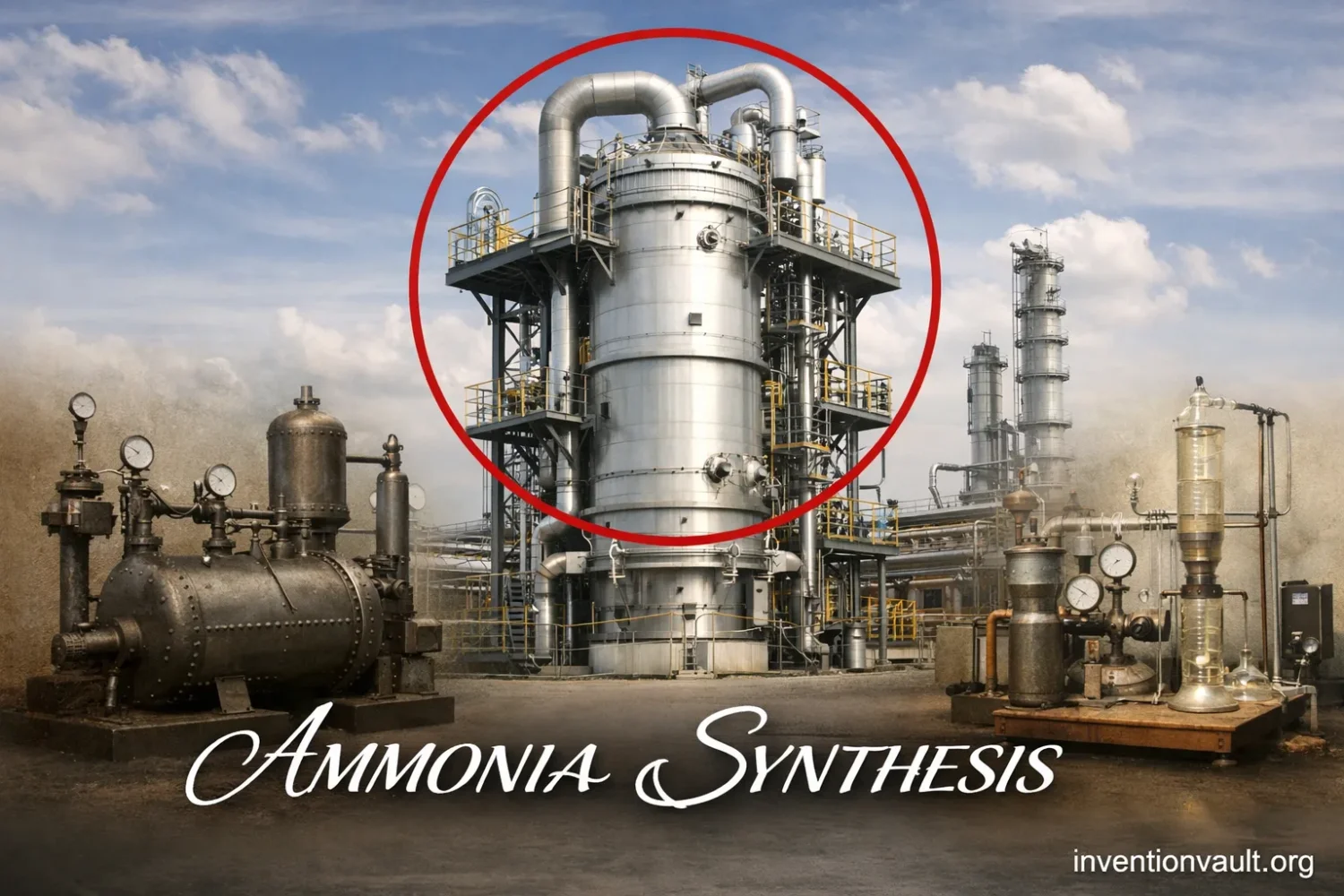
| Aspect | Details |
|---|---|
| Invention Name | Ammonia synthesis by the Haber process, later industrialized as the Haber-Bosch process. |
| Main Contributors | Fritz Haber established the laboratory method; Carl Bosch turned it into plant-scale industry; Robert Le Rossignol helped build the early high-pressure apparatus. |
| Breakthrough Period | Laboratory success in 1909, followed by the first industrial ammonia plant in 1913. |
| Core Reaction | N2 + 3H2 ⇌ 2NH3 |
| What Was New | Direct conversion of atmospheric nitrogen and hydrogen into ammonia under high pressure, heat, and catalytic control. |
| Early Catalysts | Laboratory work used rare catalysts such as osmium and uranium before industry adopted iron-based catalysts with additives. |
| Industrial Conditions | Very high pressure and elevated temperature; classical commercial descriptions often place operation around 200–400 atmospheres and 400–650°C. |
| First Plant | Oppau, operated by BASF in 1913. |
| Present-Day Scale | Global ammonia output remains above 180 million tonnes a year, and about 70% goes into fertilizers. |
| Ongoing Direction | Modern work focuses on low-emission ammonia, cleaner hydrogen supply, carbon capture where used, electrification, and more efficient synthesis loops. |
Ammonia synthesis turned nitrogen from the air into usable ammonia through a controlled catalytic process. Its invention cannot be reduced to two surnames and one date. The working story includes Fritz Haber’s laboratory chemistry, Robert Le Rossignol’s high-pressure apparatus, early catalyst trials, reactor failures, and Carl Bosch’s conversion of a bench process into factory-scale production.
Why Fixed Nitrogen Became a Scientific Race
By the late nineteenth century, farms still leaned on manure, legumes, and mined nitrate deposits. Chemists knew the atmosphere held an enormous nitrogen reserve, yet that nitrogen sat inside a stubborn triple bond. The problem was never access. The problem was conversion. Industry needed fixed nitrogen—nitrogen in compounds that plants and chemical processes could actually use.
That need created several competing routes. Haber-Bosch did not appear in an empty field: electric-arc fixation and calcium cyanamide were already industrial attempts to secure fixed nitrogen. Direct ammonia synthesis eventually became the dominant route because it fit large-scale production and supplied a versatile chemical feedstock. The broader history of manure, superphosphate, potash, and NPK products belongs to the separate fertilizer history.
| Route | Main Product | What It Offered | Why It Lost Ground |
|---|---|---|---|
| Birkeland–Eyde | Nitrogen oxides, later nitric products | One of the first industrial nitrogen-fixation methods, especially attractive where hydropower was cheap. | Its electricity demand was much heavier than later ammonia-based routes. |
| Frank–Caro | Calcium cyanamide | A workable fertilizer chemical and an early industrial answer to nitrogen scarcity. | It never matched the scale and process fit of direct ammonia production. |
| Haber-Bosch | Ammonia | Direct nitrogen-to-ammonia synthesis with a better long-run energy balance and strong links to fertilizer manufacture. | It did not lose ground. It became the main route. |
How the First Working Apparatus Appeared
Fritz Haber reached the laboratory breakthrough in Karlsruhe, but the first working system was not just an idea on paper. Robert Le Rossignol, an engineer and assistant in the laboratory, helped build the high-pressure apparatus that made controlled gas circulation and continuous ammonia removal possible. Ammonia synthesis was a working apparatus before it became an industry.
A surviving 1909 apparatus attributed to Haber and Le Rossignol is preserved by the Deutsches Museum. It shows that the invention began as a controlled system of valves, seals, heat, pressure, gas circulation, and product removal—not merely as a balanced chemical equation. In early laboratory work, catalysts such as osmium and uranium helped demonstrate the reaction under demanding conditions.
Why Bosch Turned a Lab Result Into Industry
Carl Bosch took over the harder half of the story. A bench result can survive awkward materials and short operating runs. A plant cannot. BASF had to build equipment that would hold very high pressure at elevated temperature, clean the gases so the catalyst would keep working, and replace rare laboratory catalysts with something cheaper and easier to source.
The Materials Problem
Early reactors failed because hot, pressurized hydrogen damaged steel. Bosch’s team studied why the metal weakened and then redesigned the reactor structure, using inner linings and pressure-shell ideas that made continuous operation possible.
The Catalyst Problem
Haber’s first catalysts proved the chemistry. Industry needed a different answer. Bosch and his collaborators moved toward iron with additives, which made large-scale ammonia production far more practical.
The invention of ammonia synthesis was not finished when ammonia first appeared in the laboratory. Industrial production required solutions for pressure vessels, steel behavior, catalyst supply, gas purification, and continuous plant operation. The first BASF ammonia plant at Oppau in 1913 marks the transition from laboratory synthesis to industrial manufacture.
What Made the Process Viable
Ammonia synthesis works inside an awkward balance. Lower temperature favors ammonia yield, but the reaction slows sharply. Higher temperature speeds the reaction, yet equilibrium gives back less product. Industry answered with a compromise: elevated temperature, very high pressure, an iron-based catalyst, continuous ammonia removal, and recycling of unreacted gases.
- Pressure pushes equilibrium toward ammonia.
- Heat keeps the reaction fast enough for production.
- Iron-based catalysts lower the barrier to breaking the nitrogen bond.
- Gas purification protects the catalyst from poisons such as oxygen-bearing impurities.
- Loop design lets unreacted nitrogen and hydrogen pass through again instead of being wasted.
Classical commercial descriptions place the process in a range of roughly 200–400 atmospheres and 400–650°C, although industrial designs vary. Those operating demands explain why scale-up required far more than knowing the equilibrium reaction. Equipment had to maintain pressure, temperature, gas purity, catalyst activity, and recycle flow during continuous operation.
Main Forms and Later Variants
Ammonia synthesis continued to change after 1909 and 1913. Some later systems were direct descendants of the original process, while others altered compression, heat recovery, feed preparation, catalyst formulation, or loop design while keeping the same chemical target—NH3.
- Haber Laboratory Method: the early bench-scale proof that nitrogen and hydrogen could be combined directly under harsh conditions.
- Haber-Bosch High-Pressure Synthesis: the industrial version that tied chemistry to metallurgy, reactor design, and plant engineering.
- Casale and Other Loop Designs: later industrial routes that showed ammonia synthesis was still evolving, not standing still.
- Low-Emission Ammonia: present-day systems that keep the synthesis step but change the hydrogen source through electrolysis or pair conventional routes with carbon capture.
Ammonia synthesis is therefore not one frozen machine from the early twentieth century. It is a family of industrial designs built around the same reaction, with later plants changing how gases are prepared, compressed, reacted, cooled, separated, and recycled.
Why the Invention Still Shapes Food and Industry
Over 180 Million Tonnes
Annual ammonia output remains at a very large industrial scale.
Around 70% for Fertilizers
Most ammonia still feeds nitrogen fertilizer production rather than specialty chemistry.
About 2% of Final Energy Use
Modern ammonia production still carries a heavy energy and emissions burden.
Those numbers show why ammonia synthesis remains tied to food production and heavy industry. Estimates reviewed by Our World in Data suggest that just under half of the global population depends on food grown with synthetic nitrogen fertilizer. Ammonia is also a feedstock for nitric acid and other industrial chemicals, so the synthesis process reaches well beyond fertilizer manufacture.
Ammonia also appears in energy planning as a possible hydrogen carrier and energy vector. That use does not change the synthesis reaction, but it raises new pressure to reduce the emissions associated with hydrogen production and plant energy demand.
Environmental Questions Around Ammonia Synthesis
Conventional ammonia production remains energy-intensive because the synthesis loop operates under demanding conditions and the hydrogen feedstock is still commonly produced from fossil fuels. The IEA estimates that ammonia production accounts for around 2% of total final energy consumption and 1.3% of energy-system CO2 emissions.
Current development therefore targets the production process itself: lower-emission hydrogen, carbon capture where applicable, electrified equipment, improved heat integration, and synthesis routes that can operate efficiently under less demanding conditions. The chemical target remains ammonia; the engineering around its production continues to change.
References Used for This Article
- NobelPrize.org — The Nobel Prize in Chemistry 1918: Records the award for the synthesis of ammonia from its elements.
- BASF — 1913 / First Ammonia Synthesis Plant: Notes the opening of the first industrial ammonia plant at Oppau.
- Science History Institute — Fritz Haber: Summarizes the laboratory breakthrough and its industrial aftermath.
- Encyclopaedia Britannica — Haber-Bosch Process: Provides process history and classic operating conditions.
- U.S. Geological Survey — Nitrogen Statistics and Information: Provides official statistics and background on fixed nitrogen and industrial ammonia.
- American Chemical Society — Ammonia: Provides production-scale context and major industrial uses.
- Our World in Data — How Many People Does Synthetic Fertilizer Feed?: Reviews population estimates linked to synthetic nitrogen fertilizer use.
- IEA — Ammonia Technology Roadmap: Explains energy use, emissions, and lower-emission directions for ammonia production.
- Google Arts & Culture / Deutsches Museum — Apparatus Demonstrating Ammonia Synthesis Made by Fritz Haber und Robert Le Rossignol: Shows the preserved apparatus linked to the 1909 laboratory breakthrough.