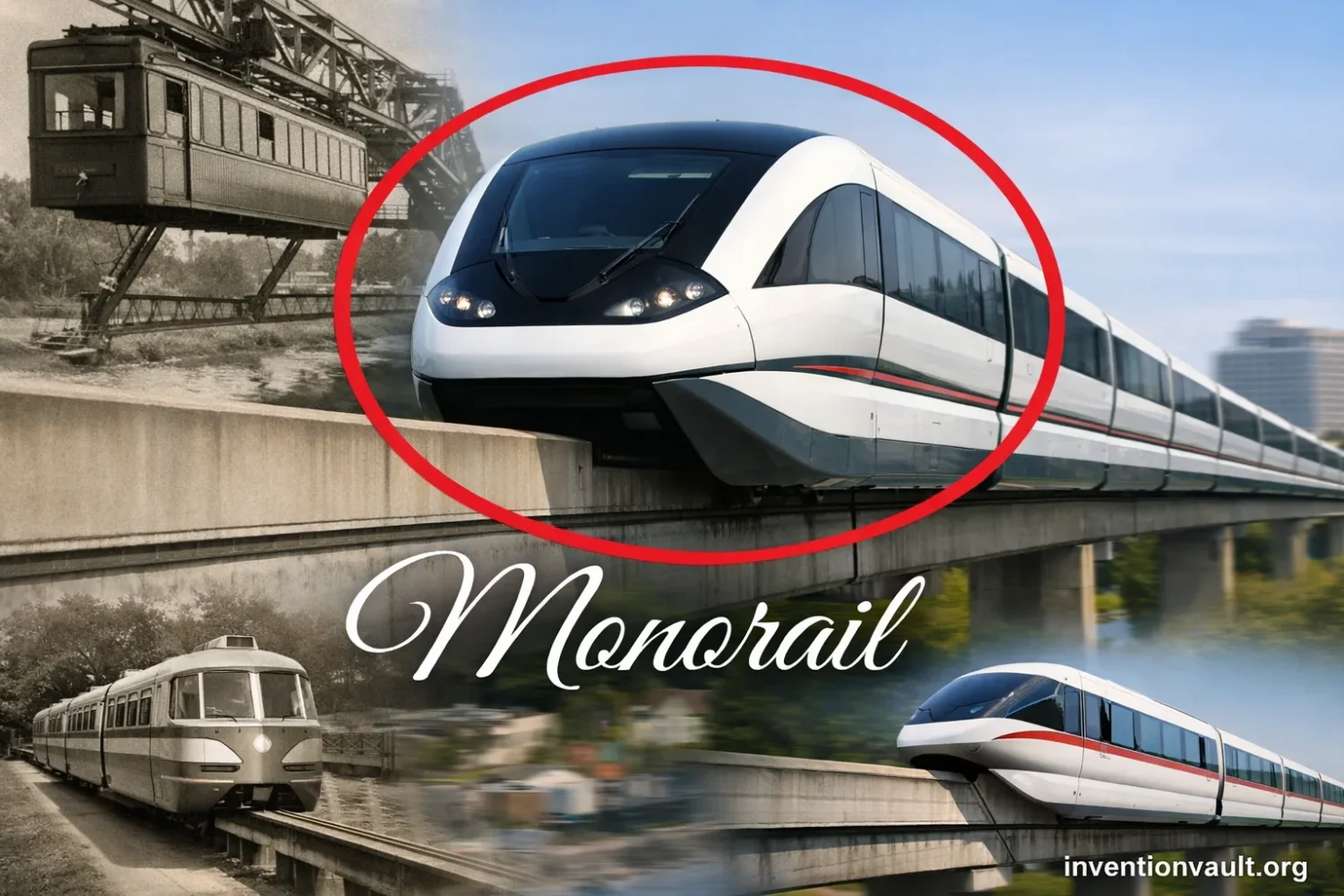
| Field | Details |
|---|---|
| Invention | Monorail, a rail-based transport system in which one rail or guide beam supports, guides, or suspends the vehicle. |
| Best-Documented Early Inventor | Henry Robinson Palmer, an English civil engineer. |
| Earliest Well-Documented Patent | UK Patent No. 4618, dated 22 November 1821. |
| Known Earlier Antecedent | Ivan Elmanov is often linked with a Russian “road on pillars” experiment around 1820, but Palmer’s British patent is the cleaner documented invention record. |
| First Practical Passenger Link | Cheshunt Railway, opened in Hertfordshire in late June 1825; built mainly for brick transport but also used to carry passengers. |
| Original Power Source | Horse traction, not steam or electric power. |
| Original Purpose | To move freight over a smooth elevated path while reducing road mud, rough ground, and the cost of broad two-rail construction. |
| Core Engineering Idea | A single elevated rail with the vehicle load arranged below or around it for stability. |
| Later Main Types | Suspended monorail, straddle-beam monorail, balanced single-rail systems, industrial monorails, and monorail-like automated guideway systems. |
| Modern Use | Urban transit, airport links, exhibition grounds, theme parks, industrial handling, and transport corridors where elevated construction is useful. |
A monorail was not born as a theme-park novelty or a sleek airport shuttle. It began as a practical answer to a muddy transport problem: how could people move heavy loads along a smooth, narrow path without building a wide two-rail railway? The safest answer to “who invented the monorail?” is Henry Robinson Palmer, because his 1821 British patent gives the invention a firm paper trail. The fuller story is more interesting. It includes an earlier Russian experiment, Palmer’s published engineering design, and the Cheshunt Railway, where a freight line briefly became part of passenger-rail history.
Best-supported answer: Henry Robinson Palmer is the earliest well-documented patentee of the monorail. The invention should be understood as a single-rail transport principle, not as one fixed vehicle design.
What Counts as the Monorail Invention
A monorail is not simply any train that runs above the street. The defining feature is the track: one rail or guide beam carries the vehicle, guides it, or does both. In some systems, the vehicle hangs below the rail. In others, it straddles a beam. In industrial settings, a load carrier may run under an overhead rail inside a factory or warehouse.
This detail matters because the word “monorail” has been used for many shapes of machinery. Palmer’s 1821 idea looked very different from a modern rubber-tired straddle-beam train. Yet the underlying principle was already present: one elevated rail created a cleaner running surface, while the vehicle’s weight was arranged to keep the load stable.
The invention is best seen as an engineering solution. It was not a single object that stayed unchanged. It was a design approach that later inventors kept revising: hang the car, balance the car, straddle the beam, enclose the running gear, electrify the vehicle, automate the operation.
Who Invented the Monorail
Henry Robinson Palmer is the name most closely tied to the invention because he patented a single-rail system in Britain in 1821 and later published a detailed description of the idea. Palmer was a civil engineer, and his design thinking was rooted in the transport problems of his time. Roads could be rough, wet, and slow. Early railways were still developing. Iron and earthworks were costly. A narrow elevated rail offered a way to reduce friction and keep the running path clear.
There is also a commonly cited earlier Russian antecedent: Ivan Elmanov’s “road on pillars,” usually dated around 1820. That experiment is often described as an elevated timber single-rail route for horse-drawn vehicles. It deserves mention, but it is less secure as the main invention record in English-language transport history. Palmer’s patent and printed technical work make his claim easier to verify.
Clean Historical Reading
- Earlier idea: Ivan Elmanov is often linked with a Russian single-rail experiment around 1820.
- Documented patent: Henry Robinson Palmer patented a single-rail elevated system in Britain in 1821.
- Practical public moment: Cheshunt Railway carried bricks and passengers in 1825.
- Modern legacy: later monorails changed the vehicle, power source, materials, and switching systems, but kept the single-guideway concept.
Why Palmer’s Design Made Sense in the 1820s
Palmer did not set out to design a futuristic city train. His problem was direct: moving goods over short or medium distances cost too much when the road surface was poor. A single rail, raised above mud and obstacles, promised lower resistance. That meant a horse could move a heavier load than it could pull over an ordinary road.
The design also reduced the amount of material needed for the running path. A conventional railway needed two rails, sleepers, careful alignment, and enough ground preparation to support the line. Palmer’s version tried to do more with less: one elevated rail, posts, suspended carriages, and a side path for the horse.
One of the clever parts was the way the load sat below the rail. By putting the carriage weight under the running surface, the system lowered the centre of gravity. That helped stability, especially because early monorails did not have the refined guide wheels, tires, sensors, or switch mechanisms used in later systems.
The Transport Problem Palmer Tried to Solve
- Rough roads: mud, ruts, stones, and seasonal weather raised the effort needed to move goods.
- Material cost: one rail used less track material than a two-rail line.
- Ground clearance: an elevated rail avoided many surface obstacles.
- Freight handling: balanced containers or pannier-style loads could be moved along the rail with limited ground works.
- Horse efficiency: smoother running reduced resistance, allowing animal power to do more useful work.
How the Early Monorail Worked
Palmer’s system used an elevated rail supported by posts. The vehicle did not sit on two parallel rails like a conventional train. Instead, the load was suspended in balanced carriage sections, with the rail above the main body of the load. A horse walked beside the line and pulled the vehicle forward.
The Cheshunt Railway followed this basic pattern. It was built to carry bricks from a pit toward a wharf near the River Lea. Because it also carried passengers at its opening, it became a small but memorable point in transport history. The line was not a mass-transit system. It was short, local, and experimental in feel. Its importance comes from what it proved: a single-rail vehicle could move real loads and real people outside a drawing office.
One practical detail shows how early the technology was. At a road crossing, the Cheshunt line used a movable section that could swing away like a gate. Later monorails would need far more complex switching and safety systems. In 1825, the challenge was simpler: make the rail continuous when the vehicle needed to pass, and clear the road when ordinary traffic needed space.
| Part of the Early System | What It Did | Why It Mattered |
|---|---|---|
| Single Elevated Rail | Provided the running path for the vehicle. | Kept movement above mud and uneven ground. |
| Posts or Piers | Held the rail above the surface. | Reduced the need for wide earthworks. |
| Suspended Load | Placed the carriage weight below the rail. | Helped the vehicle remain balanced. |
| Horse Towpath | Allowed animal power to pull the vehicle from the side. | Used familiar power in a new rail arrangement. |
| Movable Crossing Section | Let road users pass when the monorail was not crossing. | Showed how the system could meet existing roads. |
From Freight Idea to Passenger Curiosity
The first monorail was not designed around passenger comfort. It came from freight logic. Bricks, raw materials, and industrial loads were the natural early use cases because the economic aim was clear: move heavy things more easily.
Cheshunt changed the story by carrying passengers, even if that use was brief and partly ceremonial. This is why the line is often called the first passenger-carrying monorail. It did not lead directly to a wave of Palmer-style railways across Britain, but it gave later inventors a working example to discuss, copy, alter, or reject.
No visible trace of the Cheshunt line survives today. That absence can make the invention feel smaller than it was. Many early transport experiments disappeared physically, but their ideas stayed alive in patents, drawings, engineering books, and later designs.
The Main Monorail Types After Palmer
Monorail history did not move in a straight line. Inventors tried different ways to solve the same problem: how to keep a vehicle stable while it uses one main rail or beam. Some designs stayed experimental. Others entered service and lasted for decades.
Suspended Monorails
A suspended monorail hangs the passenger cabin or load below the running rail or beam. This form fits naturally with Palmer’s early logic because the vehicle mass sits beneath the support point. Later suspended systems used steel structures, electric power, improved bogies, and better braking.
The best-known example is the Wuppertal Schwebebahn in Germany. It opened to public passenger service in 1901 and became one of the longest-lived suspended railway systems. Its route used the Wupper valley in a way that a conventional surface railway could not easily match. The system also shows why monorails often appear in places with awkward streets, rivers, steep terrain, or little room at ground level.
Straddle-Beam Monorails
A straddle-beam monorail rides on top of a large concrete or steel beam. Rubber tires usually carry the vehicle, while guide and stabilizing wheels press against the sides of the beam. This is the form many people picture today when they hear the word monorail.
The straddle-beam type became practical in the 20th century because materials, motors, tires, control systems, and precast concrete construction had improved. Instead of a horse pulling a hanging load, an electric vehicle could run on a shaped beam with controlled acceleration, braking, and switching.
Lartigue-Style Balanced Monorails
The Lartigue system used a raised central rail with loads or passenger compartments balanced on both sides. Its most famous passenger example was the Listowel and Ballybunion Railway in Ireland, which opened in 1888 and ran until 1924. This type showed that single-rail transport could operate beyond a short demonstration, but it also revealed practical limits: loading had to be balanced, crossings were awkward, and standard railway freight handling did not fit easily.
Gyroscopic Monorails
Gyroscopic monorails tried a different answer to the stability problem. Rather than hanging the load below the rail or balancing weight on both sides, they used gyroscopes to keep the vehicle upright. Louis Brennan’s early 20th-century demonstrations attracted attention because the idea was technically bold. The problem was reliability and practicality. A vehicle that depends on active balance has to keep its stabilizing system working at all times.
Industrial Monorails
Industrial monorails are often simpler than passenger systems. A trolley or carrier runs along an overhead rail to move parts, tools, or materials through a workplace. These systems connect strongly with the original freight logic of the invention. They prove that a monorail does not have to be a city train; it can also be a compact material-handling tool.
| Type | Vehicle Position | Main Strength | Main Limitation |
|---|---|---|---|
| Palmer-Type Suspended Rail | Load hangs below an elevated rail. | Simple freight logic and low ground obstruction. | Limited speed, basic switching, and horse-powered operation. |
| Lartigue Balanced Monorail | Loads sit on both sides of a raised central rail. | Good for certain rural or industrial routes. | Balanced loading and crossings can be awkward. |
| Gyroscopic Monorail | Vehicle balances on one rail using gyroscopes. | Technically elegant and narrow. | Depends on active stabilization. |
| Suspended Electric Monorail | Cabin hangs below a steel or enclosed guideway. | Grade-separated travel with low street-level footprint. | Specialized structures and maintenance needs. |
| Straddle-Beam Monorail | Vehicle rides on and around a concrete or steel beam. | Compact elevated guideway and rubber-tired operation. | Switches and vehicles are often system-specific. |
Why the Monorail Was Hard to Adopt Widely
The monorail solved one problem and created others. A single elevated path could avoid bad roads, but a transport network also needs stations, switches, depots, evacuation routes, maintenance access, and compatibility with existing freight or passenger systems.
Switching is one of the oldest challenges. On a two-rail railway, points can move sections of rail to guide a train onto another track. On many monorails, the beam or internal guideway mechanism must move instead. That can work well, but it needs careful design and usually costs more than a simple straight guideway.
Standardization was another barrier. Conventional railways developed shared gauges, rolling stock practices, and freight interchange. Monorails often used proprietary designs. A vehicle built for one beam type might not fit another. This made each project feel more like a custom machine than a universal railway.
Capacity also shaped adoption. A monorail can be useful when the corridor needs grade separation but not the scale of a heavy metro. If demand is very high, a full metro may move more people. If demand is low, buses, trams, or surface rail may cost less. The invention sits in a specific transport niche, not above every other mode.
What Modern Monorails Inherited From the Invention
Modern monorails look far removed from Palmer’s horse-drawn rail, yet they still answer the same basic question: how can a guided vehicle move through a limited corridor while using less ground-level space?
Early Idea
- Raise the running surface above poor ground.
- Use one main rail instead of two.
- Keep the vehicle stable by arranging weight carefully.
- Reduce resistance for a given load.
- Fit transport into places where a wider railway is awkward.
Modern Expression
- Elevated guide beams over roads, rivers, or tight urban land.
- Electric traction instead of animal power.
- Rubber tires, guide wheels, air springs, and electronic control.
- Precast beams and specialized switches.
- Airport links, urban feeders, exhibition systems, and dense-site shuttles.
Technical Notes on Modern Monorail Design
A modern passenger monorail is not just a train placed on one beam. It is a full system of vehicles, guideways, switches, power supply, control equipment, stations, and emergency planning. The beam is both a track and a structural member, which is why design precision matters.
| Component | Role in the System | Technical Note |
|---|---|---|
| Guide Beam | Supports and guides the vehicle. | Often made from prestressed concrete or steel in modern systems. |
| Running Wheels or Tires | Carry the vehicle’s weight. | Straddle-beam systems commonly use rubber tires on the top of the beam. |
| Guide Wheels | Control lateral movement. | They press against beam sides or internal guide surfaces. |
| Stabilizing Wheels | Reduce roll and help hold the vehicle to the guideway. | They are one reason modern straddle-beam vehicles can ride smoothly. |
| Power Supply | Feeds electric traction motors. | Power may come through rails, contact channels, or other protected conductors. |
| Switch | Moves vehicles between routes. | In many systems, a beam or guideway section must physically shift. |
| Control System | Maintains spacing, braking, and safe operation. | Many modern systems can operate with high levels of automation. |
| Evacuation Planning | Provides safe passenger exit during service disruption. | Elevated systems need walkways, station access, or special rescue procedures. |
Common Misunderstandings About the Invention
The First Monorail Was Not a Theme-Park Ride
The earliest monorail thinking was industrial and practical. It focused on moving goods more efficiently. Theme parks helped make monorails familiar to the public in the 20th century, but they did not create the invention.
One Rail Does Not Always Mean One Thin Steel Rail
Modern monorails often run on large concrete or steel beams. The “mono” part refers to the single guideway principle, not necessarily to a small rail like the rail on a conventional railway track.
Not Every Elevated Railway Is a Monorail
An elevated metro or light railway may still run on two rails. A monorail depends on one main rail or beam for support and guidance. The height of the line alone does not define it.
The Invention Was Not One Perfect Design
Palmer’s design was an early solution. Later inventors changed the rail shape, the vehicle position, the power source, and the balancing method. The invention’s importance lies in the single-guideway idea and the engineering questions it opened.
The Invention’s Place in Transport History
The monorail belongs to the experimental edge of railway history. It developed beside conventional railways rather than replacing them. Two-rail systems won the main freight and intercity passenger markets because they could scale, standardize, and connect across long networks. Monorails found narrower but durable roles.
That does not make the invention a failure. It makes it specialized. The monorail asked a different question from the standard railway. Instead of “How do we build a national rail network?” it asked, “How do we move guided vehicles where space, ground conditions, or surface traffic make ordinary routes difficult?”
This is why the invention keeps returning in new forms. Airport connectors, hilly urban corridors, dense visitor sites, and industrial handling lines all echo Palmer’s original concern: create a guided route with a small footprint and a smoother path than ordinary ground movement can offer.
Important Dates in Monorail Development
| Date | Event | Why It Matters |
|---|---|---|
| c. 1820 | Ivan Elmanov’s Russian “road on pillars” is often cited as an early single-rail experiment. | Shows that the idea of elevated single-rail transport was being explored before Palmer’s patent. |
| 1821 | Henry Robinson Palmer patented a single-rail elevated railway in Britain. | Gives the monorail its strongest early documented invention record. |
| 1823–1824 | Palmer’s description of the system appeared in print. | Preserved the engineering logic of the invention for later readers. |
| 1825 | Cheshunt Railway opened in Hertfordshire. | Linked the invention to practical freight movement and early passenger carrying. |
| 1888 | Listowel and Ballybunion Railway opened in Ireland using Lartigue’s balanced monorail system. | Showed a single-rail passenger railway operating over a longer public route. |
| 1901 | Wuppertal Schwebebahn entered public service in Germany. | Became the best-known long-lived suspended monorail. |
| 1950s–1960s | Modern straddle-beam and suspended systems matured through ALWEG, SAFEGE, and Japanese development. | Shifted monorails from experiments toward urban electric transit and shuttle systems. |
| 1964 | Tokyo Monorail began service between Hamamatsucho and Haneda Airport. | Helped prove the monorail as a real urban-airport transport link. |
Why the Monorail Still Attracts Engineers
The monorail remains attractive where the guideway can be narrow, elevated, and separated from road traffic. A beam can pass above busy streets with a smaller shadow than many broader elevated rail structures. Rubber-tired systems can climb steeper grades and handle tighter curves than many conventional rail vehicles, depending on the design.
It also gives planners a clear visual identity. That can help in airports, exhibition sites, and special corridors where wayfinding matters. Passengers usually understand the route because the guideway is visible. The trade-off is that the same visual clarity can become a planning concern if the structure does not fit the street or skyline.
The original invention still feels relevant because cities continue to face old problems in new forms: limited ground space, crowded roads, difficult terrain, and the need for reliable short-to-medium-distance movement. Palmer’s horse-drawn design is gone, but the question he worked on has not disappeared.
References Used for This Article
- Purdue University Libraries — Description of a Railway on a New Principle: Library record for Palmer’s original monorail publication.
- Google Books — Description of a Railway on a New Principle: Digitized bibliographic entry for Palmer’s 1824 edition.
- Herts Memories — Cheshunt Railway, 1825: Local archive page on the Cheshunt line and its passenger use.
- Encyclopaedia Britannica — Monorail: Concise reference on the definition and basic forms of monorail railways.
- International Monorail Association — What Are Monorails?: Technical overview of suspended and straddle monorail principles.
- SpringerLink — Application and Prospect of Straddle Monorail Transit System in China: Academic article on straddle-beam technology, guide beams, and vehicle systems.
- Japan Railway & Transport Review — New Types of Guided Transport: Technical review covering monorail cars, guideways, and postwar system development.
- Schwebebahn — The History of the Wuppertal Suspension Railway: Official history page for Wuppertal’s suspended railway.
- The Monorail Society — Monorail History: Specialist timeline of early and modern monorail systems.